
Digital Pathology Market Size, Share and Forecast 2026 to 2035
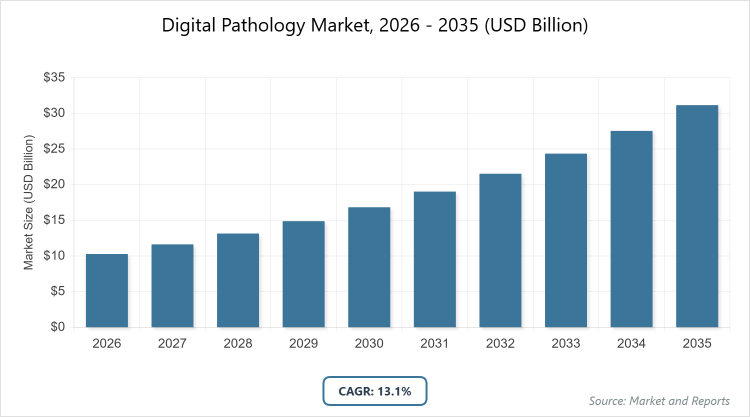
According to our latest research, the global digital pathology market is projected to grow from USD 10.29 billion in 2026 to USD 31.3 billion by 2035, growing at a CAGR is estimated at 13.1% during 2026-2035. The Digital Pathology Market is primarily driven by the rising prevalence of chronic diseases like cancer and the integration of AI-powered diagnostic tools, which address the global shortage of pathologists by automating complex image analysis and enabling seamless remote collaboration.
What are the Key Insights into the Digital Pathology Market?
- Global market value projected to reach USD 31.3 billion by 2035 from USD 10.29 billion in 2026.
- Compound Annual Growth Rate (CAGR) estimated at 13.1% during 2026-2035.
- Scanners dominate the product segment.
- Disease Diagnosis dominates the application segment.
- Hospitals dominate the end-user segment.
- North America dominates the regional market.
What is the Digital Pathology Market?
Industry Overview
The digital pathology market involves the digitization of pathology workflows through the use of whole-slide imaging, software platforms, and AI tools to scan, store, analyze, and share glass slides as high-resolution digital images, enabling remote diagnosis, collaboration, and data-driven insights in healthcare. This technology replaces traditional microscopy with digital scanners, image management systems, and analytics software, facilitating faster turnaround times, reduced errors, and integration with electronic health records for applications in disease diagnosis, drug discovery, and medical education.
It serves hospitals, diagnostic labs, pharmaceutical companies, and research institutions, driven by the need for efficient pathology services amid rising chronic diseases and pathologist shortages. The market emphasizes interoperability, data security, and regulatory compliance, while advancing through AI for automated image analysis and cloud-based solutions for global access, transforming pathology into a more scalable, collaborative field in modern medicine.
What are the Market Dynamics in the Digital Pathology Market?
Growth Drivers
The digital pathology market is driven by the increasing adoption of AI and machine learning for automated image analysis, which enhances diagnostic accuracy and efficiency amid pathologist shortages and rising cancer cases, alongside government initiatives promoting digital healthcare infrastructure through funding and policies that accelerate implementation in hospitals and labs. Advancements in whole-slide imaging technology and cloud platforms enable remote consultations and real-time collaboration, while the surge in telepathology post-pandemic addresses access issues in underserved areas. Additionally, partnerships between tech firms and healthcare providers foster innovation in personalized medicine, supported by the need for data integration with EHRs to streamline workflows and improve patient outcomes.
Restraints
Restraints include high initial costs for scanners and software integration, which limit adoption in resource-constrained settings like small clinics or developing regions, compounded by data privacy concerns under regulations like HIPAA that require robust cybersecurity measures and increase operational expenses. Interoperability issues with legacy systems hinder seamless deployment, while a lack of standardized protocols for image quality and AI validation leads to hesitancy among pathologists. Furthermore, reimbursement challenges for digital services in some countries slow market penetration, as payers demand evidence of cost-effectiveness.
Opportunities
Opportunities arise from the expansion of AI-based tools for predictive diagnostics and drug discovery, where collaborations with pharma companies can leverage big data for faster R&D, while emerging markets in Asia offer growth through investments in digital health infrastructure. The integration of digital pathology with telemedicine platforms opens avenues for remote second opinions, and advancements in cloud storage enable scalable solutions for large-scale pathology networks. Additionally, government grants for AI research and partnerships for training programs can address skill gaps, fostering innovation in portable scanners for point-of-care applications.
Challenges
Challenges encompass navigating complex regulatory approvals for AI algorithms, which vary by region and require extensive validation to ensure safety and efficacy, alongside cybersecurity threats to sensitive patient data that could undermine trust. The shortage of trained pathologists proficient in digital tools poses adoption hurdles, while high maintenance costs for hardware and software updates strain budgets. Competition from traditional methods and the need for high-speed internet in remote areas further complicate rollout, necessitating strategic alliances to standardize practices and enhance accessibility.
Digital Pathology Market: Report Scope
| Report Attributes | Report Details |
| Report Name | Digital Pathology Market |
| Market Size 2025 | USD 10.29 Billion |
| Market Forecast 2035 | USD 31.3 Billion |
| Growth Rate | CAGR of 13.1% |
| Report Pages | 220 |
| Key Companies Covered | Leica Biosystems (Danaher), Koninklijke Philips N.V., Hamamatsu Photonics, 3DHISTECH (Sysmex), Visiopharm, Roche (Ventana), Indica Labs, and Akoya Biosciences |
| Segments Covered | By Product, By Application, By End-User, By Region |
| Regions Covered | North America, Europe, Asia Pacific (APAC), Latin America, The Middle East and Africa (MEA) |
| Base Year | 2025 |
| Historical Year | 2020 – 2024 |
| Forecast Year | 2026 – 2035 |
| Customization Scope | Avail customized purchase options to meet your exact research needs. |
What is the Market Segmentation Analysis for the Digital Pathology Market?
The digital pathology market is segmented by product, application, end-user and region.
By product segment, scanners emerge as the most dominant subsegment, followed by software as the second most dominant. Scanners lead due to their essential role in digitizing slides for high-resolution imaging, driven by technological advancements in speed and quality that enable efficient workflows in high-volume labs, and the need for accurate data capture amid rising diagnostic demands; this dominance drives the market by facilitating the transition to digital systems, enabling AI integrations for automated analysis, and reducing turnaround times that attract investments from hospitals, thereby expanding adoption and revenue through hardware upgrades and service contracts. Software, as the second dominant, provides analytics and management platforms, contributing through cloud-based solutions that enhance collaboration and data storage, supporting growth via subscription models.
By application segment, Disease Diagnosis is the most dominant subsegment in the application segment, followed by Drug Discovery & Development as the second most dominant. Disease Diagnosis dominates owing to its critical use in oncology and pathology for accurate, remote interpretations, supported by AI for pattern recognition that addresses pathologist shortages; this leadership propels the market by improving diagnostic precision, enabling telepathology in underserved areas, and integrating with EHRs for better patient care, thus driving regulatory approvals and investments that accelerate overall digital adoption. Drug Discovery & Development, gaining traction for virtual trials and biomarker analysis, contributes through pharma collaborations that foster R&D efficiency.
By end-user segment, Hospitals are the most dominant subsegment in the end-user segment, followed by Diagnostic Laboratories as the second most dominant. Hospitals dominate with a 37% share, due to their high case volumes requiring rapid diagnostics and integration with clinical systems for comprehensive care; this position drives the market by generating demand for scalable solutions, facilitating AI deployments for workflow optimization, and securing funding through improved outcomes that encourage expansions, thereby boosting market value through large-scale implementations. Diagnostic Laboratories, focused on specialized testing, support growth via high-throughput scanning for efficiency.
What are the Recent Developments in the Digital Pathology Market?
- In December 2025, GE Healthcare acquired Intelerad Medical Systems, enhancing its imaging IT portfolio with digital pathology capabilities to improve workflow integration in hospitals.
- In December 2025, a partnership was announced for scaling AI-assisted precision oncology testing across a major U.S. pathology network, aiming to expand digital diagnostics.
- In January 2026, Sectra began implementing its first digital pathology project in Japan, focusing on cancer diagnostics to reduce treatment times through remote access.
What is the Regional Analysis of the Digital Pathology Market?
- North America to dominate the market
North America holds the largest share in the digital pathology market, driven by advanced healthcare infrastructure, high adoption of AI technologies, and supportive regulations like FDA approvals for digital systems; the United States dominates this region with its concentration of key players like PathAI and Paige, substantial R&D investments, and widespread implementation in hospitals for telepathology, addressing pathologist shortages amid rising cancer rates, while Canada contributes through government-funded digital health initiatives that enhance accessibility in remote areas.
Europe maintains a strong position with emphasis on data privacy under GDPR and collaborative research, where Germany leads as the dominating country through its pharmaceutical heritage, EU-funded projects like the European Cancer Imaging Initiative, and adoption in labs for drug discovery, supported by the UK’s NHS integrations for diagnostics.
Asia Pacific emerges as the fastest-growing region, propelled by digital health expansions and population health needs; China dominates here with government investments in AI pathology, massive hospital networks, and partnerships for telepathology to tackle rural-urban disparities, while Japan focuses on precision medicine integrations.
Who are the Key Market Players and Their Strategies in the Digital Pathology Market?
- Leica Biosystems (Danaher) employs strategies focused on scanner innovations and AI partnerships, expanding through acquisitions to enhance whole-slide imaging for diagnostics.
- Koninklijke Philips N.V. leverages integrated platforms with radiology, pursuing collaborations for cloud-based solutions to target hospitals and telepathology.
- Hamamatsu Photonics prioritizes high-resolution scanners, investing in R&D for photonics tech and alliances with software firms for analysis tools.
- 3DHISTECH (Sysmex) focuses on affordable systems for labs, adopting mergers to strengthen European presence and customize for research applications.
- Visiopharm concentrates on AI software, forming partnerships for image analysis in pharma to drive drug discovery.
- Roche (Ventana) utilizes diagnostic integrations, emphasizing regulatory compliance and expansions in oncology pathology.
- Indica Labs adopts HALO platform enhancements, targeting academia with open-source tools for collaborative research.
- Akoya Biosciences pursues spatial biology integrations, investing in multiplex imaging for advanced diagnostics.
What are the Market Trends in the Digital Pathology Market?
- Increasing integration of AI for automated slide analysis and predictive diagnostics to reduce pathologist workload.
- Growth in telepathology for remote consultations, addressing global pathologist shortages.
- Adoption of cloud-based platforms for data storage and sharing, enhancing collaboration.
- Emphasis on interoperability with EHRs for seamless workflow integration.
- Rise in partnerships for AI validation and regulatory approvals.
- Focus on sustainable digital solutions to minimize physical slide handling.
- Expansion into drug discovery with virtual tissue banks.
- Development of mobile apps for point-of-care pathology.
What Market Segments are Covered in the Digital Pathology Market Report?
By Product
- Scanners
- Software
- Storage and Communication Systems
By Application
- Disease Diagnosis
- Drug Discovery & Development
- Education & Training
By End-User
- Hospitals
- Diagnostic Laboratories
- Pharmaceutical & Biotechnology Companies
- Academic & Research Institutes
By Region
- North America
- U.S.
- Canada
- Europe
- UK
- Germany
- France
- Rest of Europe
- Asia Pacific
- China
- India
- Japan
- Rest of Asia Pacific
- Latin America
- Brazil
- Mexico
- Rest of Latin America
- Middle East & Africa
- UAE
- South Africa
- Rest of Middle East & Africa
Frequently Asked Questions
Digital pathology involves scanning glass slides into digital images for analysis, storage, and sharing using software and AI, enabling remote diagnostics and data-driven insights in healthcare.
Key factors include AI adoption for diagnostics, pathologist shortages, telepathology expansion, government digital health initiatives, and integrations with EHRs.
The market is projected to grow from USD 10.29 billion in 2026 to USD 31.3 billion by 2035.
The CAGR is estimated at 13.1% during 2026-2035.
North America will contribute notably, holding the largest share due to advanced infrastructure and R&D.
Major players include Leica Biosystems (Danaher), Koninklijke Philips N.V., Hamamatsu Photonics, 3DHISTECH (Sysmex), Visiopharm, Roche (Ventana), Indica Labs, and Akoya Biosciences.
The report provides comprehensive insights into market size, forecasts, segmentation, regional analysis, key players, trends, dynamics, and recent developments.
The value chain includes hardware manufacturing (scanners), software development, image acquisition and storage, analysis and AI integration, and end-user deployment with support services.
Trends are evolving toward AI automation and cloud platforms, with preferences shifting to remote, collaborative tools for efficiency and accuracy.
Regulatory factors include FDA approvals for AI tools and GDPR for data privacy, while environmental factors involve sustainable digital practices reducing physical waste.