
Dental Implants Market Size, Share and Trends 2026 to 2035
According to MarketnReports, the global Dental Implants market size was estimated at USD 5.99 billion in 2025 and is expected to reach USD 15.08 billion by 2035, growing at a CAGR of 10.71% from 2026 to 2035. Dental Implants Market is driven by increasing demand for cosmetic dentistry and technological advancements in implant procedures.
What are the Key Insights into Dental Implants Market?
- The global dental implants market size was valued at USD 5.99 billion in 2025 and is projected to reach USD 15.08 billion by 2035.
- The market is expected to grow at a CAGR of 10.71% during the forecast period from 2026 to 2035.
- The dental implants market is driven by rising prevalence of dental disorders, aging population, and advancements in implant technologies.
- In the material segment, titanium dominated with a 92% share due to its superior biocompatibility, strength, and proven track record in osseointegration.
- In the product segment, tapered implants dominated because of their enhanced primary stability and suitability for immediate loading procedures.
- In the end-user segment, dental clinics dominated owing to their accessibility, specialized focus on implant procedures, and growing adoption of digital tools.
- In the type segment, endosteal implants dominated as they offer direct bone integration, versatility for various jaw structures, and high success rates.
- In the procedure segment, root-form dental implants dominated due to their mimicry of natural tooth roots and effectiveness in load-bearing.
- In the demographics segment, geriatric dominated driven by higher rates of tooth loss and increased life expectancy.
- In the price segment, premium implants dominated because of their advanced features, durability, and brand reputation among high-income consumers.
- North America dominated the market with a 38.10% share due to advanced healthcare infrastructure, high awareness of oral health, and presence of key manufacturers.
What is the Industry Overview of Dental Implants Market?
The dental implants market encompasses a range of medical devices designed to replace missing teeth by providing artificial roots that support dental prosthetics such as crowns, bridges, or dentures. Market definition includes surgically placed fixtures made from biocompatible materials like titanium or zirconium, which integrate with the jawbone through osseointegration to offer long-term stability and functionality. This industry addresses tooth loss caused by factors such as periodontal disease, trauma, or aging, and it integrates advancements in digital dentistry, biomaterials, and minimally invasive procedures to enhance patient outcomes and aesthetic results. The market serves a broad spectrum of end-users, from individual dental clinics to large hospitals, and is influenced by global trends in oral health awareness and healthcare infrastructure development.
What are the Market Dynamics Shaping Dental Implants Market?
Growth Drivers
The growth of the dental implants market is primarily fueled by the increasing prevalence of dental disorders and tooth loss worldwide, exacerbated by factors such as poor oral hygiene, aging populations, and lifestyle-related issues like diabetes and smoking. Technological advancements, including the integration of CAD/CAM systems, 3D printing, and AI-driven treatment planning, have significantly improved implant precision, reduced recovery times, and enhanced success rates, making procedures more appealing to patients. Rising demand for cosmetic dentistry, particularly among younger demographics seeking aesthetic improvements, further drives adoption. Additionally, expanding healthcare access in emerging economies, coupled with growing disposable incomes, enables more individuals to afford these treatments, while government initiatives promoting oral health awareness contribute to sustained market expansion.
Restraints
High costs associated with dental implant procedures, including surgery, materials, and follow-up care, pose a significant barrier, particularly in developing regions where insurance coverage is limited or nonexistent. Reimbursement challenges and varying regulatory approvals across countries can delay market entry for new innovations and increase operational complexities for manufacturers. The requirement for specialized surgical skills and potential complications such as implant failure or infections deter some patients and practitioners. Economic uncertainties and fluctuations in raw material prices, like titanium, also impact affordability and supply chain stability, restraining overall market growth.
Opportunities
Emerging markets in Asia-Pacific and Latin America present substantial opportunities due to rising healthcare investments, increasing dental tourism, and a growing middle-class population with higher disposable incomes. Innovations in regenerative dentistry, such as stem cell integration and bioactive coatings, offer potential for improved osseointegration and faster healing, attracting investment in R&D. The expansion of digital dentistry platforms, including cloud-based workflows and smart implants with sensors for real-time monitoring, can create new revenue streams. Partnerships between dental service organizations and technology firms could streamline supply chains and enhance accessibility, while sustainability-focused developments like biodegradable materials align with global environmental trends.
Challenges
Stringent regulatory requirements and lengthy approval processes for new implant materials and technologies can hinder timely product launches and increase development costs. Competition from alternative treatments, such as dentures or bridges, remains a challenge in cost-sensitive markets. Ensuring consistent quality and biocompatibility across global supply chains is difficult amid geopolitical tensions and material shortages. Patient reluctance due to fear of surgery or lack of awareness in underserved areas, combined with the need for ongoing professional training, adds to the challenges faced by the industry.
Dental Implants Market: Report Scope
| Report Attributes | Report Details |
| Report Name | Dental Implants Market |
| Market Size 2025 | USD 5.99 Billion |
| Market Forecast 2035 | USD 15.08 Billion |
| Growth Rate | CAGR of 10.71% |
| Report Pages | 250 |
| Key Companies Covered |
Institut Straumann AG, Dentsply Sirona, Zimmer Biomet Holdings Inc., Nobel Biocare Services AG, BioHorizons IPH Inc., Osstem Implant, Henry Schein, Envista, Dentium Co. Ltd., KYOCERA Medical Corporation, and Others 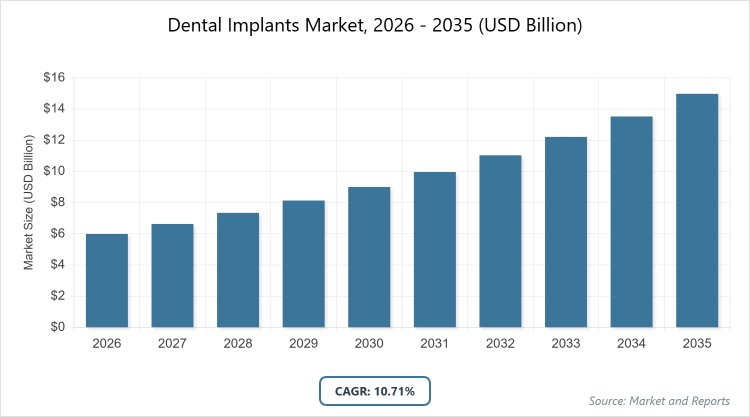 |
| Segments Covered | By Material, By Product, By End User, By Type, By Procedure, By Demographics, By Price, and By Region |
| Regions Covered | North America, Europe, Asia Pacific (APAC), Latin America, and The Middle East and Africa (MEA) |
| Base Year | 2025 |
| Historical Year | 2020 – 2024 |
| Forecast Year | 2026 – 2035 |
| Customization Scope | Avail customized purchase options to meet your exact research needs. |
How is the Market Segmentation Structured in Dental Implants Market?
The Dental Implants market is segmented by material, product, end user, type, procedure, demographics, price, and region.
Based on Material Segment, titanium emerged as the most dominant subsegment due to its exceptional biocompatibility, corrosion resistance, and ability to promote strong osseointegration, which drives market growth by ensuring high success rates and long-term durability for implants. Zirconium stood as the second most dominant, valued for its aesthetic appeal in visible areas and hypoallergenic properties, contributing to market expansion by catering to patients seeking metal-free options that blend naturally with gum tissue.
Based on Product Segment, tapered implants were the most dominant subsegment, offering superior primary stability in soft bone and facilitating immediate loading, which propels market growth through reduced treatment times and enhanced patient satisfaction. Parallel wall implants ranked second, appreciated for their versatility in dense bone structures and precise fit, aiding overall market development by providing reliable alternatives for complex cases.
Based on End User Segment, dental clinics dominated as the primary subsegment, benefiting from specialized equipment and focused expertise in outpatient procedures, driving the market by improving accessibility and efficiency in implant placements. Hospitals followed as the second dominant, equipped for handling advanced surgeries and integrating with multidisciplinary care, supporting market growth through comprehensive treatment options for severe cases.
Based on Type Segment, endosteal implants led as the most dominant, providing direct bone anchorage and high adaptability to various jaw anatomies, which accelerates market progress by offering versatile solutions with proven efficacy. Subperiosteal implants were the second most dominant, suitable for patients with insufficient bone height, contributing to market expansion by addressing niche needs without extensive bone grafting.
Based on Procedure Segment, root-form dental implants dominated, mimicking natural tooth roots for optimal load distribution and stability, fueling market growth via minimally invasive techniques that enhance recovery. Plate-form dental implants came second, effective for narrow jawbones, bolstering the market by enabling treatments in anatomically challenging scenarios.
Based on Demographics Segment, the geriatric group was most dominant, driven by higher tooth loss rates from age-related issues, propelling the market through increased demand for restorative solutions that improve quality of life. Middle-aged individuals ranked second, influenced by lifestyle factors and cosmetic preferences, aiding market growth with a focus on preventive and aesthetic implants.
Based on Price Segment, premium implants dominated, featuring advanced technologies and superior materials for longevity, driving the market by appealing to affluent consumers seeking high-performance options. Value implants were second, balancing quality and affordability, expanding the market reach to budget-conscious segments without compromising essential functionality.
What are the Recent Developments in Dental Implants Market?
- In May 2025, Dentsply Sirona launched MIS LYNX, an affordable dental implant solution in the US, designed for various clinical applications and offering reliable performance.
- In June 2024, BioHorizons introduced the Tapered Pro Conical implant with a deep conical connection, building on existing designs to provide enhanced stability.
- In October 2024, Integral Dental launched Oracle’s early diagnostic test for peri-implant disease, aiming to improve early detection and management.
- In February 2024, ZimVie Inc. released the TSX Implant in Japan, expanding its portfolio to meet regional demands.
- In August 2025, Nobel Biocare launched a new implant system focused on enhancing osseointegration for better patient outcomes.
- In September 2025, Straumann expanded its partnership with a digital dentistry firm to integrate advanced technologies.
- In July 2025, Dentsply Sirona unveiled an AI-driven software platform for optimizing treatment planning.
What is the Regional Analysis of Dental Implants Market?
North America to dominate the global market.
North America holds the largest share, driven by robust healthcare infrastructure, high prevalence of dental issues, and technological adoption; the United States dominates this region due to its advanced research facilities, large geriatric population, and favorable reimbursement policies, contributing significantly to market leadership through innovation and high procedure volumes.
Europe follows as a key region, supported by strong regulatory frameworks and increasing cosmetic dentistry demand; Germany leads here with its manufacturing prowess and skilled dental professionals, fostering growth through exports and clinical advancements.
Asia Pacific is the fastest-growing region, fueled by rising disposable incomes, dental tourism, and population aging; China dominates, propelled by expanding healthcare access and government initiatives on oral health, enabling rapid market penetration.
Latin America shows promising growth with improving economic conditions and awareness; Brazil is the dominating country, benefiting from a large consumer base and established dental clinics, driving expansion via affordable treatments.
The Middle East and Africa region is emerging, aided by urbanization and investments in healthcare; the United Arab Emirates leads, attracting medical tourists with state-of-the-art facilities and supporting growth through international collaborations.
Who are the Key Market Players in Dental Implants Market?
- Institut Straumann AG focuses on innovation through R&D investments in advanced materials and digital solutions, while expanding globally via partnerships and acquisitions to enhance product portfolios and market reach.
- Dentsply Sirona emphasizes digital transformation with AI-integrated tools and affordable implant launches, strengthening its position through strategic collaborations and e-commerce enhancements for clinician accessibility.
- Zimmer Biomet Holdings Inc. pursues growth via new implant system introductions and distribution partnerships, targeting emerging markets like China to broaden its footprint and improve procedural efficiency.
- Nobel Biocare Services AG invests in osseointegration-enhancing technologies and patient education programs, leveraging clinical trials and regulatory approvals to maintain premium branding and drive adoption.
- BioHorizons IPH Inc. develops tapered implant designs for stability, focusing on product diversification and competitive pricing to capture shares in both developed and developing regions.
- Osstem Implant forms strategic alliances for digital integrations, emphasizing cost-effective solutions and R&D in biocompatible materials to expand in Asia and beyond.
- Henry Schein restructures portfolios for better treatment planning demonstrations, utilizing distribution networks and acquisitions to support dental professionals and enhance supply chain efficiency.
- Envista prioritizes mergers and clinical innovations, such as CAD/CAM integrations, to offer comprehensive solutions and capitalize on growing demand for customized implants.
- Dentium Co. Ltd. concentrates on value-priced implants with high-quality standards, investing in regional expansions and marketing to penetrate price-sensitive markets.
- KYOCERA Medical Corporation advances ceramic implant technologies for aesthetics, collaborating on research to improve biocompatibility and target niche segments like metal-free preferences.
What are the Market Trends in Dental Implants Market?
- Integration of AI for personalized treatment planning and risk reduction.
- Adoption of 3D printing for custom prosthetics and faster production.
- Rise in nanotechnology for enhanced osseointegration and healing.
- Shift towards minimally invasive, one-appointment procedures.
- Growing use of regenerative biomaterials like stem cells and growth factors.
- Expansion of digital workflows with cloud-based platforms.
- Focus on smart implants with sensors for real-time monitoring.
- Increasing emphasis on sustainability with biodegradable materials.
- Surge in dental tourism in emerging economies.
- Advancements in CAD/CAM and CBCT for precision surgery.
What Market Segments and their Subsegments are Covered in the Dental Implants Report?
By Material
-
Titanium
-
Zirconium
-
Ceramic
-
Others
By Product
- Tapered Implants
- Parallel Wall Implants
By End User
- Dental Clinics
- Hospitals
- Research Institutes
By Type
- Endosteal Implants
- Subperiosteal Implants
- Transosteal Implants
- Intramucosal Implants
By Procedure
- Root-form Dental Implants
- Plate-form Dental Implants
By Demographics
- Geriatric
- Middle Aged
- Adult
- Others
By Price
- Premium Implants
- Value Implants
- Discounted Implants
By Region
- North America
- U.S.
- Canada
- Europe
- UK
- Germany
- France
- Rest of Europe
- Asia Pacific
- China
- India
- Japan
- Rest of Asia Pacific
- Latin America
- Brazil
- Mexico
- Rest of Latin America
- Middle East & Africa
- UAE
- South Africa
- Rest of Middle East & Africa
Frequently Asked Questions
Dental implants are artificial tooth roots, typically made of titanium or zirconium, surgically placed into the jawbone to support replacement teeth or bridges, providing a stable and natural-looking solution for tooth loss.
Key factors include rising prevalence of dental disorders, aging global population, technological advancements in materials and procedures, increasing cosmetic dentistry demand, and expanding healthcare access in emerging markets.
The market is projected to grow from approximately USD 6.63 billion in 2026 to USD 15.08 billion by 2035.
The CAGR is expected to be 10.71% during the forecast period.
North America will contribute notably, holding around 38% of the market share due to advanced infrastructure and high adoption rates.
Major players include Institut Straumann AG, Dentsply Sirona, Zimmer Biomet Holdings Inc., Nobel Biocare Services AG, and BioHorizons IPH Inc.
The report provides comprehensive analysis including market size, trends, segmentation, regional insights, key players, and forecasts, along with dynamics like drivers and opportunities.
Stages include raw material sourcing, manufacturing of implants and components, distribution through suppliers and clinics, surgical implantation by professionals, and post-procedure maintenance and follow-up care.
Trends are shifting towards digital integration, minimally invasive procedures, and aesthetic materials, while consumers prefer customized, durable solutions with faster recovery and natural appearances.
Regulatory factors include stringent approval processes for new materials, while environmental factors involve sustainability demands pushing for biodegradable options and reduced waste in manufacturing.