
Cultured Meat Market Size, Share and Trends 2026 to 2035
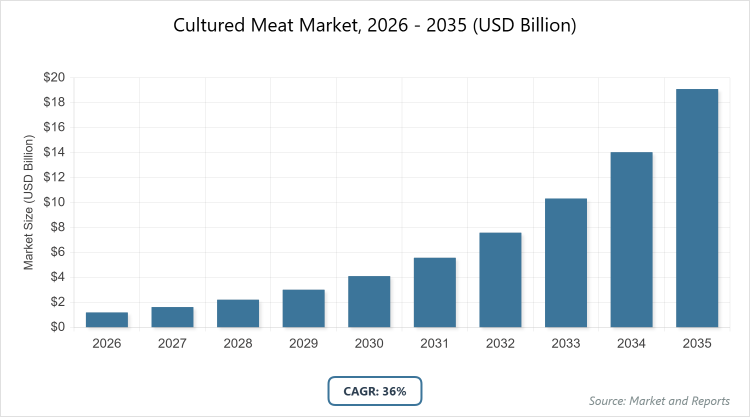
According to MarketnReports, the global Cultured Meat Market size was estimated at USD 1.2 billion in 2025 and is expected to reach USD 27.4 billion by 2035, growing at a CAGR of 36% from 2026 to 2035. The cultured meat market is driven by the increasing demand for sustainable and ethical protein alternatives.
What are the key insights into the Cultured Meat market?
- The global cultured meat market size was valued at USD 1.2 billion in 2025 and is projected to reach USD 27.4 billion by 2035.
- The market is expected to grow at a CAGR of 36% during the forecast period from 2026 to 2035.
- The market is driven by advancements in biotechnology, regulatory approvals, and growing consumer preference for sustainable foods.
- Poultry dominates the product type segment with a 40% share due to faster cell growth cycles, lower production costs, and high consumer acceptance as an entry-level alternative meat.
- Nuggets dominate the application segment with a 35% share, owing to their processed nature,e allowing easier scalability and familiarity in fast-food formats.
- Foodservice dominates the end-user segment with a 50% share because of partnerships with restaurants for pilot launches and consumer trials.
- North America dominates the regional segment with a 40% share owing to significant investments, regulatory progress in the US, and strong R&D infrastructure.
What is the overview of the Cultured Meat industry?
The cultured meat market encompasses the production and commercialization of meat products grown from animal cells in a laboratory setting, eliminating the need for traditional livestock farming and slaughter. This innovative sector utilizes biotechnology, including cell culturing, scaffolding, and bioreactors, to create edible tissues that mimic conventional meat in taste, texture, and nutrition. Market definition includes all lab-grown animal-based proteins, such as beef, poultry, and seafood, aimed at addressing environmental concerns, animal welfare issues, and food security challenges by offering a scalable, resource-efficient alternative to conventional meat production, with applications spanning consumer retail and foodservice industries.
What drives the growth in the Cultured Meat market?
Growth Drivers
The growth drivers for the cultured meat market are anchored by escalating environmental concerns and the push for sustainable food systems, as traditional livestock farming contributes significantly to greenhouse gas emissions, deforestation, and water usage, prompting consumers and governments to seek alternatives that reduce these impacts. Technological breakthroughs in cell culture efficiency, bioreactor design, and serum-free media formulations have lowered production costs and improved scalability, enabling commercial viability and attracting venture capital. Additionally, shifting dietary preferences toward ethical, animal-free proteins amid rising veganism and flexitarianism, coupled with food security needs in urbanizing populations, accelerate adoption, supported by collaborations between startups and food giants for product innovation and market entry.
Restraints
Restraints in the cultured meat market include high production costs associated with advanced bioreactors, cell lines, and growth factors, which make products significantly more expensive than conventional meat, limiting affordability and mass-market penetration. Regulatory hurdles and varying approval processes across regions delay commercialization, as safety assessments for novel foods require extensive data on allergenicity and nutritional equivalence. Moreover, consumer skepticism regarding taste, texture, and the “unnatural” perception of lab-grown meat, amplified by cultural attachments to traditional farming, poses acceptance challenges, while supply chain complexities for scaling up without contamination add operational risks.
Opportunities
Opportunities in the cultured meat market emerge from expanding regulatory approvals, such as those in Singapore and the US, paving the way for global market access and encouraging investments in new geographies like Europe and Asia. Innovations in hybrid products combining cultured cells with plant-based ingredients offer cost reductions and enhanced sensory profiles, appealing to a broader consumer base. Partnerships with traditional meat companies and foodservice chains can facilitate distribution networks, while government grants for sustainable agriculture research provide funding for R&D, enabling breakthroughs in cost-effective production and opening niches in premium, customized meats for health-conscious demographics.
Challenges
Challenges in the cultured meat market revolve around achieving price parity with conventional meat, as current high costs from energy-intensive processes and specialized equipment hinder competitiveness in price-sensitive markets. Intellectual property disputes and technological bottlenecks in replicating complex meat structures, like marbling in beef, require ongoing research amid a limited skilled workforce in biotechnology. Public perception and ethical debates over genetic modification, combined with potential supply shortages of key inputs like fetal bovine serum alternatives, necessitate transparent communication and sustainable sourcing, while navigating diverse cultural and religious attitudes toward novel foods adds layers of market entry complexity.
Cultured Meat Market: Report Scope
| Report Attributes | Report Details |
| Report Name | Cultured Meat Market |
| Market Size 2025 | USD 1.2 Billion |
| Market Forecast 2035 | USD 27.4 Billion |
| Growth Rate | CAGR of 36% |
| Report Pages | 220 |
| Key Companies Covered |
Upside Foods, Aleph Farms, Mosa Meat, BlueNalu, Meatable, and Others |
| Segments Covered | By Product Type, By Application, By End-User, and By Region |
| Regions Covered | North America, Europe, Asia Pacific (APAC), Latin America, and The Middle East and Africa (MEA) |
| Base Year | 2025 |
| Historical Year | 2020 – 2024 |
| Forecast Year | 2026 – 2035 |
| Customization Scope | Avail customized purchase options to meet your exact research needs. |
How is the Cultured Meat market segmented?
The Cultured Meat market is segmented by product type, application, end-user, and region.
By Product Type, poultry emerges as the most dominant subsegment, holding approximately 40% market share, followed by beef as the second most dominant at around 30%. Poultry dominates due to its shorter cultivation timelines, lower resource requirements, and alignment with popular processed foods, making it more feasible for early commercialization and cost efficiencies. This dominance drives the market by enabling quicker scaling, attracting initial investments, and building consumer familiarity through accessible products like nuggets, thereby accelerating overall adoption and paving the way for diversification into other meats.
By Application, nuggets stand as the most dominant subsegment with about 35% share, while burgers are the second most dominant at roughly 25%. Nuggets dominate owing to their simple structure, facilitating easier cell assembly and production at scale, coupled with high demand in quick-service restaurants for affordable entry points. This segment propels market growth by serving as a gateway product for consumer trials, reducing development risks, and generating early revenues that fund R&D for complex formats, ultimately expanding market reach and investor confidence.
By End-User, foodservice is the most dominant subsegment, capturing around 50% share, with retail as the second most dominant at approximately 30%. Foodservice leads due to strategic partnerships for menu integrations and controlled environments for product testing, allowing direct consumer feedback and premium pricing. This dominance fuels market advancement by driving volume through high-traffic outlets, enhancing visibility, and supporting supply chain maturation, which in turn facilitates retail expansion and broader accessibility.
What are the recent developments in the Cultured Meat market?
- In August 2025, Meatable announced the acquisition of Uncommon Bio’s cultivated meat platform, including key technologies for cell differentiation, to accelerate its pork production scalability and reduce costs.
- In January 2026, Upside Foods secured USD 150 million in Series C funding from investors, including Cargill, focusing on expanding its California facility for chicken products amid US regulatory approvals.
- In November 2025, Aleph Farms received preliminary approval from the Israeli government for beef sales, marking a step toward commercial launch and partnerships with local retailers.
- In December 2025, BlueNalu collaborated with a major seafood chain for pilot testing of cultivated fish fillets, emphasizing sustainability in overfished species.
- In October 2025, Mosa Meat unveiled a new serum-free medium breakthrough, reducing production costs by 30% and attracting EU grants for further R&D.
Which region dominates the Cultured Meat market?
- North America is expected to dominate the global market.
North America commands the cultured meat market with a 40% share, bolstered by substantial venture funding exceeding USD 1 billion annually and progressive regulations from the FDA and USDA, facilitating first-in-market approvals for chicken and beef. The United States, as the dominating country, contributes over 70% regionally through hubs like California, where companies like Upside Foods and Good Meat lead with commercial facilities and consumer trials in upscale restaurants. The region is projected to grow at a CAGR of 38%, driven by high meat consumption rates and sustainability initiatives, though high costs may limit mass adoption until scale-up.
Asia Pacific holds a 25% share, propelled by early regulatory milestones in Singapore and growing investments in China and Japan for food security amid population pressures. Singapore dominates regionally at around 30%, as the first country to approve sales in 2020, with ongoing expansions by Eat Just and government support via A*STAR research grants. Expected CAGR of 40% stems from urban demand for ethical proteins and collaborations with traditional food firms, yet cultural resistance in rural areas poses integration challenges.
Europe maintains a 20% share, supported by EU funding for alternative proteins under Horizon Europe and strong R&D in the Netherlands and UK. The Netherlands leads at approximately 25% regionally, home to Mosa Meat and its bioreactor innovations, backed by national policies for circular economies. The market anticipates a CAGR of 35%, fueled by vegan trends and bans on animal testing, but stringent novel food regulations may delay broader commercialization.
Latin America captures an emerging 8% share, driven by agricultural shifts in Brazil and Argentina toward sustainable exports. Brazil dominates at about 35% regionally, with investments in beef alternatives amid deforestation concerns and partnerships like those with BRF. Projected CAGR of 32% is supported by growing middle-class preferences for health-focused foods, though the infrastructure for biotech lags behind.
The Middle East and Africa region accounts for 7% share, growing through Israeli innovations and UAE food tech hubs. Israel leads with around 40% regionally via Aleph Farms’ approvals and desert agriculture synergies. Expected CAGR of 30% arises from water-scarce sustainability needs and investments like the UAE’s Food Tech Valley, but limited consumer awareness hinders faster growth.
Who are the key players in the Cultured Meat market?
- Upside Foods focuses on chicken production, pursuing scale-up through funding rounds and restaurant partnerships to achieve cost parity and expand retail presence.
- Aleph Farms emphasizes beef steaks, investing in 3D bioprinting and regulatory advocacy in Israel and Europe to pioneer whole-cut meats and secure global approvals.
- Mosa Meat specializes in ground beef, adopting serum-free media innovations and collaborations with food giants like Merck for supply chain efficiency and market entry.
- BlueNalu targets seafood, leveraging cell-based fish fillets with sustainability claims, seeking Asian partnerships for overfished species and commercial pilots.
- Meatable develops pork and beef, utilizing acquisitions like Uncommon Bio for tech enhancements and focusing on hybrid products to reduce costs and appeal to flexitarians.
What are the emerging trends in the Cultured Meat market?
- Increasing focus on serum-free and animal-free growth media to lower costs and address ethical concerns.
- Rise in hybrid products combining cultured cells with plant-based ingredients for improved texture and affordability.
- Expansion of regulatory approvals in new markets, accelerating commercialization, and investor confidence.
- Growing investments in bioreactor technology for large-scale production and efficiency gains.
- Emphasis on sustainability claims, including reduced carbon footprints and water usage compared to traditional meat.
- Partnerships between startups and traditional meat companies for distribution and co-development.
What segments and subsegments are covered in the Cultured Meat report?
By Product Type
- Poultry
- Beef
- Pork
- Seafood
- Duck
- Lamb
- Turkey
- Exotic Meats
- Hybrid Meats
- Others
By Application
- Nuggets
- Burgers
- Meatballs
- Sausages
- Hot Dogs
- Ground Meat
- Steaks
- Fillets
- Patties
- Others
By End-User
- Foodservice
- Retail
- Institutional
- Others
By Region
-
- North America
- U.S.
- Canada
- Europe
- UK
- Germany
- France
- Rest of Europe
- Asia Pacific
- China
- India
- Japan
- Rest of Asia Pacific
- Latin America
- Brazil
- Mexico
- Rest of Latin America
- Middle East & Africa
- UAE
- South Africa
- Rest of Middle East & Africa
- North America
Frequently Asked Questions
Cultured meat is lab-grown protein produced from animal cells using biotechnology, offering a sustainable alternative to traditional livestock farming.
Key factors include technological advancements, regulatory approvals, sustainability demands, and investments in production scalability.
The market is projected to grow from USD 1.2 billion in 2026 to USD 27.4 billion by 2035.
The market is expected to register a CAGR of 36% during 2026-2035.
North America will contribute notably, driven by investments and regulatory progress in the United States.
Major players include Upside Foods, Aleph Farms, Mosa Meat, BlueNalu, and Meatable.
The report provides comprehensive analysis including market size, trends, segmentation, regional insights, key players, and forecasts from 2026 to 2035.
Stages include cell sourcing, culturing and proliferation, scaffolding and maturation, harvesting, processing, packaging, and distribution.
Trends are shifting toward sustainable, ethical proteins with preferences for affordable, tasty hybrids and transparent production processes.
Regulatory approvals accelerate growth, while environmental mandates for low-emission foods drive innovation and investments.