
Crypto Asset Management Market Size, Share and Trends 2026 to 2035
According to MarketnReports, the global Crypto Asset Management market size was estimated at USD 1.53 billion in 2025 and is expected to reach USD 13.81 billion by 2035, growing at a CAGR of 24.6% from 2026 to 2035. Crypto Asset Management Market is driven by the proliferation of blockchain technology and increasing adoption of cryptocurrencies.
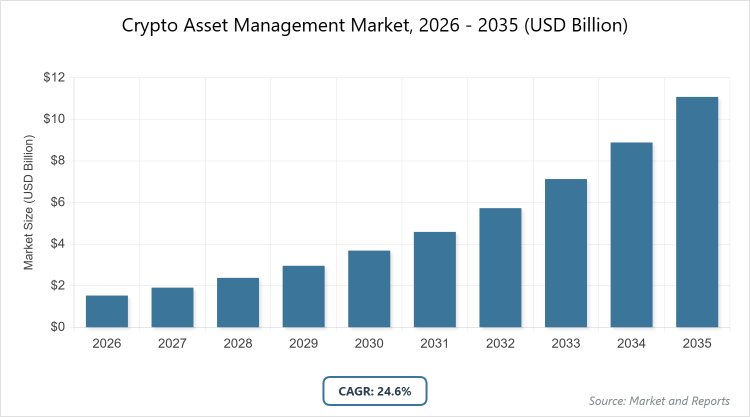
What are the Key Insights in the Crypto Asset Management Market?
- The global Crypto Asset Management market was valued at USD 1.53 billion in 2025 and is projected to reach USD 13.81 billion by 2035.
- The market is anticipated to grow at a CAGR of 24.6% during the forecast period from 2026 to 2035.
- The market is driven by the proliferation of blockchain technology, rising institutional investments, and the integration of AI and ML in asset management solutions.
- The Custodian Solution segment dominated the solution category with a revenue share of over 62% due to high demand from institutional investors for secure and compliant storage options.
- This dominance is attributed to the need for robust custody services that mitigate risks associated with digital asset storage, enabling large-scale investors to confidently enter the market and driving overall growth through enhanced trust and regulatory adherence.
- The Cloud segment dominated the deployment mode with the largest share, as it offers scalability, flexibility, and real-time access, making it ideal for dynamic crypto environments.
- Cloud’s dominance stems from its cost-effectiveness and integration capabilities with AI/ML tools, which streamline operations and attract more users, thereby propelling market expansion.
- The Mobile segment led the application category, holding the majority share owing to the convenience of on-the-go management via smartphones.
- Mobile’s leading position is driven by widespread smartphone adoption and DeFi integrations, which facilitate activities like staking and yield farming, contributing significantly to market growth by increasing accessibility for retail investors.
- The Android segment was dominant in the operating system category, capturing the largest portion due to its open ecosystem supporting diverse crypto apps.
- Android’s dominance is fueled by its compatibility with third-party developments and enhanced device features, enabling broader user engagement and driving market momentum through innovation in mobile crypto tools.
- The Individual segment dominated the end-use industry with the highest share, as retail investors increasingly adopt user-friendly platforms for personal portfolios.
- This segment’s lead is due to mainstream crypto awareness, potential for high returns, and educational resources, which boost participation and help drive the market by expanding the user base.
- North America dominated the regional landscape with a 30.4% revenue share, owing to regulatory clarity, technological innovation, and strong institutional involvement.
- North America’s dominance is driven by a robust ecosystem of crypto exchanges, startups, and venture capital, fostering mainstream adoption and contributing to global market growth through leadership in fintech advancements.
What is the Industry Overview of Crypto Asset Management?
The Crypto Asset Management industry encompasses solutions designed to securely store, track, and optimize digital assets such as cryptocurrencies, leveraging blockchain technology for enhanced transparency and efficiency. Market definition refers to the suite of tools and platforms that enable individuals and institutions to manage diverse crypto portfolios, including wallets and custodian services that integrate multiple accounts into unified dashboards with analytical capabilities for performance monitoring and decision-making. This market addresses the complexities arising from the volatile nature of digital assets, providing features like risk assessment and automated rebalancing to support both retail and professional investors in navigating the evolving landscape of blockchain-based finance.
What are the Market Dynamics in Crypto Asset Management?
Growth Drivers
The primary growth drivers in the Crypto Asset Management market include the widespread adoption of blockchain technology across various sectors beyond cryptocurrencies, such as finance, supply chain, and healthcare, which enhances the security, transparency, and functionality of digital assets. Additionally, the surge in institutional investors incorporating crypto into their portfolios has significantly boosted assets under management, creating a demand for professional, compliant management solutions. The integration of AI and machine learning further automates processes like portfolio rebalancing and risk assessment, reducing operational costs and improving efficiency for handling diverse asset types. Rising individual and business investments in cryptocurrencies as alternative assets and transaction mediums also propel market expansion, supported by user-friendly platforms that bridge traditional and digital finance systems.
Restraints
Key restraints in the Crypto Asset Management market revolve around regulatory uncertainties and varying global policies, which can hinder adoption by creating compliance challenges for platforms and investors alike. The inherent volatility of cryptocurrency prices poses risks to asset values, deterring conservative investors and complicating portfolio management strategies. Security concerns, including cyber threats and hacking incidents, undermine user confidence despite advancements in technology, leading to potential losses and slower market penetration. High operational costs associated with developing and maintaining secure infrastructure, coupled with a lack of standardized practices, further restrict growth, particularly for smaller players in the ecosystem.
Opportunities
Opportunities in the Crypto Asset Management market are abundant with the expansion of decentralized finance (DeFi) platforms, allowing for innovative services like lending, borrowing, and staking integrated directly into management tools. The convergence of traditional financial systems with digital assets opens avenues for institutions to offer hybrid services, enhancing interoperability and attracting a broader client base. Advancements in wallet technologies, such as multi-signature and biometric security, present chances to improve user trust and accessibility. Moreover, the rise of cloud-based solutions infused with AI/ML enables real-time analytics and personalized insights, creating potential for market differentiation and penetration into emerging regions with growing digital adoption.
Challenges
Challenges facing the Crypto Asset Management market include navigating complex and evolving regulatory landscapes that differ by jurisdiction, requiring continuous adaptation to avoid legal pitfalls. Ensuring robust cybersecurity measures against sophisticated threats remains a hurdle, as breaches can lead to significant financial and reputational damage. The scalability of platforms to handle increasing transaction volumes without compromising speed or cost-efficiency poses technical difficulties. Additionally, educating users on the intricacies of crypto management and addressing the skills gap among potential adopters can slow widespread acceptance, while environmental concerns related to blockchain’s energy consumption may invite scrutiny and impact public perception.
Crypto Asset Management Market: Report Scope
| Report Attributes | Report Details |
| Report Name | Crypto Asset Management Market |
| Market Size 2025 | USD 1.53 Billion |
| Market Forecast 2035 | USD 13.81 Billion |
| Growth Rate | CAGR of 24.6% |
| Report Pages | 220 |
| Key Companies Covered | Gemini Trust Company LLC; BitGo; Ripple; CRYPTO FINANCE AG; Coinbase; Fidelity Digital Assets; Bakkt; Paxos Trust Company LLC; Ledger SAS; Anchorage Digital, and Others |
| Segments Covered | By Solution, By Deployment Mode, By Application, By Operating System, By End-Use Industry, and By Region |
| Regions Covered | North America, Europe, Asia Pacific (APAC), Latin America, and The Middle East and Africa (MEA) |
| Base Year | 2025 |
| Historical Year | 2020 – 2024 |
| Forecast Year | 2026 – 2035 |
| Customization Scope | Avail customized purchase options to meet your exact research needs. |
What is the Market Segmentation in Crypto Asset Management?
The Crypto Asset Management market is segmented by solution, deployment mode, application, operating system, end-use industry, and region.
Based on Solution Segment, the Custodian Solution emerged as the most dominant, holding over 62% revenue share, followed by Wallet Management as the second most dominant. The Custodian Solution’s dominance is due to its critical role in providing secure, institutional-grade storage and compliance features that appeal to large investors entering the crypto space, while Wallet Management supports everyday secure transactions; together, they drive the market by enhancing trust, enabling efficient portfolio handling, and facilitating broader adoption through risk mitigation and user-friendly interfaces that attract both retail and enterprise users.
Based on Deployment Mode Segment, Cloud was the most dominant, with On-premise as the second most dominant. Cloud’s leading position stems from its scalability and flexibility, allowing seamless integration with AI tools for real-time management, whereas On-premise offers superior control and security for regulated entities; these segments propel market growth by catering to diverse needs, reducing costs for dynamic environments, and supporting institutional demands for customized, secure infrastructures that expand accessibility and operational efficiency.
Based on Application Segment, Mobile dominated, followed by Web-based as the second most dominant. Mobile’s dominance is driven by smartphone proliferation and on-the-go convenience for activities like staking, with Web-based providing cross-platform analytics; they contribute to market expansion by increasing user engagement through DeFi integrations and real-time monitoring, making crypto management more inclusive and efficient for a global audience.
Based on Operating System Segment, Android was the most dominant, with iOS as the second most dominant. Android’s lead is attributed to its open ecosystem fostering diverse app developments, while iOS emphasizes privacy and intuitive interfaces; these drive the market by enabling widespread mobile adoption, integrating with DEXs and NFTs, and providing predictive insights via AI, thus broadening participation and innovation in crypto tools.
Based on End-Use Industry Segment, Individual held the dominant share, followed by Enterprise as the second most dominant. Individual’s dominance arises from retail adoption fueled by high-return potential and educational platforms, with Enterprise focusing on treasury integration and compliance; they advance the market by expanding the user base through transparent blockchain transactions and analytical tools, supporting institutional portfolios and driving overall growth via increased liquidity and mainstream integration.
What are the Recent Developments in Crypto Asset Management?
- In September 2023, Gemini Trust Company, LLC announced plans to invest USD 24 million for expansion in India, building on its establishment of a development center in Gurgaon in May 2023, aiming to enhance local engineering capabilities and support global crypto adoption.
- In June 2023, Amberdata expanded its operations to the Asia-Pacific region by opening a new office in Hong Kong, focusing on providing localized sales and support for its suite of products including DeFi intelligence, spot data, on-chain analytics, and derivatives insights to cater to growing regional demand.
What is the Regional Analysis of Crypto Asset Management?
- North America to dominate the global market
North America leads the Crypto Asset Management market with a 30.4% revenue share, driven by regulatory clarity, technological advancements, and significant institutional investments that foster a mature ecosystem of exchanges and startups. The United States stands as the dominating country, with expansions in brokerages and payment processors enhancing mainstream adoption, while Canada and Mexico contribute through supportive fintech policies and growing digital asset integration, collectively propelling regional growth through innovation and venture capital influx.
Asia Pacific is experiencing rapid growth due to tech-savvy populations and a burgeoning startup ecosystem that promotes digital financial services. Japan emerges as a key dominating country with its regulated environment encouraging investment, alongside South Korea, Singapore, Australia, China, and India, where increases in exchanges and fintech innovations boost liquidity and accessibility, driving the region’s expansion through broader crypto participation and infrastructure development.
Europe is emerging as a strong contender with diverse regulations promoting innovation while ensuring consumer protection, coupled with institutional involvement in blockchain applications across finance and supply chain. Germany is the dominating country, supported by the UK and France, where financial institutions are integrating crypto custody and products, enhancing market growth through technological advancements and crypto-friendly jurisdictions that facilitate seamless adoption.
Latin America shows promising potential with increasing digital asset awareness and adoption amid economic volatility, where cryptocurrencies serve as alternative stores of value. Brazil dominates the region, with efforts in regulatory frameworks and exchange growth, contributing to market development by improving financial inclusion and transaction efficiency in underserved areas.
Middle East and Africa (MEA) is gradually adopting crypto asset management, influenced by blockchain initiatives in finance and remittances. The UAE leads as the dominating country, followed by KSA and South Africa, where progressive policies and investments in digital infrastructure are fostering growth, aiding the market through enhanced security and cross-border transaction capabilities.
Who are the Key Market Players in Crypto Asset Management?
Gemini Trust Company, LLC focuses on global expansion strategies, such as investing USD 24 million in India for development centers to bolster engineering teams and localize services, enabling it to capture emerging markets and enhance platform capabilities for secure crypto management.
BitGo employs new product development and strategic alliances to maintain competitiveness, emphasizing secure custody solutions for institutional clients, which strengthens its market position through mergers and acquisitions that expand service offerings.
Ripple pursues organic and inorganic growth strategies, including partnerships for cross-border payments integration, leveraging blockchain to improve interoperability and drive adoption in traditional finance sectors.
CRYPTO FINANCE AG engages in initiatives like alliances and product innovations to stay ahead in the competitive landscape, focusing on compliant solutions that cater to European institutional demands.
Coinbase dictates market trends through continuous innovations in user-friendly platforms and educational resources, expanding its reach via acquisitions and integrations with DeFi protocols.
Fidelity Digital Assets holds a significant share by offering enterprise-grade custody and trading services, with strategies centered on regulatory compliance and integration with traditional investment portfolios.
Bakkt emphasizes strategic partnerships with financial institutions to bridge digital and traditional assets, driving growth through platform enhancements for consumer and institutional users.
Paxos Trust Company, LLC focuses on regulated stablecoin and custody services, utilizing alliances to expand its blockchain infrastructure and ensure secure asset management.
Ledger SAS prioritizes hardware wallet innovations and security features, with strategies involving product diversification to address both individual and enterprise needs.
Anchorage Digital adopts a client-centric approach with custom custody solutions for institutions, leveraging regulatory approvals to build trust and expand its footprint in the market.
What are the Market Trends in Crypto Asset Management?
- Increasing integration of AI and ML for automated portfolio management, risk assessment, and predictive analytics to enhance efficiency.
- Growing adoption of DeFi platforms within management tools for lending, staking, and yield farming opportunities.
- Expansion of cloud-based solutions offering scalability and real-time access for global investors.
- Convergence of traditional finance with crypto assets, enabling hybrid services from banks and institutions.
- Advancements in wallet security, including multi-signature and biometric features to combat cyber threats.
- Rise in institutional involvement, boosting demand for compliant and secure custody services.
- Proliferation of blockchain applications beyond crypto, such as in supply chain and healthcare, indirectly supporting asset management growth.
- Focus on mobile-first strategies to capitalize on smartphone ubiquity for on-the-go trading and monitoring.
What are the Market Segments and their Subsegments Covered in the Crypto Asset Management Report?
By Solution
- Custodian Solution
- Wallet Management
By Deployment Mode
- Cloud
- On-premise
By Application
- Web-based
- Mobile
By Operating System
- iOS
- Android
By End-Use Industry
- Individual
- Enterprise
- Institutions
- Retail & E-commerce
- Healthcare
- Travel & Hospitality
- Others
By Region
- North America
- U.S.
- Canada
- Europe
- UK
- Germany
- France
- Rest of Europe
- Asia Pacific
- China
- India
- Japan
- Rest of Asia Pacific
- Latin America
- Brazil
- Mexico
- Rest of Latin America
- Middle East & Africa
- UAE
- South Africa
- Rest of Middle East & Africa
Chapter 1. Preface
1.1 Report Description and Scope1.2 Research Scope1.3 Research Methodology1.3.1 Market Research Type1.3.2 Market Research MethodologyChapter 2. Executive Summary
2.1 Global Crypto Asset Management Market, (2026 - 2035) (USD Billion)2.2 Global Crypto Asset Management Market: SnapshotChapter 3. Global Crypto Asset Management Market - Industry Analysis
3.1 Crypto Asset Management Market: Market Dynamics3.2 Market Drivers3.2.1 The Crypto Asset Management market is driven by growing blockchain adoption, rising institutional and retail crypto investments, and the use of AI-driven tools that enhance portfolio management, security, and operational efficiency.3.3 Market Restraints3.3.1 The Crypto Asset Management market is restrained by regulatory uncertainty, high price volatility, security risks, high infrastructure costs, and the lack of standardized practices limiting wider adoption.3.4 Market Opportunities3.4.1 The Crypto Asset Management market offers opportunities through DeFi integration, convergence of traditional and digital finance, advanced secure wallet technologies, and AI-powered cloud platforms enabling personalized, real-time asset management and expansion in emerging markets.3.5 Market Challenges3.5.1 The Crypto Asset Management market faces challenges from complex regulatory compliance, cybersecurity threats, scalability and performance issues, user education and skills gaps, and environmental concerns around blockchain energy consumption.3.6 Porter’s Five Forces Analysis3.7 Market Attractiveness Analysis3.7.1 Market Attractiveness Analysis By Solution3.7.2 Market Attractiveness Analysis By Deployment Mode3.7.3 Market Attractiveness Analysis By Application3.7.4 Market Attractiveness Analysis By Operating System3.7.5 Market Attractiveness Analysis By End-Use IndustryChapter 4. Global Crypto Asset Management Market- Competitive Landscape
4.1 Company Market Share Analysis4.1.1 Global Crypto Asset Management Market: Company Market Share, 20254.2 Strategic Development4.2.1 Acquisitions & mergers4.2.2 New Product launches4.2.3 Agreements, partnerships, collaborations, and joint ventures4.2.4 Research and development and regional expansion4.3 Price Trend AnalysisChapter 5. Global Crypto Asset Management Market - Solution Analysis
5.1 Global Crypto Asset Management Market Overview: Solution5.1.1 Global Crypto Asset Management Market share, By Solution, 2025 and 20355.2 Custodian Solution5.2.1 Global Crypto Asset Management Market by Custodian Solution, 2026 - 2035 (USD Billion)5.3 Wallet Management5.3.1 Global Crypto Asset Management Market by Wallet Management, 2026 - 2035 (USD Billion)5.4 Others5.4.1 Global Crypto Asset Management Market by Others, 2026 - 2035 (USD Billion)Chapter 6. Global Crypto Asset Management Market - Deployment Mode Analysis
6.1 Global Crypto Asset Management Market Overview: Deployment Mode6.1.1 Global Crypto Asset Management Market Share, By Deployment Mode, 2025 and 20356.2 Cloud6.2.1 Global Crypto Asset Management Market by Cloud, 2026 - 2035 (USD Billion)6.3 On-premise6.3.1 Global Crypto Asset Management Market by On-premise, 2026 - 2035 (USD Billion)6.4 Others6.4.1 Global Crypto Asset Management Market by Others, 2026 - 2035 (USD Billion)Chapter 7. Global Crypto Asset Management Market - Application Analysis
7.1 Global Crypto Asset Management Market Overview: Application7.1.1 Global Crypto Asset Management Market Share, By Application, 2025 and 20357.2 Web-based7.2.1 Global Crypto Asset Management Market by Web-based, 2026 - 2035 (USD Billion)7.3 Mobile7.3.1 Global Crypto Asset Management Market by Mobile, 2026 - 2035 (USD Billion)7.4 Others7.4.1 Global Crypto Asset Management Market by Others, 2026 - 2035 (USD Billion)Chapter 8. Global Crypto Asset Management Market - Operating System Analysis
8.1 Global Crypto Asset Management Market Overview: Operating System8.1.1 Global Crypto Asset Management Market Share, By Operating System, 2025 and 20358.2 iOS8.2.1 Global Crypto Asset Management Market by iOS, 2026 - 2035 (USD Billion)8.3 Android8.3.1 Global Crypto Asset Management Market by Android, 2026 - 2035 (USD Billion)8.4 Others8.4.1 Global Crypto Asset Management Market by Others, 2026 - 2035 (USD Billion)Chapter 9. Global Crypto Asset Management Market - End-Use Industry Analysis
9.1 Global Crypto Asset Management Market Overview: End-Use Industry9.1.1 Global Crypto Asset Management Market Share, By End-Use Industry, 2025 and 20359.2 Individual9.2.1 Global Crypto Asset Management Market by Individual, 2026 - 2035 (USD Billion)9.3 Enterprise9.3.1 Global Crypto Asset Management Market by Enterprise, 2026 - 2035 (USD Billion)9.4 Institutions9.4.1 Global Crypto Asset Management Market by Institutions, 2026 - 2035 (USD Billion)9.5 Retail & E-commerce9.5.1 Global Crypto Asset Management Market by Retail & E-commerce, 2026 - 2035 (USD Billion)9.6 Healthcare9.6.1 Global Crypto Asset Management Market by Healthcare, 2026 - 2035 (USD Billion)9.7 Travel & Hospitality9.7.1 Global Crypto Asset Management Market by Travel & Hospitality, 2026 - 2035 (USD Billion)9.8 Others9.8.1 Global Crypto Asset Management Market by Others, 2026 - 2035 (USD Billion)Chapter 10. Crypto Asset Management Market - Regional Analysis
10.1 Global Crypto Asset Management Market Regional Overview10.2 Global Crypto Asset Management Market Share, by Region, 2025 & 2035 (USD Billion)10.3 North America10.3.1 North America Crypto Asset Management Market, 2026 - 2035 (USD Billion)10.3.1.1 North America Crypto Asset Management Market, by Country, 2026 - 2035 (USD Billion)10.3.2 North America Crypto Asset Management Market, by Solution, 2026 - 203510.3.2.1 North America Crypto Asset Management Market, by Solution, 2026 - 2035 (USD Billion)10.3.3 North America Crypto Asset Management Market, by Deployment Mode, 2026 - 203510.3.3.1 North America Crypto Asset Management Market, by Deployment Mode, 2026 - 2035 (USD Billion)10.3.4 North America Crypto Asset Management Market, by Application, 2026 - 203510.3.4.1 North America Crypto Asset Management Market, by Application, 2026 - 2035 (USD Billion)10.3.5 North America Crypto Asset Management Market, by Operating System, 2026 - 203510.3.5.1 North America Crypto Asset Management Market, by Operating System, 2026 - 2035 (USD Billion)10.3.6 North America Crypto Asset Management Market, by End-Use Industry, 2026 - 203510.3.6.1 North America Crypto Asset Management Market, by End-Use Industry, 2026 - 2035 (USD Billion)10.4 Europe10.4.1 Europe Crypto Asset Management Market, 2026 - 2035 (USD Billion)10.4.1.1 Europe Crypto Asset Management Market, by Country, 2026 - 2035 (USD Billion)10.4.2 Europe Crypto Asset Management Market, by Solution, 2026 - 203510.4.2.1 Europe Crypto Asset Management Market, by Solution, 2026 - 2035 (USD Billion)10.4.3 Europe Crypto Asset Management Market, by Deployment Mode, 2026 - 203510.4.3.1 Europe Crypto Asset Management Market, by Deployment Mode, 2026 - 2035 (USD Billion)10.4.4 Europe Crypto Asset Management Market, by Application, 2026 - 203510.4.4.1 Europe Crypto Asset Management Market, by Application, 2026 - 2035 (USD Billion)10.4.5 Europe Crypto Asset Management Market, by Operating System, 2026 - 203510.4.5.1 Europe Crypto Asset Management Market, by Operating System, 2026 - 2035 (USD Billion)10.4.6 Europe Crypto Asset Management Market, by End-Use Industry, 2026 - 203510.4.6.1 Europe Crypto Asset Management Market, by End-Use Industry, 2026 - 2035 (USD Billion)10.5 Asia Pacific10.5.1 Asia Pacific Crypto Asset Management Market, 2026 - 2035 (USD Billion)10.5.1.1 Asia Pacific Crypto Asset Management Market, by Country, 2026 - 2035 (USD Billion)10.5.2 Asia Pacific Crypto Asset Management Market, by Solution, 2026 - 203510.5.2.1 Asia Pacific Crypto Asset Management Market, by Solution, 2026 - 2035 (USD Billion)10.5.3 Asia Pacific Crypto Asset Management Market, by Deployment Mode, 2026 - 203510.5.3.1 Asia Pacific Crypto Asset Management Market, by Deployment Mode, 2026 - 2035 (USD Billion)10.5.4 Asia Pacific Crypto Asset Management Market, by Application, 2026 - 203510.5.4.1 Asia Pacific Crypto Asset Management Market, by Application, 2026 - 2035 (USD Billion)10.5.5 Asia Pacific Crypto Asset Management Market, by Operating System, 2026 - 203510.5.5.1 Asia Pacific Crypto Asset Management Market, by Operating System, 2026 - 2035 (USD Billion)10.5.6 Asia Pacific Crypto Asset Management Market, by End-Use Industry, 2026 - 203510.5.6.1 Asia Pacific Crypto Asset Management Market, by End-Use Industry, 2026 - 2035 (USD Billion)10.6 Latin America10.6.1 Latin America Crypto Asset Management Market, 2026 - 2035 (USD Billion)10.6.1.1 Latin America Crypto Asset Management Market, by Country, 2026 - 2035 (USD Billion)10.6.2 Latin America Crypto Asset Management Market, by Solution, 2026 - 203510.6.2.1 Latin America Crypto Asset Management Market, by Solution, 2026 - 2035 (USD Billion)10.6.3 Latin America Crypto Asset Management Market, by Deployment Mode, 2026 - 203510.6.3.1 Latin America Crypto Asset Management Market, by Deployment Mode, 2026 - 2035 (USD Billion)10.6.4 Latin America Crypto Asset Management Market, by Application, 2026 - 203510.6.4.1 Latin America Crypto Asset Management Market, by Application, 2026 - 2035 (USD Billion)10.6.5 Latin America Crypto Asset Management Market, by Operating System, 2026 - 203510.6.5.1 Latin America Crypto Asset Management Market, by Operating System, 2026 - 2035 (USD Billion)10.6.6 Latin America Crypto Asset Management Market, by End-Use Industry, 2026 - 203510.6.6.1 Latin America Crypto Asset Management Market, by End-Use Industry, 2026 - 2035 (USD Billion)10.7 The Middle-East and Africa10.7.1 The Middle-East and Africa Crypto Asset Management Market, 2026 - 2035 (USD Billion)10.7.1.1 The Middle-East and Africa Crypto Asset Management Market, by Country, 2026 - 2035 (USD Billion)10.7.2 The Middle-East and Africa Crypto Asset Management Market, by Solution, 2026 - 203510.7.2.1 The Middle-East and Africa Crypto Asset Management Market, by Solution, 2026 - 2035 (USD Billion)10.7.3 The Middle-East and Africa Crypto Asset Management Market, by Deployment Mode, 2026 - 203510.7.3.1 The Middle-East and Africa Crypto Asset Management Market, by Deployment Mode, 2026 - 2035 (USD Billion)10.7.4 The Middle-East and Africa Crypto Asset Management Market, by Application, 2026 - 203510.7.4.1 The Middle-East and Africa Crypto Asset Management Market, by Application, 2026 - 2035 (USD Billion)10.7.5 The Middle-East and Africa Crypto Asset Management Market, by Operating System, 2026 - 203510.7.5.1 The Middle-East and Africa Crypto Asset Management Market, by Operating System, 2026 - 2035 (USD Billion)10.7.6 The Middle-East and Africa Crypto Asset Management Market, by End-Use Industry, 2026 - 203510.7.6.1 The Middle-East and Africa Crypto Asset Management Market, by End-Use Industry, 2026 - 2035 (USD Billion)Chapter 11. Company Profiles
11.1 Gemini Trust Company LLC11.1.1 Overview11.1.2 Financials11.1.3 Product Portfolio11.1.4 Business Strategy11.1.5 Recent Developments11.2 BitGo11.2.1 Overview11.2.2 Financials11.2.3 Product Portfolio11.2.4 Business Strategy11.2.5 Recent Developments11.3 Ripple11.3.1 Overview11.3.2 Financials11.3.3 Product Portfolio11.3.4 Business Strategy11.3.5 Recent Developments11.4 CRYPTO FINANCE AG11.4.1 Overview11.4.2 Financials11.4.3 Product Portfolio11.4.4 Business Strategy11.4.5 Recent Developments11.5 Coinbase11.5.1 Overview11.5.2 Financials11.5.3 Product Portfolio11.5.4 Business Strategy11.5.5 Recent Developments11.6 Fidelity Digital Assets11.6.1 Overview11.6.2 Financials11.6.3 Product Portfolio11.6.4 Business Strategy11.6.5 Recent Developments11.7 Bakkt11.7.1 Overview11.7.2 Financials11.7.3 Product Portfolio11.7.4 Business Strategy11.7.5 Recent Developments11.8 Paxos Trust Company LLC11.8.1 Overview11.8.2 Financials11.8.3 Product Portfolio11.8.4 Business Strategy11.8.5 Recent Developments11.9 Ledger SAS11.9.1 Overview11.9.2 Financials11.9.3 Product Portfolio11.9.4 Business Strategy11.9.5 Recent Developments11.10 Anchorage Digital11.10.1 Overview11.10.2 Financials11.10.3 Product Portfolio11.10.4 Business Strategy11.10.5 Recent Developments
Frequently Asked Questions
Crypto Asset Management refers to the tools, platforms, and services used to securely store, track, optimize, and manage digital assets like cryptocurrencies, providing features such as portfolio analytics, risk assessment, and integration with wallets for individuals and institutions.
Key factors include the proliferation of blockchain technology, rising institutional investments, AI/ML integrations for automation, regulatory clarity in key regions, and increasing adoption of DeFi platforms that enhance management efficiency and accessibility.
The market is projected to grow from an estimated value post-2025 of USD 1.53 billion to USD 13.81 billion by 2035, reflecting substantial expansion driven by technological advancements and adoption trends.
The CAGR is expected to be 24.6%, indicating robust growth fueled by innovation and increasing demand for secure digital asset solutions.
North America will contribute notably, holding a dominant 30.4% share due to its advanced regulatory framework, institutional participation, and technological ecosystem.
Major players include Gemini Trust Company LLC, BitGo, Ripple, CRYPTO FINANCE AG, Coinbase, Fidelity Digital Assets, Bakkt, Paxos Trust Company LLC, Ledger SAS, and Anchorage Digital, who drive growth through innovations, expansions, and strategic alliances.
The report provides comprehensive analysis including market size, forecasts, segmentation, dynamics, regional insights, key players, trends, and strategic recommendations for stakeholders.
The value chain includes asset creation and issuance, secure storage and custody, portfolio management and analytics, trading and exchange integration, compliance and regulatory services, and end-user application through platforms and wallets.
Trends are shifting towards mobile and cloud-based solutions with AI-driven automation, while consumers prefer user-friendly, secure platforms that integrate DeFi for higher yields and real-time insights, emphasizing convenience and compliance.
Regulatory factors like varying global policies on crypto taxation and licensing impact adoption, while environmental concerns over blockchain's energy use push for sustainable practices, influencing growth through calls for greener technologies and stricter compliance.