
Cryo-electron Microscopy Market Size, Share and Trends 2026 to 2035
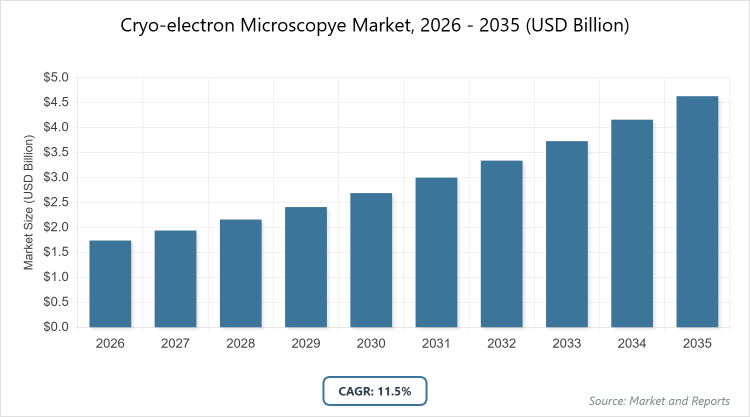
According to MarketReports, the global cryo-electron microscopy market size was estimated at USD 1.74 billion in 2025 and is expected to reach USD 4.63 billion by 2035, growing at a CAGR of 11.5% from 2026 to 2035. The Cryo-Electron Microscopy (cryo-EM) Market is primarily driven by the surging demand for near-atomic resolution imaging in drug discovery and structural biology, alongside technological breakthroughs in direct electron detectors and AI-powered automation that bypass the traditional need for crystal growth.
What are the Key Insights into the Cryo-electron Microscopy Market?
- The global cryo-electron microscopy market is projected to grow from approximately USD 1.74 billion in 2026 to USD 4.63 billion by 2035, reflecting a compound annual growth rate (CAGR) of around 11.5%.
- Among method types, single particle analysis dominates as the leading subsegment, essential for high-resolution protein structure determination.
- In application segments, biological science holds the dominant position, driven by drug discovery and vaccine development.
- By end-user, pharmaceutical and biotechnology companies are the most prominent, benefiting from R&D in therapeutics.
- North America emerges as the dominant region, contributing the largest market share owing to robust funding and advanced facilities.
What is the Cryo-electron Microscopy Industry?
Industry Overview
The cryo-electron microscopy industry revolves around advanced imaging techniques that enable high-resolution visualization of biological specimens at cryogenic temperatures, preserving their native state without chemical fixation or staining to study molecular structures like proteins, viruses, and cellular components for applications in drug discovery, structural biology, and material science. These systems, including single-particle analysis, tomography, and micro-electron diffraction, utilize electron beams to generate detailed 3D models, integrating hardware like electron microscopes, detectors, and cryostages with software for data processing and reconstruction.
Serving as a pivotal tool in life sciences and nanotechnology, the market bridges academia, pharmaceuticals, and research institutions, emphasizing innovations in resolution enhancement, automation, and AI-driven analysis to accelerate scientific breakthroughs while addressing challenges in sample preparation and high operational costs, ultimately advancing personalized medicine and material engineering amid global research investments.
What Drives the Cryo-electron Microscopy Market?
Growth Drivers
The cryo-electron microscopy market is propelled by escalating investments in life sciences research and drug development, where high-resolution imaging is crucial for understanding biomolecular structures and accelerating vaccine and therapeutic discoveries, coupled with government funding for advanced microscopy facilities in academia and pharma. Technological advancements, such as direct electron detectors and AI-enhanced data analysis, improve imaging speed and accuracy, attracting adoption in structural biology and nanotechnology applications. Additionally, the rising prevalence of infectious diseases and need for rapid diagnostics drive demand, as cryo-EM enables detailed pathogen studies without artifacts, supporting market expansion through collaborations between research institutions and industry players.
Restraints
High capital costs for cryo-EM systems, including specialized equipment and maintenance, limit accessibility for small research labs and emerging markets, hindering widespread adoption amid budget constraints. Complex sample preparation and data processing require skilled personnel, creating barriers in regions with limited training infrastructure. Moreover, regulatory hurdles for clinical applications and competition from alternative techniques like X-ray crystallography restrain growth, while supply chain issues for critical components like detectors inflate prices.
Opportunities
The integration of AI and machine learning for automated image reconstruction opens avenues for user-friendly systems, appealing to non-experts and expanding into pharmaceutical R&D for faster drug screening. Emerging economies present untapped potential through increasing biotech investments and government initiatives for research infrastructure, where affordable, portable models can capture demand. Furthermore, applications in material science for nanomaterial analysis align with sustainability trends, enabling partnerships and entry into high-growth sectors like battery development.
Challenges
Navigating stringent safety and ethical regulations for biological imaging increases compliance costs, complicating global operations amid varying international standards. Rapid technological obsolescence demands continuous R&D investment, straining resources for smaller firms. Additionally, environmental concerns over energy-intensive cooling systems pressure manufacturers to develop greener alternatives without sacrificing performance.
Cryo-electron Microscopy Market: Report Scope
| Report Attributes | Report Details |
| Report Name | Cryo-electron Microscopy Market |
| Market Size 2025 | USD 1.74 Billion |
| Market Forecast 2035 | USD 4.63 Billion |
| Growth Rate | CAGR of 11.5% |
| Report Pages | 210 |
| Key Companies Covered | Thermo Fisher Scientific, JEOL Ltd, Hitachi High-Technologies Corporation, Carl Zeiss AG, Leica Microsystems, Gatan Inc, Oxford Instruments, Danaher Corporation, Roper Technologies, and Nikon Corporation |
| Segments Covered | By Method, By Application, By End-User, By Region |
| Regions Covered | North America, Europe, Asia Pacific (APAC), Latin America, The Middle East and Africa (MEA) |
| Base Year | 2025 |
| Historical Year | 2020 – 2024 |
| Forecast Year | 2026 – 2035 |
| Customization Scope | Avail customized purchase options to meet your exact research needs. |
How is the Sous Vide Machine Market Segmented?
The cryo-electron microscopy market is segmented by method, application, end-user, and region.
By method, including single particle analysis, cryo-electron tomography, electron crystallography, and others, with single particle analysis emerging as the most dominant due to its ability to provide atomic-level resolution for complex biomolecules without crystallization, making it ideal for drug design; this dominance drives the market by accelerating research outputs and attracting pharma investments, while cryo-electron tomography ranks as the second most dominant, valued for 3D cellular imaging, supporting growth through applications in virology and cell biology.
By application, the market divides into biological science, material science, life science, semiconductor, and others, where biological science dominates owing to its critical role in protein and virus structure elucidation for therapeutics; its prevalence propels market expansion by aligning with biotech funding, whereas material science follows as the second dominant, applied in nanomaterial characterization, contributing via industrial innovations.
By end-user, segments include pharmaceutical and biotechnology companies, research institutes and universities, contract research organizations, and others, with pharmaceutical and biotechnology leading as they utilize cryo-EM for target validation and lead optimization; this segment fuels dynamics by generating high-value contracts, while research institutes and universities secure second place, focusing on fundamental discoveries, enhancing knowledge dissemination through publications.
What are the Recent Developments in the Cryo-electron Microscopy Market?
- In January 2025, NanoImaging Services announced the acquisition of a key cryo-EM technology firm, expanding its service offerings for pharmaceutical clients and enhancing high-throughput structural analysis capabilities.
- In May 2024, Danaher Corporation launched the VIVENTIS LS2, incorporating light sheet technology to complement cryo-EM workflows, aimed at improving sample preparation for biological research.
- In 2023, Sika AG’s acquisition of Bexel Consulting indirectly supported digital advancements in related imaging fields, though primarily focused on industrial applications, influencing broader microscopy tools.
How Does Regional Performance Vary in the Cryo-electron Microscopy Market?
- North America to dominate the market
North America dominates the cryo-electron microscopy market, bolstered by substantial R&D funding from NIH and private sectors, advanced facilities in universities like Stanford, and a concentration of biotech hubs; the United States leads this region with its innovative ecosystem, high adoption in pharma for drug discovery, and collaborations driving technological exports. Canada contributes through research grants in structural biology, fostering cross-border partnerships, while Mexico emerges with growing biotech startups leveraging US proximity for shared resources. The region’s strong patent landscape accelerates commercialization, with venture capital supporting startups in AI-enhanced cryo-EM software.
Europe exhibits robust growth through EU Horizon programs and collaborative networks like Instruct-ERIC; Germany stands out as the dominating country, leveraging precision engineering from firms like Zeiss and strong academic output in protein research. The UK and France add momentum via Brexit-adjusted funding and CNRS initiatives, emphasizing vaccine development, while Italy and Spain contribute through Mediterranean research consortia on infectious diseases. Nordic countries focus on sustainable lab practices, with Eastern Europe gaining from EU integrations for facility upgrades. Europe’s emphasis on open-access data repositories enhances global knowledge sharing.
Asia Pacific emerges as the fastest-growing region for cryo-electron microscopy, propelled by government investments in biotech and rising publications; China predominates with state-backed facilities and rapid adoption in virology, supported by Japan’s electron microscopy heritage from JEOL. India accelerates through CSIR labs focusing on affordable innovations, with South Korea contributing advanced detectors for semiconductor applications. Southeast Asia gains from collaborative ASEAN initiatives, while Australia leads in oceanic biology studies. The region’s manufacturing strengths lower costs for components, driving exports.
Latin America shows emerging potential amid biotech growth; Brazil excels with EMBRAPA and university partnerships for agricultural applications, promoting regional collaborations. Mexico and Argentina support through NAFTA ties and pharma R&D, while Chile advances via Andean biodiversity studies. Colombia benefits from international grants for tropical disease research, with Peru focusing on archaeological material analysis. Economic partnerships with North America facilitate technology transfers.
The Middle East & Africa region represents nascent opportunities, focused on academic collaborations; the United Arab Emirates dominates via investments in Dubai Science Park for research hubs, with Saudi Arabia growing through Vision 2030’s biotech push. South Africa emerges through university cryo-EM centers for disease studies, complemented by Israel’s tech integrations in structural biology. Egypt contributes via Nile Basin research, while Kenya gains from African Union initiatives. Infrastructure challenges are offset by international aid for health research.
Who are the Key Market Players in the Cryo-electron Microscopy Industry?
- Thermo Fisher Scientific invests in high-throughput systems and acquisitions to dominate pharma applications.
- JEOL Ltd. focuses on resolution enhancements and Asian expansions for academic sectors.
- Hitachi High-Technologies Corporation emphasizes AI integrations and partnerships for material sciences.
- Carl Zeiss AG pursues precision optics innovations targeting European research.
- Leica Microsystems adopts user-friendly designs for entry-level users in biotech.
- Gatan Inc. leverages detector technologies for software synergies.
- Oxford Instruments optimizes cryogenic stages for global supply.
- Danaher Corporation launches complementary technologies like light sheet for workflow improvements.
- Roper Technologies supports through subsidiary integrations for data analysis tools.
- Nikon Corporation diversifies into life science imaging with collaborative R&D.
What are the Current Market Trends in Cryo-electron Microscopy?
- Integration of AI for automated data collection and analysis to speed up research.
- Growth in high-resolution detectors for sub-atomic imaging in drug design.
- Rise in cryo-EM for vaccine development post-COVID.
- Adoption of portable cryostages for field applications.
- Expansion of software platforms for cloud-based collaboration.
- Focus on sustainable cooling systems to reduce energy use.
- Shift toward multi-modal imaging combining cryo-EM with other techniques.
- Increasing use in material science for battery and nanomaterial studies.
- Rise in open-access facilities for broader research access.
- Advancements in sample preparation for fragile biomolecules.
What Market Segments are Covered in the Report?
By Method
- Single Particle Analysis
- Cryo-Electron Tomography
- Electron Crystallography
- Others
By Application
- Biological Science
- Material Science
- Life Science
- Semiconductor
- Others
By End-User
- Pharmaceutical and Biotechnology Companies
- Research Institutes and Universities
- Contract Research Organizations
- Others
By Region
-
- North America
- U.S.
- Canada
- Europe
- UK
- Germany
- France
- Rest of Europe
- Asia Pacific
- China
- India
- Japan
- Rest of Asia Pacific
- Latin America
- Brazil
- Mexico
- Rest of Latin America
- Middle East & Africa
- UAE
- South Africa
- Rest of Middle East & Africa
- North America
Frequently Asked Questions
Cryo-electron microscopy is an imaging technique that uses electron beams to visualize frozen biological samples at high resolution, preserving their natural structure for molecular studies.
Key factors include R&D investments in biotech, AI advancements, drug discovery demands, and government funding for research infrastructure.
The market is projected to grow from approximately USD 1.74 billion in 2026 to USD 4.63 billion by 2035, driven by life sciences applications.
The compound annual growth rate (CAGR) is expected to be around 11.5% from 2026 to 2035, indicating steady expansion.
North America will contribute notably, holding the largest share due to advanced research facilities.
Major players include Thermo Fisher Scientific, JEOL Ltd, Hitachi High-Technologies Corporation, Carl Zeiss AG, Leica Microsystems, Gatan Inc, Oxford Instruments, Danaher Corporation, Roper Technologies, and Nikon Corporation, driving growth through innovations.
The report provides insights into size, trends, segmentation, regions, players, and forecasts for strategic planning.
Stages include component manufacturing, system assembly, software development, distribution, and end-user training/services.
Trends are shifting toward AI-automated systems and high-resolution imaging, with preferences for user-friendly software in research.
Regulations on lab safety drive quality standards; environmental concerns over energy use push for efficient cooling systems.