
Cross Laminated Timber (CLT) Market Size, Share and Trends 2026 to 2035
According to MarketnReports, the global Cross Laminated Timber (CLT) market size was estimated at USD 1.8 billion in 2025 and is expected to reach USD 7.2 billion by 2035, growing at a CAGR of 14.8% from 2026 to 2035. Cross Laminated Timber (CLT) Market is driven by rising demand for sustainable and eco-friendly construction materials.
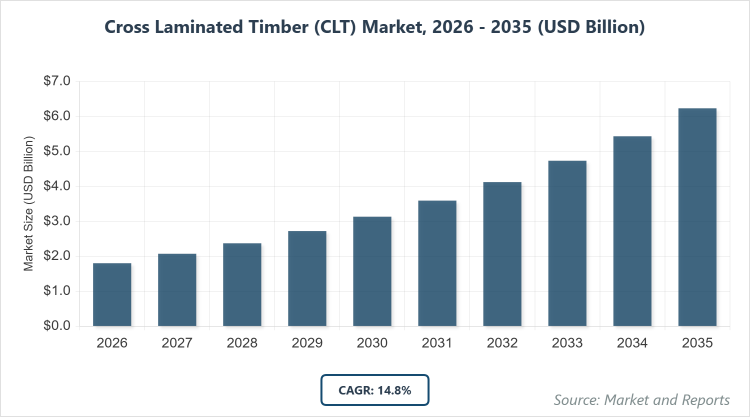
What are the Key Insights of the CLT Market?
- The global CLT market was valued at USD 1.8 billion in 2025 and is projected to reach USD 7.2 billion by 2035.
- The market is expected to grow at a CAGR of 14.8% from 2026 to 2035.
- The market is driven by favorable government policies promoting green buildings and rapid urbanization increasing demand for prefabricated solutions.
- Adhesive Bonded CLT dominates the type segment with 80% share due to its superior mechanical performance, dimensional accuracy, and suitability for large-scale prefabrication.
- Spruce dominates the raw material segment with 55% share because of its widespread availability in Europe, excellent strength-to-weight ratio, and compatibility with adhesive bonding processes.
- Non-Residential dominates the end-use industry segment with 60% share owing to its extensive use in large commercial and public projects requiring high structural integrity and quick assembly.
- Europe dominates with 50% share due to its mature timber ecosystem, strong regulatory frameworks for sustainable construction, and advanced manufacturing capabilities.
What is the Industry Overview of CLT?
Cross-laminated timber (CLT) refers to an engineered wood product consisting of multiple layers of solid-sawn lumber stacked in alternating perpendicular directions and bonded together under pressure, typically using structural adhesives. This creates large, solid panels that offer exceptional strength, stability, and versatility for use in construction. The market encompasses the production, distribution, and application of these panels, which serve as a sustainable alternative to traditional materials like concrete and steel. CLT is defined as a mass timber system that enables efficient, prefabricated building solutions with reduced environmental impact, aligning with global shifts toward eco-friendly architecture and modular construction methods. It supports diverse structural elements such as walls, floors, and roofs, promoting faster build times and enhanced seismic performance.
What are the Market Dynamics in the CLT Market?
Growth Drivers
The growth of the CLT market is propelled by increasing emphasis on sustainable construction practices worldwide, as governments and organizations prioritize low-carbon materials to combat climate change. Favorable policies, such as building code revisions in regions like Europe and North America, allow for taller mass timber structures, boosting adoption in high-rise projects. Additionally, the material’s advantages in reducing construction time and labor costs through prefabrication appeal to developers facing urbanization pressures and skilled labor shortages. This driver is further amplified by growing consumer awareness of environmental benefits, including CLT’s ability to sequester carbon and minimize waste, positioning it as a key component in green building certifications like LEED.
Restraints
A major restraint in the CLT market is the limited manufacturing capacity and supply chain inefficiencies, particularly outside established regions like Europe, leading to extended lead times and elevated costs in emerging markets. The dependency on high-quality lumber sources and specialized equipment restricts scalability, while a lack of skilled workforce for design and installation hampers widespread implementation. Furthermore, perceptions of wood’s vulnerability to fire and pests, despite advancements in treatments, create hesitation among stakeholders accustomed to conventional materials. These factors collectively slow market penetration in price-sensitive areas and delay project timelines.
Opportunities
Opportunities in the CLT market arise from expanding applications in renovation and adaptive reuse projects, where its lightweight nature facilitates vertical extensions and rooftop additions without overburdening existing structures. The rise in commercial and institutional buildings, such as data centers and corporate campuses, presents avenues for innovation in fire-resistant and modular designs. Emerging markets in Asia Pacific offer potential through infrastructure investments and technology transfers, while collaborations with digital tools like BIM enhance precision and efficiency. This opens doors for manufacturers to diversify into hybrid systems combining CLT with other materials for broader appeal.
Challenges
Challenges in the CLT market include moisture sensitivity and durability issues, as wood’s natural absorbency can lead to swelling, delamination, or decay in humid environments without proper sealing. Stringent testing and certification requirements add complexity and costs to compliance, particularly for international trade. Market fragmentation with varying regional standards complicates global supply chains, and competition from alternative sustainable materials like glulam or steel hybrids poses threats. Addressing these requires ongoing R&D in protective coatings and education to build trust among architects and engineers.
Cross Laminated Timber (CLT) Market: Report Scope
| Report Attributes | Report Details |
| Report Name | Cross Laminated Timber (CLT) Market |
| Market Size 2025 | USD 1.8 Billion |
| Market Forecast 2035 | USD 7.2 Billion |
| Growth Rate | CAGR of 14.8% |
| Report Pages | 201 |
| Key Companies Covered | Stora Enso, Mayr-Melnhof Holz, Binderholz GmbH, HASSLACHER Holding GmbH, Schilliger Holz AG, and Others |
| Segments Covered | By Type, By Raw Material, By End-Use Industry, and By Region |
| Regions Covered | North America, Europe, Asia Pacific (APAC), Latin America, and The Middle East and Africa (MEA) |
| Base Year | 2025 |
| Historical Year | 2020 – 2024 |
| Forecast Year | 2026 – 2035 |
| Customization Scope | Avail customized purchase options to meet your exact research needs. |
What is the Market Segmentation of the CLT Market?
The Cross Laminated Timber (CLT) market is segmented by type, raw material, end-use industry, and region.
Based on Type Segment. The adhesive bonded CLT is the most dominant segment, holding approximately 80% of the market share, due to its enhanced structural integrity, precise manufacturing, and compatibility with automated production lines, which enable cost-effective scaling for large projects. The mechanically fastened CLT serves as the second most dominant, with about 20% share, offering advantages in regions with adhesive restrictions or for applications requiring disassembly, though it is less prevalent because of higher labor needs and potential for reduced panel uniformity; both segments drive the market by catering to diverse construction demands, with adhesive bonded leading growth through its alignment with prefabrication trends that accelerate building timelines and reduce on-site waste.
Based on Raw Material Segment. Spruce is the most dominant raw material, capturing around 55% market share, attributed to its abundant supply in key producing regions, optimal fiber properties for bonding, and favorable strength characteristics that enhance panel performance in load-bearing applications. Pine ranks as the second most dominant with roughly 25% share, valued for its cost-effectiveness and availability, though it is slightly less preferred due to higher resin content potentially affecting adhesive adhesion; these materials propel market expansion by ensuring reliable supply chains and enabling innovations in sustainable forestry practices that support eco-friendly certifications.
Based on End-Use Industry Segment. Non-residential is the most dominant, comprising about 60% of the market, driven by its use in expansive projects like commercial complexes and public infrastructure where CLT’s quick installation and seismic resilience provide significant advantages over traditional materials. Residential follows as the second most dominant with 40% share, gaining traction through demand for energy-efficient homes and modular housing; together, they fuel market growth by addressing urbanization needs and promoting sustainable development in both sectors.
What are the Recent Developments in the CLT Market?
- In June 2024, Mercer Mass Timber acquired Structurlam in Canada, expanding its production capacity to 255,000 cubic meters annually and integrating specialized expertise in mass timber fabrication, which strengthens its North American presence and supports increased supply for large-scale projects.
- In March 2024, Mercer Mass Timber launched a new Construction Services division focused on on-site installation and consulting, enhancing end-to-end solutions for clients and addressing gaps in skilled labor by providing comprehensive project support from design to completion.
- In February 2024, HASSLACHER Holding GmbH invested in Element5 in Canada, boosting annual capacity to 100,000 cubic meters and facilitating entry into the North American glulam market, thereby diversifying its portfolio and capitalizing on regional growth in sustainable building.
- In November 2023, Schilliger Holz AG rebuilt its CLT plant in Switzerland with an automated production line for large-format panels, improving efficiency and output quality to meet rising demand for customized, high-performance timber products in Europe.
What is the Regional Analysis of the CLT Market?
- Europe to dominate the global market
Europe: This region holds the largest market share at around 50%, driven by a well-established timber construction ecosystem, extensive R&D, and supportive policies like subsidies for green buildings in countries such as Austria and Germany. Austria emerges as the dominating country due to its pioneering role in CLT production, with companies like Binderholz leading innovations and benefiting from abundant spruce resources, which facilitate high-volume manufacturing and export. The region’s focus on sustainability standards and urban redevelopment projects further solidifies its position, enabling faster adoption in multi-story constructions.
North America: Experiencing the fastest growth, North America accounts for about 25% of the market, fueled by evolving building codes allowing taller timber structures and increasing acceptance of eco-friendly materials in the US and Canada. Canada stands out as the dominating country, with investments in facilities like Element5 and Mercer Mass Timber expansions enhancing production capabilities and addressing demand from commercial sectors, while initiatives for carbon reduction in construction amplify market momentum.
Asia Pacific: Representing approximately 15% share, Asia Pacific is emerging rapidly through infrastructural investments in China, Japan, and Australia, where CLT is adopted for earthquake-resistant buildings and sustainable urbanization. Japan dominates within the region owing to its advanced technology integration and government incentives for wooden architecture, promoting CLT in residential and public projects to replace traditional methods.
Rest of the World: This segment holds about 10% share, with potential in Latin America and the Middle East driven by renovation projects and environmental regulations, though limited by supply chain constraints. Brazil leads in Latin America due to its vast forestry resources and growing interest in prefabricated solutions for housing shortages.
What are the Key Market Players in the CLT Market?
Stora Enso: As a leading player, Stora Enso employs strategies focused on expanding its product portfolio through R&D in sustainable timber solutions and strategic partnerships for global distribution, emphasizing digital tools for design optimization to capture market share in high-growth regions like North America.
Mayr-Melnhof Holz: This company prioritizes organic growth via capacity expansions in Europe and investments in advanced manufacturing technologies, aiming to enhance supply chain efficiency and meet demand for customized CLT panels in commercial applications.
Binderholz GmbH: Binderholz adopts inorganic strategies such as acquisitions and collaborations to broaden its footprint, focusing on sustainability certifications and innovation in fire-resistant products to drive adoption in urban construction projects.
HASSLACHER Holding GmbH: HASSLACHER’s approach includes cross-regional investments, like in North American facilities, to diversify production and leverage economies of scale, while emphasizing eco-friendly sourcing to align with global green building trends.
Schilliger Holz AG: Schilliger concentrates on technological upgrades, such as automated production lines, to improve product quality and reduce costs, targeting niche markets in Europe with specialized large-format panels.
What are the Market Trends in the CLT Market?
- Increasing integration of digital design tools like Building Information Modeling (BIM) for precise CLT prefabrication, enhancing project efficiency and reducing errors.
- Rising focus on fire-resistant CLT innovations, including encapsulated panels, to comply with stringent safety regulations in high-rise buildings.
- Growth in hybrid construction systems combining CLT with steel or concrete for improved durability and versatility in commercial applications.
- Expansion of CLT use in data centers and corporate campuses, driven by up to 65% carbon footprint reductions compared to traditional materials.
- Emphasis on sustainable forestry certifications like FSC to appeal to environmentally conscious consumers and meet regulatory requirements.
What are the Market Segments and their Subsegments Covered in the Report?
By Type
- Adhesive Bonded CLT
- Mechanically Fastened CLT
By Raw Material
- Spruce
- Pine
- Fir & Larch
- Others
By End-Use Industry
- Residential Buildings
- Educational Institutes
- Government/Public Buildings
- Commercial Spaces
- Industrial
By Region
- North America
- U.S.
- Canada
- Europe
- UK
- Germany
- France
- Rest of Europe
- Asia Pacific
- China
- India
- Japan
- Rest of Asia Pacific
- Latin America
- Brazil
- Mexico
- Rest of Latin America
- Middle East & Africa
- UAE
- South Africa
- Rest of Middle East & Africa
Chapter 1. Preface
1.1 Report Description and Scope1.2 Research Scope1.3 Research Methodology1.3.1 Market Research Type1.3.2 Market Research MethodologyChapter 2. Executive Summary
2.1 Global Cross Laminated Timber (CLT) Market, (2026 - 2035) (USD Billion)2.2 Global Cross Laminated Timber (CLT) Market: SnapshotChapter 3. Global Cross Laminated Timber (CLT) Market - Industry Analysis
3.1 Cross Laminated Timber (CLT) Market: Market Dynamics3.2 Market Drivers3.2.1 The cross-laminated timber (CLT) market is driven by the global push for sustainable construction, supportive building regulations for taller timber structures, prefabrication benefits reducing construction time and labor costs, and growing awareness of CLT’s environmental advantages in carbon sequestration and waste reduction.3.3 Market Restraints3.3.1 The CLT market is restrained by limited manufacturing capacity, supply chain inefficiencies, dependency on high-quality lumber and specialized equipment, shortage of skilled workforce, and persistent concerns over fire and pest vulnerability.3.4 Market Opportunities3.4.1 The CLT market offers opportunities through adaptive reuse and vertical extension projects, growth in commercial and institutional buildings, expansion into Asia-Pacific emerging markets, adoption of digital design tools like BIM, and development of hybrid timber-based construction systems.3.5 Market Challenges3.5.1 The CLT market faces challenges from moisture sensitivity and durability concerns, stringent testing and certification requirements, fragmented regional standards, competition from alternative sustainable materials, and the need for ongoing R&D and stakeholder education.3.6 Porter’s Five Forces Analysis3.7 Market Attractiveness Analysis3.7.1 Market Attractiveness Analysis By Type3.7.2 Market Attractiveness Analysis By Raw Material3.7.3 Market Attractiveness Analysis By End-Use IndustryChapter 4. Global Cross Laminated Timber (CLT) Market- Competitive Landscape
4.1 Company Market Share Analysis4.1.1 Global Cross Laminated Timber (CLT) Market: Company Market Share, 20254.2 Strategic Development4.2.1 Acquisitions & mergers4.2.2 New Product launches4.2.3 Agreements, partnerships, collaborations, and joint ventures4.2.4 Research and development and regional expansion4.3 Price Trend AnalysisChapter 5. Global Cross Laminated Timber (CLT) Market - Type Analysis
5.1 Global Cross Laminated Timber (CLT) Market Overview: Type5.1.1 Global Cross Laminated Timber (CLT) Market share, By Type, 2025 and 20355.2 Adhesive Bonded CLT5.2.1 Global Cross Laminated Timber (CLT) Market by Adhesive Bonded CLT, 2026 - 2035 (USD Billion)5.3 Mechanically Fastened CLT5.3.1 Global Cross Laminated Timber (CLT) Market by Mechanically Fastened CLT, 2026 - 2035 (USD Billion)5.4 Others5.4.1 Global Cross Laminated Timber (CLT) Market by Others, 2026 - 2035 (USD Billion)Chapter 6. Global Cross Laminated Timber (CLT) Market - Raw Material Analysis
6.1 Global Cross Laminated Timber (CLT) Market Overview: Raw Material6.1.1 Global Cross Laminated Timber (CLT) Market Share, By Raw Material, 2025 and 20356.2 Spruce6.2.1 Global Cross Laminated Timber (CLT) Market by Spruce, 2026 - 2035 (USD Billion)6.3 Pine6.3.1 Global Cross Laminated Timber (CLT) Market by Pine, 2026 - 2035 (USD Billion)6.4 Fir & Larch6.4.1 Global Cross Laminated Timber (CLT) Market by Fir & Larch, 2026 - 2035 (USD Billion)6.5 Others6.5.1 Global Cross Laminated Timber (CLT) Market by Others, 2026 - 2035 (USD Billion)Chapter 7. Global Cross Laminated Timber (CLT) Market - End-Use Industry Analysis
7.1 Global Cross Laminated Timber (CLT) Market Overview: End-Use Industry7.1.1 Global Cross Laminated Timber (CLT) Market Share, By End-Use Industry, 2025 and 20357.2 Residential Buildings7.2.1 Global Cross Laminated Timber (CLT) Market by Residential Buildings, 2026 - 2035 (USD Billion)7.3 Educational Institutes7.3.1 Global Cross Laminated Timber (CLT) Market by Educational Institutes, 2026 - 2035 (USD Billion)7.4 Government/Public Buildings7.4.1 Global Cross Laminated Timber (CLT) Market by Government/Public Buildings, 2026 - 2035 (USD Billion)7.5 Commercial Spaces7.5.1 Global Cross Laminated Timber (CLT) Market by Commercial Spaces, 2026 - 2035 (USD Billion)7.6 Industrial7.6.1 Global Cross Laminated Timber (CLT) Market by Industrial, 2026 - 2035 (USD Billion)7.7 Others7.7.1 Global Cross Laminated Timber (CLT) Market by Others, 2026 - 2035 (USD Billion)Chapter 8. Cross Laminated Timber (CLT) Market - Regional Analysis
8.1 Global Cross Laminated Timber (CLT) Market Regional Overview8.2 Global Cross Laminated Timber (CLT) Market Share, by Region, 2025 & 2035 (USD Billion)8.3 North America8.3.1 North America Cross Laminated Timber (CLT) Market, 2026 - 2035 (USD Billion)8.3.1.1 North America Cross Laminated Timber (CLT) Market, by Country, 2026 - 2035 (USD Billion)8.3.2 North America Cross Laminated Timber (CLT) Market, by Type, 2026 - 20358.3.2.1 North America Cross Laminated Timber (CLT) Market, by Type, 2026 - 2035 (USD Billion)8.3.3 North America Cross Laminated Timber (CLT) Market, by Raw Material, 2026 - 20358.3.3.1 North America Cross Laminated Timber (CLT) Market, by Raw Material, 2026 - 2035 (USD Billion)8.3.4 North America Cross Laminated Timber (CLT) Market, by End-Use Industry, 2026 - 20358.3.4.1 North America Cross Laminated Timber (CLT) Market, by End-Use Industry, 2026 - 2035 (USD Billion)8.4 Europe8.4.1 Europe Cross Laminated Timber (CLT) Market, 2026 - 2035 (USD Billion)8.4.1.1 Europe Cross Laminated Timber (CLT) Market, by Country, 2026 - 2035 (USD Billion)8.4.2 Europe Cross Laminated Timber (CLT) Market, by Type, 2026 - 20358.4.2.1 Europe Cross Laminated Timber (CLT) Market, by Type, 2026 - 2035 (USD Billion)8.4.3 Europe Cross Laminated Timber (CLT) Market, by Raw Material, 2026 - 20358.4.3.1 Europe Cross Laminated Timber (CLT) Market, by Raw Material, 2026 - 2035 (USD Billion)8.4.4 Europe Cross Laminated Timber (CLT) Market, by End-Use Industry, 2026 - 20358.4.4.1 Europe Cross Laminated Timber (CLT) Market, by End-Use Industry, 2026 - 2035 (USD Billion)8.5 Asia Pacific8.5.1 Asia Pacific Cross Laminated Timber (CLT) Market, 2026 - 2035 (USD Billion)8.5.1.1 Asia Pacific Cross Laminated Timber (CLT) Market, by Country, 2026 - 2035 (USD Billion)8.5.2 Asia Pacific Cross Laminated Timber (CLT) Market, by Type, 2026 - 20358.5.2.1 Asia Pacific Cross Laminated Timber (CLT) Market, by Type, 2026 - 2035 (USD Billion)8.5.3 Asia Pacific Cross Laminated Timber (CLT) Market, by Raw Material, 2026 - 20358.5.3.1 Asia Pacific Cross Laminated Timber (CLT) Market, by Raw Material, 2026 - 2035 (USD Billion)8.5.4 Asia Pacific Cross Laminated Timber (CLT) Market, by End-Use Industry, 2026 - 20358.5.4.1 Asia Pacific Cross Laminated Timber (CLT) Market, by End-Use Industry, 2026 - 2035 (USD Billion)8.6 Latin America8.6.1 Latin America Cross Laminated Timber (CLT) Market, 2026 - 2035 (USD Billion)8.6.1.1 Latin America Cross Laminated Timber (CLT) Market, by Country, 2026 - 2035 (USD Billion)8.6.2 Latin America Cross Laminated Timber (CLT) Market, by Type, 2026 - 20358.6.2.1 Latin America Cross Laminated Timber (CLT) Market, by Type, 2026 - 2035 (USD Billion)8.6.3 Latin America Cross Laminated Timber (CLT) Market, by Raw Material, 2026 - 20358.6.3.1 Latin America Cross Laminated Timber (CLT) Market, by Raw Material, 2026 - 2035 (USD Billion)8.6.4 Latin America Cross Laminated Timber (CLT) Market, by End-Use Industry, 2026 - 20358.6.4.1 Latin America Cross Laminated Timber (CLT) Market, by End-Use Industry, 2026 - 2035 (USD Billion)8.7 The Middle-East and Africa8.7.1 The Middle-East and Africa Cross Laminated Timber (CLT) Market, 2026 - 2035 (USD Billion)8.7.1.1 The Middle-East and Africa Cross Laminated Timber (CLT) Market, by Country, 2026 - 2035 (USD Billion)8.7.2 The Middle-East and Africa Cross Laminated Timber (CLT) Market, by Type, 2026 - 20358.7.2.1 The Middle-East and Africa Cross Laminated Timber (CLT) Market, by Type, 2026 - 2035 (USD Billion)8.7.3 The Middle-East and Africa Cross Laminated Timber (CLT) Market, by Raw Material, 2026 - 20358.7.3.1 The Middle-East and Africa Cross Laminated Timber (CLT) Market, by Raw Material, 2026 - 2035 (USD Billion)8.7.4 The Middle-East and Africa Cross Laminated Timber (CLT) Market, by End-Use Industry, 2026 - 20358.7.4.1 The Middle-East and Africa Cross Laminated Timber (CLT) Market, by End-Use Industry, 2026 - 2035 (USD Billion)Chapter 9. Company Profiles
9.1 Stora Enso9.1.1 Overview9.1.2 Financials9.1.3 Product Portfolio9.1.4 Business Strategy9.1.5 Recent Developments9.2 Mayr-Melnhof Holz9.2.1 Overview9.2.2 Financials9.2.3 Product Portfolio9.2.4 Business Strategy9.2.5 Recent Developments9.3 Binderholz GmbH9.3.1 Overview9.3.2 Financials9.3.3 Product Portfolio9.3.4 Business Strategy9.3.5 Recent Developments9.4 HASSLACHER Holding GmbH9.4.1 Overview9.4.2 Financials9.4.3 Product Portfolio9.4.4 Business Strategy9.4.5 Recent Developments9.5 Schilliger Holz AG9.5.1 Overview9.5.2 Financials9.5.3 Product Portfolio9.5.4 Business Strategy9.5.5 Recent Developments
Frequently Asked Questions
Cross-laminated timber (CLT) is an engineered wood panel made by layering solid-sawn lumber in perpendicular directions and bonding them with adhesives, offering high strength for structural applications in construction.
Key factors include government policies promoting sustainable buildings, advancements in prefabrication technology, urbanization-driven demand, and innovations addressing moisture and fire concerns.
The market is projected to grow from approximately USD 1.8 billion in 2025 to USD 7.2 billion by 2035.
The CAGR is expected to be 14.8% during 2026-2035.
Europe will contribute notably, holding the largest share due to its advanced infrastructure and policy support.
Major players include Stora Enso, Mayr-Melnhof Holz, Binderholz GmbH, HASSLACHER Holding GmbH, and Schilliger Holz AG.
The report provides comprehensive analysis, including market size, trends, segmentation, regional insights, key players, and forecasts.
Stages include raw material sourcing, manufacturing of panels, distribution and supply, and end-use application in construction.
Trends are shifting toward sustainable and modular construction, with consumers preferring low-carbon materials for eco-friendly buildings.
Factors include building code revisions for taller timber structures, carbon emission regulations, and sustainability certifications like FSC.