
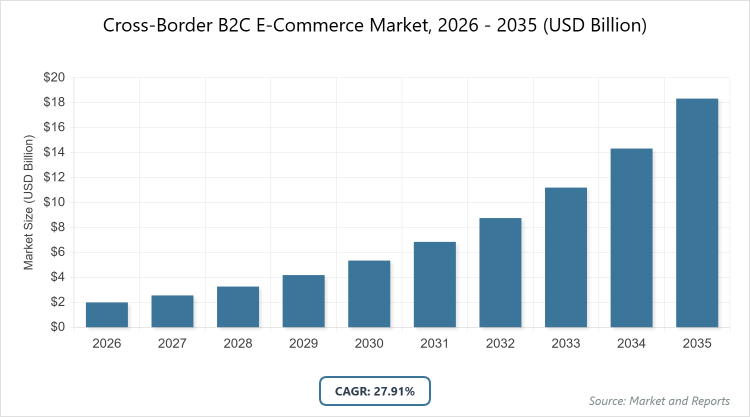
Cross-Border B2C E-Commerce Market Size, Share and Trends 2026 to 2035
According to our latest research, the global cross-border B2C e-commerce market is projected to grow from approximately USD 2,386 billion in 2026 to USD 21,895 billion by 2035, growing at a CAGR of 27.91% from 2026 to 2035. The Cross-Border B2C E-Commerce Market is primarily driven by increasing global internet and smartphone penetration, which grants consumers seamless access to a vast array of international brands, competitive pricing, and unique products unavailable in their domestic markets.
What are the Key Insights into the Cross-Border B2C E-Commerce Market?
- The global cross-border B2C e-commerce market is valued at approximately USD 2,386 billion in 2026 and is projected to reach USD 21,895 billion by 2035.
- The market is expected to grow at a compound annual growth rate (CAGR) of 27.91% from 2026 to 2035.
- Among offerings, the assorted brands segment dominates due to its wide product variety and global appeal.
- In category types, apparel & accessories is the leading subsegment, driven by fashion trends and affordability.
- By payment method, digital wallets hold the largest share, fueled by convenience and security features.
- Asia Pacific is the dominated region, supported by high consumer demand and e-commerce infrastructure.
What is the Cross-Border B2C E-Commerce Market?
Industry Overview
The cross-border B2C e-commerce market refers to the online retail transactions where businesses sell goods and services directly to consumers located in different countries, facilitated through digital platforms that enable seamless international shopping experiences, including product discovery, payment processing, and logistics management. It encompasses a wide range of activities such as browsing global marketplaces, utilizing multilingual interfaces, and leveraging secure cross-currency payments to overcome geographical barriers, allowing consumers access to diverse products unavailable locally while enabling sellers to expand their customer base beyond domestic markets. This market integrates advanced technologies like artificial intelligence for personalized recommendations, blockchain for supply chain transparency, and mobile apps for on-the-go purchasing, fostering a global ecosystem that emphasizes convenience, variety, and competitive pricing amid evolving consumer demands for fast delivery and sustainable practices.
What Drives the Cross-Border B2C E-Commerce Market?
Growth Drivers
The cross-border B2C e-commerce market is driven by surging internet and smartphone penetration in emerging economies, which expands consumer access to global products, coupled with advancements in logistics and payment technologies that streamline international shipping and secure transactions, enabling faster delivery and reduced costs. Rising disposable incomes and a growing middle class in developing regions fuel demand for premium and diverse goods, while platforms’ use of AI for personalized shopping experiences and social media integration for marketing further accelerate adoption by enhancing user engagement and trust in cross-border purchases.
Restraints
Significant restraints in the cross-border B2C e-commerce market include complex regulatory frameworks such as varying tariffs, customs duties, and compliance requirements across countries, which increase operational complexities and costs for sellers, alongside currency exchange fluctuations that can deter price-sensitive consumers. High shipping fees, longer delivery times, and concerns over product authenticity or return policies also hinder growth, particularly in regions with underdeveloped infrastructure, limiting market penetration among risk-averse buyers.
Opportunities
Opportunities in the cross-border B2C e-commerce market are amplified by the integration of emerging technologies like blockchain for transparent supply chains and AI for fraud detection, allowing platforms to build consumer trust and expand into untapped markets through localized strategies and partnerships with local logistics providers. The shift toward sustainable practices, such as eco-friendly packaging and carbon-neutral shipping, presents avenues for differentiation, while government initiatives promoting digital trade in developing regions open doors for scalable, inclusive growth models that cater to evolving preferences for ethical and convenient shopping.
Challenges
Key challenges in the cross-border B2C e-commerce market involve navigating diverse cultural and linguistic barriers that affect consumer preferences and marketing effectiveness, requiring substantial investments in localization to ensure relevance and avoid miscommunications. Supply chain disruptions from geopolitical tensions or environmental factors, combined with data privacy regulations like GDPR that demand robust compliance systems, pose ongoing hurdles, necessitating adaptive strategies to maintain operational resilience and consumer confidence across global operations.
Cross-Border B2C E-Commerce Market: Report Scope
| Report Attributes | Report Details |
| Report Name | Cross-Border B2C E-Commerce Market |
| Market Size 2025 | USD 2,386 Billion |
| Market Forecast 2035 | USD 21,895 Billion |
| Growth Rate | CAGR of 27.91% |
| Report Pages | 220 |
| Key Companies Covered | Alibaba Group Holding Limited, Amazon.com, Inc., eBay Inc., Wish (ContextLogic Inc.), Etsy, Inc., PayPal Holdings, Inc., JD.com, Inc., Sia Joom, Rakuten Group, Inc., and Shein |
| Segments Covered | By Offering, By Category, By Payment Method, By Region |
| Regions Covered | North America, Europe, Asia Pacific (APAC), Latin America, The Middle East and Africa (MEA) |
| Base Year | 2025 |
| Historical Year | 2020 – 2024 |
| Forecast Year | 2026 – 2035 |
| Customization Scope | Avail customized purchase options to meet your exact research needs. |
How is the Cross-Border B2C E-Commerce Market Segmented?
The cross-border B2C e-commerce market is segmented by offering, category, payment method, and region.
By Offering, The offering segmentation in the cross-border B2C e-commerce market is dominated by assorted brands, which lead due to their ability to provide a diverse range of products from multiple suppliers, attracting consumers seeking variety and competitive pricing across international borders, thereby driving market growth through increased platform traffic and repeat purchases enabled by curated selections that cater to global tastes. In-house brands rank as the second most dominant, offering exclusive, cost-effective options controlled by platforms for quality assurance, but they trail assorted brands because the latter’s broader assortment better addresses consumer desires for choice, propelling overall expansion via enhanced marketplace ecosystems.
By Category, In the category segmentation, apparel & accessories emerges as the most dominant in the cross-border B2C e-commerce market, attributed to high demand for trendy, affordable fashion items that benefit from visual online presentations and easy sizing adaptations, driving growth by capitalizing on social media influences and seasonal trends that boost impulse buys internationally. Electronics & media follows as the second most dominant, appealing through technological innovations and global branding, yet it lags behind apparel due to the latter’s lower price points and frequent purchase cycles, contributing to market advancement by fostering consumer loyalty through diverse product accessibility.
By Payment Method, The payment method segmentation sees digital wallets as the most dominant in the cross-border B2C e-commerce market, owing to their speed, security, and multi-currency support that simplify transactions for international shoppers, propelling growth by reducing cart abandonment and enhancing user trust in seamless cross-border payments. Credit/debit cards are the second most dominant, providing widespread acceptance and fraud protection, but they trail digital wallets as the latter offers greater convenience for mobile users, accelerating market expansion through integrated fintech solutions.
What are the Recent Developments in the Cross-Border B2C E-Commerce Market?
- In December 2025, EY US identified eight health trends, but for e-commerce, parallel insights from Shopify’s global statistics emphasized AI adoption in 84% of brands for personalization, influencing cross-border strategies amid tariff risks.
- In November 2025, a Passport + Drive Research study highlighted ecommerce brands’ focus on AI across marketing and logistics, boosting cross-border efficiency with projections for doubled B2B markets by 2030.
- In December 2025, Statista reported retail e-commerce sales exceeding 3.6 trillion USD, with cross-border segments driven by convenience as the top consumer driver.
- In July 2025, the EU Parliament’s resolution scrutinized non-EU imports, signaling tighter regulations for online platforms and logistics in cross-border trade.
- In January 2024, but extending impacts into 2025, Brazil’s paradigm shift in regulatory compliance for e-commerce emphasized stakeholder discussions for streamlined customs, affecting global sellers.
How Does the Cross-Border B2C E-Commerce Market Vary by Region?
- North America to dominate the market
Asia Pacific dominates the cross-border B2C e-commerce market with the largest share, driven by rapid digital adoption, a burgeoning middle class, and robust platforms facilitating intra-regional trade; China and India are the dominating countries, with China leading through giants like Alibaba enabling massive exports and India via growing smartphone penetration for imports, together accelerating growth by addressing diverse consumer needs in populous markets.
North America exhibits strong performance in the cross-border B2C e-commerce market, supported by advanced logistics and high consumer spending on international goods; the United States dominates, leveraging platforms like Amazon for seamless imports and exports, though challenges like tariffs persist, the focus on tech-driven personalization drives steady expansion.
Europe shows significant growth in the cross-border B2C e-commerce market due to unified regulations like GDPR and strong intra-EU trade; Germany and the United Kingdom are dominating countries, with Germany excelling in efficient supply chains and the UK through post-Brexit digital adaptations, collectively enhancing market through consumer trust in secure transactions.
Latin America is emerging in the cross-border B2C e-commerce market with increasing mobile commerce and partnerships for better payment options; Brazil dominates, utilizing its large population and initiatives for digital inclusion to boost imports from Asia, navigating economic volatility to foster growth in accessible online shopping.
The Middle East & Africa region witnesses gradual advancement in the cross-border B2C e-commerce market through mobile-first strategies addressing connectivity gaps; the United Arab Emirates and Saudi Arabia lead, with the UAE as a logistics hub and Saudi Arabia via Vision 2030 investments, propelling the market despite infrastructure hurdles.
Who are the Key Market Players in the Cross-Border B2C E-Commerce Market and What Are Their Strategies?
- Alibaba Group Holding Limited: Alibaba focuses on ecosystem expansions like AliExpress for global reach, AI-driven recommendations, and logistics partnerships to dominate cross-border trade.
- Amazon.com, Inc.: Amazon employs international marketplace integrations, Prime for fast shipping, and AWS for scalable platforms to lead in consumer convenience.
- eBay Inc.: eBay pursues seller tools for cross-border listings, payment security via PayPal, and data analytics for market insights to enhance global auctions.
- Wish (ContextLogic Inc.): Wish leverages mobile-first apps, algorithmic merchandising, and affordable sourcing from China to target budget-conscious international buyers.
- Etsy, Inc.: Etsy emphasizes artisan goods with localization, sustainability features, and community building to capture niche cross-border handmade markets.
- PayPal Holdings, Inc.: PayPal integrates multi-currency payments, fraud protection, and merchant services to facilitate secure transactions across borders.
- JD.com, Inc.: JD.com focuses on supply chain optimizations, drone deliveries, and partnerships for authentic product assurances in international sales.
- Sia Joom: Joom adopts gamified shopping, social integrations, and European expansions to grow in personalized cross-border deals.
- Rakuten Group, Inc.: Rakuten uses loyalty programs, e-wallet integrations, and global alliances to boost repeat cross-border purchases.
- Shein: Shein employs fast fashion trends, influencer marketing, and efficient logistics to dominate apparel exports to Western markets.
What are the Current Market Trends in the Cross-Border B2C E-Commerce Market?
- Adoption of AI for personalized recommendations and fraud detection to enhance user trust and conversion rates.
- Integration of blockchain for supply chain transparency and secure transactions amid rising consumer demands for authenticity.
- Shift toward mobile-first platforms with seamless apps for on-the-go cross-border shopping.
- Emphasis on sustainable practices like eco-friendly packaging to align with environmentally conscious preferences.
- Growth in social commerce via influencers and platforms for discovery of international products.
- Expansion of digital wallets and localized payment options to reduce transaction barriers.
- Focus on localization strategies including multilingual support and cultural adaptations for better engagement.
- Rise in hybrid logistics models combining drones and IoT for faster deliveries.
- Increasing regulatory compliance tools to navigate tariffs and data privacy laws.
- Trend toward niche marketplaces for specialized goods like handmade or eco-products.
What Market Segments are Covered in the Report? (Market Segments Covered in the Report)
By Offering
- Assorted Brands
- In-House Brands
By Category
- Apparel & Accessories
- Electronics & Media
- Entertainment & Education
- Home Furnishing
- Others
By Payment Method
- Digital Wallets
- Credit/Debit Cards
- Internet Banking
- Others
By Region
- North America
- U.S.
- Canada
- Europe
- UK
- Germany
- France
- Rest of Europe
- Asia Pacific
- China
- India
- Japan
- Rest of Asia Pacific
- Latin America
- Brazil
- Mexico
- Rest of Latin America
- Middle East & Africa
- UAE
- South Africa
- Rest of Middle East & Africa
Chapter 1. Preface
Chapter 2. Executive Summary
Chapter 3. Global Cross-Border B2C E-Commerce Market - Industry Analysis
Chapter 4. Global Cross-Border B2C E-Commerce Market- Competitive Landscape
Chapter 5. Global Cross-Border B2C E-Commerce Market - Offering Analysis
Chapter 6. Global Cross-Border B2C E-Commerce Market - Category Analysis
Chapter 7. Global Cross-Border B2C E-Commerce Market - Payment Method Analysis
Chapter 15. Cross-Border B2C E-Commerce Market - Regional Analysis
Chapter 16. Company Profiles
Frequently Asked Questions
Cross-border B2C e-commerce involves businesses selling products directly to consumers in foreign countries via online platforms, encompassing international transactions, logistics, and payments for global retail access.
Key factors include internet expansion, AI and blockchain advancements, rising middle-class demand, improved logistics, and sustainable practices, while restraints like regulations and supply disruptions may temper pace.
The cross-border B2C e-commerce market is projected to grow from approximately USD 2,386 billion in 2026 to USD 21,895 billion by 2035, driven by digital globalization.
The compound annual growth rate (CAGR) for the cross-border B2C e-commerce market is expected to be 27.91% from 2026 to 2035.
Asia Pacific will contribute notably, holding the largest share due to high population, digital infrastructure, and key players, with China as the primary driver.
Major players include Alibaba Group Holding Limited, Amazon.com, Inc., eBay Inc., Wish (ContextLogic Inc.), Etsy, Inc., PayPal Holdings, Inc., JD.com, Inc., Sia Joom, Rakuten Group, Inc., and Shein, driving growth through innovations and expansions.
The global cross-border B2C e-commerce market report provides comprehensive insights into size, forecasts, segmentation, drivers, restraints, opportunities, regional trends, key players, developments, and future strategies for stakeholder guidance.
The value chain includes product sourcing and manufacturing, platform development and listing, marketing and consumer engagement, payment processing, logistics and delivery, and after-sales support with returns management.
Market trends are evolving toward AI personalization, sustainability, and mobile commerce, while consumer preferences favor convenience, diverse selections, secure payments, and eco-friendly options over traditional retail.
Regulatory factors include tariffs, data privacy laws like GDPR, and customs compliance increasing costs but ensuring security; environmental factors involve sustainable logistics and packaging demands to reduce carbon footprints amid green consumer shifts.