
Craft Beer Market Size, Share and Trends 2026 to 2035
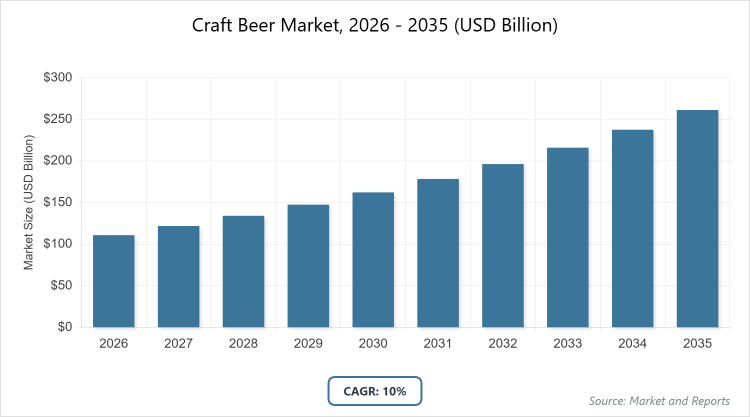
According to MarketnReports, the global Craft Beer market size was estimated at USD 110.8 billion in 2025 and is expected to reach USD 285.3 billion by 2035, growing at a CAGR of 10% from 2026 to 2035. Craft Beer Market is driven by increasing demand for unique flavors and health-conscious options like low-alcohol beers.
What are the Key Insights of the Craft Beer Market?
- The global craft beer market was valued at USD 110.8 billion in 2025 and is projected to reach USD 285.3 billion by 2035.
- The market is expected to grow at a CAGR of 10% from 2026 to 2035.
- The market is driven by rising consumer interest in unique flavors, health-conscious low-ABV options, and support for local breweries.
- The lager segment dominated the type category with a 35% share, owing to its refreshing, crisp taste and suitability for casual consumption.
- The on-trade segment dominated the distribution channel with a 57.4% share, driven by socializing trends in pubs and bars that enhance consumer experiences.
- Asia Pacific dominated the regional market with a 31.9% share, fueled by a young population experimenting with local-inspired flavors and international investments.
What is the Industry Overview of the Craft Beer Market?
The craft beer market encompasses small, independent breweries that emphasize traditional brewing methods, premium ingredients, and innovative flavor profiles to produce limited quantities of beer. This industry focuses on creativity, quality, and differentiation from mass-produced beers, appealing to consumers seeking unique experiences and artisanal products. Market definition refers to beers brewed by craft producers that prioritize experimentation, local sourcing, and distinct tastes, often distributed through specialized channels to build brand loyalty and community engagement.
What are the Market Dynamics in the Craft Beer Market?
Growth Drivers
The growth of the craft beer market is primarily propelled by increasing consumer demand for diverse and innovative flavors, as well as a shift toward health-conscious choices such as low-alcohol and non-alcoholic variants. Technological advancements in brewing processes and supply chain efficiencies have enabled brewers to experiment with premium ingredients, resulting in higher quality products that attract millennials and Gen Z consumers who value unique experiences and local support. Rising disposable incomes in emerging markets further encourage spending on premium beverages, while digital marketing and e-commerce expand reach, fostering global awareness and adoption of craft beers.
Restraints
Despite its growth, the craft beer market faces restraints from high production costs associated with premium ingredients and small-scale operations, which can limit scalability and profitability for independent brewers. Stringent government regulations on alcohol production, labeling, and distribution vary across regions, creating compliance challenges and barriers to entry for new players. Additionally, intense competition from large-scale beer corporations offering cheaper alternatives can erode market share, while supply chain disruptions, such as fluctuations in raw material prices for hops and grains, further hinder consistent growth and operational stability.
Opportunities
Opportunities in the craft beer market abound with the expansion into emerging regions like Asia Pacific, where international brewers are establishing local operations to tap into evolving consumer tastes for flavored and low-ABV options. Innovation in non-alcoholic craft beers caters to health trends, opening new segments for growth among non-drinkers and wellness-focused demographics. Partnerships, acquisitions, and collaborations allow companies to diversify portfolios and enter new markets, while the rise of on-trade channels through experiential venues like craft beer festivals and pop-up bars presents avenues to enhance brand visibility and consumer engagement.
Challenges
The craft beer market encounters challenges from evolving consumer preferences that demand constant innovation, putting pressure on brewers to balance creativity with cost management. Environmental concerns, including water usage and waste in brewing, require sustainable practices that may increase operational expenses. Market saturation in mature regions like North America leads to fierce competition among numerous microbreweries, making differentiation difficult, while economic uncertainties and inflationary pressures can reduce discretionary spending on premium products, impacting overall demand and profitability.
Craft Beer Market: Report Scope
| Report Attributes | Report Details |
| Report Name | Craft Beer Market |
| Market Size 2025 | USD 110.8 Billion |
| Market Forecast 2035 | USD 285.3 Billion |
| Growth Rate | CAGR of 10% |
| Report Pages | 216 |
| Key Companies Covered | D.G. Yuengling and Son Inc., The Boston Beer Company, The Gambrinus Company, Lagunitas Brewing Company, Sierra Nevada Brewing Co., New Belgium Brewing Company, Deschutes Brewery, Minhas Brewery, Chimay Beers And Cheeses, Omer Vander Ghinste, and Others |
| Segments Covered | By Type, By Distribution Channel, and By Region |
| Regions Covered | North America, Europe, Asia Pacific (APAC), Latin America, and The Middle East and Africa (MEA) |
| Base Year | 2025 |
| Historical Year | 2020 – 2024 |
| Forecast Year | 2026 – 2035 |
| Customization Scope | Avail customized purchase options to meet your exact research needs. |
What is the Market Segmentation of the Craft Beer Market?
The Craft Beer market is segmented by type, distribution channel, and region.
Based on Type Segment, the lager subsegment emerged as the most dominant, holding a significant share due to its crisp, refreshing profile and lower alcohol content that appeals to a broad audience in warm climates and casual settings; this dominance drives the market by enabling craft brewers to innovate with premium ingredients and unique twists, attracting health-conscious consumers and boosting overall sales volume. The ale subsegment ranked as the second most dominant, benefiting from its traditional nutritional properties, wide flavor variety, and strong bitter taste ideal for social gatherings; it contributes to market growth by offering versatility in experimentation, drawing in enthusiasts seeking premium experiences and supporting expansion through pubs and events.
Based on Distribution Channel Segment, the on-trade subsegment was the most dominant with a 57.4% share, encompassing pubs, bars, restaurants, and hotels that provide immersive customer experiences and higher pricing; this leads the market by capitalizing on socializing trends, fostering direct consumer interactions, and driving revenue through premium on-site consumption that enhances brand loyalty. The off-trade subsegment followed as the second most dominant, including supermarkets and liquor stores offering convenience and broader selection for home use; it propels the market by reaching a larger consumer base, enabling bulk purchases, and adapting to e-commerce trends that increase accessibility and support sustained growth in retail channels.
What are the Recent Developments in the Craft Beer Market?
- In August 2024, Tilray Brands Inc. acquired four craft breweries from Molson Coors Beverage Co., including Terrapin Beer Co., Hop Valley Brewing Co., Atwater Brewery, and Revolver Brewing, expanding its portfolio to 18 brands and strengthening its presence in the U.S. market.
- In April 2024, New Belgium Brewing collaborated with India’s Bira 91 to launch Tamarind Chutney Dubbel, a limited-edition beer featuring specialty malts, available in Bengaluru and Delhi NCR, highlighting cross-cultural flavor innovation.
- In February 2024, American Brew Crafts Pvt Ltd. introduced Flying Monkey, a Belgian-style craft beer, in Hyderabad, aiming to cater to evolving tastes in the Indian market with premium offerings.
- In August 2023, Lone Wolf released two new low-ABV variants, Mavrick (malt lager) and Alpha (Belgium Wit bier), launched in New Delhi, targeting health-conscious consumers with under 5% alcohol content.
What is the Regional Analysis of the Craft Beer Market?
- Asia Pacific to dominate the global market
Asia Pacific: This region leads the craft beer market with a 31.9% revenue share, driven by a youthful demographic eager for flavorful varieties and local ingredient integrations, such as spices and fruits inspired by cultural traditions; international companies are investing heavily in local production facilities to meet rising demand, with China dominating as the key country due to its massive population, rapid urbanization, and growing middle class that embraces premium imported and domestic craft options, further accelerated by e-commerce platforms and beer festivals promoting experimentation.
Europe: Europe is poised for significant growth, underpinned by its rich brewing heritage and consumer appreciation for quality, innovation, and variety in beer styles; millennials here are willing to invest in premium experiences, supporting local artisanal brewers, with Germany standing out as the dominating country thanks to its longstanding beer culture, strict purity laws that emphasize craftsmanship, and export strength that influences global trends, enabling sustained market expansion through festivals like Oktoberfest and advancements in sustainable brewing practices.
North America: North America maintains a strong position in the craft beer landscape, characterized by a mature market with numerous microbreweries focusing on bold flavors and community engagement; the region’s emphasis on independence and creativity attracts loyal consumers, with the United States as the dominating country, fueled by its vast number of craft breweries, supportive regulations for small producers, and cultural shifts toward local sourcing that drive innovation in IPAs and seasonal brews, contributing to robust domestic sales and exports.
Latin America: Latin America shows promising growth potential in craft beer, with increasing awareness and adoption among urban populations seeking alternatives to traditional lagers; the market benefits from local ingredient experimentation, such as tropical fruits, with Brazil dominating as the key country due to its large consumer base, vibrant nightlife scene, and rising disposable incomes that encourage premium purchases, supported by expanding distribution networks and collaborations with international brands to enhance variety.
Middle East and Africa (MEA): The MEA region is emerging in the craft beer sector, though growth is slower due to cultural and regulatory factors; opportunities arise from tourism and expatriate communities demanding diverse options, with South Africa leading as the dominating country through its established wine and beer culture, innovative local brewers incorporating African ingredients, and growing urban middle class that supports craft festivals and imports, gradually building market presence amid challenges like alcohol restrictions in some areas.
Who are the Key Market Players in the Craft Beer Market?
D.G. Yuengling and Son Inc. As America’s oldest brewery, this company focuses on producing light, premium beers, lagers, porters, and seasonal offerings, employing strategies like maintaining family-owned independence, emphasizing quality through traditional methods, and expanding distribution to build regional loyalty and compete with larger players.
The Boston Beer Company: This leading U.S. craft brewer offers a wide range of products worldwide, with strategies centered on innovation in flavors and branding, aggressive marketing through digital channels, and acquisitions to diversify its portfolio, driving growth by appealing to diverse consumer tastes and strengthening market position.
The Gambrinus Company: Known for importing and marketing specialty beers, its strategies include partnerships with international brewers, focus on premium positioning, and targeted distribution in key markets, which help in capturing niche segments and promoting unique European-style offerings to enhance brand recognition.
Lagunitas Brewing Company: This company emphasizes bold, hop-forward beers like IPAs, with strategies involving creative packaging, community events, and sustainability initiatives, enabling it to foster consumer engagement and expand globally through parent company Heineken’s resources while retaining craft authenticity.
Sierra Nevada Brewing Co.: A pioneer in American craft beer, it prioritizes sustainable practices and high-quality ingredients, using strategies such as vertical integration in supply chains, innovation in pale ales and seasonal brews, and direct-to-consumer sales to drive loyalty and environmental responsibility.
New Belgium Brewing Company: Focused on employee-owned operations and eco-friendly brewing, its strategies include flavor experimentation, collaborations like with Bira 91, and strong branding around social responsibility, which attract conscious consumers and support expansion into new markets.
Deschutes Brewery: This Oregon-based brewer specializes in balanced ales and lagers, employing strategies like local sourcing, limited-edition releases, and taproom experiences to build community ties and differentiate in a competitive landscape.
Minhas Brewery: Operating across North America, it uses cost-effective production and private-label strategies, alongside craft offerings, to target value-conscious segments while maintaining quality to broaden accessibility.
What are the Market Trends in the Craft Beer Market?
- Rising demand for low-ABV and non-alcoholic craft beers among health-conscious consumers.
- Increased experimentation with local ingredients and cultural flavors, especially in emerging markets.
- Growth in digital marketing and e-commerce for wider distribution and consumer reach.
- Emphasis on sustainable brewing practices and eco-friendly packaging to appeal to environmentally aware buyers.
- Acquisitions and partnerships among brewers to expand portfolios and enter new regions.
- Shift toward premium experiences in on-trade channels like pubs and festivals.
- Appeal to millennials and Gen Z through innovative branding and social media engagement.
What are the Market Segments and their Subsegments Covered in the Craft Beer Report?
By Type
- Ale
- Lager
- Pilsner
- Others (Sour, fruit and specialty)
By Distribution Channel
- On Trade
- Off Trade
- Others
By Region
- North America
- U.S.
- Canada
- Europe
- UK
- Germany
- France
- Rest of Europe
- Asia Pacific
- China
- India
- Japan
- Rest of Asia Pacific
- Latin America
- Brazil
- Mexico
- Rest of Latin America
- Middle East & Africa
- UAE
- South Africa
- Rest of Middle East & Africa
Chapter 1. Preface
1.1 Report Description and Scope1.2 Research Scope1.3 Research Methodology1.3.1 Market Research Type1.3.2 Market Research MethodologyChapter 2. Executive Summary
2.1 Global Craft Beer Market, (2026 - 2035) (USD Billion)2.2 Global Craft Beer Market: SnapshotChapter 3. Global Craft Beer Market - Industry Analysis
3.1 Craft Beer Market: Market Dynamics3.2 Market Drivers3.2.1 The craft beer market is growing due to rising demand for innovative flavors, health-conscious low/no-alcohol options, premium quality brewing, digital expansion, and increasing consumer spending power—especially among millennials and Gen Z.3.3 Market Restraints3.3.1 The craft beer market is constrained by high production costs, strict regulatory compliance, strong competition from low-cost mass producers, and supply chain volatility in key raw materials like hops and grains.3.4 Market Opportunities3.4.1 The craft beer market offers strong opportunities through expansion in emerging regions, growth of non-alcoholic and low-ABV innovations, strategic partnerships and acquisitions, and increased brand engagement via festivals, pop-ups, and experiential on-trade channels.3.5 Market Challenges3.5.1 The craft beer market faces challenges from rapid innovation demands, rising sustainability costs, intense competition in saturated markets, and economic pressures that reduce spending on premium products.3.6 Porter’s Five Forces Analysis3.7 Market Attractiveness Analysis3.7.1 Market Attractiveness Analysis By Type3.7.2 Market Attractiveness Analysis By Distribution ChannelChapter 4. Global Craft Beer Market- Competitive Landscape
4.1 Company Market Share Analysis4.1.1 Global Craft Beer Market: Company Market Share, 20254.2 Strategic Development4.2.1 Acquisitions & mergers4.2.2 New Product launches4.2.3 Agreements, partnerships, collaborations, and joint ventures4.2.4 Research and development and regional expansion4.3 Price Trend AnalysisChapter 5. Global Craft Beer Market - Type Analysis
5.1 Global Craft Beer Market Overview: Type5.1.1 Global Craft Beer Market share, By Type, 2025 and 20355.2 Ale5.2.1 Global Craft Beer Market by Ale, 2026 - 2035 (USD Billion)5.3 Lager5.3.1 Global Craft Beer Market by Lager, 2026 - 2035 (USD Billion)5.4 Pilsner5.4.1 Global Craft Beer Market by Pilsner, 2026 - 2035 (USD Billion)5.5 Stout5.5.1 Global Craft Beer Market by Stout, 2026 - 2035 (USD Billion)5.6 Porter5.6.1 Global Craft Beer Market by Porter, 2026 - 2035 (USD Billion)5.7 IPA5.7.1 Global Craft Beer Market by IPA, 2026 - 2035 (USD Billion)5.8 Wheat Beer5.8.1 Global Craft Beer Market by Wheat Beer, 2026 - 2035 (USD Billion)5.9 Saison5.9.1 Global Craft Beer Market by Saison, 2026 - 2035 (USD Billion)5.10 Sour Beer5.10.1 Global Craft Beer Market by Sour Beer, 2026 - 2035 (USD Billion)5.11 Fruit Beer5.11.1 Global Craft Beer Market by Fruit Beer, 2026 - 2035 (USD Billion)Chapter 6. Global Craft Beer Market - Distribution Channel Analysis
6.1 Global Craft Beer Market Overview: Distribution Channel6.1.1 Global Craft Beer Market Share, By Distribution Channel, 2025 and 20356.2 On Trade6.2.1 Global Craft Beer Market by On Trade, 2026 - 2035 (USD Billion)6.3 Off Trade6.3.1 Global Craft Beer Market by Off Trade, 2026 - 2035 (USD Billion)6.4 Others6.4.1 Global Craft Beer Market by Others, 2026 - 2035 (USD Billion)Chapter 7. Craft Beer Market - Regional Analysis
7.1 Global Craft Beer Market Regional Overview7.2 Global Craft Beer Market Share, by Region, 2025 & 2035 (USD Billion)7.3 North America7.3.1 North America Craft Beer Market, 2026 - 2035 (USD Billion)7.3.1.1 North America Craft Beer Market, by Country, 2026 - 2035 (USD Billion)7.3.2 North America Craft Beer Market, by Type, 2026 - 20357.3.2.1 North America Craft Beer Market, by Type, 2026 - 2035 (USD Billion)7.3.3 North America Craft Beer Market, by Distribution Channel, 2026 - 20357.3.3.1 North America Craft Beer Market, by Distribution Channel, 2026 - 2035 (USD Billion)7.4 Europe7.4.1 Europe Craft Beer Market, 2026 - 2035 (USD Billion)7.4.1.1 Europe Craft Beer Market, by Country, 2026 - 2035 (USD Billion)7.4.2 Europe Craft Beer Market, by Type, 2026 - 20357.4.2.1 Europe Craft Beer Market, by Type, 2026 - 2035 (USD Billion)7.4.3 Europe Craft Beer Market, by Distribution Channel, 2026 - 20357.4.3.1 Europe Craft Beer Market, by Distribution Channel, 2026 - 2035 (USD Billion)7.5 Asia Pacific7.5.1 Asia Pacific Craft Beer Market, 2026 - 2035 (USD Billion)7.5.1.1 Asia Pacific Craft Beer Market, by Country, 2026 - 2035 (USD Billion)7.5.2 Asia Pacific Craft Beer Market, by Type, 2026 - 20357.5.2.1 Asia Pacific Craft Beer Market, by Type, 2026 - 2035 (USD Billion)7.5.3 Asia Pacific Craft Beer Market, by Distribution Channel, 2026 - 20357.5.3.1 Asia Pacific Craft Beer Market, by Distribution Channel, 2026 - 2035 (USD Billion)7.6 Latin America7.6.1 Latin America Craft Beer Market, 2026 - 2035 (USD Billion)7.6.1.1 Latin America Craft Beer Market, by Country, 2026 - 2035 (USD Billion)7.6.2 Latin America Craft Beer Market, by Type, 2026 - 20357.6.2.1 Latin America Craft Beer Market, by Type, 2026 - 2035 (USD Billion)7.6.3 Latin America Craft Beer Market, by Distribution Channel, 2026 - 20357.6.3.1 Latin America Craft Beer Market, by Distribution Channel, 2026 - 2035 (USD Billion)7.7 The Middle-East and Africa7.7.1 The Middle-East and Africa Craft Beer Market, 2026 - 2035 (USD Billion)7.7.1.1 The Middle-East and Africa Craft Beer Market, by Country, 2026 - 2035 (USD Billion)7.7.2 The Middle-East and Africa Craft Beer Market, by Type, 2026 - 20357.7.2.1 The Middle-East and Africa Craft Beer Market, by Type, 2026 - 2035 (USD Billion)7.7.3 The Middle-East and Africa Craft Beer Market, by Distribution Channel, 2026 - 20357.7.3.1 The Middle-East and Africa Craft Beer Market, by Distribution Channel, 2026 - 2035 (USD Billion)Chapter 8. Company Profiles
8.1 D.G. Yuengling and Son Inc.8.1.1 Overview8.1.2 Financials8.1.3 Product Portfolio8.1.4 Business Strategy8.1.5 Recent Developments8.2 The Boston Beer Company8.2.1 Overview8.2.2 Financials8.2.3 Product Portfolio8.2.4 Business Strategy8.2.5 Recent Developments8.3 The Gambrinus Company8.3.1 Overview8.3.2 Financials8.3.3 Product Portfolio8.3.4 Business Strategy8.3.5 Recent Developments8.4 Lagunitas Brewing Company8.4.1 Overview8.4.2 Financials8.4.3 Product Portfolio8.4.4 Business Strategy8.4.5 Recent Developments8.5 Sierra Nevada Brewing Co.8.5.1 Overview8.5.2 Financials8.5.3 Product Portfolio8.5.4 Business Strategy8.5.5 Recent Developments8.6 New Belgium Brewing Company8.6.1 Overview8.6.2 Financials8.6.3 Product Portfolio8.6.4 Business Strategy8.6.5 Recent Developments8.7 Deschutes Brewery8.7.1 Overview8.7.2 Financials8.7.3 Product Portfolio8.7.4 Business Strategy8.7.5 Recent Developments8.8 Minhas Brewery8.8.1 Overview8.8.2 Financials8.8.3 Product Portfolio8.8.4 Business Strategy8.8.5 Recent Developments8.9 Chimay Beers And Cheeses8.9.1 Overview8.9.2 Financials8.9.3 Product Portfolio8.9.4 Business Strategy8.9.5 Recent Developments8.10 Omer Vander Ghinste8.10.1 Overview8.10.2 Financials8.10.3 Product Portfolio8.10.4 Business Strategy8.10.5 Recent Developments
Frequently Asked Questions
Craft beers are small-batch beverages produced by independent breweries using traditional methods, premium ingredients, and innovative techniques to create unique flavors, distinguishing them from mass-produced beers.
Key factors include demand for unique flavors, health-conscious low-ABV options, technological advancements in brewing, rising disposable incomes, and expansion in emerging markets like Asia Pacific.
The market is projected to grow from over USD 110.8 billion in 2025 to USD 285.3 billion by 2035.
The CAGR is expected to be 10%.
Asia Pacific will contribute notably, driven by its large young population and flavor innovations.
Major players include D.G. Yuengling and Son, Inc., The Boston Beer Company, The Gambrinus Company, Lagunitas Brewing Company, Sierra Nevada Brewing Co., New Belgium Brewing Company, Deschutes Brewery, and Minhas Brewery.
The report provides comprehensive analysis, including market size, trends, segmentation, regional insights, key players, and forecasts.
Stages include raw material sourcing (hops, grains), brewing and fermentation, packaging, distribution through channels, and retail or on-site consumption.
Trends are shifting toward sustainable practices, low-alcohol options, and local flavor integrations, with consumers preferring premium, experiential products over standard beers.
Regulatory factors include alcohol licensing and labeling laws, while environmental factors involve water conservation and sustainable sourcing pressures impacting production costs.