
Cosmetic Products Market Size, Share and Trends 2026 to 2035
According to MarketnReports, the global Cosmetic Products market size was estimated at USD 331.4 billion in 2025 and is expected to reach USD 470.8 billion by 2035, growing at a CAGR of 3.57% from 2026 to 2035. Cosmetic Products Market is driven by increasing demand for natural and organic products along with the rise of e-commerce platforms.
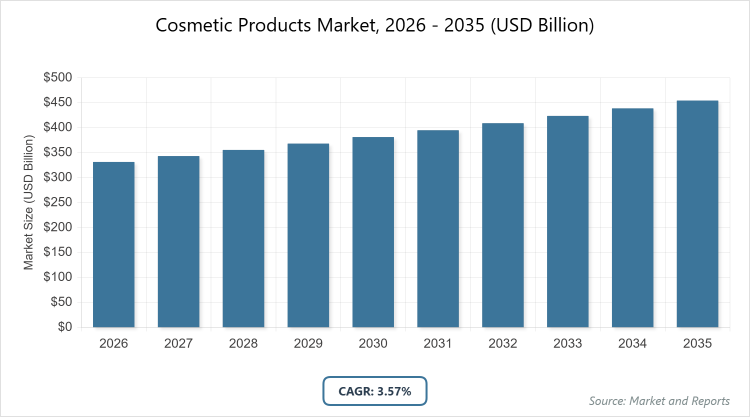
What are the Key Insights into the Cosmetic Products Market?
- The global Cosmetic Products market was valued at USD 331.4 billion in 2025 and is projected to reach USD 470.8 billion by 2035.
- The market is anticipated to grow at a CAGR of 3.57% during the forecast period from 2026 to 2035.
- The market is driven by the rise of e-commerce platforms, expansion of men’s grooming products, and growing demand for natural and organic ingredients.
- Dominated subsegment of product type: Skincare with 39% share because it caters to essential consumer needs like skin protection, hydration, and anti-aging, making it a staple in daily routines and driving overall market growth through innovation in formulations.
- Dominated subsegment of gender: Female with 70% share because women traditionally represent the primary consumers of beauty and personal care items, with high demand for diverse products like makeup and skincare that align with fashion trends and self-expression.
- Dominated subsegment of distribution channel: Offline with 70% share because it offers hands-on experiences such as product testing and personalized consultations in retail and specialty stores, which build consumer trust and loyalty in purchasing decisions.
- Dominated region: North America with 35% share because of its advanced innovation ecosystem, high disposable incomes, and strong presence of leading brands that continuously introduce premium and tech-integrated products.
What is the Industry Overview of the Cosmetic Products Market?
The Cosmetic Products Market refers to the industry involved in the production, distribution, and sale of items designed to enhance personal appearance and hygiene, encompassing a wide array of goods that cater to beauty, grooming, and self-care needs. This market includes everything from everyday essentials to luxury items, reflecting cultural, social, and technological influences on consumer behavior. It is defined as the global ecosystem where manufacturers develop formulations using ingredients like botanicals, chemicals, and synthetics to create products that address diverse skin types, hair concerns, and aesthetic preferences. The industry thrives on innovation, with brands constantly evolving to meet shifting ideals of beauty, inclusivity, and wellness, while navigating supply chains from raw material sourcing to end-consumer retail. At its core, the market serves as a bridge between personal identity and commercial enterprise, fostering trends that promote confidence and self-expression across demographics.
What are the Market Dynamics in the Cosmetic Products Market?
Growth Drivers
The growth of the Cosmetic Products Market is propelled by several interconnected factors that align with modern consumer lifestyles. The surge in e-commerce has revolutionized accessibility, allowing brands to reach global audiences with personalized recommendations and convenient delivery, thereby expanding market penetration especially in remote areas. Additionally, the expansion of men’s grooming products has opened new revenue streams, as societal norms evolve to encourage male participation in beauty routines, boosting demand for specialized items like beard care and skincare. Furthermore, the increasing preference for natural and organic ingredients resonates with health-conscious consumers seeking safer, eco-friendly options free from harmful chemicals, driving brands to innovate in clean beauty formulations. Social media and influencer marketing play a pivotal role by shaping trends and fostering community engagement, while technological advancements such as AI-driven personalization enhance product efficacy and customer satisfaction, collectively fueling sustained market expansion.
Restraints
The Cosmetic Products Market faces notable restraints that could hinder its progress if not addressed strategically. Intense competition from both established giants and emerging indie brands creates pricing pressures and market saturation, making it challenging for players to differentiate their offerings. Shifting consumer preferences towards sustainability can restrain traditional products that rely on non-eco-friendly packaging or synthetic ingredients, leading to potential sales declines for non-compliant lines. Additionally, economic fluctuations and inflationary trends impact disposable incomes, particularly in developing regions, reducing spending on non-essential beauty items. Supply chain disruptions, including raw material shortages or logistical issues, further exacerbate costs and availability, while counterfeit products erode brand trust and revenue. These factors collectively pose barriers to growth, requiring companies to adapt through cost optimization and robust quality controls.
Opportunities
The Cosmetic Products Market presents abundant opportunities for innovation and expansion amid evolving global trends. The rise of personalized skincare solutions, powered by AI and data analytics, allows brands to offer tailored products that meet individual needs, capturing a premium segment and enhancing customer loyalty. Eco-friendly packaging and sustainable practices open doors for differentiation, appealing to environmentally aware consumers and enabling entry into green markets with higher margins. Investment in augmented reality for virtual try-ons can revolutionize online shopping, reducing return rates and boosting e-commerce sales. Emerging markets in Asia-Pacific and Middle East offer untapped potential due to rising urbanization and youth populations, where niche segments like halal or vegan cosmetics can thrive. Moreover, partnerships with influencers and tech firms can amplify brand visibility, while exploring men’s and unisex lines provides avenues for diversification, positioning companies for long-term profitability.
Challenges
The Cosmetic Products Market encounters significant challenges that demand agile responses from industry stakeholders. Regulatory changes across regions, particularly stringent standards in Europe on product safety and environmental impact, require constant compliance efforts that increase operational costs and delay product launches. Competition from emerging brands disrupts market share, as they leverage digital platforms to offer affordable, trendy alternatives, challenging established players to innovate rapidly. Ethical sourcing of ingredients poses difficulties, with sustainability concerns leading to supply shortages and higher prices for natural components. Adapting to fragmented supply chains, especially post-pandemic, involves optimizing logistics to minimize disruptions and maintain efficiency. Addressing consumer skepticism around claims like “cruelty-free” or “organic” necessitates transparent verification processes, while balancing affordability with quality in price-sensitive markets adds complexity, ultimately testing the resilience of market participants.
Cosmetic Products Market: Report Scope
| Report Attributes | Report Details |
| Report Name | Cosmetic Products Market |
| Market Size 2025 | USD 331.4 Billion |
| Market Forecast 2035 | USD 470.8 Billion |
| Growth Rate | CAGR of 3.57% |
| Report Pages | 218 |
| Key Companies Covered |
L’Oreal, Unilever, Estée Lauder, Procter & Gamble, Coty, and Others |
| Segments Covered | By Product Type, By Gender, By Distribution Channel, and By Region |
| Regions Covered | North America, Europe, Asia Pacific (APAC), Latin America, and The Middle East and Africa (MEA) |
| Base Year | 2025 |
| Historical Year | 2020 – 2024 |
| Forecast Year | 2026 – 2035 |
| Customization Scope | Avail customized purchase options to meet your exact research needs. |
How is the Market Segmentation Structured in the Cosmetic Products Market?
The Cosmetic Products market is segmented by product type, gender, distribution channel, and region.
Based on Product Type Segment. The most dominant segment is Skincare, accounting for the largest share due to its essential role in daily routines focused on health and prevention, such as moisturizers and sunscreens that protect against environmental damage; this dominance drives the market by encouraging repeated purchases and innovation in anti-aging and dermatological solutions, contributing to overall revenue growth through high consumer loyalty and premium pricing. The second most dominant is Makeup, which appeals to expressive and trend-driven consumers with products like foundations and lipsticks that enable personalization and social media sharing; it helps drive the market by attracting younger demographics and fostering seasonal trends that boost sales volumes and brand collaborations.
Based on Gender Segment. The most dominant segment is Female, holding the majority share as it encompasses a broad range of products tailored to women’s beauty standards, including comprehensive lines for skincare and color cosmetics that align with fashion and self-care trends; this dominance propels market growth by leveraging high spending power and cultural emphasis on appearance, leading to diverse product developments and marketing campaigns targeted at empowerment. The second most dominant is Male, gaining traction with grooming essentials like shavers and aftershaves that cater to increasing acceptance of men’s beauty routines; it contributes to market expansion by tapping into untapped male consumers, promoting inclusivity, and creating new categories that enhance overall industry diversity and revenue potential.
Based on Distribution Channel Segment. The most dominant segment is Offline, comprising retail and specialty stores that provide tactile experiences and expert advice, such as in-store trials and consultations; this dominance supports market growth by building trust and immediate gratification, encouraging impulse buys and loyalty programs that sustain foot traffic and brand presence. The second most dominant is Online, facilitated by e-commerce platforms offering convenience and vast selections with features like reviews and virtual tools; it drives the market by expanding global reach, enabling data-driven personalization, and accelerating sales through digital marketing, particularly among tech-savvy younger buyers.
What are the Recent Developments in the Cosmetic Products Market?
- L’Oreal partnered with a tech firm for AI in product development in August 2025. This collaboration aims to enhance personalized beauty solutions, integrating data analytics to create customized skincare regimens that improve efficacy and consumer satisfaction, marking a step towards tech-infused innovation in the industry.
- Unilever launched an eco-friendly product line in September 2025. Focusing on sustainable sourcing and biodegradable packaging, this initiative addresses consumer demand for green alternatives, strengthening the brand’s commitment to environmental responsibility and potentially increasing market share in the clean beauty segment.
- Estée Lauder unveiled an AR platform for virtual try-ons in October 2025. This technology allows users to test products digitally, reducing barriers in online shopping and enhancing engagement, which could drive e-commerce sales and set a new standard for interactive consumer experiences.
- Coty merged with KKW Beauty in May 2023. This strategic move expanded Coty’s luxury portfolio, incorporating celebrity-driven lines that appeal to younger audiences, boosting brand visibility and diversifying offerings in the competitive makeup category.
- Estée Lauder acquired Dr. Jart+ in August 2023. The acquisition bolsters Estée Lauder’s skincare expertise, integrating innovative Korean beauty formulations to cater to global demands for advanced, dermatologist-approved products.
How Does the Regional Analysis Look in the Cosmetic Products Market?
- North America to dominate the global market
North America leads the Cosmetic Products Market with a significant share, driven by robust innovation and high consumer spending power. The United States dominates this region, thanks to its concentration of major brands, advanced R&D facilities, and a culture that emphasizes premium beauty and wellness products. Canada contributes through its focus on natural ingredients and inclusive offerings, while the region’s e-commerce boom and social media influence further accelerate growth, making it a hub for trends like clean beauty and personalized solutions that shape global standards.
Europe holds a strong position in the market, characterized by stringent regulations and a preference for sustainable practices. Germany dominates, with its emphasis on high-quality, organic formulations and engineering precision in product development. France and the United Kingdom follow closely, renowned for luxury fragrances and skincare innovations, respectively; the region’s commitment to eco-friendly packaging and cruelty-free standards drives consumer loyalty, positioning Europe as a leader in ethical beauty that influences international policies and trends.
Asia-Pacific emerges as the fastest-growing region, fueled by urbanization and rising middle-class incomes. China dominates, with its massive population and booming e-commerce platforms that facilitate rapid adoption of beauty trends. Japan and South Korea contribute significantly through K-beauty and J-beauty innovations, such as advanced skincare technologies and multifunctional products; the region’s youthful demographics and social media savvy consumers propel demand for affordable, trendy items, making it a key area for market expansion and cultural export of beauty ideals.
Latin America shows promising growth potential, supported by diverse cultural influences and increasing beauty awareness. Brazil dominates, with its vibrant market for haircare and body products aligned with tropical climates and festive traditions. Mexico adds to the momentum through affordable cosmetics and growing online sales; the region’s focus on natural ingredients from local sources like botanicals enhances appeal, though economic variability poses challenges, overall driving opportunities for accessible and inclusive product lines.
Middle East and Africa represents an emerging frontier with untapped opportunities from young populations and rising urbanization. The United Arab Emirates dominates, leveraging its luxury retail hubs and affluent consumers interested in high-end fragrances and skincare. South Africa contributes with its diverse market for inclusive products addressing varied skin tones; the region’s cultural emphasis on grooming and increasing disposable incomes foster growth, particularly in halal-certified and sustainable options, positioning it for future expansion amid infrastructural developments.
Who are the Key Market Players in the Cosmetic Products Market?
L’Oreal employs strategies centered on innovation and digital transformation, investing heavily in R&D for personalized products and AI integrations to meet diverse consumer needs. The company focuses on sustainability by sourcing ethical ingredients and expanding its portfolio through acquisitions, enabling it to maintain leadership in skincare and makeup segments while enhancing global market presence via influencer partnerships.
Unilever prioritizes sustainability and inclusivity in its strategies, launching eco-friendly lines and committing to zero-waste goals to appeal to conscious consumers. By optimizing supply chains and leveraging digital marketing, the company strengthens its position in personal care and haircare, fostering growth through community engagement and affordable pricing models that cater to emerging markets.
Estée Lauder adopts a premium branding approach, utilizing AR technologies for virtual experiences and acquiring niche brands to diversify its offerings. The company’s focus on luxury skincare and e-commerce expansion drives revenue, with strategies emphasizing data analytics for targeted campaigns that build loyalty among high-end consumers worldwide.
Procter & Gamble leverages its broad consumer goods expertise, implementing innovation in product formulations and marketing through data-driven insights. Strategies include partnerships for tech enhancements and sustainability initiatives, positioning the company strongly in everyday beauty essentials and enabling market penetration in both developed and developing regions.
Coty focuses on luxury and celebrity collaborations, expanding through mergers like with KKW Beauty to capture younger demographics. The company’s strategies involve digital channels and portfolio restructuring to emphasize high-margin products, driving growth in fragrances and makeup while navigating competitive landscapes effectively.
Shiseido targets Asia-Pacific dominance with strategies rooted in cultural relevance and advanced R&D for skincare innovations. By integrating sustainability and e-commerce, the company expands globally, using data to personalize offerings and strengthen its position in premium segments through strategic alliances.
Revlon employs brand restructuring and cost optimization strategies to revive its portfolio, focusing on affordable makeup and haircare. Through digital marketing and influencer ties, the company aims to regain market share, emphasizing inclusivity to appeal to diverse consumers in a dynamic industry.
Beiersdorf concentrates on dermatological expertise, developing skin-focused products with clinical backing. Strategies include sustainable sourcing and global expansion, enhancing its Nivea brand’s reach and driving growth through innovation in health-oriented cosmetics.
Avon revitalizes its direct selling model with e-commerce integration, focusing on empowerment and affordable access. Strategies involve community building and product diversification, enabling penetration in emerging markets and sustaining loyalty among female consumers.
Mary Kay maintains a direct sales approach, emphasizing entrepreneurship and personalized service. The company’s strategies include digital tools for virtual consultations and sustainability efforts, supporting growth in color cosmetics and skincare through a network of independent consultants.
What are the Market Trends in the Cosmetic Products Market?
- Shift towards natural, organic, and cruelty-free formulations to align with consumer health and ethical concerns.
- Emphasis on sustainability in sourcing, packaging, and production, including biodegradable materials and refillable options.
- Rise of inclusivity, with products catering to diverse skin tones, genders, and cultural preferences.
- Integration of digital technologies like AR, AI, and social media for enhanced consumer engagement and personalization.
- Growth in clean beauty and wellness-oriented products that combine beauty with health benefits.
What Market Segments and Their Subsegments are Covered in the Cosmetic Products Report?
By Product Type
- Skincare
- Makeup
- Fragrance
- Haircare
- Personal Care
- Others
By Gender
- Female
- Male
- Unisex
- Others
By Distribution Channel
- Online
- Offline
- Others
By Region
- North America
- U.S.
- Canada
- Europe
- UK
- Germany
- France
- Rest of Europe
- Asia Pacific
- China
- India
- Japan
- Rest of Asia Pacific
- Latin America
- Brazil
- Mexico
- Rest of Latin America
- Middle East & Africa
- UAE
- South Africa
- Rest of Middle East & Africa
Chapter 1. Preface
1.1 Report Description and Scope1.2 Research Scope1.3 Research Methodology1.3.1 Market Research Type1.3.2 Market Research MethodologyChapter 2. Executive Summary
2.1 Global Cosmetic Products Market, (2026 - 2035) (USD Billion)2.2 Global Cosmetic Products Market: SnapshotChapter 3. Global Cosmetic Products Market - Industry Analysis
3.1 Cosmetic Products Market: Market Dynamics3.2 Market Drivers3.2.1 The Cosmetic Products Market is growing due to e-commerce expansion, rising men’s grooming demand, preference for natural and organic ingredients, social media influence, and AI-driven personalization enhancing customer experience.3.3 Market Restraints3.3.1 The Cosmetic Products Market is restrained by intense competition, shifting sustainability preferences, economic fluctuations, supply chain disruptions, and counterfeit products that threaten brand trust and profitability.3.4 Market Opportunities3.4.1 The Cosmetic Products Market offers opportunities through AI-driven personalized skincare, sustainable packaging, AR-enabled virtual try-ons, emerging market expansion, influencer partnerships, and growth in men’s and unisex product lines.3.5 Market Challenges3.5.1 The Cosmetic Products Market faces challenges from stringent regulations, rising competition from digital-native brands, ethical sourcing and sustainability pressures, fragmented supply chains, consumer skepticism, and the need to balance quality with affordability.3.6 Porter’s Five Forces Analysis3.7 Market Attractiveness Analysis3.7.1 Market Attractiveness Analysis By Product Type3.7.2 Market Attractiveness Analysis By Gender3.7.3 Market Attractiveness Analysis By Distribution ChannelChapter 4. Global Cosmetic Products Market- Competitive Landscape
4.1 Company Market Share Analysis4.1.1 Global Cosmetic Products Market: Company Market Share, 20254.2 Strategic Development4.2.1 Acquisitions & mergers4.2.2 New Product launches4.2.3 Agreements, partnerships, collaborations, and joint ventures4.2.4 Research and development and regional expansion4.3 Price Trend AnalysisChapter 5. Global Cosmetic Products Market - Product Type Analysis
5.1 Global Cosmetic Products Market Overview: Product Type5.1.1 Global Cosmetic Products Market share, By Product Type, 2025 and 20355.2 Skincare5.2.1 Global Cosmetic Products Market by Skincare, 2026 - 2035 (USD Billion)5.3 Makeup5.3.1 Global Cosmetic Products Market by Makeup, 2026 - 2035 (USD Billion)5.4 Fragrance5.4.1 Global Cosmetic Products Market by Fragrance, 2026 - 2035 (USD Billion)5.5 Haircare5.5.1 Global Cosmetic Products Market by Haircare, 2026 - 2035 (USD Billion)5.6 Personal Care5.6.1 Global Cosmetic Products Market by Personal Care, 2026 - 2035 (USD Billion)5.7 Others5.7.1 Global Cosmetic Products Market by Others, 2026 - 2035 (USD Billion)Chapter 6. Global Cosmetic Products Market - Gender Analysis
6.1 Global Cosmetic Products Market Overview: Gender6.1.1 Global Cosmetic Products Market Share, By Gender, 2025 and 20356.2 Female6.2.1 Global Cosmetic Products Market by Female, 2026 - 2035 (USD Billion)6.3 Male6.3.1 Global Cosmetic Products Market by Male, 2026 - 2035 (USD Billion)6.4 Unisex6.4.1 Global Cosmetic Products Market by Unisex, 2026 - 2035 (USD Billion)6.5 Others6.5.1 Global Cosmetic Products Market by Others, 2026 - 2035 (USD Billion)Chapter 7. Global Cosmetic Products Market - Distribution Channel Analysis
7.1 Global Cosmetic Products Market Overview: Distribution Channel7.1.1 Global Cosmetic Products Market Share, By Distribution Channel, 2025 and 20357.2 Online7.2.1 Global Cosmetic Products Market by Online, 2026 - 2035 (USD Billion)7.3 Offline7.3.1 Global Cosmetic Products Market by Offline, 2026 - 2035 (USD Billion)7.4 Others7.4.1 Global Cosmetic Products Market by Others, 2026 - 2035 (USD Billion)Chapter 8. Cosmetic Products Market - Regional Analysis
8.1 Global Cosmetic Products Market Regional Overview8.2 Global Cosmetic Products Market Share, by Region, 2025 & 2035 (USD Billion)8.3 North America8.3.1 North America Cosmetic Products Market, 2026 - 2035 (USD Billion)8.3.1.1 North America Cosmetic Products Market, by Country, 2026 - 2035 (USD Billion)8.3.2 North America Cosmetic Products Market, by Product Type, 2026 - 20358.3.2.1 North America Cosmetic Products Market, by Product Type, 2026 - 2035 (USD Billion)8.3.3 North America Cosmetic Products Market, by Gender, 2026 - 20358.3.3.1 North America Cosmetic Products Market, by Gender, 2026 - 2035 (USD Billion)8.3.4 North America Cosmetic Products Market, by Distribution Channel, 2026 - 20358.3.4.1 North America Cosmetic Products Market, by Distribution Channel, 2026 - 2035 (USD Billion)8.4 Europe8.4.1 Europe Cosmetic Products Market, 2026 - 2035 (USD Billion)8.4.1.1 Europe Cosmetic Products Market, by Country, 2026 - 2035 (USD Billion)8.4.2 Europe Cosmetic Products Market, by Product Type, 2026 - 20358.4.2.1 Europe Cosmetic Products Market, by Product Type, 2026 - 2035 (USD Billion)8.4.3 Europe Cosmetic Products Market, by Gender, 2026 - 20358.4.3.1 Europe Cosmetic Products Market, by Gender, 2026 - 2035 (USD Billion)8.4.4 Europe Cosmetic Products Market, by Distribution Channel, 2026 - 20358.4.4.1 Europe Cosmetic Products Market, by Distribution Channel, 2026 - 2035 (USD Billion)8.5 Asia Pacific8.5.1 Asia Pacific Cosmetic Products Market, 2026 - 2035 (USD Billion)8.5.1.1 Asia Pacific Cosmetic Products Market, by Country, 2026 - 2035 (USD Billion)8.5.2 Asia Pacific Cosmetic Products Market, by Product Type, 2026 - 20358.5.2.1 Asia Pacific Cosmetic Products Market, by Product Type, 2026 - 2035 (USD Billion)8.5.3 Asia Pacific Cosmetic Products Market, by Gender, 2026 - 20358.5.3.1 Asia Pacific Cosmetic Products Market, by Gender, 2026 - 2035 (USD Billion)8.5.4 Asia Pacific Cosmetic Products Market, by Distribution Channel, 2026 - 20358.5.4.1 Asia Pacific Cosmetic Products Market, by Distribution Channel, 2026 - 2035 (USD Billion)8.6 Latin America8.6.1 Latin America Cosmetic Products Market, 2026 - 2035 (USD Billion)8.6.1.1 Latin America Cosmetic Products Market, by Country, 2026 - 2035 (USD Billion)8.6.2 Latin America Cosmetic Products Market, by Product Type, 2026 - 20358.6.2.1 Latin America Cosmetic Products Market, by Product Type, 2026 - 2035 (USD Billion)8.6.3 Latin America Cosmetic Products Market, by Gender, 2026 - 20358.6.3.1 Latin America Cosmetic Products Market, by Gender, 2026 - 2035 (USD Billion)8.6.4 Latin America Cosmetic Products Market, by Distribution Channel, 2026 - 20358.6.4.1 Latin America Cosmetic Products Market, by Distribution Channel, 2026 - 2035 (USD Billion)8.7 The Middle-East and Africa8.7.1 The Middle-East and Africa Cosmetic Products Market, 2026 - 2035 (USD Billion)8.7.1.1 The Middle-East and Africa Cosmetic Products Market, by Country, 2026 - 2035 (USD Billion)8.7.2 The Middle-East and Africa Cosmetic Products Market, by Product Type, 2026 - 20358.7.2.1 The Middle-East and Africa Cosmetic Products Market, by Product Type, 2026 - 2035 (USD Billion)8.7.3 The Middle-East and Africa Cosmetic Products Market, by Gender, 2026 - 20358.7.3.1 The Middle-East and Africa Cosmetic Products Market, by Gender, 2026 - 2035 (USD Billion)8.7.4 The Middle-East and Africa Cosmetic Products Market, by Distribution Channel, 2026 - 20358.7.4.1 The Middle-East and Africa Cosmetic Products Market, by Distribution Channel, 2026 - 2035 (USD Billion)Chapter 9. Company Profiles
9.1 L'Oreal9.1.1 Overview9.1.2 Financials9.1.3 Product Portfolio9.1.4 Business Strategy9.1.5 Recent Developments9.2 Unilever9.2.1 Overview9.2.2 Financials9.2.3 Product Portfolio9.2.4 Business Strategy9.2.5 Recent Developments9.3 Estée Lauder9.3.1 Overview9.3.2 Financials9.3.3 Product Portfolio9.3.4 Business Strategy9.3.5 Recent Developments9.4 Procter & Gamble9.4.1 Overview9.4.2 Financials9.4.3 Product Portfolio9.4.4 Business Strategy9.4.5 Recent Developments9.5 Coty9.5.1 Overview9.5.2 Financials9.5.3 Product Portfolio9.5.4 Business Strategy9.5.5 Recent Developments
Frequently Asked Questions
Cosmetic Products are items designed to enhance personal appearance, hygiene, and grooming, including categories like skincare, makeup, fragrances, haircare, and personal care formulations used for beautification and self-expression.
Key factors include the rise of e-commerce, demand for natural and organic ingredients, expansion of men's grooming, social media influence, and technological advancements like AI for personalization.
The Cosmetic Products market is expected to grow from approximately USD 331.4 billion in 2025 to USD 470.8 billion by 2035.
The CAGR value will be 3.57% during 2026-2035.
North America will contribute notably, holding around 35% of the market value due to innovation and high consumer spending.
Major players include L'Oreal, Unilever, Estée Lauder, Procter & Gamble, Coty, Shiseido, Revlon, Beiersdorf, Avon, and Mary Kay.
The report provides revenue forecasts, competitive landscape analysis, growth factors, market trends, segmentation details, regional insights, and strategic recommendations for stakeholders.
The value chain includes raw material sourcing, product formulation and manufacturing, packaging, distribution through channels like retail and online, marketing and branding, and end-consumer usage and feedback.
Market trends are evolving towards sustainability, clean beauty, and digital integration, while consumer preferences shift to personalized, inclusive, and eco-friendly products influenced by social media and wellness focus.
Regulatory factors include stringent safety standards in Europe and bans on animal testing, while environmental factors involve demands for sustainable sourcing, reduced plastic use, and compliance with eco-labels impacting production and innovation.