
Corporate Wellness Market Size, Share and Trends 2026 to 2035
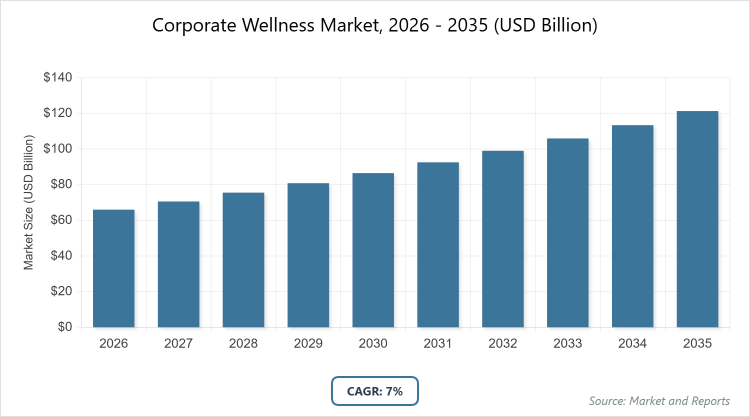
According to MarketnReports, the global Corporate Wellness Market size was estimated at USD 66 Billion in 2025 and is expected to reach USD 133 Billion by 2035, growing at a CAGR of 7% from 2026 to 2035. Corporate Wellness Market is driven by increasing employer focus on employee health and productivity to reduce healthcare costs.
What is the Industry Overview of Corporate Wellness Market?
The corporate wellness market encompasses programs and services designed to promote health and well-being among employees in organizational settings. This market includes a range of initiatives aimed at preventing illness, enhancing physical and mental health, and improving overall quality of life for workers. Market definition refers to the structured provision of health assessments, fitness activities, nutritional guidance, stress management, and other supportive services by employers or third-party providers to foster a healthier workforce and mitigate workplace-related health risks.
What are the Key Insights into Corporate Wellness Market?
- The global corporate wellness market was valued at USD 66 billion in 2025 and is projected to reach USD 133 billion by 2035.
- The market is expected to grow at a CAGR of 7% during the forecast period from 2026 to 2035.
- The market is driven by rising healthcare costs, increasing awareness of employee mental health, and the need for improved productivity and retention.
- Health risk assessment dominates the service segment with a 22% share due to its role in identifying early health risks and enabling targeted interventions that reduce long-term medical expenses for employers.
- Large scale organizations dominate the end-user segment with a 60% share as they have the resources to implement comprehensive programs that yield measurable ROI through reduced absenteeism and enhanced employee engagement.
- North America dominates the regional segment with a 40% share owing to advanced healthcare infrastructure, supportive regulations like the Affordable Care Act, and high adoption rates among corporations focused on cost containment and talent retention.
What are the Market Dynamics of Corporate Wellness Market?
Growth Drivers
Rising healthcare costs are a primary driver, prompting employers to invest in preventive wellness programs that address chronic conditions like obesity and diabetes early, thereby reducing insurance premiums and medical claims over time. Additionally, the emphasis on employee retention in competitive labor markets encourages companies to offer holistic wellness benefits, which boost job satisfaction and loyalty.
Restraints
High implementation costs for comprehensive wellness programs can deter small and medium-sized enterprises, particularly in regions with limited budgets or economic instability. Low employee participation rates due to skepticism or lack of awareness also hinder program effectiveness and ROI.
Opportunities
The integration of advanced technologies like AI-driven apps and wearables presents opportunities for personalized wellness solutions that enhance engagement and outcomes. Emerging markets in Asia Pacific offer untapped potential as growing corporate sectors prioritize health initiatives amid rapid urbanization and workforce expansion.
Challenges
Measuring the true ROI of wellness programs remains challenging due to difficulties in quantifying intangible benefits like improved morale or reduced stress. Privacy concerns related to health data collection and sharing can also lead to regulatory hurdles and employee resistance.
Corporate Wellness Market Report Scope
| Report Attributes | Report Details |
| Report Name | Corporate Wellness Market |
| Market Size 2025 | USD 66 Billion |
| Market Forecast 2035 | USD 133 Billion |
| Growth Rate | CAGR of 7% |
| Report Pages | 220 |
| Key Companies Covered | ComPsych Corporation, Virgin Pulse, EXOS, Privia Health, Wellness Corporate Solutions, Central Corporate Wellness, Wellsource, Inc., Vitality, Truworth Wellness, SOL Wellness, and Others |
| Segments Covered | By Service, By End-User, By Delivery Model, and By Region |
| Regions Covered | North America, Europe, Asia Pacific (APAC), Latin America, and The Middle East and Africa (MEA) |
| Base Year | 2025 |
| Historical Year | 2020 - 2024 |
| Forecast Year | 2026 - 2035 |
| Customization Scope | Avail customized purchase options to meet your exact research needs. |
What is the Market Segmentation of Corporate Wellness Market?
The Corporate Wellness Market is segmented by service, end-user, delivery model, and region. All the segments have been analyzed based on present and future trends and the market is estimated from 2026 to 2035.
Based on Service Segment, health risk assessment is the most dominant subsegment, followed by stress management as the second most dominant. Health risk assessment leads due to its foundational role in identifying employee health vulnerabilities through screenings and surveys, enabling tailored interventions that prevent costly health issues and drive market growth by providing data-driven insights for program optimization. Stress management ranks second, gaining prominence amid rising workplace burnout; it helps by offering tools like mindfulness sessions and counseling, which improve mental resilience, reduce absenteeism, and contribute to overall market expansion through enhanced employee productivity.
Based on End-User Segment, large scale organizations are the most dominant subsegment, followed by medium scale organizations as the second most dominant. Large scale organizations dominate because they possess the financial capacity and scale to deploy extensive wellness initiatives across global workforces, driving the market by setting industry benchmarks that influence smaller entities and amplify demand for scalable solutions. Medium scale organizations follow, adopting programs to compete for talent; their flexibility allows for innovative, cost-effective approaches that support market growth by bridging the gap between small firms and enterprises.
Based on Delivery Model Segment, onsite is the most dominant subsegment, followed by offsite as the second most dominant. Onsite delivery leads as it provides convenient, integrated access to services like fitness classes and health screenings directly at workplaces, fostering higher participation rates and driving market growth through immediate impact on employee health behaviors. Offsite ranks second, appealing for its flexibility in remote or hybrid work environments via virtual platforms, which expands market reach by accommodating diverse workforce needs and promoting sustained engagement.
What are the Recent Developments in Corporate Wellness Market?
- In January 2025, Virgin Pulse merged with HealthComp to form a major tech-enabled wellness and benefits platform, integrating claims analytics with personalized health insights to enhance employer-sponsored programs.
- In March 2025, Teladoc Health launched myStrength Complete, a virtual therapy platform tailored for employer wellness plans, utilizing AI for care navigation to address mental health needs more effectively.
- In December 2024, Limeade introduced an AI-powered empathy engine for personalized wellness communication based on employee sentiment, targeting mid-sized firms for improved engagement.
What is the Regional Analysis of Corporate Wellness Market?
North America to dominate the global market.
North America leads the market, driven by robust healthcare systems and high corporate adoption in the U.S., where companies like Google and Microsoft implement advanced programs; Canada contributes through government incentives, making the region a hub for innovation in wellness tech.
Europe follows with strong growth, particularly in the UK and Germany, where regulations promote work-life balance; France emphasizes mental health initiatives in firms like L'Oréal, supporting regional expansion amid rising awareness of employee well-being.
Asia Pacific is the fastest-growing region, led by China and India; Japan's aging workforce drives programs in companies like Toyota, while India's IT sector, including Infosys, adopts wellness to combat stress, fueled by urbanization and increasing corporate investments.
Latin America shows emerging potential, with Brazil dominating through initiatives in multinationals like Petrobras; Mexico focuses on preventive care amid rising chronic diseases, contributing to gradual market penetration.
The Middle East and Africa lag but grow steadily, with the UAE leading via Dubai's corporate hubs like Emirates Group; South Africa emphasizes health screenings in mining sectors, driven by improving economic conditions and global influences.
What are the Key Market Players and Strategies in Corporate Wellness Market?
ComPsych Corporation focuses on expanding mental health services through partnerships with employers, emphasizing EAP integration and data analytics to customize programs for better outcomes.
Virgin Pulse pursues mergers and tech innovations, like AI-driven platforms, to offer personalized wellness experiences and expand globally via scalable digital solutions.
EXOS specializes in performance-based fitness programs, collaborating with sports organizations to deliver high-impact training that enhances employee physical health and productivity.
Privia Health leverages physician networks for comprehensive health assessments, adopting value-based care models to reduce costs and improve wellness program efficacy.
Wellness Corporate Solutions emphasizes biometric screenings and health coaching, using data-driven strategies to tailor interventions for small to mid-sized businesses.
Central Corporate Wellness integrates holistic approaches like nutrition and stress management, focusing on onsite delivery to build strong client relationships and loyalty.
Wellsource, Inc. develops assessment tools with predictive analytics, partnering with insurers to provide evidence-based programs that demonstrate clear ROI.
Vitality employs gamification and incentives in its platforms, expanding through international alliances to boost engagement and health behaviors.
Truworth Wellness targets emerging markets with affordable digital solutions, using mobile apps for remote access to drive adoption in Asia.
SOL Wellness offers integrative therapies like yoga, focusing on cultural customization to appeal to diverse workforces in Europe and beyond.
What are the Market Trends in Corporate Wellness Market?
- Increased integration of AI and wearables for personalized wellness tracking.
- Growing emphasis on mental health programs amid rising workplace stress.
- Shift toward hybrid delivery models combining onsite and virtual elements.
- Rise in gamification to boost employee engagement and participation.
- Expansion of wellness programs to include financial and social well-being.
What are the Market Segments and their Subsegments Covered in the Report?
- By Service
- Health Risk Assessment
- Fitness
- Smoking Cessation
- Health Screening
- Nutrition & Weight Management
- Stress Management
- Biometric Screening
- Alcohol & Substance Abuse Programs
- Mental Health Support
- Health Education
- Others
- By End-User
- Small Scale Organizations
- Medium Scale Organizations
- Large Scale Organizations
- Private Sector
- Public Sector
- Non-Profit Organizations
- Healthcare Providers
- Educational Institutions
- Manufacturing Companies
- IT & Technology Firms
- Others
- By Delivery Model
- Onsite
- Offsite
- Virtual
- Hybrid
- Telehealth
- Wearable Technology Integration
- App-Based Programs
- Group Sessions
- Individual Coaching
- Community Events
- Others
By Region
-
- North America
- U.S.
- Canada
- Europe
- UK
- Germany
- France
- Rest of Europe
- Asia Pacific
- China
- India
- Japan
- Rest of Asia Pacific
- Latin America
- Brazil
- Mexico
- Rest of Latin America
- Middle East & Africa
- UAE
- South Africa
- Rest of Middle East & Africa
- North America
Frequently Asked Questions
The corporate wellness market involves programs and services aimed at improving employee health, including physical, mental, and preventive care initiatives provided by employers.
Key factors include rising healthcare costs, increasing mental health awareness, technological advancements in wellness platforms, and employer focus on productivity and retention.
The market is projected to grow from USD 66 billion in 2025 to USD 133 billion by 2035.
The CAGR is expected to be 7% from 2026 to 2035.
North America will contribute notably, holding around 40% of the market share due to advanced infrastructure and high adoption rates.
Major players include ComPsych Corporation, Virgin Pulse, EXOS, Privia Health, and Wellness Corporate Solutions.
The report provides in-depth analysis of market size, trends, segments, regional insights, key players, and forecasts.
Stages include program design and consultation, service delivery (assessments, coaching), technology integration (apps, wearables), evaluation and analytics, and ongoing support.
Trends show a shift toward digital and personalized solutions, with consumers preferring mental health focus, flexibility in delivery, and integration with daily life tools.
Regulations like data privacy laws (GDPR, HIPAA) and incentives under acts like the Affordable Care Act influence growth, while environmental factors include remote work trends post-pandemic.