
Conveyor System Market Size, Share and Trends 2026 to 2035
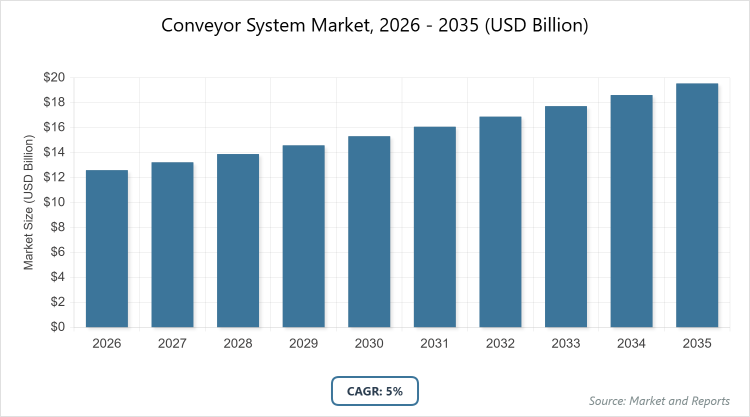
According to MarketnReports, the global Conveyor System market size was estimated at USD 12.6 billion in 2025 and is expected to reach USD 20.3 billion by 2035, growing at a CAGR of 5.0% from 2026 to 2035. Conveyor System Market is driven by increasing automation in manufacturing and logistics sectors.
What is the Overview of Conveyor System Market?
The conveyor system market comprises the design, manufacturing, installation, and maintenance of mechanical handling equipment used to transport materials and goods efficiently within industrial facilities, warehouses, and distribution centers. This market includes various types of conveyors such as belt, roller, and overhead systems, which facilitate seamless movement of products, reducing manual labor and enhancing operational productivity. Market definition refers to the industry focused on automated material handling solutions that optimize supply chain processes across sectors like manufacturing, retail, and logistics, addressing needs for speed, accuracy, and cost-efficiency in handling bulk or unit loads. It integrates advanced technologies like sensors and controls to ensure reliability and adaptability in dynamic environments.
What are the Key Insights into Conveyor System Market?
- The global conveyor system market was valued at USD 12.6 billion in 2025 and is projected to reach USD 20.3 billion by 2035.
- The market is expected to grow at a CAGR of 5.0% during the forecast period from 2026 to 2035.
- The market is driven by rising e-commerce activities and the need for efficient supply chain management.
- In the type segment, belt conveyors dominate with a 35% share.
- This dominance is due to their versatility, low maintenance, and ability to handle diverse materials, which drives market growth by enabling widespread adoption in high-volume industries.
- In the application segment, warehouse & distribution dominates with a 40% share.
- This is attributed to surging online retail demands requiring rapid sorting and fulfillment, fueling market expansion through automation enhancements.
- In the end-use segment, manufacturing dominates with a 30% share.
- This stems from assembly line efficiencies in automotive and electronics, propelling the market by reducing downtime and labor costs.
- Asia Pacific dominates the global market with a 42% share.
- This is owing to rapid industrialization, manufacturing hubs in China and India, and investments in infrastructure.
What are the Market Dynamics in Conveyor System?
Growth Drivers
Growth drivers in the conveyor system market are fueled by the escalating demand for automation in industries to improve efficiency and reduce operational costs, particularly in e-commerce and logistics where rapid order fulfillment is critical. The integration of Industry 4.0 technologies, such as IoT and AI, enables predictive maintenance and real-time monitoring, enhancing system reliability and attracting investments from manufacturers seeking competitive edges. Expanding global trade and supply chain complexities necessitate advanced material handling solutions, while sustainability initiatives promote energy-efficient conveyors that align with corporate environmental goals. Moreover, the rise of smart factories in developing regions accelerates adoption, driving overall market expansion through technological upgrades and scalable solutions.
Restraints
Restraints in the conveyor system market include high initial installation costs and the need for significant capital investment, which deter small and medium-sized enterprises from adopting advanced systems, limiting market penetration in cost-sensitive regions. Technical complexities in integrating conveyors with existing infrastructure can lead to downtime and additional expenses during implementation. Volatility in raw material prices, such as steel and electronics components, impacts manufacturing costs and profitability. Furthermore, stringent safety regulations and compliance requirements add bureaucratic hurdles, slowing deployment and innovation in regulated industries.
Opportunities
Opportunities in the conveyor system market emerge from the growing emphasis on sustainable and eco-friendly solutions, such as modular conveyors made from recyclable materials, which appeal to environmentally conscious industries and open new revenue streams. The expansion of e-commerce in emerging markets presents potential for customized, high-speed sorting systems tailored to local logistics needs. Advancements in robotics and AI integration offer prospects for hybrid systems that enhance flexibility and adaptability. Strategic partnerships with software providers can facilitate smart conveyor ecosystems, enabling data-driven optimizations and capturing shares in untapped sectors like pharmaceuticals and food processing.
Challenges
Challenges in the conveyor system market involve maintaining system uptime amid increasing operational demands, where failures can disrupt entire supply chains and lead to financial losses. The shortage of skilled technicians for installation and maintenance poses workforce issues, particularly in remote or developing areas. Rapid technological evolution requires continuous R&D investments to stay competitive, straining resources for smaller players. Additionally, cybersecurity threats to IoT-enabled systems raise concerns over data breaches, necessitating robust protections that add complexity and costs.
Conveyor System Market: Report Scope
| Report Attributes | Report Details |
| Report Name | Conveyor System Market |
| Market Size 2025 | USD 12.6 Billion |
| Market Forecast 2035 | USD 20.3 Billion |
| Growth Rate | CAGR of 5.0% |
| Report Pages | 220 |
| Key Companies Covered | Daifuku Co., Ltd., Siemens AG, Dematic (KION Group), Honeywell Intelligrated, Vanderlande Industries, and Others |
| Segments Covered | By Type, By Application, By End-Use, and By Region |
| Regions Covered | North America, Europe, Asia Pacific (APAC), Latin America, and The Middle East and Africa (MEA) |
| Base Year | 2025 |
| Historical Year | 2020 – 2024 |
| Forecast Year | 2026 – 2035 |
| Customization Scope | Avail customized purchase options to meet your exact research needs. |
The Conveyor System market is segmented by type, application, end-use, and region.
Based on Type Segment, the most dominant subsegment is belt, while the second most dominant is roller. Belt conveyors lead due to their cost-effectiveness, high load capacity, and adaptability to various terrains and materials, driving market growth by supporting bulk handling in mining and manufacturing, thus boosting efficiency and scalability; roller conveyors rank second as they excel in unit load transport with low friction, contributing to expansion through applications in warehousing where they facilitate smooth, energy-efficient movement of goods.
Based on Application Segment, the most dominant subsegment is warehouse & distribution, while the second most dominant is packaging. Warehouse & distribution dominates owing to the boom in e-commerce requiring automated sorting and fulfillment, propelling market growth via high-throughput systems that reduce labor and errors; packaging follows as the second dominant, driven by precision needs in food and pharmaceuticals, enhancing the market through integration with filling lines for streamlined operations.
Based on End-Use Segment, the most dominant subsegment is manufacturing, while the second most dominant is automotive. Manufacturing leads because of its reliance on continuous production lines for efficiency, fueling market growth by minimizing downtime in diverse sectors like electronics; automotive ranks second with assembly-specific customizations, advancing the market through innovations in just-in-time delivery and robotic integrations.
What are Recent Developments in Conveyor System?
- In 2025, Daifuku Co., Ltd. acquired a European automation firm to expand its smart conveyor portfolio, focusing on AI-driven predictive maintenance for enhanced reliability in logistics.
- In late 2024, Siemens AG launched an energy-efficient belt conveyor series with IoT integration, aimed at reducing carbon footprints in manufacturing facilities.
- In 2025, Dematic announced a partnership with a robotics company to develop hybrid conveyor-robot systems for e-commerce warehouses, improving sorting speeds.
- In 2024, Honeywell Intelligrated invested in modular conveyor technology, enabling quick reconfigurations for seasonal demands in retail distribution.
What is the Regional Analysis for Conveyor System Market?
- Asia Pacific to dominate the global market.
Asia Pacific dominates the conveyor system market, driven by rapid industrialization, massive infrastructure projects, and a burgeoning manufacturing sector. The region’s growth is supported by government initiatives in automation and supply chain enhancements. China dominates within Asia Pacific, fueled by its position as a global manufacturing powerhouse with companies like Siemens expanding operations, alongside high demand in electronics and automotive; India contributes through logistics expansions, Japan focuses on high-tech integrations, but challenges include supply chain disruptions from geopolitical tensions.
North America holds a significant share in the conveyor system market, characterized by advanced technological adoption and strong e-commerce infrastructure. Investments in smart factories and sustainability drive innovation. The United States leads as the dominating country, with robust demand in warehousing from giants like Amazon, supported by firms like Honeywell; Canada benefits from mining applications, Mexico leverages nearshoring trends, though high labor costs pose restraints.
Europe exhibits steady growth in the conveyor system market, emphasizing energy efficiency and regulatory compliance with EU standards. The focus on green manufacturing propels eco-friendly solutions. Germany dominates the region, driven by its automotive and engineering prowess with players like Dematic leading in precision systems; the UK and France follow with logistics advancements, while Eastern Europe offers cost advantages, despite varying infrastructure levels.
Latin America shows emerging potential in the conveyor system market, influenced by mining and agriculture sectors. Improving trade agreements facilitate imports of advanced technologies. Brazil dominates as the key country, with its resource extraction industries adopting bulk handling conveyors; Mexico benefits from manufacturing shifts, Argentina focuses on food processing, though economic volatility challenges investments.
The Middle East and Africa (MEA) region is nascent in the conveyor system market, with growth tied to oil, mining, and infrastructure developments. Investments in diversification boost adoption. South Africa dominates within MEA, supported by mining operations and companies like Vanderlande implementing airport systems; the UAE invests in logistics hubs, Saudi Arabia through Vision 2030, but harsh environments and skill gaps restrain progress.
Who are the Key Market Players in Conveyor System?
Daifuku Co., Ltd. focuses on global acquisitions and R&D in automated guided vehicles integrated with conveyors, aiming to enhance warehouse efficiency and expand in Asia Pacific.
Siemens AG employs digital twin technology for conveyor simulations, prioritizing energy-efficient designs to meet sustainability goals and strengthen its European presence.
Dematic (KION Group) pursues e-commerce solutions through robotic integrations, leveraging data analytics for predictive maintenance to capture North American market shares.
Honeywell Intelligrated adopts modular systems for flexible installations, focusing on software-driven optimizations to target retail and distribution sectors.
Vanderlande Industries emphasizes airport and parcel handling innovations, using AI for traffic management to dominate in high-throughput environments.
Swisslog Holding AG concentrates on healthcare and pharmaceutical applications, implementing scalable systems with traceability features for regulatory compliance.
What are the Market Trends in Conveyor System?
- Integration of IoT for real-time monitoring and predictive maintenance.
- Adoption of modular and flexible conveyor designs for quick adaptations.
- Rise in energy-efficient and sustainable materials to reduce environmental impact.
- Growth in AI-driven automation for optimized material flow.
- Expansion of robotic integrations for hybrid handling systems.
- Focus on safety enhancements with sensor technologies.
- Surge in demand for vertical conveyors in space-constrained facilities.
- Emphasis on customization for industry-specific needs.
What Market Segments and Subsegments are Covered in the Conveyor System Report?
By Type
-
- Belt
- Roller
- Overhead
- Pallet
- Chain
- Bucket
- Screw
- Vibrating
- Pneumatic
- Slat
- Others
By Application
-
- Packaging
- Automotive
- Electronics
- Food & Beverages
- Pharmaceuticals
- Airport
- Warehouse & Distribution
- Mining
- Agriculture
- Recycling
- Others
By End-Use
-
- Manufacturing
- Logistics
- Retail
- Airports
- Mining
- Food Processing
- Automotive
- E-commerce
- Pharmaceuticals
- Construction
- Others
By Region
-
- North America
- U.S.
- Canada
- Europe
- UK
- Germany
- France
- Rest of Europe
- Asia Pacific
- China
- India
- Japan
- Rest of Asia Pacific
- Latin America
- Brazil
- Mexico
- Rest of Latin America
- Middle East & Africa
- UAE
- South Africa
- Rest of Middle East & Africa
- North America
Frequently Asked Questions
Conveyor systems are mechanical devices used to transport materials and goods efficiently within industrial and commercial settings, including types like belt and roller for automated handling.
Key factors include automation trends, e-commerce expansion, technological advancements in IoT and AI, and increasing demand for efficient supply chains.
The Conveyor System market is projected to grow from approximately USD 12.6 billion in 2025 to USD 20.3 billion by 2035.
The Conveyor System market is expected to register a CAGR of 5.0% during the forecast period from 2026 to 2035.
Asia Pacific will contribute notably, holding around 42% of the market share due to industrialization and manufacturing growth.
Major players include Daifuku Co., Ltd., Siemens AG, Dematic (KION Group), Honeywell Intelligrated, Vanderlande Industries, and Swisslog Holding AG, driving growth through innovation and expansions.
The report provides comprehensive insights on market size, trends, segmentation, regional analysis, key players, and forecasts for informed decision-making.
The value chain includes raw material sourcing, design and manufacturing, assembly and installation, distribution, and after-sales maintenance services.
Trends are evolving toward smart, sustainable systems with IoT, while preferences shift to customizable, energy-efficient solutions for operational efficiency.
Regulatory factors include safety standards like OSHA and EU directives, while environmental factors involve emissions reductions pushing for green materials and energy-efficient designs.