
Confidential Computing Market Size, Share and Trends 2026 to 2035
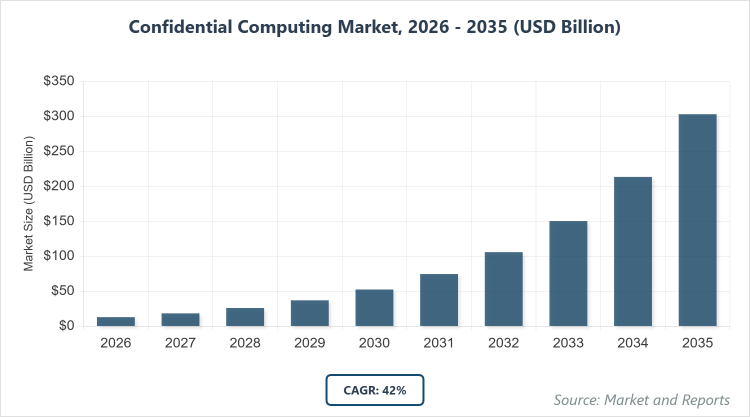
According to MarketnReports, the global Confidential Computing Market size was estimated at USD 12.91 billion in 2025 and is expected to reach USD 500 billion by 2035, growing at a CAGR of 42% from 2026 to 2035. Confidential Computing Market is driven by rising data privacy concerns and the need for secure data processing in cloud environments.
What are the Key Insights into the Confidential Computing Market?
- The global Confidential Computing Market was valued at USD 12.91 billion in 2025.
- The market is projected to grow at a CAGR of 42% from 2026 to 2035.
- The Confidential Computing Market is driven by increasing cyberattacks, stringent data privacy regulations, and growing adoption of cloud and AI technologies requiring secure data processing.
- Software dominates the Component segment with approximately 45% share because it enables flexible, scalable implementations of confidential computing frameworks, facilitating integration with existing systems and driving adoption across diverse applications.
- Data Security dominates the Application segment with around 40% share as it addresses critical needs for protecting sensitive information during computation, essential for compliance and trust in cloud environments.
- BFSI dominates the Vertical segment with over 30% share since financial institutions handle vast amounts of sensitive data, necessitating advanced security to prevent breaches and comply with regulations like GDPR.
- North America dominates the global market with 37% share due to advanced technological infrastructure, high awareness of data privacy, and presence of major players in the United States.
What is the Industry Overview of the Confidential Computing Market?
The Confidential Computing Market revolves around technologies that protect data during processing by isolating it in secure enclaves, ensuring confidentiality even from cloud providers or insiders through hardware-based Trusted Execution Environments (TEEs) and advanced encryption methods. This market includes hardware, software, and services enabling secure computations for sensitive data in sectors vulnerable to breaches, such as finance and healthcare, while facilitating compliance with privacy regulations. The market definition emphasizes solutions that safeguard data in use, complementing encryption at rest and in transit, to enable secure multi-party collaborations, AI training on private datasets, and cloud migrations without compromising security, driven by escalating cyber threats and digital transformation initiatives.
What are the Market Dynamics of the Confidential Computing Market?
Growth Drivers
The Confidential Computing Market is accelerated by the surge in sophisticated cyberattacks targeting data in use, compelling organizations to adopt TEEs and encryption to protect intellectual property and customer information during processing. Regulatory frameworks like GDPR and CCPA mandate enhanced data protection, boosting demand for confidential solutions in cloud deployments, while the proliferation of AI and big data analytics requires secure environments for collaborative computations without exposing raw data, supported by hardware advancements from Intel and AMD that minimize performance overheads.
Restraints
Adoption is hampered by high implementation costs for hardware-enabled TEEs and integration with legacy systems, particularly for SMEs lacking technical expertise. Limited standardization across platforms leads to interoperability issues, while concerns over potential vulnerabilities in TEEs themselves, such as side-channel attacks, erode trust, further constrained by a shortage of skilled professionals in secure computing architectures.
Opportunities
Opportunities lie in expanding CCaaS offerings by cloud giants like AWS and Google, enabling seamless adoption for hybrid environments, alongside integrations with emerging technologies like blockchain for secure decentralized computations. Growing sectors like healthcare for privacy-preserving AI in drug discovery and IoT for edge security present untapped potential, fueled by government funding for cybersecurity and partnerships to develop open-source confidential frameworks.
Challenges
Challenges encompass ensuring zero-trust architectures amid evolving threat landscapes, with performance trade-offs in encrypted computations affecting latency-sensitive applications. Regulatory divergences across regions complicate global deployments, while educating stakeholders on confidential computing benefits and addressing supply chain dependencies for specialized hardware pose persistent barriers to scalable growth.
Confidential Computing Market: Report Scope
| Report Attributes | Report Details |
| Report Name | Confidential Computing Market |
| Market Size 2025 | USD 12.91 Billion |
| Market Forecast 2035 | USD 500 Billion |
| Growth Rate | CAGR of 42% |
| Report Pages | 220 |
| Key Companies Covered |
Microsoft, Intel Corporation, Google,Amazon Web Services, Inc., IBM and Others. |
| Segments Covered | By Component, By Application, By Vertical, and By Region. |
| Regions Covered | North America, Europe, Asia Pacific (APAC), Latin America, and The Middle East and Africa (MEA) |
| Base Year | 2025 |
| Historical Year | 2020 - 2024 |
| Forecast Year | 2026 - 2035 |
| Customization Scope | Avail customized purchase options to meet your exact research needs. |
What is the Market Segmentation of the Confidential Computing Market?
The Confidential Computing Market is segmented by Component, Application, Vertical, and region.
By Component Segment, Software represents the most dominant segment while Hardware stands as the second most dominant. Software leads due to its role in developing and deploying confidential frameworks that are adaptable and cost-effective, driving market growth by enabling rapid innovation and integration with cloud services to meet diverse security needs without heavy hardware investments.
By Application Segment, Data Security is the most dominant segment followed by Secure Enclaves as the second most dominant. Data Security dominates as it fulfills the core requirement for protecting sensitive information in transit to processing, propelling market expansion through widespread demand in regulated industries that prioritize breach prevention and compliance.
By Vertical Segment, BFSI is the most dominant while Healthcare & Life Sciences constitute the second most dominant. BFSI prevails owing to its handling of high-stakes financial data requiring utmost confidentiality, supporting market growth by adopting solutions that enhance trust and enable secure fintech innovations.
What are the Recent Developments in the Confidential Computing Market?
- In May 2023, Microsoft partnered with Habu to integrate Data Clean Room applications with Azure confidential computing, enabling secure data processing for collaborative analytics without exposure.
- In January 2023, Intel unveiled Trust Domain Extension (TDX) for VM isolation, enhancing data protection in virtualized environments to support enterprise cloud migrations.
- In February 2022, IBM acquired Neudesic, LLC to bolster its hybrid multi-cloud services, expanding capabilities in confidential computing for AI-driven applications.
- In June 2024, Thales partnered with Google Cloud to develop a next-generation global SOC platform using AI for advanced threat detection in confidential setups.
What is the Regional Analysis of the Confidential Computing Market?
North America to dominate the global market
North America maintains dominance in the Confidential Computing Market, led by the United States with its cutting-edge tech ecosystem, stringent privacy laws like CCPA, and heavy investments from hyperscalers in secure cloud infrastructures, fostering innovation in BFSI and healthcare sectors.
Europe demonstrates strong growth, driven by Germany through GDPR compliance and EU initiatives for digital sovereignty, emphasizing secure data sharing in manufacturing and public sectors amid rising cyber threats.
Asia Pacific is the fastest-growing region, spearheaded by China with rapid cloud adoption, government support for data security in IT & telecom, and expanding manufacturing base requiring protected computations.
Latin America shows emerging progress, with Brazil leading via improving regulatory frameworks and private sector investments in secure fintech, though limited by infrastructure challenges.
The Middle East and Africa are evolving, led by the UAE through smart city initiatives and partnerships for confidential tech in government & defense, constrained by skill gaps but bolstered by oil-funded digital transformations.
Who are the Key Market Players in the Confidential Computing Market?
Microsoft pursues partnerships for Azure confidential integrations, focusing on CCaaS to enhance data clean rooms and AI security for enterprise clients.
Intel Corporation invests in TDX and SGX hardware advancements, collaborating with cloud providers to minimize overheads and expand VM protection strategies.
Google emphasizes confidential VMs and AI/ML tools, leveraging partnerships like with AMD to offer scalable, hardware-agnostic secure computing environments.
Amazon Web Services, Inc. adopts enclave-based services in AWS Nitro, targeting multi-party computations and regulatory compliance for BFSI workloads.
IBM acquires firms to bolster hybrid cloud security, prioritizing open-source contributions for confidential AI in healthcare and government applications.
What are the Market Trends in the Confidential Computing Market?
- Rising integration with AI and ML for privacy-preserving analytics in sensitive datasets.
- Expansion of CCaaS models by major cloud providers for easier enterprise adoption.
- Focus on digital sovereignty with sovereign cloud mandates in Europe and Asia.
- Advancements in TEEs reducing performance overheads to under 10% for production workloads.
- Growing use in blockchain and IoT for secure edge computing and data sharing.
- Emphasis on auditable operations with zero-knowledge proofs and transparent logging.
- Collaborations between hardware vendors and software developers for hybrid solutions.
What Market Segments and their Subsegments are Covered in the Report?
By Component
- Hardware
- Software
- Services
- Trusted Execution Environments (TEEs)
- Encryption Technologies
- Secure Multi-Party Computation Tools
- Homomorphic Encryption Solutions
- Confidential VMs
- Data Protection Platforms
- AI/ML Security Vendors
- Others
By Application
- Data Security
- Secure Enclaves
- Pellucidity Between Users
- Blockchain
- Multi-Party Computing
- IoT & Edge Security
- Privacy-Preserving Analytics
- Personal Computing Devices
- Regulatory Compliance
- Cloud Data Protection
- Others
By Vertical
- BFSI
- Government & Defense
- Healthcare & Life Sciences
- IT & Telecommunications
- Manufacturing
- Retail & Consumer Goods
- Education
- Utilities
- Media & Entertainment
- Automotive
- Others
- North America
- U.S.
- Canada
- Europe
- UK
- Germany
- France
- Rest of Europe
- Asia Pacific
- China
- India
- Japan
- Rest of Asia Pacific
- Latin America
- Brazil
- Mexico
- Rest of Latin America
- Middle East & Africa
- UAE
- South Africa
- Rest of Middle East & Africa
Frequently Asked Questions
The Confidential Computing Market involves technologies and services that secure data during processing using hardware-based enclaves, ensuring privacy in cloud and collaborative environments.
Key factors include escalating cyber threats, regulatory demands for data privacy, cloud adoption growth, and advancements in TEE technologies.
The market is anticipated to expand from approximately USD 12.91 billion in 2026 to USD 500 billion by 2035.
The CAGR is projected to be 42% during the forecast period.
North America will contribute notably, driven by technological leadership and regulatory focus in the United States.
Major players include Microsoft, Intel Corporation, Google, Amazon Web Services, Inc., and IBM.
The report provides comprehensive insights into market size, segmentation, dynamics, trends, regional analysis, competitive landscape, and forecasts.
Stages include hardware development, software framework creation, service integration, deployment in cloud/on-premise, and ongoing security auditing.
Trends favor AI-integrated security and CCaaS, while preferences shift toward verifiable privacy solutions for sensitive data handling.
Factors include GDPR and CCPA compliance requirements, alongside pushes for reduced energy consumption in secure computing infrastructures.