
Conductive Yarn Market Size, Share and Trends 2026 to 2035
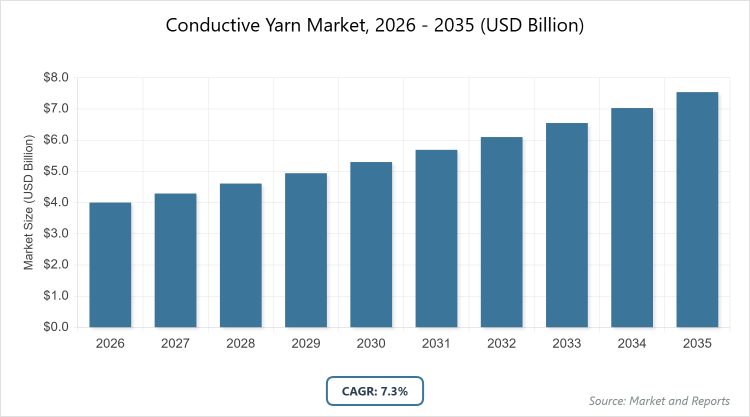
According to MarketnReports, the global Conductive Yarn Market size was estimated at USD 4 billion in 2025 and is expected to reach USD 8 billion by 2035, growing at a CAGR of 7.3% from 2026 to 2035. Conductive Yarn Market is driven by increasing demand for smart textiles and wearable electronics.What are the Key Insights of the Conductive Yarn Market?
- The global conductive yarn market was valued at USD 4 billion in 2025 and is projected to reach USD 8 billion by 2035.
- The market is anticipated to grow at a CAGR of 7.3% during the forecast period from 2026 to 2035.
- The market is driven by rising adoption of wearable technology, advancements in smart textiles, and increasing demand in healthcare and consumer electronics.
- In type, metallic type dominates with a 40% share due to its excellent conductivity, durability, and suitability for high-performance applications like smart wearables.
- In application, anti-static fabric dominates with a 35% share because of its critical role in electronics and industrial environments to prevent static buildup and enhance safety.
- In end-use industry, consumer electronics dominates with a 30% share owing to the surge in demand for integrated sensors in gadgets and wearables.
- Asia Pacific dominates the regional market with a 40% share, attributed to robust manufacturing capabilities, technological advancements, and high production volumes in countries like China and Japan.
What is the Industry Overview of the Conductive Yarn Market?
The conductive yarn market encompasses the production and distribution of yarns infused with conductive materials such as metals, carbon, or polymers to enable electrical conductivity while maintaining textile properties like flexibility and durability. This market serves industries requiring integrated electronics in fabrics, including smart clothing and sensors, emphasizing innovation in materials that combine conductivity with washability and comfort. Market definition includes yarns designed for applications in e-textiles, antistatic protection, and signal transmission, focusing on sustainable and high-performance solutions to meet evolving demands in wearable technology and industrial uses.
What are the Market Dynamics of the Conductive Yarn Market?
Growth Drivers
The growth drivers in the conductive yarn market are primarily fueled by the rapid expansion of wearable technology and IoT devices, which require flexible and reliable conductive materials for seamless integration into fabrics. Advancements in nanotechnology and material science have enabled the development of yarns with improved conductivity, flexibility, and wash resistance, making them ideal for applications in healthcare monitoring and sports performance tracking. Increasing consumer preference for smart clothing that offers functionality like health tracking and connectivity further accelerates demand. Additionally, regulatory pushes for safety in electronics and environmental standards encourage innovation in sustainable conductive yarns, driving market expansion across diverse sectors.
Restraints
Restraints in the conductive yarn market include high production costs associated with incorporating conductive materials like silver or carbon nanotubes, which can limit affordability and scalability for mass-market applications. Hygiene concerns, such as maintaining conductivity after repeated washing and potential skin irritation from metallic components, pose challenges for consumer adoption in wearables. Supply chain disruptions and competition from alternative materials like conductive inks or films further hinder growth. Moreover, limited awareness and technical expertise in integrating these yarns into traditional textile manufacturing processes restrict market penetration in developing regions.
Opportunities
Opportunities in the conductive yarn market emerge from the development of sustainable and eco-friendly materials, such as recycled conductive fibers, aligning with global environmental initiatives and attracting conscious consumers. Partnerships between textile manufacturers and tech companies can foster innovations in smart textiles for emerging sectors like automotive and aerospace. Expanding e-commerce and digital marketing platforms offer avenues to educate consumers on benefits, boosting adoption in healthcare and fitness. Additionally, investments in R&D for customizable yarns open new applications in personalized medicine and industrial safety, providing long-term growth potential amid digital transformation trends.
Challenges
Challenges in the conductive yarn market involve maintaining consistent electrical performance across repeated use cycles, including washing and stretching, which requires advanced quality control and testing. Scaling production while ensuring cost-effectiveness amid fluctuating raw material prices adds operational hurdles. Navigating diverse regulatory frameworks for safety and environmental compliance across regions complicates global expansion. Finally, addressing competition through differentiation in durability and integration efficiency demands continuous innovation, particularly in niche applications where performance reliability is critical.
Conductive Yarn Market: Report Scope
| Report Attributes | Report Details |
| Report Name | Conductive Yarn Market |
| Market Size 2025 | USD 4 Billion |
| Market Forecast 2035 | USD 8 Billion |
| Growth Rate | CAGR of 7.3% |
| Report Pages | 220 |
| Key Companies Covered |
KB Seiren, Textronics, Bekaert, Statex Produktions & Vertriebs GmbH, Coats Group, Toray Industries, and Others. |
| Segments Covered | By Type, By Application, By End-Use Industry, and By Region. |
| Regions Covered | North America, Europe, Asia Pacific (APAC), Latin America, and The Middle East and Africa (MEA) |
| Base Year | 2025 |
| Historical Year | 2020 - 2024 |
| Forecast Year | 2026 - 2035 |
| Customization Scope | Avail customized purchase options to meet your exact research needs. |
What is the Market Segmentation of the Conductive Yarn Market?
The Conductive Yarn Market is segmented by type123, application123, end-user123, and region.By Type123 Segment, metallic type emerges as the most dominant subsegment, holding approximately 40% market share, followed by carbon-based type as the second most dominant with around 30%. Metallic type dominates due to its superior conductivity and mechanical strength, making it essential for demanding applications like signal transmission in wearables; this subsegment drives the market by enabling reliable integration in high-volume sectors such as consumer electronics, fostering innovation in flexible electronics and increasing overall adoption through proven performance in durable textiles. Carbon-based type, the second dominant, excels in flexibility and lightweight properties, propelling market growth by supporting advancements in smart clothing and healthcare devices where comfort and adaptability are key.
By Application123 Segment, anti-static fabric stands out as the most dominant subsegment with a 35% share, while signal transmission follows as the second most dominant at about 25%. Anti-static fabric's dominance stems from its vital role in preventing electrostatic discharge in electronics and industrial settings, driving the market by ensuring safety and product longevity in manufacturing; this helps propel growth by meeting regulatory requirements and expanding into cleanroom environments. Signal transmission, as the second dominant, facilitates connectivity in smart textiles, advancing the market through applications in IoT devices and wearables that enhance data capture efficiency.
By End-User123 Segment, consumer electronics is the most dominant subsegment, capturing 30% of the market, with healthcare as the second most dominant at 20%. Consumer electronics leads due to the boom in wearables and smart gadgets requiring integrated conductivity, which drives the market by boosting demand for innovative yarns that support seamless functionality; this dominance enhances growth by encouraging R&D in user-friendly integrations. Healthcare, the second dominant, utilizes conductive yarns for monitoring devices, supporting market expansion by addressing needs for real-time health data in remote and fitness applications.
What are the Recent Developments in the Conductive Yarn Market?
- In 2025, KB Seiren announced a collaboration with a leading wearable tech firm to develop eco-friendly metallic conductive yarns with enhanced wash durability, targeting the sports and fitness sector.
- Textronics launched a new carbon-based yarn series optimized for signal transmission in medical devices, following successful trials that improved conductivity after repeated use.
- Bekaert invested USD 50 million in expanding production facilities in Asia to meet rising demand for anti-static fabrics in electronics manufacturing.
What is the Regional Analysis of the Conductive Yarn Market?
Asia Pacific to dominate the global market.Asia Pacific leads the conductive yarn market with a 40% share, driven by advanced manufacturing and rapid adoption of smart technologies in populous economies. China dominates the region, leveraging its extensive supply chains and investments in R&D for conductive materials, with companies like Hebei Swiit Metallic Fiber leading production; this dominance is supported by government initiatives for electronics and textiles, propelling growth through exports and domestic demand in consumer electronics and automotive sectors. Japan contributes through innovation in high-tech yarns, enhancing regional leadership in quality-driven applications.
North America exhibits strong growth in the conductive yarn market, fueled by innovation in wearables and healthcare. The United States dominates, with key players like Textronics focusing on sustainable integrations for smart textiles; this leadership drives expansion via partnerships with tech giants and regulatory support for safety standards, positioning the region as a hub for advanced applications in fitness and medical monitoring. Canada supports through material science advancements.
Europe is a key player in the conductive yarn market, emphasized by sustainability regulations and fashion tech integration. Germany dominates, home to firms like Novonic emphasizing eco-friendly yarns; this supremacy stems from strong automotive and industrial sectors, driving growth by exporting specialized products and complying with EU environmental goals. The UK and France add through wearable innovations in sports and healthcare.
Latin America shows emerging potential in the conductive yarn market, benefiting from industrial and agricultural applications. Brazil dominates, utilizing local manufacturing for anti-static solutions; this position is strengthened by partnerships for smart farming textiles, driving development by addressing regional needs in electronics and safety gear. Mexico contributes as a supply hub for North America.
The Middle East and Africa region is gradually advancing in the conductive yarn market, focused on fashion and industrial uses. The UAE emerges as the dominating country, with investments in smart wearables; this leadership is driven by tech-savvy consumers and collaborations with global brands, helping diversify economies while promoting applications in aerospace and military. Turkey supports through textile exports.
Who are the Key Market Players and Strategies in the Conductive Yarn Market?
KB Seiren focuses on R&D for sustainable metallic yarns, partnering with tech firms to enhance durability and expand into wearables.
Textronics emphasizes innovation in carbon-based yarns for medical applications, investing in wash-resistant technologies to capture healthcare markets.
Bekaert pursues production expansion and cost optimization, leveraging global networks for anti-static solutions in electronics.
Statex Produktions & Vertriebs GmbH adopts eco-friendly processes, collaborating with integrators for customized industrial yarns.
Coats Group prioritizes digital transformation, integrating IoT compatibility to differentiate in smart textiles.
Toray Industries strategies include mergers for market consolidation, focusing on high-performance hybrid yarns for aerospace.
What are the Market Trends in the Conductive Yarn Market?
- Rising adoption of sustainable and recycled conductive materials to reduce environmental impact.
- Integration with IoT for advanced health monitoring and smart garment functionalities.
- Market consolidation through mergers and acquisitions for comprehensive solutions.
- Growing demand for customizable yarns in healthcare, fashion, and automotive sectors.
- Strategic partnerships with tech firms to accelerate product development.
- Focus on nanotechnology for enhanced conductivity and flexibility.
- Shift towards eco-friendly production processes amid regulatory pressures.
- Expansion of digital marketing to educate on benefits in emerging applications.
What Market Segments and their Subsegments are Covered in the Report for the Conductive Yarn Market?
By Type- Metallic Type
- Carbon-Based Type
- Metal Compound Type
- Polymer Coated
- Silver Coated
- Copper Based
- Stainless Steel
- Graphite
- Nanotube
- Hybrid
- Others
- Anti-static Fabric
- Signal Transmission
- Cellphone Protective Cover
- Smart Clothing
- Medical Devices
- Automotive Interiors
- Aerospace
- Military
- Industrial
- Consumer Electronics
- Others
- Healthcare
- Sports and Fitness
- Automotive
- Aerospace and Defense
- Consumer Electronics
- Fashion
- Industrial
- Military
- Construction
- Agriculture
- Others
By Region
- North America
- U.S.
- Canada
- Europe
- UK
- Germany
- France
- Rest of Europe
- Asia Pacific
- China
- India
- Japan
- Rest of Asia Pacific
- Latin America
- Brazil
- Mexico
- Rest of Latin America
- Middle East & Africa
- UAE
- South Africa
- Rest of Middle East & Africa
Frequently Asked Questions
The conductive yarn market involves yarns with electrical conductivity for applications in smart textiles, electronics, and industrial uses.
Key factors include wearable tech adoption, material innovations, sustainability regulations, and demand in healthcare and electronics.
The market is projected to USD 4 billion in 2025 and is expected to reach USD 8 billion by 2035.
The CAGR is expected to be 7.3% during 2026-2035.
Asia Pacific will contribute notably, driven by manufacturing and tech advancements.
Major players include KB Seiren, Textronics, Bekaert, Statex Produktions & Vertriebs GmbH, Coats Group, and Toray Industries.
The report provides detailed analysis of size, trends, segments, regions, players, and forecasts.
Stages include raw material sourcing, yarn manufacturing, integration, distribution, and end-use application.
Trends favor sustainable materials and IoT integration, with consumers preferring functional smart textiles.
Safety standards and eco-regulations promote sustainable yarns, while pushing innovation in low-impact production.