
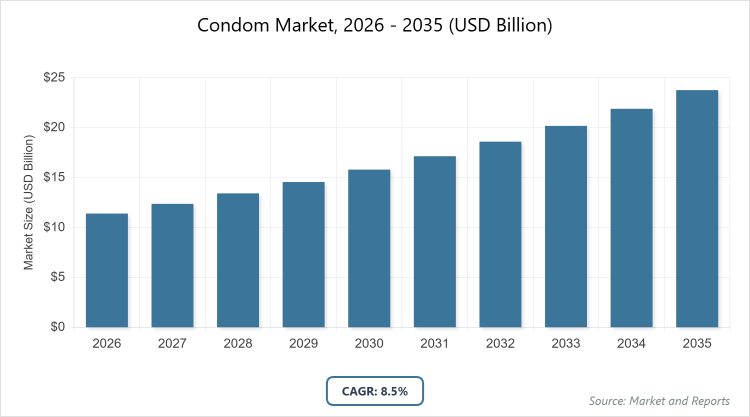
Condom Market Size, Share and Trends 2026 to 2035
According to MarketnReports, the global condom market size was estimated at USD 11.40 billion in 2025 and is expected to reach USD 25.78 billion by 2035, growing at a CAGR of 8.50% from 2026 to 2035. Increasing awareness of sexually transmitted infections and family planning initiatives.
What are the Key Insights into the condom market?
- The global condom market size was USD 11.40 billion in 2025 and is projected to reach USD 25.78 billion by 2035.
- The market is anticipated to grow at a CAGR of 8.50% from 2026 to 2035.
- The market is driven by rising awareness of STIs, government family planning programs, and product innovations in materials and designs.
- The latex segment dominates the material with around 88% share, owing to its cost-effectiveness, high elasticity, proven efficacy in STI prevention, and widespread availability in global supply chains.
- The male condoms segment leads the product type with approximately 98% market share, due to higher demand, ease of use, extensive marketing, and cultural acceptance as the primary contraceptive method.
- The drug stores/pharmacies segment is dominant in distribution channel with about 41% share, as it offers discreet access, professional advice, and integration with health services that build consumer trust.
- Asia Pacific dominates the regional market with around 52% share, driven by large populations in China and India, government initiatives for population control, and increasing urbanization boosting sexual health awareness.
What is a condom?
Industry Overview
The condom market involves the production, distribution, and consumption of barrier contraceptives designed to prevent sexually transmitted infections (STIs) and unintended pregnancies, available in various materials, sizes, textures, and flavors to cater to diverse consumer preferences and needs. This industry supports global public health efforts by promoting safe sexual practices, with products ranging from standard latex options to innovative non-latex alternatives that address allergies and enhance user experience through features like ultra-thin designs or added lubrication. Market definition encompasses all sheath-like devices used during intercourse for protection, excluding other contraceptive methods such as hormonal pills or intrauterine devices, and it reflects ongoing advancements in sustainable materials and discreet packaging to reduce stigma and improve accessibility amid rising emphasis on sexual health education and empowerment.
What are the Market Dynamics Affecting Condoms?
Growth Drivers
The growth drivers in the condom market are significantly influenced by heightened global awareness campaigns on sexual health, spearheaded by organizations like the World Health Organization and national governments, which emphasize condom use to curb the spread of HIV/AIDS and other STIs, with over 1 million new STI cases reported daily worldwide, prompting increased adoption among young adults and at-risk populations. This is further amplified by expanding family planning initiatives in developing regions, where subsidies and free distribution programs make condoms accessible, reducing unintended pregnancies and supporting demographic control in high-population countries like India and Nigeria.
Additionally, product innovations such as graphene-infused ultra-thin variants and eco-friendly biodegradable options appeal to environmentally conscious consumers, enhancing market penetration through e-commerce platforms that offer privacy and variety, thereby driving overall demand amid shifting social norms toward open discussions on intimacy and wellness.
Restraints
Restraints in the condom market include persistent cultural and religious stigmas in conservative societies, which deter open purchasing and usage, particularly in regions like the Middle East and parts of Africa where taboos around premarital sex limit market expansion despite health needs. High production costs for premium non-latex materials, coupled with supply chain disruptions from raw material shortages like natural rubber affected by climate events, elevate prices and reduce affordability for low-income consumers. Moreover, competition from alternative contraceptives such as long-acting reversible methods like IUDs and implants, which offer convenience without per-use application, diverts potential users, especially in developed markets with advanced healthcare access.
Opportunities
Opportunities in the condom market arise from the burgeoning demand for sustainable and vegan-friendly products, as millennial and Gen Z consumers prioritize eco-conscious choices, opening avenues for brands to develop plant-based or recyclable condoms that align with global sustainability goals and attract premium pricing. The rapid growth of digital retail channels enables targeted marketing and subscription models, expanding reach to underserved rural areas through apps and discreet delivery services. Furthermore, partnerships with NGOs and governments for educational programs in emerging economies can boost penetration, while innovations in smart packaging with QR codes for health tips enhance user engagement and loyalty.
Challenges
Challenges in the condom market encompass counterfeit products flooding online marketplaces, which undermine consumer trust due to inferior quality and potential health risks, necessitating stricter regulations and authentication technologies that increase operational burdens for legitimate manufacturers. Volatility in raw material prices, particularly latex from rubber plantations vulnerable to diseases and trade tariffs, creates supply inconsistencies and profit squeezes. Additionally, gender disparities in usage, with lower adoption of female condoms due to higher costs and insertion complexities, limit market inclusivity, requiring focused R&D and awareness efforts to balance the portfolio.
Condom Market: Report Scope
| Report Attributes | Report Details |
| Report Name | Condom Market |
| Market Size 2025 | USD 11.40 Billion |
| Market Forecast 2035 | USD 25.78 Billion |
| Growth Rate | CAGR of 8.50% |
| Report Pages | 220 |
| Key Companies Covered |
Reckitt Benckiser Group, Church & Dwight Co., Inc., Karex Berhad, LifeStyles Healthcare, Okamoto Industries, Cupid Limited, Sagami Rubber Industries, and Others |
| Segments Covered | By Material, By Product Type, By Distribution Channel, and By Region |
| Regions Covered | North America, Europe, Asia Pacific (APAC), Latin America, and The Middle East and Africa (MEA) |
| Base Year | 2025 |
| Historical Year | 2020 – 2024 |
| Forecast Year | 2026 – 2035 |
| Customization Scope | Avail customized purchase options to meet your exact research needs. |
How is the Condom Market Segmented?
The Condom market is segmented by material, product type, distribution channel, and region.
Based on the material segment, the latex subsegment is the most dominant, holding around 88% share, due to its superior strength, flexibility, and barrier properties against STIs and pregnancies, combined with low production costs that enable mass availability, which drives the market by ensuring affordability and reliability for widespread global use in public health programs. The polyurethane subsegment is the second most dominant, with approximately 6% share, as it provides a hypoallergenic alternative for latex-sensitive users with better heat transfer for enhanced sensation, contributing to market growth by catering to niche preferences and expanding inclusivity in premium segments.
Based on product type segment, the male condoms subsegment is the most dominant, capturing about 98% share, attributed to established cultural norms, simpler application, and extensive variety in sizes and features, which propel the market by dominating sales volumes and supporting large-scale distribution in both retail and institutional channels. The female condom subsegment is the second most dominant, with around 2% share, owing to its empowerment-focused design offering women control over protection, helping to drive the market through targeted health initiatives addressing gender-specific needs and increasing adoption in STI-prone areas.
Based on distritribution channel segment, the drug stores/pharmacies subsegment is the most dominant, with roughly 41% share, facilitated by trusted health advice, immediate availability, and integration with contraceptive consultations, driving the market by building consumer confidence and encouraging impulse buys in a professional setting. The e-commerce subsegment is the second most dominant, holding about 20% share, propelled by privacy, variety, and subscription options, which contribute to market expansion by reaching tech-savvy younger demographics and remote areas with discreet delivery.
What are the Recent Developments in the Condom Market?
- In September 2024, Durex launched Close Fit Invisible Condoms in India, introducing the country’s first thin, close-fitted design to enhance intimacy while maintaining protection standards.
- In April 2024, Mankind Pharma’s Manforce released a campaign for Realgasm Condoms, focusing on women’s satisfaction to drive awareness and sales through innovative marketing.
- In October 2023, ONE Condoms introduced the world’s first graphene condoms, offering ultra-thin construction with improved strength and heat transfer for a better user experience.
- In March 2023, Durex unveiled the Real Feel non-latex range made from polyisoprene, targeting allergy-prone consumers with enhanced sensitivity.
- In April 2023, Veru Inc. partnered with Afaxys Group Services to distribute FC2 Female Condoms, expanding access through public health networks.
How Does Regional Analysis Impact the Condom Market?
- Asia Pacific to dominate the global market.
Asia Pacific holds the leading position in the condom market with a substantial share, propelled by dense populations exceeding 4.7 billion, aggressive government campaigns for family planning, and rising STI incidences amid urbanization; China dominates this region, with its massive 1.4 billion populace and state-subsidized distribution programs reaching over 1 billion units annually, fostering growth through localized manufacturing and e-commerce integration that addresses cultural sensitivities.
North America maintains a strong foothold, supported by advanced sexual education, high disposable incomes, and robust retail infrastructure; the United States is the dominating country, where over 450 million condoms are sold yearly, driven by brands like Trojan emphasizing innovation in premium products and partnerships with health organizations to combat teen pregnancy rates.
Europe exhibits steady progress, influenced by progressive policies on sexual health and EU-wide STI prevention strategies; Germany stands out as the dominating country, leveraging its efficient pharmacy networks and brands like Ritex to promote eco-friendly options, contributing to growth via sustainability-focused consumer trends.
Latin America shows emerging momentum, fueled by improving access to contraceptives and awareness programs; Brazil dominates here, with government initiatives distributing millions of free units during events like Carnival, aiding market expansion by tackling high HIV rates and unplanned pregnancies.
The Middle East and Africa represent developing potential, constrained by cultural barriers but boosted by international aid; South Africa is the dominating country, where NGO partnerships and anti-HIV campaigns distribute over 500 million condoms annually, driving gradual growth through targeted interventions in high-prevalence zones.
Who are the Key Market Players in condoms?
- Reckitt Benckiser Group leads with its Durex brand, employing strategies like product innovation in ultra-thin and non-latex variants, digital campaigns targeting youth, and expansions into emerging markets to capture premium segments.
- Church & Dwight Co., Inc. focuses on Trojan condoms, utilizing strategies such as sustainability initiatives with eco-packaging, collaborations with health NGOs for free distributions, and R&D in textured designs to enhance user satisfaction.
- Karex Berhad emphasizes manufacturing excellence, adopting strategies including acquisitions for global reach, cost-efficient production of private-label brands, and investments in graphene technology to differentiate in competitive landscapes.
- LifeStyles Healthcare targets diverse preferences, with strategies involving vegan and allergen-free options, e-commerce partnerships for discreet sales, and marketing focused on empowerment to grow in female condom segments.
- Okamoto Industries specializes in thin condoms, employing strategies like Japanese quality standards for branding, expansions in Asia-Pacific retail, and innovations in lubrication for improved comfort.
- Cupid Limited caters to affordable markets, with strategies including government tenders for bulk supplies, flavored variants for youth appeal, and digital platforms to boost accessibility in India.
- Sagami Rubber Industries pioneers non-latex products, adopting strategies such as ultra-thin polyurethane developments, international certifications for exports, and sustainability in packaging to attract eco-conscious consumers.
What are the Market Trends Shaping Condoms?
- Rising demand for non-latex materials like polyurethane and polyisoprene to address allergies and enhance sensation.
- Growth in premium ultra-thin and textured variants for improved user experience and intimacy.
- Increasing adoption of sustainable and biodegradable condoms amid environmental concerns.
- Expansion of e-commerce and subscription models for discreet and convenient purchasing.
- Focus on female condoms and empowerment-focused products to promote gender equality in protection.
- Integration of innovative features like graphene for strength and heat transfer.
- Surge in flavored and glow-in-the-dark options targeting younger demographics.
What Market Segments and Subsegments are Covered in the Condom Report?
By Material
- Latex
- Polyurethane
- Polyisoprene
- Nitrile
- Lambskin
- Synthetic
- Natural
- Polyamide
- Graphene-Based
- Biodegradable
- Others
By Product Type
- Male Condoms
- Female Condoms
- Flavored Condoms
- Textured Condoms
- Ultra-Thin Condoms
- Extra Safe Condoms
- Glow-in-the-Dark Condoms
- Edible Condoms
- Studded Condoms
- Warming Condoms
- Others
By Distribution Channel
- Drug Stores/Pharmacies
- Supermarkets/Hypermarkets
- Convenience Stores
- Online Retail
- Mass Merchandisers
- Specialty Stores
- Vending Machines
- Public Health Centers
- E-commerce Platforms
- Institutional
- Others
By Region
- North America
- U.S.
- Canada
- Europe
- UK
- Germany
- France
- Rest of Europe
- Asia Pacific
- China
- India
- Japan
- Rest of Asia Pacific
- Latin America
- Brazil
- Mexico
- Rest of Latin America
- Middle East & Africa
- UAE
- South Africa
- Rest of Middle East & Africa
Chapter 1. Preface
Chapter 2. Executive Summary
Chapter 3. Global Condom Market - Industry Analysis
Chapter 4. Global Condom Market- Competitive Landscape
Chapter 5. Global Condom Market - Material Analysis
Chapter 6. Global Condom Market - Product Type Analysis
Chapter 7. Global Condom Market - Distribution Channel Analysis
Chapter 8. Condom Market - Regional Analysis
Chapter 9. Company Profiles
Frequently Asked Questions
Condoms are thin, flexible sheaths typically made from latex or non-latex materials, used during sexual intercourse to prevent pregnancy and reduce the transmission of sexually transmitted infections.
Key factors include rising STI awareness, government family planning initiatives, product innovations, e-commerce growth, and sustainability trends.
The condom market is projected to grow from approximately USD 12.37 billion in 2026 to USD 25.78 billion by 2035.
The CAGR value is expected to be 8.50% during 2026-2035.
Asia Pacific will contribute notably, driven by large populations and health campaigns.
Major players include Reckitt Benckiser Group, Church & Dwight Co., Inc., Karex Berhad, LifeStyles Healthcare, and Okamoto Industries.
The report provides detailed analysis on size, trends, segments, regions, players, and forecasts from 2026 to 2035.
Stages include raw material sourcing, manufacturing, quality testing, packaging, distribution, and retail sales.
Trends are shifting toward sustainable, premium, and innovative products, with consumers preferring non-latex and eco-friendly options.
Regulatory factors include safety standards and health approvals, while environmental factors involve pressures for biodegradable materials and reduced plastic packaging.