
Concrete Floor Coatings Market Size, Share and Trends 2026 to 2035
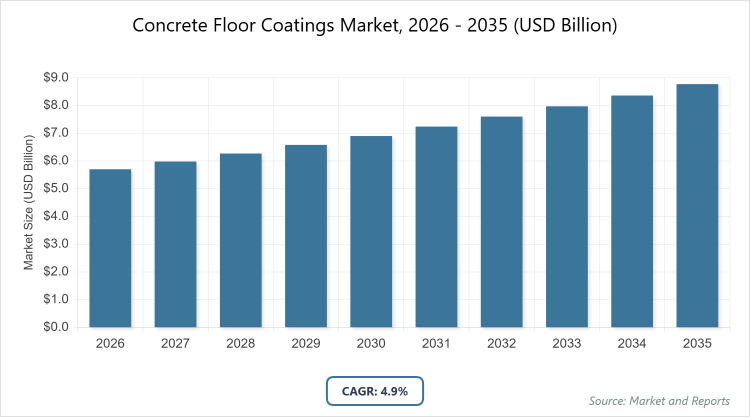
According to MarketnReports, the global concrete floor coatings market size was estimated at USD 5.7 billion in 2025 and is expected to reach USD 9.2 billion by 2035, growing at a CAGR of 4.9% from 2026 to 2035. Increasing industrialization and demand for durable, low-maintenance flooring solutions.
What are the Key Insights into the concrete floor coatings market?
- The global concrete floor coatings market size was USD 5.7 billion in 2025 and is projected to reach USD 9.2 billion by 2035.
- The market is anticipated to grow at a CAGR of 4.9% from 2026 to 2035.
- The market is driven by expanding construction activities, demand for eco-friendly coatings, and innovations in durable formulations.
- The epoxy segment dominates the product type with around 47% share, owing to its superior adhesion, chemical resistance, and cost-effectiveness for high-traffic areas.
- The industrial flooring segment leads the application with approximately 51% market share, due to the need for robust protection in manufacturing and warehousing environments against heavy loads and spills.
- The industrial segment is dominant in end-use with about 50% share, as it requires coatings that enhance safety, durability, and maintenance efficiency in production facilities.
- Asia Pacific dominates the regional market with around 35% share, driven by rapid industrialization, urbanization, and infrastructure development in China and India.
What is the Concrete Floor Coatings?
Industry Overview
The concrete floor coatings market involves the formulation, production, and application of protective and decorative layers applied to concrete surfaces to enhance durability, aesthetics, chemical resistance, and safety in various settings, including industrial facilities, commercial spaces, and residential areas, using materials like epoxy, polyurethane, and polyaspartic that provide seamless, impermeable barriers against moisture, abrasion, and contaminants. This industry serves to extend the lifespan of concrete floors while meeting specific performance requirements such as slip resistance, UV stability, and low VOC emissions, driven by advancements in eco-friendly formulations and application techniques that cater to diverse end-uses from warehouses to healthcare environments.
Market definition encompasses all resin-based, solvent-based, or water-based coatings specifically designed for concrete substrates, excluding general paints or sealers not intended for heavy-duty protection, and it reflects the growing emphasis on sustainable and high-performance solutions amid rising construction activities and maintenance needs globally.
What are the Market Dynamics Affecting Concrete Floor Coatings?
Growth Drivers
The growth drivers in the concrete floor coatings market are primarily propelled by the booming construction sector in emerging economies, where rapid urbanization and infrastructure projects demand durable flooring solutions that withstand heavy usage, chemical exposure, and environmental stresses, leading to increased adoption of advanced coatings like epoxy and polyurethane for enhanced longevity and aesthetics. This is supported by technological innovations in low-VOC and water-based formulations that comply with environmental regulations, appealing to sustainability-focused industries such as food processing and healthcare, while reducing health risks for applicators and end-users.
Furthermore, the rising emphasis on facility maintenance and renovation in developed regions, coupled with the expansion of e-commerce warehouses requiring slip-resistant and easy-to-clean surfaces, is accelerating market demand through cost-effective protection that minimizes downtime and operational costs.
Restraints
Restraints in the concrete floor coatings market include volatile raw material prices, particularly for petroleum-based resins like epoxy, which fluctuate with oil market dynamics and supply chain disruptions, increasing production costs and affecting profitability for manufacturers in price-sensitive markets. Stringent environmental regulations on VOC emissions and hazardous substances require reformulation efforts that elevate R&D expenses and may delay product launches. Additionally, the labor-intensive application process, needing skilled professionals for proper surface preparation and curing, poses challenges in regions with workforce shortages, potentially leading to installation errors and reduced market adoption.
Opportunities
Opportunities in the concrete floor coatings market emerge from the shift toward green building practices, as demand for bio-based and recyclable coatings aligns with LEED certifications and corporate sustainability goals, enabling manufacturers to develop plant-derived alternatives that attract premium pricing in eco-conscious sectors like retail and education. The integration of smart coatings with antimicrobial or self-healing properties offers potential for differentiation in healthcare and food industries, where hygiene is paramount. Moreover, expanding into untapped markets in Africa and Latin America through localized production and partnerships can capitalize on infrastructure booms, providing affordable, customized solutions that address regional climate and usage challenges.
Challenges
Challenges in the concrete floor coatings market involve environmental sustainability concerns, as traditional solvent-based products contribute to air pollution, prompting the need for eco-friendly alternatives that may compromise performance in extreme conditions, requiring balanced innovation to maintain efficacy. Competition from alternative flooring materials like vinyl or polished concrete reduces demand in cost-driven segments, necessitating continuous product differentiation. Additionally, global supply chain vulnerabilities, including raw material shortages from geopolitical issues, create pricing instability and delivery delays, impacting project timelines in construction-dependent industries.
Concrete Floor Coatings Market: Report Scope
| Report Attributes | Report Details |
| Report Name | Concrete Floor Coatings Market |
| Market Size 2025 | USD 5.7 Billion |
| Market Forecast 2035 | USD 9.2 Billion |
| Growth Rate | CAGR of 4.9% |
| Report Pages | 220 |
| Key Companies Covered |
The Sherwin-Williams Company, BASF SE, Sika Corporation, PPG Industries, AkzoNobel, and Others |
| Segments Covered | By Product Type, By Application, By End-Use, and By Region |
| Regions Covered | North America, Europe, Asia Pacific (APAC), Latin America, and The Middle East and Africa (MEA) |
| Base Year | 2025 |
| Historical Year | 2020 – 2024 |
| Forecast Year | 2026 – 2035 |
| Customization Scope | Avail customized purchase options to meet your exact research needs. |
How is the Concrete Floor Coatings Market Segmented?
The Concrete Floor Coatings market is segmented by product type, application, end-use, and region.
Based on product type segment, the epoxy subsegment is the most dominant, holding around 47% share, due to its excellent mechanical properties, resistance to chemicals and abrasion, and versatility across various substrates, which drives the market by providing reliable protection in high-demand environments and encouraging widespread use in industrial applications. The polyurethane subsegment is the second most dominant, with approximately 25% share, as it offers superior UV resistance, flexibility, and aesthetic appeal, contributing to market growth by catering to outdoor and decorative needs that enhance durability and visual quality.
Based on the application segment, the industrial flooring subsegment is the most dominant, capturing about 51% share, attributed to the requirement for heavy-duty coatings that withstand machinery loads, spills, and traffic, which propels the market by ensuring operational efficiency and safety in manufacturing settings. The commercial flooring subsegment is the second most dominant, with around 30% share, owing to the need for attractive, low-maintenance surfaces in retail and offices, helping to drive the market through aesthetic enhancements and cost savings on upkeep.
Based on the end-use segment, the industrial subsegment is the most dominant, with roughly 50% share, facilitated by the demand for protective coatings in factories and warehouses to prevent corrosion and extend floor life, driving the market by supporting productivity and compliance with safety standards. The commercial subsegment is the second most dominant, holding about 25% share, propelled by applications in stores and institutions for durable, visually appealing floors, which contribute to market expansion by meeting design and functionality requirements.
What are the Recent Developments in the Concrete Floor Coatings Market?
- In March 2025, Sherwin-Williams introduced a new low-VOC epoxy coating line with enhanced antimicrobial properties, targeting healthcare facilities to improve hygiene and durability.
- In June 2025, BASF launched a sustainable polyaspartic coating derived from bio-based materials, reducing environmental impact while maintaining high performance for industrial applications.
- In September 2025, Sika acquired a regional coatings manufacturer to expand its polyurethane offerings, strengthening its presence in the Asia Pacific market.
- In December 2025, PPG Industries announced a partnership with a tech firm to develop smart coatings that detect wear, enabling predictive maintenance for commercial floors.
How Does Regional Analysis Impact the Concrete Floor Coatings Market?
- Asia Pacific to dominate the global market.
Asia Pacific leads the concrete floor coatings market with a significant share, driven by rapid industrialization, massive infrastructure investments, and urbanization trends; China stands out as the dominating country, where booming manufacturing and construction sectors fuel demand for durable coatings, contributing to regional growth through cost-effective production and government initiatives for sustainable building.
North America follows with strong performance, supported by stringent safety regulations and renovation activities in commercial spaces; the United States dominates this region, leveraging advanced R&D and high adoption in warehouses and healthcare, which bolsters market expansion via innovative, eco-friendly products.
Europe maintains a steady position, influenced by green building standards and automotive industry needs; Germany is the dominating country, with its engineering focus driving demand for high-performance coatings, supporting growth through EU sustainability directives.
Latin America exhibits emerging potential, boosted by infrastructure projects and mining operations; Brazil dominates here, where industrial growth requires protective flooring, aiding market development via local partnerships.
The Middle East and Africa represent nascent opportunities, driven by oil & gas and tourism infrastructure; the UAE dominates in this region, with luxury developments adopting premium coatings for aesthetics and durability, propelling gradual growth.
Who are the Key Market Players in Concrete Floor Coatings?
- The Sherwin-Williams Company specializes in epoxy and polyurethane coatings, employing strategies like product innovation for low-VOC formulas, acquisitions for market expansion, and sustainability initiatives to capture industrial segments.
- BASF SE focuses on polyaspartic solutions, utilizing R&D for bio-based materials, global supply chain optimizations, and partnerships for customized applications in commercial environments.
- Sika Corporation offers comprehensive flooring systems, adopting strategies such as regional manufacturing, compliance with green standards, and digital tools for applicator training to enhance market penetration.
- PPG Industries targets high-performance coatings, with strategies involving AI for formulation development, e-commerce distribution, and a focus on antimicrobial features for healthcare.
- AkzoNobel emphasizes decorative and protective options, employing strategies like brand collaborations, eco-certifications, and investments in fast-cure technologies for residential growth.
What are the Market Trends Shaping Concrete Floor Coatings?
- Adoption of low-VOC and water-based formulations to meet environmental regulations.
- Growth in polyaspartic coatings for faster curing and UV resistance.
- Increasing demand for antimicrobial and self-leveling coatings in healthcare.
- Rise in sustainable, bio-based materials for green building projects.
- Integration of smart technologies for wear detection and maintenance.
- Expansion of decorative coatings with customizable aesthetics.
- Focus on high-durability solutions for e-commerce warehouses.
What Market Segments and Subsegments are Covered in the Concrete Floor Coatings Report?
By Product Type
- Epoxy
- Polyurethane
- Polyaspartic
- Acrylic
- Methyl Methacrylate (MMA)
- Cementitious Urethane
- Polyurea
- Alkyd
- Fluoropolymer
- Silicone
- Others
By Application
- Indoor
- Outdoor
- Industrial Flooring
- Commercial Flooring
- Residential Flooring
- Garage Flooring
- Warehouse Flooring
- Retail Flooring
- Hangar Flooring
- Patio Flooring
- Others
By End-Use
- Industrial
- Commercial
- Residential
- Infrastructure
- Manufacturing Facilities
- Food & Beverage Processing
- Healthcare Facilities
- Retail Stores
- Educational Institutions
- Automotive Garages
- Others
By Region
- North America
- U.S.
- Canada
- Europe
- UK
- Germany
- France
- Rest of Europe
- Asia Pacific
- China
- India
- Japan
- Rest of Asia Pacific
- Latin America
- Brazil
- Mexico
- Rest of Latin America
- Middle East & Africa
- UAE
- South Africa
- Rest of Middle East & Africa
Frequently Asked Questions
Concrete floor coatings are protective layers applied to concrete surfaces to enhance durability, aesthetics, and resistance to chemicals, abrasion, and moisture, using materials like epoxy or polyurethane.
Key factors include industrialization, sustainable innovations, construction growth, and regulatory demands for low-VOC products.
The concrete floor coatings market is projected to grow from approximately USD 6.0 billion in 2026 to USD 9.2 billion by 2035.
The CAGR value is expected to be 4.9% during 2026-2035.
Asia Pacific will contribute notably, driven by rapid infrastructure development.
Major players include The Sherwin-Williams Company, BASF SE, Sika Corporation, PPG Industries, and AkzoNobel.
The report provides detailed insights on size, trends, segments, regions, players, and forecasts from 2026 to 2035.
Stages include raw material sourcing, formulation and manufacturing, distribution, application services, and end-user maintenance.
Trends are shifting toward eco-friendly and fast-cure coatings, with preferences for durable, aesthetic solutions.
Regulatory factors include VOC emission standards, while environmental factors involve demands for sustainable, bio-based materials.