
Composite Hose Market Size, Share and Trends 2026 to 2035
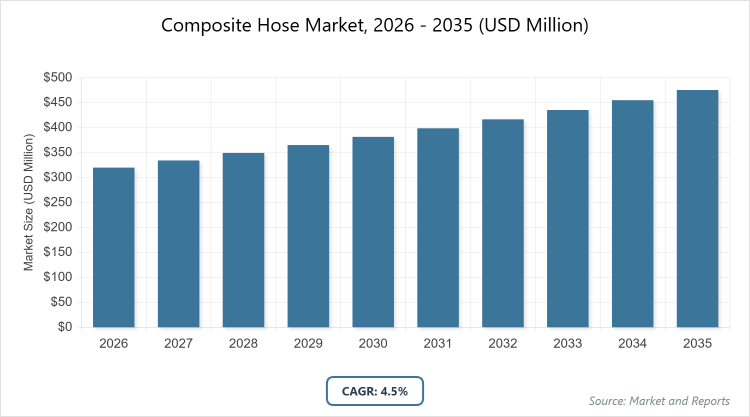
According to MarketnReports, the global composite hose market size was estimated at USD 320 million in 2025 and is expected to reach USD 510 million by 2035, growing at a CAGR of 4.5% from 2026 to 2035. Composite Hose Market is driven by increasing demands for safe and efficient fluid transfer solutions in expanding industries like oil & gas and chemical processing, alongside a growing preference for these lightweight, flexible, and chemically resistant alternatives over traditional rigid piping or rubber hoses.
What are the Key Insights into the Composite Hose Market?
- Global composite hose market valued at approximately USD 320 million in 2025, projected to reach USD 510 million by 2035.
- Expected CAGR of around 4.5% from 2026 to 2035, driven by industrial expansion and regulatory compliance.
- Dominant subsegment by media type: Chemicals, accounting for the largest share due to high compatibility needs.
- Dominant subsegment by inner liner: Polypropylene, holding over 40% market share for cost-effectiveness.
- Dominant subsegment by application: Tanker trucks, leading with around 35% share for mobile transfer.
- Dominant subsegment by end-use: Oil & gas, contributing over 50% revenue.
- Dominant region: Asia-Pacific, contributing over 40% of global revenue with China as the leading country.
What is the Composite Hose Industry Overview?
Industry Overview
Composite hoses are specialized flexible conduits constructed from multiple layers of thermoplastic films, fabrics, and helical wires, designed to safely transfer a variety of fluids including chemicals, oils, and gases under high pressure and in harsh environments. These hoses offer superior resistance to corrosion, abrasion, and extreme temperatures compared to traditional rubber or metal hoses, making them indispensable in industries requiring reliable fluid handling without the risk of leaks or failu
res. The market encompasses the design, manufacturing, distribution, and maintenance of these hoses, catering to sectors like oil and gas, chemicals, pharmaceuticals, and food processing, where safety, flexibility, and lightweight properties are paramount. Composite hoses typically feature an inner liner for chemical compatibility, reinforcing layers for strength, and an outer cover for protection, allowing customization based on media type and application needs. This industry is driven by the need for efficient, durable transfer solutions that comply with stringent safety standards, reducing downtime and environmental risks while supporting global trade in hazardous materials through marine, rail, and road transport.
What are the Market Dynamics in the Composite Hose Sector?
Growth Drivers
The composite hose market is fueled by expanding industrial activities in oil and gas exploration, chemical manufacturing, and pharmaceutical production, where the demand for safe and efficient fluid transfer solutions rises with increasing production volumes and global trade. Stringent safety regulations and environmental standards mandate the use of high-performance hoses that prevent leaks and spills, driving adoption among operators seeking compliance and risk mitigation.
Technological advancements in material science, such as enhanced thermoplastic composites, improve hose durability and versatility, attracting investments from end-users aiming to optimize operations. The growth of emerging economies with rapid infrastructure development further amplifies demand, as new facilities require reliable hoses for handling aggressive media in diverse applications like marine bunkering and tanker loading.
Restraints
High initial costs associated with advanced composite materials and manufacturing processes limit market accessibility, particularly for small-scale operators in price-sensitive regions where cheaper alternatives like rubber hoses suffice for less demanding applications. Volatility in raw material prices, including polymers and metals, increases production expenses and affects profitability, while supply chain disruptions from geopolitical tensions or pandemics delay deliveries.
Limited standardization across regions leads to compatibility issues and higher customization needs, deterring widespread adoption. Environmental concerns over non-biodegradable components and disposal challenges also restrain growth, as industries face pressure to shift toward sustainable options amid evolving regulations.
Opportunities
Opportunities lie in the development of eco-friendly composite hoses using recyclable materials and bio-based polymers, aligning with global sustainability goals and opening markets in green-focused industries like renewable energy. Expansion into emerging applications such as cryogenic fluid transfer for LNG and hydrogen presents growth potential, driven by the energy transition and clean fuel initiatives. Strategic partnerships with end-users for customized solutions can enhance market penetration, while digital integration like smart sensors for real-time monitoring offers differentiation through predictive maintenance. Government incentives for infrastructure upgrades in developing regions provide avenues for market entry, fostering long-term contracts and technological collaborations.
Challenges
Adapting to diverse regulatory landscapes across countries poses challenges, as manufacturers must navigate varying safety certifications and environmental compliance, escalating R&D costs and time-to-market. The technical complexity of handling aggressive chemicals requires continuous innovation to prevent failures, demanding skilled labor and quality control investments.
Competition from alternative technologies like flexible pipes or metallic hoses intensifies pricing pressures, while counterfeit products undermine market trust and safety. Balancing lightweight design with high-pressure capabilities in extreme conditions remains a hurdle, necessitating advanced testing to ensure reliability amid growing demand for versatile applications.
Composite Hose Market: Report Scope
| Report Attributes | Report Details |
| Report Name | Composite Hose Market |
| Market Size 2025 | USD 320 million |
| Market Forecast 2035 | USD 510 million |
| Growth Rate | CAGR of 4.5% |
| Report Pages | 215 |
| Key Companies Covered | Parker Hannifin Corporation, Trelleborg AB, Eaton Corporation, Continental AG, Alfagomma Group, Dantec, and United Flexible |
| Segments Covered | By Media Type, Inner Liner, Application, End-Use and Region |
| Regions Covered | North America, Europe, Asia Pacific (APAC), Latin America, The Middle East and Africa (MEA) |
| Base Year | 2025 |
| Historical Year | 2020 – 2024 |
| Forecast Year | 2026 – 2035 |
| Customization Scope | Avail customized purchase options to meet your exact research needs. |
How is the Composite Hose Market Segmented?
The composite hose market is segmented by media type, inner liner, application, end-use, and region.
By Media Type The chemicals segment dominates the composite hose market, owing to its critical role in safely transferring aggressive substances like acids and solvents, where superior resistance to corrosion and permeation is essential, supported by stringent handling regulations in chemical industries. This dominance drives the market by necessitating specialized hoses that ensure safety and efficiency, boosting demand through high-value applications and encouraging material innovations that enhance compatibility, thereby expanding usage in global supply chains. The oil segment ranks second, utilized extensively for petroleum products due to its flexibility and lightweight nature ideal for dynamic environments, helping to propel market growth by aligning with the oil and gas sector’s expansion, reducing transportation risks, and supporting cost savings through durable, low-maintenance solutions.
By Inner Liner Polypropylene leads the inner liner segment, primarily because of its excellent chemical resistance, affordability, and versatility across various media, making it the preferred choice for standard applications in cost-conscious industries. This subsegment drives the market by enabling mass production and broad adoption, lowering entry barriers for users and fostering volume-driven growth through reliable performance in moderate conditions. PTFE follows as the second dominant, prized for its exceptional inertness to harsh chemicals and high temperatures, contributing to market expansion by catering to premium, high-stakes applications where failure is unacceptable, thus commanding higher prices and stimulating R&D in advanced composites.
By Application Tanker trucks dominate the application segment, as they require flexible, robust hoses for efficient loading and unloading of fluids in mobile settings, driven by the logistics demands of chemical and oil distribution. This leadership accelerates market growth by syncing with the rise in road transport infrastructure, ensuring safe handling and minimizing spills, which in turn increases regulatory compliance and operational efficiency. Marine bunkering ranks second, essential for ship fueling operations where hoses must withstand marine environments, helping to drive the market through integration with global shipping trends, enhancing durability for offshore use and supporting energy trade expansions.
By End-Use Oil & gas leads the end-use segment, fueled by the need for reliable transfer in exploration, refining, and distribution, where hoses handle hydrocarbons under pressure in challenging terrains. This dominance propels market growth by aligning with energy sector investments, promoting safety standards that reduce accidents and environmental impact, thereby attracting large-scale contracts. Chemicals follow as the second dominant, requiring hoses for precise handling of reactive materials in manufacturing, contributing to market expansion through innovation in compatibility and supporting industrial output in pharma and agrochemicals.
What are the Recent Developments in the Composite Hose Market?
- In 2023, Trelleborg AB introduced a new line of cryogenic composite hoses designed for LNG transfer, enhancing flexibility and thermal resistance to meet rising demand in clean energy applications, which positioned the company as a leader in sustainable fluid handling.
- Parker Hannifin acquired a specialty hose manufacturer in 2024, integrating advanced polymer technologies to expand its portfolio for chemical transfer, improving market reach and innovation in high-pressure solutions.
- In 2025, Eaton Corporation launched eco-friendly composite hoses with bio-based liners, targeting environmental regulations and appealing to green-focused industries, boosting adoption in Europe and Asia. Continental AG partnered with a logistics firm in late 2025 for custom tanker hoses, incorporating smart sensors for leak detection, enhancing safety and opening new revenue streams in digital monitoring.
What is the Regional Analysis of the Composite Hose Market?
- Asia-Pacific to dominate the market
Asia-Pacific dominates the composite hose market, driven by rapid industrialization, booming oil and gas activities, and extensive chemical manufacturing, with China as the dominating country due to its massive export-oriented industries, government infrastructure investments, and leadership in polymer production that fuel demand for cost-effective hoses. The region’s growth is supported by expanding ports and refineries, promoting adoption of durable hoses for marine and rail applications; India and Japan contribute through pharmaceutical and automotive sectors, but China’s dominance stems from its supply chain hubs, low-cost manufacturing, and policies like Belt and Road, enhancing global competitiveness and driving revenue through high-volume exports.
North America holds a significant share in the composite hose market, characterized by advanced oil shale operations and strict safety regulations, with the United States as the dominating country owing to its vast energy sector, technological innovations, and regulatory frameworks like OSHA that mandate high-quality hoses. The region benefits from shale gas boom and chemical exports, driving demand for specialized products; Canada supports through oil sands, but the U.S. leads with R&D centers and major players, boosting market expansion via premium applications and sustainability initiatives.
Europe exhibits steady growth in the composite hose market, focused on environmental compliance and renewable energy transitions, with Germany as the dominating country due to its engineering expertise, chemical industry strength, and EU regulations promoting low-emission hoses. The region is propelled by maritime trade and pharma manufacturing; the UK and Netherlands contribute via ports, but Germany’s leadership arises from export focus and green tech investments, fostering market development by addressing energy shifts and enhancing standards.
Rest of the World, including Latin America, Middle East, and Africa, shows emerging potential, with Saudi Arabia dominating in the Middle East through oil exports and Vision 2030, while Brazil leads in Latin America with petrochemical growth. Growth is driven by resource extraction and infrastructure; UAE and South Africa follow, but the region’s progress relies on foreign investments and tech transfers to improve safety, gradually increasing share in energy applications.
Who are the Key Market Players and Their Strategies in the Composite Hose Industry?
Parker Hannifin Corporation: Emphasizes innovation in high-pressure hoses, pursuing acquisitions and R&D for cryogenic applications to expand in energy sectors.
Trelleborg AB: Focuses on sustainable materials, leveraging partnerships for custom solutions in marine and chemical industries to enhance global presence.
Eaton Corporation: Prioritizes digital integration with sensors, targeting efficiency through product diversification and regional expansions.
Continental AG: Adopts eco-friendly strategies, investing in bio-based liners and collaborations for logistics applications to drive compliance.
Alfagomma Group: Concentrates on cost-effective manufacturing, expanding via dealerships in emerging markets for broad accessibility.
Dantec: Specializes in chemical-resistant designs, focusing on R&D for harsh environments to secure niche contracts.
United Flexible: Employs flexible production, pursuing mergers to strengthen aerospace and pharma segments.
What are the Current Market Trends in the Composite Hose Sector?
- Shift toward sustainable, bio-based materials to meet environmental regulations and reduce carbon footprints.
- Integration of smart technologies like IoT sensors for real-time monitoring and predictive maintenance.
- Growing demand for cryogenic hoses in LNG and hydrogen transfer amid energy transitions.
- Emphasis on lightweight designs to improve handling and reduce transportation costs.
- Rise in customization for specific media, enhancing compatibility in chemical and pharma sectors.
- Expansion in marine applications with anti-static features for safety in bunkering.
What Market Segments are Covered in the Report?
By Media Type
-
- Chemicals
- Oil
- Others
By Inner Liner
-
- Polypropylene
- PTFE
- Others
By Application
-
- Tanker Trucks
- Marine Bunkering
- Rail Cars
- Others
By End-Use
-
- Oil & Gas
- Chemicals
- Pharmaceuticals
- Food & Beverage
- Others
By Region
-
- North America
- U.S.
- Canada
- Europe
- UK
- Germany
- France
- Rest of Europe
- Asia Pacific
- China
- India
- Japan
- Rest of Asia Pacific
- Latin America
- Brazil
- Mexico
- Rest of Latin America
- Middle East & Africa
- UAE
- South Africa
- Rest of Middle East & Africa
- North America
Chapter 1. Preface
Chapter 2. Executive Summary
Chapter 3. Global Composite Hose Market - Industry Analysis
Chapter 4. Global Composite Hose Market- Competitive Landscape
Chapter 5. Global Composite Hose Market - Media Type Analysis
Chapter 6. Global Composite Hose Market - Inner Liner Analysis
Chapter 7. Global Composite Hose Market - Application Analysis
Chapter 8. Global Composite Hose Market - End-Use Analysis
Chapter 9. Composite Hose Market - Regional Analysis
Chapter 10. Company Profiles
Frequently Asked Questions
Composite hose market refers to the industry involved in the production and distribution of multi-layered flexible hoses used for transferring fluids like chemicals and oils in industrial applications.
Key factors include industrial expansion in oil & gas and chemicals, regulatory compliance for safety, technological advancements in materials, and sustainability initiatives.
The composite hose market is projected to grow from approximately USD 320 million in 2026 to USD 510 million by 2035, reflecting steady demand.
The CAGR for the composite hose market during 2026-2035 is expected to be around 4.5%, supported by end-use growth.
Asia-Pacific will contribute notably, accounting for over 40% of the market value, led by industrialization in China.
Major players include Parker Hannifin Corporation, Trelleborg AB, Eaton Corporation, Continental AG, Alfagomma Group, Dantec, and United Flexible, through innovations and expansions.
The global composite hose market report provides insights into size, segmentation, dynamics, regional analysis, players, trends, and forecasts for informed decisions.
The value chain includes raw material sourcing, manufacturing and assembly, distribution and sales, installation and maintenance, and end-user application.
Market trends are evolving toward sustainable and smart hoses, with preferences shifting to lightweight, customizable products that ensure safety and efficiency.
Regulatory factors include safety standards like ISO certifications, while environmental factors involve emission reductions and recyclable materials, promoting green innovations but raising costs.