
Cold Plasma Market Size, Share and Trends 2026 to 2035
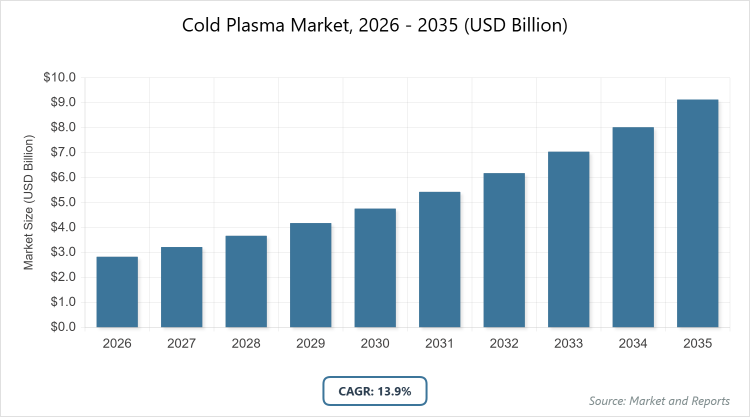
According to MarketnReports, the global Cold Plasma market size was estimated at USD 2.83 Billion in 2025 and is expected to reach USD 10.39 Billion by 2035, growing at a CAGR of 13.9% from 2026 to 2035. Cold Plasma Market is driven by expanding applications in healthcare for wound healing and sterilization, coupled with technological advancements.
What is the Industry Overview of the Cold Plasma Market?
The Cold Plasma Market encompasses technologies that generate partially ionized gas at low temperatures, enabling non-thermal processes for sterilization, surface modification, and material treatment without damaging heat-sensitive substrates. This market supports diverse industries by providing eco-friendly alternatives to traditional chemical methods, such as in medical device disinfection, electronics manufacturing for adhesion enhancement, and food processing for decontamination. It addresses the need for sustainable, efficient solutions that minimize environmental impact while improving product safety and performance.
The market definition includes all equipment, systems, and services related to cold plasma generation, including atmospheric and low-pressure variants, driven by innovations in plasma sources, control systems, and integration with AI for optimized applications, ensuring broad compatibility across sectors like healthcare and semiconductors.
What are the Key Insights into the Cold Plasma Market?
- The global Cold Plasma Market size was estimated at USD 2.83 Billion in 2025 and is expected to reach USD 10.39 Billion by 2035.
- Growing at a CAGR of 13.9% from 2026 to 2035.
- The Cold Plasma Market is driven by expanding applications in healthcare for wound healing and sterilization, coupled with technological advancements and increasing demand for eco-friendly processing solutions.
- Dominated subsegment in Regime: Atmospheric Cold Plasma with 72% share, because of its cost-effectiveness, ease of integration into existing processes, and versatility for large-scale applications without requiring vacuum systems.
- Dominated subsegment in Application: Wound Healing with 35% share, because of rising prevalence of chronic wounds and clinical evidence supporting faster healing times with minimal side effects.
- Dominated subsegment in End-User: Healthcare with 40% share, because of stringent sterilization requirements and growing adoption in medical treatments like cancer therapy and dentistry.
- Dominated region: North America with 37% share, because of advanced healthcare infrastructure, significant R&D investments, and supportive regulatory frameworks in the United States promoting innovative medical technologies.
What are the Market Dynamics of the Cold Plasma Market?
Growth Drivers
The primary growth drivers for the Cold Plasma Market include the surging demand for non-thermal sterilization and surface treatment solutions across healthcare and food industries, where cold plasma offers effective microbial inactivation without compromising material integrity or generating harmful residues. Technological advancements, such as improved plasma generators and integration with robotics, enhance precision and scalability, enabling broader adoption in electronics for better adhesion and coating processes.
Government initiatives promoting sustainable manufacturing practices further accelerate market expansion by incentivizing eco-friendly alternatives to chemical treatments, reducing environmental footprints. Additionally, the rising incidence of chronic diseases and wounds drives healthcare applications, with cold plasma proving efficacious in accelerating healing and combating antibiotic-resistant infections. Increasing investments in R&D by key players also foster innovation, leading to new applications in cancer treatment and environmental remediation, solidifying long-term market growth.
Restraints
Key restraints in the Cold Plasma Market arise from high initial capital costs associated with equipment and infrastructure, particularly for low-pressure systems requiring vacuum chambers, which limit adoption among small and medium enterprises in developing regions. Limited awareness and technical expertise in handling plasma technologies pose barriers, as specialized training is needed to optimize processes and ensure safety.
Regulatory hurdles, including varying standards for medical device approvals across countries, can delay market entry and increase compliance expenses. Moreover, scalability issues in achieving uniform plasma distribution over large surfaces challenge industrial applications, potentially leading to inefficiencies. Economic fluctuations and supply chain disruptions, such as those from global events, further impact component availability, hindering steady market progression.
Opportunities
Opportunities in the Cold Plasma Market are prominent through expanding applications in emerging sectors like aerospace and automotive, where plasma treatments improve material durability and reduce emissions via eco-friendly coatings. Collaborations between technology providers and end-users, such as partnerships in food processing for extended shelf life without preservatives, open new revenue streams.
Advancements in portable and AI-integrated devices enable on-site medical treatments, tapping into the growing telemedicine and home healthcare trends. Government funding for green technologies in regions like Europe and Asia Pacific supports infrastructure development for plasma-based pollution control and water purification. The rise of personalized medicine also presents avenues for customized plasma therapies in oncology, positioning companies to innovate and capture niche markets with high growth potential.
Challenges
Challenges in the Cold Plasma Market include achieving consistent plasma quality and process control across diverse applications, as variations in gas composition and pressure can affect efficacy and reproducibility. High energy consumption for generating stable plasma fields raises operational costs, particularly in energy-sensitive industries. Integrating cold plasma systems into existing manufacturing lines requires significant modifications, leading to downtime and additional expenses.
Intellectual property disputes and the need for continuous innovation to stay competitive add pressure on R&D budgets. Furthermore, addressing safety concerns related to ozone generation and electromagnetic interference is crucial, especially in healthcare settings, necessitating robust mitigation strategies to ensure user and environmental protection.
Cold Plasma: Report Scope
| Report Attributes | Report Details |
| Report Name | Cold Plasma Market |
| Market Size 2025 | USD 2.83 Billion |
| Market Forecast 2035 | USD 10.39 Billion |
| Growth Rate | CAGR of 13.9% |
| Report Pages | 220 |
| Key Companies Covered |
Adtec Healthcare Limited, Apyx Medical, CINOGY System GmbH, terraplasma medical GmbH, neoplas med GmbH, Plasmatreat GmbH, relyon plasma GmbH, Nordson Corporation, Enercon Industries Corporation, Europlasma N.V., Henniker Plasma, Coating Plasma Innovation, US Medical Innovations, LLC, Tantec Group, and Others |
| Segments Covered | By Regime, By Application , By End-User, and By Region |
| Regions Covered | North America, Europe, Asia Pacific (APAC), Latin America, and The Middle East and Africa (MEA) |
| Base Year | 2025 |
| Historical Year | 2020 – 2024 |
| Forecast Year | 2026 – 2035 |
| Customization Scope | Avail customized purchase options to meet your exact research needs. |
How is the Market Segmentation Structured in the Cold Plasma Market?
The Cold Plasma market is segmented by regime, application, end-user, and region.
Based on Regime Segment. The most dominant segment is Atmospheric Cold Plasma, which holds the largest market share due to its operational flexibility, lower setup costs, and ability to treat large or irregularly shaped surfaces without vacuum requirements; this dominance drives the market by facilitating widespread adoption in industries like textiles and food processing, enhancing efficiency and enabling real-time applications that accelerate overall innovation and penetration. The second most dominant segment is Low Pressure Cold Plasma, valued for its precision in controlled environments like electronics manufacturing; it contributes to market growth by supporting high-tech applications such as semiconductor etching and sterilization, where uniformity is critical, thereby attracting investments in advanced sectors and broadening the technology’s industrial footprint.
Based on Application Segment. The most dominant segment is Wound Healing, leading due to the increasing global burden of chronic wounds and diabetes-related complications, where cold plasma accelerates tissue regeneration and reduces infection risks; this drives market expansion by integrating into clinical practices, improving patient outcomes, and generating demand for portable medical devices that enhance accessibility. The second most dominant segment is Sterilization, essential for medical and food safety amid rising hygiene standards; it propels growth by offering non-chemical alternatives that comply with regulations, supporting scalable solutions in hospitals and processing plants to minimize contamination and extend product shelf life.
Based on End-User Segment. The most dominant segment is Healthcare, commanding the majority share owing to stringent infection control needs and advancements in plasma-based therapies for cancer and dentistry; this dominance fuels market growth by driving R&D in medical innovations, leading to regulatory approvals and widespread clinical adoption that boost revenue. The second most dominant segment is Electronics & Semiconductors, driven by the need for precise surface activation and cleaning in microelectronics production; it aids expansion by enabling higher yields in device manufacturing, aligning with the tech industry’s miniaturization trends and attracting investments in high-value applications.
What are the Recent Developments in the Cold Plasma Market?
- In September 2025, Niterra Ventures Company invested an additional USD 18 million in Neoplas Med GmbH to accelerate international expansion and development of its argon cold plasma jet device, kINPen MED, for wound healing applications.
- In July 2025, Venture Medical LLC led a strategic investment round exceeding USD 10 million in Plasmacure BV to support U.S. regulatory approval and market expansion for its PLASOMA cold plasma wound healing system.
- In October 2025, BioLab Holdings, Inc. partnered with Terraplasma medical GmbH to develop a portable cold atmospheric plasma device for advanced medical treatments.
How Does Regional Analysis Impact the Cold Plasma Market?
- North America to dominate the global market.
North America, valued at approximately USD 1.05 billion in 2025 and projected to reach USD 3.85 billion by 2035 at a CAGR of 13.9%, dominates with over 37% revenue share due to robust healthcare infrastructure, high R&D investments, and favorable regulatory environments supporting medical innovations; the United States stands as the dominating country with leading companies and clinical trials advancing plasma therapies for wound care and cancer, bolstered by government grants and a large patient population driving adoption.
Europe exhibits strong growth, fueled by stringent environmental regulations and emphasis on sustainable technologies, with increasing applications in food safety and textiles; collaborations between academia and industry accelerate innovations, and Germany emerges as the dominating country through its engineering expertise, export-oriented manufacturing, and policies promoting green plasma solutions for industrial processes.
Asia Pacific is rapidly expanding, driven by industrialization and rising healthcare demands in populous nations, with investments in electronics and semiconductors boosting plasma usage; China dominates the region as the leading country, leveraging its manufacturing prowess, government subsidies for tech advancements, and growing focus on pollution control via plasma-based environmental applications.
Latin America shows promising development, supported by emerging healthcare reforms and agricultural needs for decontamination, though economic challenges persist; Brazil leads as the dominating country with initiatives in bio-medical research and partnerships for plasma sterilization in food exports, enhancing regional competitiveness.
The Middle East and Africa are gradually advancing, influenced by oil diversification efforts and healthcare improvements, with pilot projects in water treatment and wound care; the United Arab Emirates dominates through investments in innovative technologies and collaborations for sustainable applications in desalination and medical tourism.
Who are the Key Market Players in the Cold Plasma Market?
Adtec Healthcare Limited. Adtec Healthcare Limited specializes in medical plasma devices for wound healing and dermatology, with strategies focused on clinical trials and regulatory approvals to expand global reach; the company emphasizes portable systems and partnerships with hospitals to integrate plasma therapy into standard care protocols.
Apyx Medical. Apyx Medical develops helium-based plasma technologies for surgical applications, employing strategies like product diversification and acquisitions to strengthen its portfolio; it targets aesthetic and oncology markets through training programs and evidence-based marketing to drive adoption.
CINOGY System GmbH. CINOGY System GmbH offers atmospheric plasma solutions for surface treatment, with strategies centered on customization and R&D for industrial clients; the company collaborates with electronics manufacturers to optimize adhesion processes, enhancing efficiency and sustainability.
terraplasma medical GmbH. terraplasma medical GmbH focuses on cold plasma for infection control, strategizing through clinical validations and portable device innovations; it partners with research institutions to advance antimicrobial applications, positioning itself in healthcare and veterinary sectors.
neoplas med GmbH. neoplas med GmbH provides argon plasma jets for wound care, with strategies involving international expansions and funding for platform development; the company invests in user-friendly designs to facilitate clinical integration and accelerate healing outcomes.
Plasmatreat GmbH. Plasmatreat GmbH excels in open-air plasma for coatings, employing strategies like nozzle innovations for low-temperature treatments; it targets automotive and aerospace through eco-friendly solutions, reducing chemical usage and improving material bonds.
relyon plasma GmbH. relyon plasma GmbH offers modular plasma systems for disinfection, with strategies including strategic partnerships for medical advancements; the company focuses on AI integration for process optimization, expanding into environmental and packaging applications.
Nordson Corporation. Nordson Corporation provides plasma surface activation for electronics, strategizing via acquisitions and global supply chains; it emphasizes precision engineering to support semiconductor yields and sustainable manufacturing.
Enercon Industries Corporation. Enercon Industries Corporation specializes in corona and plasma treaters for adhesion, with strategies focused on energy-efficient designs; the company serves packaging and textiles through customized installations and after-sales support.
Europlasma N.V. Europlasma N.V. develops low-pressure plasma for textiles, employing strategies like R&D in nanofinishes; it targets fashion and medical fabrics with eco-friendly treatments, complying with environmental standards.
Henniker Plasma. Henniker Plasma offers benchtop systems for research, strategizing through educational collaborations; the company expands into academia and small-scale industries with affordable, versatile plasma tools.
Coating Plasma Innovation. Coating Plasma Innovation focuses on PECVD coatings, with strategies involving innovation in barrier films; it serves food packaging by enhancing shelf life and reducing waste.
US Medical Innovations, LLC. US Medical Innovations, LLC develops plasma scalpels for surgery, strategizing via FDA clearances; the company invests in minimally invasive tools to improve surgical precision and patient recovery.
Tantec Group. Tantec Group provides plasma treaters for plastics, with strategies centered on automation integration; it targets automotive components for better paint adhesion and durability.
What are the Market Trends in the Cold Plasma Market?
- Increasing adoption of atmospheric pressure cold plasma for its cost-effectiveness and versatility in real-time applications across industries.
- Integration of AI and IoT for precise control, predictive maintenance, and optimization of plasma processes in healthcare and manufacturing.
- Growing focus on sustainability, with cold plasma replacing chemical treatments in sterilization, coatings, and environmental remediation.
- Expansion in medical applications, particularly for chronic wound management and cancer therapies amid rising global health challenges.
- Rising investments in R&D and partnerships to develop portable devices for on-site treatments and emerging markets.
What Market Segments and their Subsegments are Covered in the Cold Plasma Report?
By Regime
-
- Atmospheric Cold Plasma
- Low Pressure Cold Plasma
- Others
By Application
-
- Wound Healing
- Cancer Treatment
- Blood Coagulation
- Dentistry
- Surface Treatment
- Sterilization
- Coating
- Adhesion
- Decontamination
- Printing
- Others
By End-User
-
- Healthcare
- Electronics & Semiconductors
- Textile
- Food & Agriculture
- Polymers & Plastics
- Automotive
- Aerospace
- Packaging
- Environmental
- Others
By Region
-
- North America
- U.S.
- Canada
- Europe
- UK
- Germany
- France
- Rest of Europe
- Asia Pacific
- China
- India
- Japan
- Rest of Asia Pacific
- Latin America
- Brazil
- Mexico
- Rest of Latin America
- Middle East & Africa
- UAE
- South Africa
- Rest of Middle East & Africa
- North America
Chapter 1. Preface
Chapter 2. Executive Summary
Chapter 3. Global Cold Plasma Market - Industry Analysis
Chapter 4. Global Cold Plasma Market- Competitive Landscape
Chapter 5. Global Cold Plasma Market - Regime Analysis
Chapter 6. Global Cold Plasma Market - Application Analysis
Chapter 7. Global Cold Plasma Market - End-User Analysis
Chapter 8. Cold Plasma Market - Regional Analysis
Chapter 9. Company Profiles
Frequently Asked Questions
Cold plasma refers to a partially ionized gas at low temperatures that enables non-thermal processes for applications like sterilization, surface modification, and medical treatments without damaging sensitive materials.
Key factors include advancements in healthcare applications, increasing demand for eco-friendly sterilization, technological innovations in plasma generation, and supportive government policies for sustainable technologies.
The market is projected to grow from USD 2.83 billion in 2025 to USD 10.39 billion by 2035.
The CAGR is expected to be 13.9% during 2026-2035.
North America will contribute notably, holding 37% share, driven by advanced R&D and healthcare infrastructure in the United States.
Major players include Adtec Healthcare Limited, Apyx Medical, CINOGY System GmbH, terraplasma medical GmbH, neoplas med GmbH, and Plasmatreat GmbH, among others.
The report provides in-depth analysis including market size, forecasts, segmentation, dynamics, regional insights, key players, trends, and strategic recommendations.
The value chain includes raw material sourcing (gases, electrodes), equipment manufacturing, system integration and customization, distribution and installation, end-user application, and maintenance services.
Trends are moving towards portable, AI-integrated devices for efficiency, with consumers preferring sustainable, non-chemical solutions that align with eco-conscious and health-focused priorities.
Regulatory factors include approvals for medical devices and sterilization standards, while environmental factors involve the push for green technologies reducing chemical waste and emissions.