
Carpets and Rugs Market Size, Share and Trends 2026 to 2035
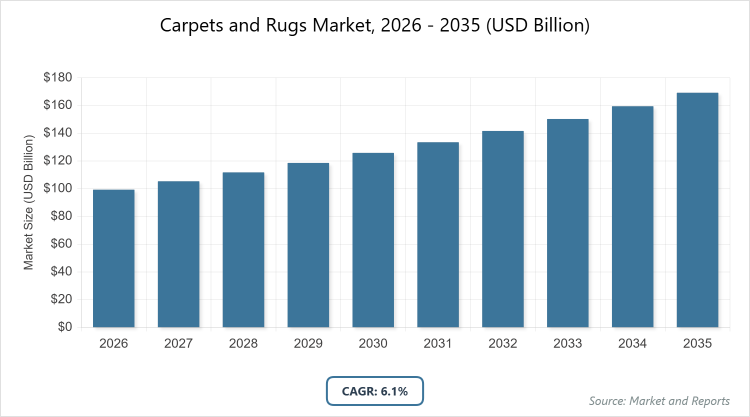
According to MarketnReports, the global carpets and rugs market size was estimated at USD 99.3 billion in 2025 and is expected to reach USD 181.2 billion by 2035, growing at a CAGR of 6.1% from 2026 to 2035. The increasing demand for sustainable and eco-friendly flooring solutions.
What are the Key Insights into Carpets and Rugs Market?
- Global carpets and rugs market size was USD 99.3 billion in 2025 and is projected to reach USD 181.2 billion by 2035.
- The market is anticipated to grow at a CAGR of 6.1% from 2026 to 2035.
- The market is driven by urbanization, rising disposable incomes, and demand for eco-friendly materials.
- The nylon segment dominates the material with around 40% share, owing to its durability, stain resistance, and cost-effectiveness for high-traffic areas.
- The tufted segment leads the type with approximately 60% market share, due to its efficient production process and versatility in designs for residential use.
- The residential segment is dominant in application with about 55% share, as it benefits from home renovation trends and aesthetic preferences.
- Asia Pacific dominates the regional market with around 40% share, driven by rapid urbanization, manufacturing capabilities, and growing middle-class population in China and India.
What is the Carpets and Rugs?
Industry Overview
The carpets and rugs market encompasses the production, distribution, and sale of floor coverings made from various materials such as nylon, wool, polyester, and natural fibers, designed to provide comfort, insulation, aesthetics, and durability in residential, commercial, and industrial settings, with types including tufted, woven, and needle-punched products that offer different textures, patterns, and functionalities like stain resistance or sound absorption to meet diverse consumer needs for interior decoration and functional flooring. This industry integrates sustainable practices with innovations in design and manufacturing, such as eco-friendly dyes and recycled materials, to address environmental concerns while catering to evolving preferences for customized and smart home solutions.
Market definition includes all textile-based floor coverings intended for indoor use, excluding hard flooring like tiles or wood, and it reflects the balance between traditional craftsmanship and modern technology amid urbanization and home improvement trends.
What are the Market Dynamics Affecting Carpets and Rugs?
Growth Drivers
The growth drivers in the carpets and rugs market are primarily propelled by rapid urbanization and rising disposable incomes in emerging economies, where expanding middle-class populations seek comfortable, stylish home interiors, leading to increased demand for affordable yet durable flooring options like nylon and polypropylene carpets that offer easy maintenance and aesthetic appeal for modern living spaces. This is complemented by innovations in sustainable materials, such as recycled polyester and natural fibers, which attract environmentally conscious consumers and comply with green building standards, enhancing market adoption in commercial sectors like hospitality. Furthermore, the boom in home renovation projects, spurred by remote work trends, fosters demand for customizable designs and smart features like antimicrobial treatments, driving overall market expansion through enhanced functionality and consumer satisfaction.
Restraints
Restraints in the carpets and rugs market include volatile raw material prices for synthetic fibers like nylon, influenced by oil market fluctuations, which elevate production costs and affect profitability for manufacturers in price-sensitive regions. Environmental concerns over non-biodegradable materials lead to regulatory pressures for sustainable alternatives, requiring costly transitions. Additionally, competition from hard flooring options like laminate and vinyl, which offer easier cleaning, poses challenges in humid climates, limiting growth in certain segments.
Opportunities
Opportunities in the carpets and rugs market arise from the integration of smart technologies, such as sensor-embedded rugs for health monitoring or heated carpets for energy efficiency, appealing to tech-savvy consumers in smart homes and opening premium pricing avenues. The shift toward eco-friendly and recycled materials enables differentiation, attracting green certifications for commercial projects. Moreover, untapped markets in Africa and Latin America present potential for affordable, localized products through partnerships, capitalizing on urbanization.
Challenges
Challenges in the carpets and rugs market involve supply chain disruptions for natural fibers like wool, affected by climate changes and trade barriers, creating availability issues and price instability. Maintaining product quality across diverse climates requires innovation in moisture-resistant treatments, increasing R&D costs. Additionally, counterfeit products in online channels erode brand trust, necessitating stricter quality controls and marketing efforts.
Carpets and Rugs Market: Report Scope
| Report Attributes | Report Details |
| Report Name | Carpets and Rugs Market |
| Market Size 2025 | USD 99.3 Billion |
| Market Forecast 2035 | USD 181.2 Billion |
| Growth Rate | CAGR of 6.1% |
| Report Pages | 220 |
| Key Companies Covered |
Mohawk Industries, Shaw Industries, Interface, Tarkett, Beaulieu International Group, and Others |
| Segments Covered | By Material, By Type, By Application, and By Region |
| Regions Covered | North America, Europe, Asia Pacific (APAC), Latin America, and The Middle East and Africa (MEA) |
| Base Year | 2025 |
| Historical Year | 2020 – 2024 |
| Forecast Year | 2026 – 2035 |
| Customization Scope | Avail customized purchase options to meet your exact research needs. |
How is the Carpets and Rugs Market Segmented?
The Carpets and Rugs market is segmented by material, type, application, and region.
Based on the Material Segment, the nylon subsegment is the most dominant, holding around 40% share, due to its resilience against wear and stains, ideal for high-traffic homes, which drives the market by offering long-lasting value and encouraging repeat purchases. The polyester subsegment is the second most dominant, with approximately 25% share, as it provides vibrant colors and affordability, contributing to market growth by attracting budget-conscious consumers in residential settings.
Based on Type Segment, the tufted subsegment is the most dominant, capturing about 60% share, attributed to its quick production and design flexibility, which propels the market by enabling mass customization and rapid supply to retail channels. The woven subsegment is the second most dominant, with around 20% share, owing to its premium quality for luxury applications, helping to drive the market through high-end demand in hospitality.
Based on Application Segment, the residential subsegment is the most dominant, with roughly 55% share, facilitated by home decor trends and renovations, driving the market by boosting consumer spending on aesthetics and comfort. The commercial subsegment is the second most dominant, holding about 30% share, propelled by office and hotel needs for durable flooring, which contribute to market expansion through large-volume contracts.
What are the Recent Developments in Carpets and Rugs Market?
- In 2025, Mohawk Industries launched a sustainable carpet line made from recycled ocean plastic, targeting eco-conscious consumers in Europe.
- In 2024, Shaw Industries acquired a tufted carpet manufacturer to expand its commercial portfolio, enhancing production capacity.
- In 2023, Interface introduced antimicrobial rugs for healthcare, complying with new hygiene standards post-pandemic.
- In 2022, Tarkett partnered with designers for customizable woven collections, boosting luxury segment sales.
How Does Regional Analysis Impact Carpets and Rugs Market?
- Asia Pacific to dominate the global market.
Asia Pacific dominates the carpets and rugs market with around 40% share, fueled by rapid urbanization and manufacturing hubs; China stands as the dominating country, where low-cost production and domestic demand drive exports, contributing to growth through affordable options.
North America follows with strong performance, supported by renovation trends; the United States dominates this region, with high disposable incomes boosting premium purchases, aiding expansion via e-commerce.
Europe maintains a steady position, influenced by a sustainability focus; Germany is the dominating country, leveraging green standards for woven products, supporting growth through EU regulations.
Latin America shows emerging momentum, driven by middle-class growth; Brazil dominates here, with residential demand for synthetic carpets, fostering development via local manufacturing.
The Middle East and Africa represent nascent opportunities, boosted by hospitality; the UAE dominates, with luxury hotel projects adopting high-end rugs, propelling growth through tourism.
Who are the Key Market Players in Carpets and Rugs?
- Mohawk Industries focuses on sustainable innovations like recycled carpets, employing acquisitions and R&D for eco-materials to lead in green segments.
- Shaw Industries specializes in commercial tufted products, utilizing supply chain optimizations and digital designs for customization.
- Interface offers modular tiles for offices, adopting sustainability and partnerships for global reach.
- Tarkett targets residential woven lines, with strategies involving designer collaborations and online sales.
- Beaulieu International Group emphasizes affordable synthetics, employing cost leadership and regional expansions.
What are the Market Trends Shaping Carpets and Rugs?
- Adoption of sustainable and recycled materials for eco-friendly products.
- Growth in customizable designs through digital printing technologies.
- Rise in antimicrobial and stain-resistant treatments for hygiene.
- Expansion of modular and easy-install options for commercial use.
- Focus on luxury natural fibers like wool for premium markets.
- Increase in online sales and virtual visualization tools.
What Market Segments and Subsegments are Covered in the Carpets and Rugs Report?
By Material
- Nylon
- Polyester
- Polypropylene
- Wool
- Cotton
- Silk
- Jute
- Sisal
- Seagrass
- Synthetic Fibers
- Others
By Type
- Tufted
- Woven
- Needle-Punched
- Knotted
- Flatweave
- Axminster
- Wilton
- Cut Pile
- Loop Pile
- Cut and Loop Pile
- Others
By Application
- Residential
- Commercial
- Hospitality
- Office Spaces
- Healthcare Facilities
- Educational Institutions
- Retail Stores
- Transportation
- Industrial
- Automotive Interiors
- Others
By Region
- North America
- U.S.
- Canada
- Europe
- UK
- Germany
- France
- Rest of Europe
- Asia Pacific
- China
- India
- Japan
- Rest of Asia Pacific
- Latin America
- Brazil
- Mexico
- Rest of Latin America
- Middle East & Africa
- UAE
- South Africa
- Rest of Middle East & Africa
Chapter 1. Preface
Chapter 2. Executive Summary
Chapter 3. Global Carpets and Rugs Market - Industry Analysis
Chapter 4. Global Carpets and Rugs Market- Competitive Landscape
Chapter 5. Global Carpets and Rugs Market - Material Analysis
Chapter 6. Global Carpets and Rugs Market - Type Analysis
Chapter 7. Global Carpets and Rugs Market - Application Analysis
Chapter 8. Carpets and Rugs Market - Regional Analysis
Chapter 9. Company Profiles
Frequently Asked Questions
Carpets and rugs are textile floor coverings made from fibers like nylon or wool, used for comfort, insulation, and aesthetics in homes and commercial spaces.
Key factors include urbanization, sustainable innovations, home renovations, and e-commerce growth.
The carpets and rugs market is projected to grow from approximately USD 105 billion in 2026 to USD 181.2 billion by 2035.
The CAGR value is expected to be 6.1% during 2026-2035.
Asia Pacific will contribute notably, driven by manufacturing and urbanization.
Major players include Mohawk Industries, Shaw Industries, Interface, Tarkett, and Beaulieu International Group.
The report provides detailed insights on size, trends, segments, regions, players, and forecasts from 2026 to 2035.
Stages include raw material sourcing, fiber processing, weaving/tufting, dyeing/finishing, distribution, and retail.
Trends are evolving toward sustainable, customizable products, with preferences for eco-friendly and durable options.
Regulatory factors include emission standards for manufacturing, while environmental factors involve demands for recyclable materials.