
Carotenoids Market Size, Share and Trends 2026 to 2035
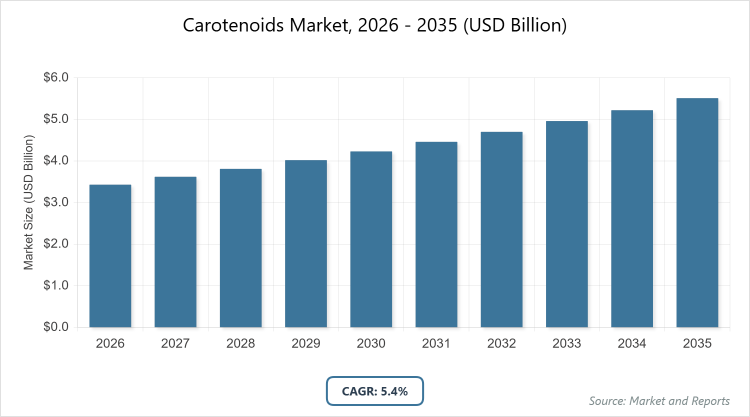
According to MarketnReports, the global Carotenoids Market size was estimated at USD 3.43 Billion in 2025 and is expected to reach USD 5.81 Billion by 2035, growing at a CAGR of 5.4% from 2026 to 2035. Carotenoids Market is driven by increasing consumer demand for natural antioxidants and clean-label products in food and supplements.
What is the Industry Overview of the Carotenoids Market?
The Carotenoids Market encompasses natural and synthetic pigments derived from plants, algae, and microorganisms, used for their antioxidant properties, colorant functions, and health benefits in various industries, including food, supplements, feed, and cosmetics. This market supports the growing emphasis on wellness by providing compounds like beta-carotene and lutein that enhance immune function, eye health, and skin protection, while serving as eco-friendly alternatives to artificial dyes.
It addresses consumer preferences for natural ingredients amid rising awareness of chronic diseases and clean-label trends, with innovations in extraction and formulation improving bioavailability and stability. The market definition includes all production, distribution, and application of carotenoids, excluding unrelated pigments, driven by regulatory shifts towards sustainable sourcing and biotechnological advancements for efficient, high-purity outputs.
What are the Key Insights into the Carotenoids Market?
- The global Carotenoids Market size was estimated at USD 3.43 Billion in 2025 and is expected to reach USD 5.81 Billion by 2035.
- Growing at a CAGR of 5.4% from 2026 to 2035.
- The Carotenoids Market is driven by increasing consumer demand for natural antioxidants, clean-label products, and health supplements amid rising awareness of wellness and chronic disease prevention.
- Dominated subsegment in Type: Beta-Carotene with 34% share, because of its dual role as a vitamin A precursor and natural colorant, offering cost-effectiveness and versatility in food and supplement applications.
- Dominated subsegment in Source: Synthetic with 58% share, because of its consistent quality, lower production costs, and scalability for large-volume industries like animal feed.
- Dominated subsegment in Application: Animal Feed with 42% share, because of its essential role in enhancing pigmentation and health in aquaculture and poultry, driven by global protein demand.
- Dominated region: Europe with 41% share, because of stringent regulations favoring natural ingredients, high consumer health consciousness, and strong presence of key manufacturers.
What are the Market Dynamics of the Carotenoids Market?
Growth Drivers
The growth drivers for the Carotenoids Market include heightened consumer awareness of health benefits, such as antioxidant protection against oxidative stress and age-related diseases, prompting increased incorporation in functional foods, supplements, and cosmetics for preventive wellness. Regulatory support for natural colorants over synthetic dyes in regions like Europe and North America accelerates adoption in food processing, reducing reliance on artificial additives and aligning with clean-label trends.
Advancements in biotechnological production, including microbial fermentation and algae cultivation, enhance yield and sustainability, lowering costs and appealing to eco-conscious brands. The expanding aquaculture industry demands carotenoids for pigmentation in salmon and shrimp, while rising veganism boosts plant-based supplement use. Corporate investments in R&D for biofortified crops and novel formulations further drive innovation, expanding applications in pharmaceuticals for eye health and skin care.
Restraints
Restraints in the Carotenoids Market stem from high production costs for natural variants, involving complex extraction from sources like algae or marigolds, which limit scalability and affordability compared to synthetics, particularly in price-sensitive emerging markets. Supply chain vulnerabilities, such as weather-dependent crop yields and geopolitical disruptions affecting raw materials from key producers like India and China, lead to price volatility and shortages. Regulatory hurdles, including varying approval standards for food additives across countries, delay market entry and increase compliance expenses.
Moreover, limited bioavailability in some formulations requires additional processing, raising costs, while consumer skepticism over synthetic options amid natural preference trends hampers balanced growth. Economic downturns also curb discretionary spending on premium supplements, slowing expansion in non-essential segments.
Opportunities
Opportunities in the Carotenoids Market arise from the surge in plant-based and vegan products, where natural carotenoids enhance color and nutrition in alternatives to animal-derived foods, supported by partnerships with food tech firms for innovative formulations. Expansion into emerging applications like personalized nutrition and cosmeceuticals, leveraging AI for customized supplements targeting specific health needs, opens niche revenue streams.
Government initiatives for biofortification in agriculture, particularly in Asia and Africa to combat vitamin deficiencies, foster large-scale adoption in fortified staples. Sustainable sourcing through vertical integration and certifications attracts premium branding, while collaborations with biotech startups for engineered strains improve efficiency. The growing pet food sector also presents avenues, as owners seek antioxidant-rich feeds for animal health, positioning companies for diversified growth.
Challenges
Challenges in the Carotenoids Market include achieving consistent quality and potency in natural extracts, as variations in source materials and extraction methods affect efficacy, requiring advanced quality control that increases operational complexity and costs. Competition from alternative antioxidants like vitamins C and E dilutes market share in supplements, necessitating differentiated marketing to highlight unique benefits. Intellectual property issues in biotechnological innovations can lead to disputes, slowing R&D progress.
Additionally, educating consumers on benefits amid misinformation demands robust campaigns, while adapting to stringent environmental regulations for sustainable harvesting adds logistical hurdles. Supply diversification to mitigate climate risks remains critical, as dependency on limited regions exposes the market to disruptions.
Carotenoids Market: Report Scope
| Report Attributes | Report Details |
| Report Name | Carotenoids Market |
| Market Size 2025 | USD 3.43 Billion |
| Market Forecast 2035 | USD 5.81 Billion |
| Growth Rate | CAGR of 5.4% |
| Report Pages | 220 |
| Key Companies Covered |
DSM, BASF SE, Chr. Hansen Holding A/S, Allied Biotech Corporation, Kemin Industries, Inc., Cyanotech Corporation, Fuji Chemical Industries Co., Ltd., Döhler GmbH, LycoRed Ltd., Divis Laboratories Limited, and Others |
| Segments Covered | By Type, By Source, By Application, and By Region |
| Regions Covered | North America, Europe, Asia Pacific (APAC), Latin America, and The Middle East and Africa (MEA) |
| Base Year | 2025 |
| Historical Year | 2020 – 2024 |
| Forecast Year | 2026 – 2035 |
| Customization Scope | Avail customized purchase options to meet your exact research needs. |
How is the Market Segmentation Structured in the Carotenoids Market?
The Carotenoids market is segmented by type, source, application, and region.
Based on Type Segment, The most dominant segment is Beta-Carotene, which holds the largest market share due to its widespread use as a vitamin A precursor and natural colorant in food and supplements, offering versatility and regulatory approval; this dominance drives the market by addressing nutritional deficiencies globally, enhancing product appeal in clean-label trends, and supporting growth in fortified foods that boost overall consumption. The second most dominant segment is Astaxanthin, valued for its potent antioxidant properties in aquaculture and cosmetics; it contributes to market growth by targeting premium health segments, improving animal pigmentation efficiency, and attracting investments in sustainable production methods.
Based on Source Segment, The most dominant segment is Synthetic, accounting for the majority share owing to its cost-effectiveness, high purity, and consistent supply for industrial applications; this leads market growth by enabling affordable inclusion in animal feed and pharmaceuticals, scaling production to meet global demand, and facilitating entry into price-sensitive markets. The second most dominant segment is Natural, preferred for clean-label preferences; it propels the market forward by commanding premium pricing in supplements and cosmetics, aligning with consumer health trends, and driving R&D in eco-friendly extraction.
Based on Application Segment, The most dominant segment is Animal Feed, leading due to its critical role in pigmentation and health for poultry and aquaculture amid rising protein consumption; this drives market expansion by supporting intensive farming efficiencies, complying with quality standards, and generating high-volume revenues. The second most dominant segment is Food & Beverages, driven by natural colorant demand; it aids growth by replacing artificial dyes, enhancing product shelf life, and catering to functional food innovations.
What are the Recent Developments in the Carotenoids Market?
- In March 2025, AstaReal showcased a new formulation combining astaxanthin with omega-3 fatty acids at a European nutraceutical event, targeting sports nutrition for enhanced recovery.
- In January 2025, NutraMaize received a USDA grant to study carotenoid-enriched corn’s impact on poultry health, building on prior research for sustainable feed solutions.
- In November 2025, Allied Biotech launched clear-color carotenoid products for transparent beverages, addressing demand for natural, stable colorants.
How Does Regional Analysis Impact the Carotenoids Market?
- Europe to dominate the global market.
Europe, valued at USD 1.41 billion in 2025 and projected to reach USD 2.38 billion by 2035 at a CAGR of 5.4%, dominates with over 41% revenue share due to stringent regulations banning artificial colorants, high consumer preference for natural ingredients in functional foods and supplements, and robust R&D infrastructure supported by EU funding for sustainable agriculture; Germany as the dominating country excels through its chemical giants like BASF advancing biotech extraction, while policies like the Farm to Fork strategy promote biofortified products, driving premium market segments in cosmetics and pharma.
North America experiences steady growth, bolstered by health-conscious consumers and FDA approvals for natural additives, with innovations in personalized nutrition enhancing supplement demand; the United States dominates with California-based firms like Cyanotech leading astaxanthin production from algae, supported by wellness trends and e-commerce expansions.
Asia Pacific is rapidly expanding, fueled by aquaculture booms and dietary supplement adoption in populous nations, with government subsidies for fortified foods addressing deficiencies; China as the dominating country leverages massive production scales in beta-carotene from microalgae, driven by export-oriented manufacturing and rising middle-class health spending.
Latin America shows promising development, driven by natural resource abundance for extraction and growing export to Europe; Brazil leads with marigold-based lutein production, supported by agribusiness investments and regional trade agreements.
The Middle East and Africa are emerging, influenced by nutritional programs and cosmetic demands; South Africa dominates through partnerships for sustainable sourcing, addressing vitamin deficiencies via fortified staples.
Who are the Key Market Players in the Carotenoids Market?
DSM. DSM focuses on sustainable carotenoid production through fermentation, with strategies including acquisitions for algae tech and partnerships for fortified foods to expand in emerging markets.
BASF SE. BASF SE emphasizes synthetic and natural blends, strategizing via R&D in stable formulations for feed and cosmetics, targeting clean-label trends.
Chr. Hansen Holding A/S. Chr. Hansen Holding A/S specializes in microbial-derived carotenoids, employing strategies like innovation in color stability for beverages and collaborations with food giants.
Allied Biotech Corporation. Allied Biotech Corporation offers clear-color solutions, with strategies involving expansions in transparent applications and certifications for natural sourcing.
Kemin Industries, Inc. Kemin Industries, Inc. targets animal nutrition, strategizing through antioxidant blends for feed efficiency and global supply chain optimizations.
Cyanotech Corporation. Cyanotech Corporation produces algae-based astaxanthin, with strategies focused on premium supplements and sustainability certifications.
Fuji Chemical Industries Co., Ltd. Fuji Chemical Industries Co., Ltd. integrates astaxanthin with omega-3s, employing strategies for sports nutrition formulations and Asian market penetrations.
Döhler GmbH. Döhler GmbH provides natural extracts, strategizing via clean-label innovations for beverages and R&D in bioavailability enhancement.
LycoRed Ltd. LycoRed Ltd. specializes in lycopene, with strategies including health claim substantiations for supplements and partnerships for functional foods.
Divis Laboratories Limited. Divis Laboratories Limited focuses on synthetic production, employing cost-leadership strategies for pharma and feed applications.
What are the Market Trends in the Carotenoids Market?
- Shift towards natural sources driven by clean-label demands and regulatory bans on synthetics.
- Rising use in functional foods and supplements for eye health and immunity amid aging populations.
- Innovations in stable, bioavailable formulations for cosmetics and transparent beverages.
- Expansion in aquaculture feed for pigmentation, supported by sustainable algae cultivation.
- Integration of biotech for cost-effective production, reducing dependency on crops.
What Market Segments and their Subsegments are Covered in the Carotenoids Report?
By Type
-
- Beta-Carotene
- Lutein
- Lycopene
- Astaxanthin
- Zeaxanthin
- Canthaxanthin
- Annatto
- Capsanthin
- Apocarotenal
- Fucoxanthin
- Others
By Source
-
- Natural
- Synthetic
- Others
By Application
-
- Food & Beverages
- Dietary Supplements
- Animal Feed
- Pharmaceuticals
- Cosmetics
- Others
By Region
-
- North America
- U.S.
- Canada
- Europe
- UK
- Germany
- France
- Rest of Europe
- Asia Pacific
- China
- India
- Japan
- Rest of Asia Pacific
- Latin America
- Brazil
- Mexico
- Rest of Latin America
- Middle East & Africa
- UAE
- South Africa
- Rest of Middle East & Africa
- North America
Chapter 1. Preface
Chapter 2. Executive Summary
Chapter 3. Global Carotenoids Market - Industry Analysis
Chapter 4. Global Carotenoids Market- Competitive Landscape
Chapter 5. Global Carotenoids Market - Type Analysis
Chapter 6. Global Carotenoids Market - Source Analysis
Chapter 7. Global Carotenoids Market - Application Analysis
Chapter 8. Carotenoids Market - Regional Analysis
Chapter 9. Company Profiles
Frequently Asked Questions
Carotenoids are organic pigments produced by plants and microorganisms, known for antioxidant properties and used as colorants, supplements, and feed additives.
Key factors include health awareness, natural ingredient preferences, regulatory support, and aquaculture growth.
The market is projected to grow from USD 3.61 billion in 2026 to USD 5.81 billion by 2035.
The CAGR is expected to be 5.4% during 2026-2035.
Europe will contribute notably, holding 41% share, driven by regulations in Germany.
Major players include DSM, BASF SE, Chr. Hansen Holding A/S, Allied Biotech Corporation, Kemin Industries, Inc., and Cyanotech Corporation, among others.
The report provides analysis on size, forecasts, segmentation, dynamics, regions, players, trends, and strategies.
The value chain includes raw material sourcing, extraction/synthesis, formulation, distribution, and end-use application.
Trends favor natural sources and functional benefits, with preferences for clean-label health products.
Regulations ban artificial dyes, while sustainability drives natural sourcing.