
Global Car Rental Market Size, Share, and Forecast 2026 to 2035
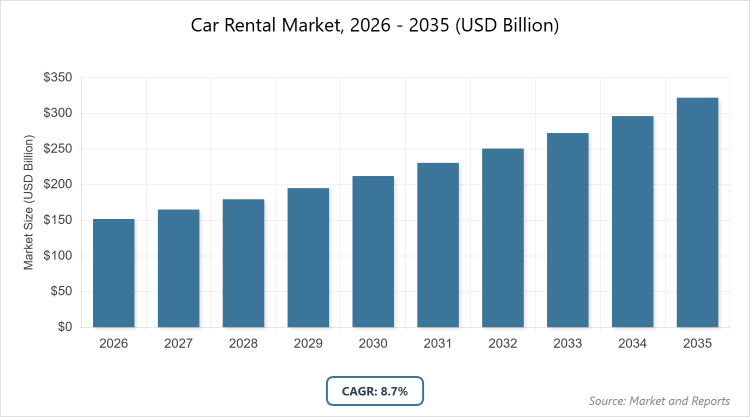
According to our latest research, the global car rental market is projected to grow from approximately USD 152 billion in 2026 to USD 348.69 billion by 2035. growing at a CAGR is estimated at 8.7% during 2026-2035. The Car Rental Market is primarily driven by the resurgence of global tourism and corporate travel, combined with a significant consumer shift toward on-demand mobility and “usership over ownership” as rising vehicle costs and urbanization make short-term rentals a more flexible and cost-effective alternative to private car ownership.
What are the Key Insights into the Car Rental Market?
- Global market value projected to reach USD 348.69 billion by 2035 from approximately USD 152 billion in 2026 (estimated based on 2025 value and CAGR).
- Compound Annual Growth Rate (CAGR) estimated at 8.7% during 2026-2035.
- Economy cars dominate the vehicle type segment.
- Leisure dominates the application segment.
- Airport rentals dominate the distribution segment.
- Asia Pacific dominates the regional market.
What is the Car Rental Market?
Industry Overview
The car rental market involves the short-term leasing of vehicles to individuals or businesses for personal, leisure, or commercial use, encompassing self-drive options, chauffeur-driven services, and fleet rentals through companies that maintain diverse inventories of cars, vans, and luxury vehicles. This market serves tourists, corporate travelers, and urban residents seeking flexible mobility without ownership costs, with services available at airports, city centers, and online platforms for bookings. It integrates digital technologies like app-based reservations, GPS tracking, and contactless pickups to enhance user experience, driven by tourism growth, urbanization reducing car ownership, and the rise of ride-sharing hybrids.
The market focuses on sustainability with electric and hybrid fleets to meet environmental regulations, while addressing challenges in fleet management, insurance, and seasonal demand fluctuations in a competitive landscape shaped by global travel trends and economic factors.
What are the Market Dynamics in the Car Rental Market?
Growth Drivers
The car rental market is driven by the surge in global tourism and business travel, fueled by economic recovery and eased restrictions post-pandemic, increasing demand for convenient, flexible mobility options like airport rentals and self-drive vehicles, alongside the rise of digital platforms enabling seamless online bookings and contactless services. Government incentives for sustainable transport promote EV rentals, while urbanization and the sharing economy reduce personal car ownership, boosting short-term rentals in cities. Innovations in fleet management with AI for optimization and partnerships with ride-hailing apps further accelerate growth, catering to millennials and Gen Z preferring experiential spending.
Restraints
Restraints include high operational costs for fleet maintenance, insurance, and fuel, exacerbated by volatile energy prices and supply chain disruptions affecting vehicle availability, while regulatory variations on emissions and licensing increase compliance burdens in different regions. Competition from ride-sharing services like Uber reduces demand for traditional rentals, and economic downturns impact travel spending, limiting market expansion in sensitive sectors.
Opportunities
Opportunities lie in the expansion of EV and hybrid fleets to align with sustainability trends and government subsidies, opening premium segments for eco-conscious travelers, while digital integrations like app-based subscriptions and AI personalization can capture younger demographics in urban areas. Emerging markets in Asia offer growth through tourism booms and infrastructure development, fostering partnerships for localized services.
Challenges
Challenges encompass navigating regulatory inconsistencies across borders that complicate international expansions, alongside cybersecurity threats to booking platforms and data privacy concerns under laws like GDPR. Fleet electrification requires infrastructure investments, while competition from alternative mobility reduces traditional rental appeal, necessitating adaptive strategies.
Car Rental Market: Report Scope
| Report Attributes | Report Details |
| Report Name | Car Rental Market |
| Market Size 2025 | USD 152 Billion |
| Market Forecast 2035 | USD 348.69 Billion |
| Growth Rate | CAGR of 8.7% |
| Report Pages | 220 |
| Key Companies Covered | Enterprise Holdings, Hertz, Avis Budget Group, Sixt, Europcar |
| Segments Covered | By Application, By Vehicle Type, By Distribution, By Region |
| Regions Covered | North America, Europe, Asia Pacific (APAC), Latin America, The Middle East and Africa (MEA) |
| Base Year | 2025 |
| Historical Year | 2020 – 2024 |
| Forecast Year | 2026 – 2035 |
| Customization Scope | Avail customized purchase options to meet your exact research needs. |
What is the Market Segmentation Analysis for the Car Rental Market?
The car rental market is segmented by application, vehicle type, distribution, and region.
By vehicle type segment, economy cars emerge as the most dominant subsegment, followed by luxury cars as the second most dominant. Economy cars lead due to their affordability and fuel efficiency, appealing to budget-conscious travelers and business users in high-volume segments like tourism and daily rentals; this dominance drives the market by enabling scalable fleet operations, attracting price-sensitive customers in emerging economies, and supporting digital platforms for quick bookings that boost utilization rates, thereby increasing revenue through high turnover and low maintenance costs. Luxury cars, as the second dominant, cater to premium tourism and corporate needs, contributing through higher margins in urban hubs.
By application segment, Leisure is the most dominant subsegment in the application segment, followed by business as the second most dominant. Leisure dominates owing to the boom in tourism and vacation travel, where rentals provide flexibility for sightseeing and road trips; this leadership propels the market by generating seasonal demand, fostering airport integrations, and enabling partnerships with travel apps that expand reach, thus driving overall growth through volume bookings and ancillary services. Business, for corporate travel, contributes through fleet contracts and an efficiency focus.
By distribution segment, Airport rentals are the most dominant subsegment in the distribution segment, followed by local rentals as the second most dominant. Airport rentals dominate due to convenience for travelers arriving by air, offering immediate access and high visibility; this position drives the market by capturing international tourism, enabling premium pricing during peaks, and supporting digital reservations that streamline operations, thus increasing profitability through high utilization. Local rentals contribute through urban mobility needs.
What are the Recent Developments in the Car Rental Market?
- In 2025, Enterprise expanded its EV fleet in Europe with 10,000 new electric vehicles, partnering with charging networks to support sustainable travel amid regulatory pushes.
- In late 2025, Hertz introduced AI-based booking apps for personalized recommendations, enhancing user experience in North America.
What is the Regional Analysis of the Car Rental Market?
- Asia Pacific to dominate the market
Asia Pacific dominates the car rental market with rapid urbanization and tourism growth; China leads as the dominating country through domestic travel booms and platforms like Didi, supporting economy rentals for business, while India contributes via airport expansions.
North America shows strong performance with business travel, where the United States leads through Enterprise and Hertz fleets at airports.
Europe focuses on sustainable rentals, led by Germany with Sixt’s EV emphasis.
Who are the Key Market Players and Strategies in the Car Rental Market?
- Enterprise Holdings focuses on fleet expansion and sustainability, emphasizing EV integrations for corporate clients.
- Hertz prioritizes digital apps and partnerships for seamless bookings in tourism segments.
- Avis Budget Group adopts cost efficiencies, targeting airport rentals with loyalty programs.
- Sixt leverages premium fleets in Europe, investing in luxury and EV options.
- Europcar concentrates on regional expansions, focusing on leisure travel services.
What are the Market Trends in the Car Rental Market?
- Rise of EV and hybrid rentals for sustainability.
- Growth in app-based, contactless bookings.
- Preference for subscription models over ownership.
- Expansion of the airport and urban rental hubs.
- Focus on personalized, AI-driven recommendations.
What Market Segments are Covered in the Report in Vertical format?
By Vehicle Type
- Economy Cars
- Luxury Cars
- SUVs
- Others
By Application
- Leisure
- Business
- Others
By Distribution
- Airport Rentals
- Local Rentals
- Online
- Others
By Region
- North America
- U.S.
- Canada
- Europe
- UK
- Germany
- France
- Rest of Europe
- Asia Pacific
- China
- India
- Japan
- Rest of Asia Pacific
- Latin America
- Brazil
- Mexico
- Rest of Latin America
- Middle East & Africa
- UAE
- South Africa
- Rest of Middle East & Africa
Chapter 1. Preface
Chapter 2. Executive Summary
Chapter 3. Global Car Rental Market - Industry Analysis
Chapter 4. Global Car Rental Market- Competitive Landscape
Chapter 5. Global Car Rental Market - Vehicle Type Analysis
Chapter 6. Global Car Rental Market - Application Analysis
Chapter 7. Global Car Rental Market - Distribution Analysis
Chapter 8. Car Rental Market - Regional Analysis
Chapter 9. Company Profiles
Frequently Asked Questions
Car rental is the short-term leasing of vehicles for personal or business use, offering flexibility without ownership costs through self-drive or chauffeured options.
Key factors include tourism recovery, digital bookings, EV adoption, urbanization reducing ownership, and regulatory incentives for sustainable transport.
The market is projected to grow from approximately USD 152 billion in 2026 to USD 348.69 billion by 2035.
The CAGR is estimated at 8.7% during 2026-2035.
Asia Pacific will contribute notably due to tourism and urbanization growth.
Major players include Enterprise Holdings, Hertz, Avis Budget Group, Sixt, Europcar.
The report provides comprehensive insights into market size, forecasts, segmentation, regional analysis, key players, trends, dynamics, and developments.
The value chain includes vehicle procurement, fleet maintenance, booking platforms, rental operations, and customer service with insurance.
Trends are evolving toward sustainable EVs and digital bookings, with consumers preferring flexible, app-based services for convenience.
Regulatory factors include emission standards promoting EVs, while environmental factors involve sustainability mandates reducing carbon footprints.