
Car Care Products Market Size, Share and Trends 2026 to 2035
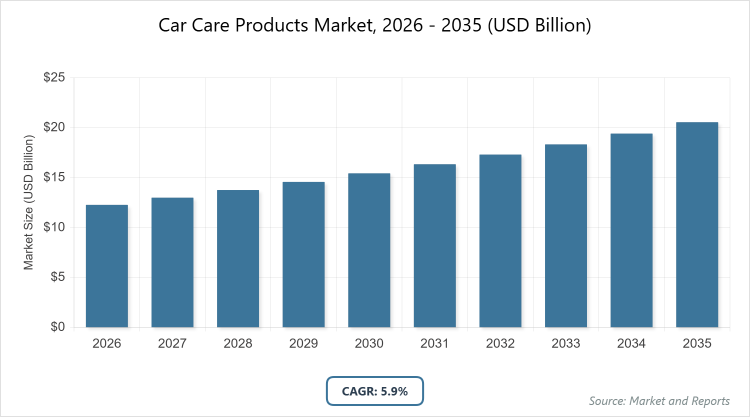
The global Car Care Products Market size was estimated at USD 12.27 Billion in 2025 and is expected to reach USD 20.55 Billion by 2035, growing at a CAGR of 5.9% from 2026 to 2035. The Car Care Products Market is primarily driven by increasing global vehicle ownership and a growing consumer emphasis on vehicle maintenance, longevity, and aesthetic preservation.
What are the Key Insights?
- Market Value in 2026: USD 12.27 billion
- Market Value in 2035: USD 20.55 billion
- CAGR (2026-2035): 5.9%
- Dominated Subsegment in Product Type: Cleaning and Washing Products
- Second Dominated Subsegment in Product Type: Waxes and Polishes
- Dominated Subsegment in Application: Exterior Care
- Second Dominated Subsegment in Application: Interior Care
- Dominated Subsegment in Distribution Channel: Retail (B2C)
- Second Dominated Subsegment in Distribution Channel: Service Centers and Garages (B2B)
- Dominated Region: North America
What is the Industry Overview?
The car care products market refers to the industry involved in the production, distribution, and sale of various items designed to clean, maintain, protect, and enhance the appearance and functionality of automobiles. This encompasses a broad array of formulations and tools tailored for both interior and exterior vehicle surfaces, such as detergents for washing, polishes for shining bodywork, protectants for upholstery and dashboards, and specialized cleaners for glass, tires, and engines. These products cater to consumer needs for preserving vehicle aesthetics, extending lifespan through preventive maintenance, and addressing environmental factors like dirt, UV exposure, and wear from daily use. The market serves individual vehicle owners, professional detailing services, and automotive aftermarket channels, emphasizing user-friendly applications that promote do-it-yourself care while also supporting professional-grade solutions for comprehensive vehicle upkeep.
What are the Market Dynamics?
Growth Drivers
The car care products market is propelled by rising vehicle ownership worldwide, coupled with increasing consumer awareness about the importance of regular maintenance to enhance vehicle longevity and resale value. Advancements in product formulations, such as eco-friendly and multi-functional items, align with shifting preferences toward sustainable options, further boosting demand. Additionally, the expansion of e-commerce platforms has made these products more accessible, enabling convenient purchases and driving market penetration in emerging economies where urbanization and disposable incomes are on the rise.
Restraints
Despite positive momentum, the market faces hurdles from economic uncertainties and inflationary pressures that can deter non-essential spending on maintenance items. High raw material costs, particularly for chemical-based formulations, combined with stringent environmental regulations restricting certain ingredients, increase production expenses and limit affordability for price-sensitive consumers. Moreover, intense competition from low-cost counterfeit products erodes brand trust and market share for established players.
Opportunities
Emerging opportunities lie in the development of specialized products for electric vehicles, such as battery-safe cleaners and advanced coatings that cater to new automotive technologies. The growing trend toward premium and customized care solutions opens avenues for innovation in biodegradable and nanotechnology-based items. Expansion into untapped regions with rising automotive sales, along with partnerships between manufacturers and online retailers, presents significant potential for market growth through targeted marketing and product diversification.
Challenges
Key challenges include navigating volatile supply chains for raw materials, which can disrupt production and lead to shortages. Adapting to rapidly evolving consumer preferences for sustainable products while maintaining efficacy poses technical hurdles for manufacturers. Furthermore, the proliferation of DIY tutorials and home-based solutions competes with professional-grade products, requiring companies to continually innovate to differentiate their offerings in a saturated market.
Car Care Products Market: Report Scope
| Report Attributes | Report Details |
| Report Name | Car Care Products Market |
| Market Size 2025 | USD 12.27 Billion |
| Market Forecast 2035 | USD 20.55 Billion |
| Growth Rate | CAGR of 5.9% |
| Report Pages | 215 |
| Key Companies Covered |
3M Company, Turtle Wax, Meguiar’s, Illinois Tool Works, Spectrum Brands (Armor All), Tetrosyl, and SOFT99. |
| Segments Covered | By Product Type, By Application, By Distribution Channel and By Region |
| Regions Covered | Asia Pacific, North America, Europe, Latin America, The Middle East and Africa |
| Base Year | 2025 |
| Historical Year | 2020 – 2024 |
| Forecast Year | 2026 – 2035 |
| Customization Scope | Avail customized purchase options to meet your exact research needs. |
What is the Market Segmentation?
Product Type Segmentation
The product type segmentation in the car care products market includes categories such as cleaning and washing products, waxes and polishes, glass cleaning products, interior care products, and others like tire dressings and engine cleaners. The most dominant subsegment is cleaning and washing products, which hold the largest share due to their essential role in routine vehicle maintenance, high frequency of use, and broad consumer appeal across all vehicle types; this dominance drives the market by addressing basic hygiene needs that prevent long-term damage from dirt and contaminants, thereby encouraging repeat purchases and supporting overall industry growth through volume sales. The second most dominant subsegment is waxes and polishes, valued for their ability to provide protective coatings and aesthetic enhancements that appeal to enthusiasts and professionals alike; their prominence stems from increasing focus on vehicle appearance and protection against environmental factors, contributing to market expansion by premiumizing product offerings and fostering loyalty through visible results in shine and durability.
Application Segmentation
The application segmentation divides the market into exterior care and interior care. Exterior care emerges as the most dominant subsegment, capturing the majority share because it directly addresses visible aspects like body paint, wheels, and glass that are most exposed to external elements, driving demand through consumer priorities for curb appeal and resale value; this leads market growth by integrating with rising vehicle customization trends and professional detailing services that emphasize comprehensive protection. Interior care follows as the second most dominant, focusing on upholstery, dashboards, and air quality; its significance arises from growing health consciousness and comfort preferences, propelling the market forward by innovating allergen-free and odor-eliminating solutions that enhance user experience and encourage bundled purchases with exterior products.
Distribution Channel Segmentation
Distribution channels in the car care products market encompass retail (B2C), service centers and garages (B2B), e-commerce, and others. Retail (B2C) stands out as the most dominant subsegment, accounting for over 70% of sales owing to widespread availability in supermarkets, auto parts stores, and convenience outlets that facilitate impulse buys and accessibility for individual consumers; this dominance fuels market dynamics by leveraging high foot traffic and promotional strategies to boost volume and introduce new products to a broad audience. The second most dominant is service centers and garages (B2B), which cater to professional applications and bulk purchases; their role is bolstered by partnerships with automotive service providers, driving growth through specialized recommendations and integrated maintenance services that ensure consistent demand from fleet operators and detailing businesses.
What are the Recent Developments?
- In 2024, the auto care industry saw a significant push toward sustainability with several manufacturers launching eco-friendly product lines, including biodegradable cleaners and waterless wash solutions, responding to heightened environmental regulations and consumer demand for green alternatives that reduce water usage and chemical runoff. This shift not only aligned with global sustainability goals but also opened new revenue streams through premium pricing for these innovative formulations.
- The year 2025 marked a surge in digital integration, with key players introducing app-based tutorials and augmented reality tools for product application, enhancing user engagement and DIY adoption; this development was particularly evident in partnerships between brands and e-commerce platforms, leading to increased online sales and personalized recommendations that boosted market accessibility.
- Early 2026 witnessed expansions in electric vehicle-specific care products, such as non-conductive polishes and battery compartment cleaners, driven by the rising EV adoption; companies invested in R&D to address unique maintenance needs, resulting in product launches that catered to this growing segment and positioned the market for future-proof growth amid automotive electrification trends.
- How Do Different Regions Contribute to the Car Care Products Market?
What is the Regional Analysis?
North America dominates the car care products market, primarily driven by high vehicle ownership rates, a strong culture of personal vehicle maintenance, and robust infrastructure for automotive aftermarket services; the United States stands out as the dominating country due to its large consumer base, extensive retail networks like auto parts chains, and enthusiasm for car customization, which fuels demand for premium products and supports innovation in eco-friendly options, contributing significantly to global market share through high disposable incomes and widespread adoption of professional detailing.
Europe follows closely, characterized by stringent environmental regulations and a focus on sustainable mobility; Germany emerges as the dominating country with its advanced automotive industry, emphasis on high-quality engineering in car care, and growing preference for biodegradable products amid EU green initiatives, driving regional growth through exports and R&D in advanced formulations that align with consumer shifts toward eco-conscious maintenance.
Asia-Pacific exhibits rapid expansion owing to urbanization, rising middle-class populations, and increasing vehicle sales; China leads as the dominating country, propelled by its massive automotive manufacturing base, e-commerce boom for affordable products, and government policies promoting vehicle upkeep to combat pollution, thereby accelerating market penetration through low-cost innovations and expanding distribution channels in emerging cities.
Latin America shows steady progress, influenced by improving economic conditions and growing awareness of vehicle preservation; Brazil is the dominating country, benefiting from its large fleet of vehicles, tropical climate necessitating frequent cleaning, and rising imports of international brands that introduce advanced care solutions, fostering market development via local partnerships and targeted marketing to urban consumers.
The Middle East and Africa region is emerging with potential from oil-rich economies and increasing tourism; the United Arab Emirates dominates, driven by luxury vehicle ownership, harsh desert environments requiring protective products, and investments in automotive retail hubs, which enhance market growth through premium segment focus and collaborations with global players for climate-specific innovations.
Who are the Key Market Players and Their Strategies?
3M Company: This player employs strategies focused on innovation and sustainability, investing heavily in R&D for advanced adhesive and coating technologies that enhance product durability, while expanding through acquisitions to broaden its portfolio and strengthen global distribution networks.
Turtle Wax: Turtle Wax prioritizes consumer education and digital marketing, launching user-friendly DIY kits and leveraging social media for tutorials, alongside partnerships with auto retailers to increase accessibility and drive brand loyalty through affordable, high-performance formulations.
Meguiar’s: Meguiar’s strategy revolves around premium positioning and professional endorsements, developing specialized detailing products for enthusiasts and collaborating with automotive events to build community engagement, while emphasizing quality control to maintain its reputation in high-end markets.
Illinois Tool Works (ITW): ITW focuses on diversification and operational efficiency, integrating car care into its broader industrial portfolio through mergers, and targeting B2B channels like service centers with bulk solutions that emphasize cost-effectiveness and reliability.
Spectrum Brands (Armor All): This company adopts a mass-market approach with strong retail presence, innovating in multi-functional protectants and using data analytics for consumer insights, while pursuing eco-friendly lines to align with regulatory trends and expand into emerging markets.
Tetrosyl: Tetrosyl emphasizes regional customization and supply chain optimization, developing climate-specific products for Europe and Asia, and forming strategic alliances with distributors to enhance market penetration and respond quickly to local demands.
SOFT99: SOFT99’s strategy includes technological advancement in nanotechnology-based coatings, focusing on export growth from Japan, and investing in e-commerce platforms to reach global consumers with innovative, long-lasting protection solutions.
What are the Market Trends?
- Shift toward eco-friendly and biodegradable products driven by environmental regulations and consumer preferences for sustainable options.
- Rise in online sales and e-commerce platforms, making products more accessible with personalized recommendations and subscriptions.
- Development of EV-specific care items, such as non-abrasive cleaners for sensitive components, amid growing electric vehicle adoption.
- Integration of smart technologies, like app-guided application tools and AR tutorials, enhancing DIY user experiences.
- Focus on premium and customized solutions, including subscription boxes and specialized kits for luxury vehicles.
- Expansion in emerging markets through affordable, localized formulations to tap into rising vehicle ownership.
- Emphasis on multi-functional products that combine cleaning, protection, and enhancement in one application for convenience.
What Market Segments are Covered in the Report?
- Product Type
- Cleaning and Washing Products
- Waxes and Polishes
- Glass Cleaning Products
- Interior Care Products
- Tire Dressings
- Engine Cleaners
- Others
- Application
- Exterior Care
- Interior Care
- Distribution Channel
- Retail (B2C)
- Service Centers and Garages (B2B)
- E-commerce
- Others
By Region
-
- North America
- U.S.
- Canada
- Europe
- UK
- Germany
- France
- Rest of Europe
- Asia Pacific
- China
- India
- Japan
- Rest of Asia Pacific
- Latin America
- Brazil
- Mexico
- Rest of Latin America
- Middle East & Africa
- UAE
- South Africa
- Rest of Middle East & Africa
- North America
Chapter 1. Preface
Chapter 2. Executive Summary
Chapter 3. Global Car Care Products Market - Industry Analysis
Chapter 4. Global Car Care Products Market- Competitive Landscape
Chapter 5. Global Car Care Products Market - Product Type Analysis
Chapter 6. Global Car Care Products Market - Application Analysis
Chapter 7. Global Car Care Products Market - Distribution Channel Analysis
Chapter 8. Car Care Products Market - Regional Analysis
Chapter 9. Company Profiles
Frequently Asked Questions
The Car Care Products Market encompasses the industry dedicated to manufacturing and distributing items like cleaners, polishes, waxes, and protectants used for vehicle maintenance, enhancement, and protection, catering to both consumer and professional needs.
Key factors include increasing vehicle ownership, rising awareness of maintenance benefits, advancements in eco-friendly formulations, expansion of e-commerce, and the growing adoption of electric vehicles requiring specialized products.
The market is projected to grow from USD 12.27 billion in 2026 to USD 20.55 billion by 2035.
The CAGR is expected to be 5.9% during 2026-2035.
North America will contribute notably, driven by high vehicle ownership and strong maintenance culture.
Major players include 3M Company, Turtle Wax, Meguiar's, Illinois Tool Works, Spectrum Brands (Armor All), Tetrosyl, and SOFT99.
The report provides comprehensive insights into market size, growth drivers, segmentation, regional analysis, key players, trends, and future forecasts.
The value chain includes raw material sourcing, product manufacturing, distribution through retail and e-commerce, marketing and sales, and end-user application in vehicle maintenance.
Trends are shifting toward sustainable and EV-compatible products, with consumers preferring convenient, multi-functional items and online purchasing for personalization.
Stringent regulations on chemical ingredients and emissions are pushing for eco-friendly innovations, while environmental concerns drive demand for biodegradable options, influencing product development and market expansion.