
Capsule Endoscopy Market Size, Share and Trends 2026 to 2035
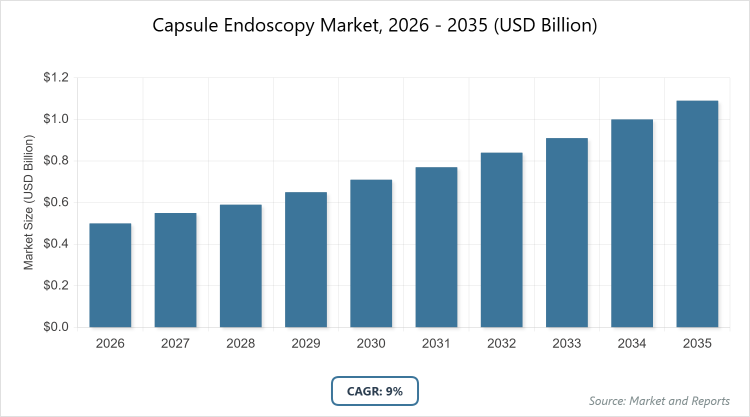
According to MarketnReports, the global Capsule Endoscopy Market size was estimated at USD 0.5 Billion in 2025 and is expected to reach USD 1.2 Billion by 2035, growing at a CAGR of 9% from 2026 to 2035. Capsule Endoscopy Market is driven by increasing prevalence of gastrointestinal disorders and advancements in minimally invasive diagnostic technologies.
What is the Industry Overview of Capsule Endoscopy Market?
The capsule endoscopy market encompasses a specialized segment of the medical diagnostics industry focused on non-invasive imaging of the gastrointestinal tract using ingestible, wireless capsules equipped with cameras, sensors, and transmitters. This market includes devices, accessories, and supporting systems designed to visualize areas like the small intestine, esophagus, and colon that are difficult to access with traditional endoscopy methods. Market definition refers to the ecosystem involving the development, manufacturing, distribution, and utilization of capsule-based endoscopic technologies for detecting conditions such as obscure gastrointestinal bleeding, Crohn’s disease, tumors, and polyps, offering patients a comfortable alternative to invasive procedures while enabling healthcare providers to achieve accurate diagnoses with minimal risk.
What are the Key Insights into Capsule Endoscopy Market?
- The global capsule endoscopy market was valued at USD 0.5 billion in 2025 and is projected to reach USD 1.2 billion by 2035.
- The market is expected to grow at a CAGR of 9% during the forecast period from 2026 to 2035.
- The market is driven by rising incidences of gastrointestinal disorders, technological advancements in imaging, and increasing demand for minimally invasive diagnostics.
- The small bowel capsule subsegment dominates the product segment with a 45% share due to its critical role in diagnosing hard-to-reach small intestine conditions like obscure bleeding and Crohn’s disease, offering high-resolution imaging and patient comfort that traditional methods cannot match.
- The obscure GI bleeding subsegment dominates the application segment with a 45% share as it addresses a common diagnostic challenge where conventional endoscopy fails, providing comprehensive visualization and early detection that improves patient outcomes.
- The hospitals subsegment dominates the end-user segment with a 60% share owing to their advanced infrastructure, high procedure volumes, and integration with multidisciplinary care teams for complex GI cases.
- North America holds the dominant regional share of 40% because of its robust healthcare infrastructure, high adoption of advanced technologies, favorable reimbursement policies, and a large patient pool with GI disorders.
What Drives the Market Dynamics of Capsule Endoscopy Market?
Growth Drivers
The growth drivers of the capsule endoscopy market are primarily fueled by the escalating global burden of gastrointestinal diseases, including colorectal cancer, inflammatory bowel disease, and celiac disease, which necessitate early and accurate detection. Technological innovations, such as enhanced battery life, higher-resolution cameras, and AI-integrated image analysis, have significantly improved diagnostic accuracy and efficiency, encouraging widespread adoption among healthcare providers. Additionally, the shift toward minimally invasive procedures reduces patient discomfort and hospital stays, aligning with healthcare cost-containment efforts and improving overall patient compliance. Government initiatives promoting preventive healthcare and increasing investments in medical research further accelerate market expansion by facilitating the development of next-generation capsules.
Restraints
Restraints in the capsule endoscopy market include the high cost of devices and procedures, which limits accessibility in low-income regions and for uninsured patients, potentially hindering market penetration. Limited reimbursement policies in certain countries create financial barriers for both providers and patients, slowing adoption rates. Technical limitations, such as capsule retention risks in patients with strictures or motility disorders, pose safety concerns and require additional interventions, deterring some clinicians. Moreover, the need for specialized training to interpret capsule data and integrate it with existing workflows adds to operational challenges, restricting broader utilization in resource-constrained settings.
Opportunities
Opportunities in the capsule endoscopy market arise from the integration of artificial intelligence and machine learning for automated lesion detection, which can streamline workflows and enhance diagnostic precision, opening new avenues for software-as-a-service models. Expanding applications beyond traditional GI diagnostics, such as pancreatic and esophageal screening, present untapped potential through innovative capsule designs. Emerging markets in Asia-Pacific and Latin America offer growth prospects due to rising healthcare expenditures, improving infrastructure, and increasing awareness of non-invasive diagnostics. Partnerships between device manufacturers and telehealth platforms could enable remote monitoring and data sharing, further democratizing access and fostering market innovation.
Challenges
Challenges facing the capsule endoscopy market involve stringent regulatory approvals and clinical validation requirements, which can delay product launches and increase development costs for manufacturers. Competition from alternative diagnostic modalities, like virtual colonoscopy or advanced fiber-optic endoscopes, may divert market share in certain applications. Data privacy and cybersecurity concerns with wireless transmission of patient images require robust protocols to maintain trust and compliance. Additionally, variability in capsule performance across diverse patient populations, including pediatrics and geriatrics, necessitates ongoing research to address inclusivity and efficacy gaps.
Capsule Endoscopy Market Report Scope
| Report Attributes | Report Details |
| Report Name | Capsule Endoscopy Market |
| Market Size 2025 | USD 0.5 Billion |
| Market Forecast 2035 | USD 1.2 Billion |
| Growth Rate | CAGR of 9% |
| Report Pages | 220 |
| Key Companies Covered | Medtronic, Olympus Corporation, Chongqing Jinshan Science & Technology, IntroMedic Co., Ltd., CapsoVision, RF Co., Ltd., AnX Robotica, Fujifilm Holdings America Corporation, Check-Cap, and Others |
| Segments Covered | By Product, By Application, By End-User, and By Region |
| Regions Covered | North America, Europe, Asia Pacific (APAC), Latin America, and The Middle East and Africa (MEA) |
| Base Year | 2025 |
| Historical Year | 2020 – 2024 |
| Forecast Year | 2026 – 2035 |
| Customization Scope | Avail customized purchase options to meet your exact research needs. |
How is the Market Segmentation Structured in Capsule Endoscopy Market?
The Capsule Endoscopy Market is segmented by product, application, end-user, and region. All the segments have been analyzed based on present and future trends and the market is estimated from 2026 to 2035.
Based on Product Segment, The small bowel capsule emerges as the most dominant subsegment due to its unparalleled ability to visualize the entire small intestine, an area inaccessible to traditional endoscopy, making it essential for diagnosing obscure bleeding, tumors, and inflammatory conditions; the esophageal capsule follows as the second most dominant, valued for its targeted imaging of esophageal disorders like Barrett’s esophagus and varices, driving market growth through early detection and reduced procedural risks, ultimately contributing to overall market expansion by addressing unmet needs in upper GI diagnostics.
Based on Application Segment, Obscure GI bleeding stands out as the most dominant subsegment because it resolves diagnostic gaps left by conventional methods, enabling comprehensive detection of hidden bleeding sources in the small bowel and improving patient prognosis; Crohn’s disease ranks as the second most dominant, benefiting from capsule endoscopy’s non-invasive monitoring of disease activity and mucosal healing, which supports personalized treatment plans and fuels market growth by enhancing chronic disease management and reducing the need for invasive follow-ups.
Based on End-User Segment, Hospitals represent the most dominant subsegment owing to their high procedural volumes, access to specialized gastroenterologists, and integration with advanced imaging systems for complex cases; ambulatory surgery centers are the second most dominant, driven by their cost-effectiveness, outpatient focus, and ability to handle routine diagnostics efficiently, propelling market growth through increased accessibility and shorter wait times for patients seeking minimally invasive GI evaluations.
What are the Recent Developments in Capsule Endoscopy Market?
- In May 2024, Medtronic received U.S. FDA clearance for its next-generation PillCam Genius SB capsule endoscopy kit, featuring improved imaging resolution and extended battery life to enhance small bowel diagnostics.
- In January 2024, AnX Robotica obtained FDA approval for its AI-powered endoscopy tool, designed to assist in analyzing small bowel capsule images for detecting bleeding in adults, boosting diagnostic efficiency.
- In December 2024, the Asian Institute of Gastroenterology introduced PillBotT, a robotic disposable endoscopy capsule developed by Endiatx, aimed at remote-controlled GI examinations.
- In April 2025, JINSHAN launched Vue Smart, an AI solution for capsule endoscopy that reduces reading time and improves lesion detection accuracy.
- In January 2025, CapsoVision secured FDA clearance for its CapsoCam Plus system for pediatric patients aged two and above, expanding non-invasive options for young patients.
How Does Regional Analysis Impact Capsule Endoscopy Market?
North America to dominate the global market.
North America leads the capsule endoscopy market with a 40% share, driven by advanced healthcare systems, high prevalence of GI disorders, and strong adoption of innovative technologies; the United States dominates within the region due to robust reimbursement policies, extensive R&D investments, and a large patient base, supported by key players like Medtronic and CapsoVision headquartered there.
Europe holds a significant position in the capsule endoscopy market, benefiting from universal healthcare coverage and increasing focus on preventive diagnostics; Germany stands out as the dominating country, fueled by its strong medical device industry, high-quality healthcare infrastructure, and government support for minimally invasive technologies.
Asia-Pacific is the fastest-growing region in the capsule endoscopy market, propelled by rising healthcare expenditures, expanding middle-class populations, and improving access to advanced diagnostics; China dominates the region with its massive patient pool, rapid technological adoption, and local manufacturers like Jinshan Science & Technology leading innovations.
Latin America shows emerging potential in the capsule endoscopy market, supported by growing awareness of GI health and investments in healthcare modernization; Brazil is the dominating country, driven by its large population, increasing private healthcare sector, and initiatives to address colorectal cancer screening.
The Middle East and Africa region experiences gradual growth in the capsule endoscopy market, aided by international partnerships and efforts to enhance diagnostic capabilities; South Africa dominates, thanks to its relatively advanced healthcare infrastructure and focus on tackling rising incidences of gastrointestinal diseases through imported technologies.
Who are the Key Market Players in Capsule Endoscopy Market?
Medtronic. Medtronic employs strategies focused on continuous innovation, such as launching AI-enhanced PillCam systems and securing FDA approvals for expanded indications, while forming partnerships with healthcare providers to integrate capsule endoscopy into telemedicine platforms for broader accessibility.
Olympus Corporation. Olympus Corporation leverages its expertise in optical technologies through R&D investments in high-resolution capsules and collaborations with AI firms to improve image analysis, alongside global expansion efforts to penetrate emerging markets with cost-effective solutions.
Chongqing Jinshan Science & Technology. Chongqing Jinshan Science & Technology emphasizes affordable, locally manufactured capsules tailored for Asian markets, with strategies including AI integration via Vue Smart and strategic alliances for distribution to enhance market share in high-growth regions.
IntroMedic Co., Ltd.. IntroMedic Co., Ltd. pursues product diversification with compact, user-friendly capsules and focuses on regulatory approvals in key markets, complemented by marketing campaigns highlighting patient comfort to drive adoption in outpatient settings.
CapsoVision. CapsoVision adopts a strategy of targeting niche applications like pediatric and pancreatic screening, securing breakthrough FDA designations, and partnering with distributors to expand its CapsoCam presence in underserved areas.
RF Co., Ltd.. RF Co., Ltd. concentrates on technological advancements in wireless transmission and battery efficiency, with strategies involving mergers for technology acquisition and emphasis on clinical trials to validate efficacy in diverse patient groups.
AnX Robotica. AnX Robotica focuses on AI-driven navigation with its NaviCam system, securing pediatric approvals and collaborating with academic institutions for research, aiming to position itself as a leader in smart endoscopy solutions.
Fujifilm Holdings America Corporation. Fujifilm Holdings America Corporation integrates its imaging heritage into capsule development, with strategies including cross-industry partnerships for hybrid diagnostics and investments in sustainable, reusable components to appeal to eco-conscious markets.
Check-Cap. Check-Cap prioritizes radiation-free colon screening capsules, pursuing clinical validations and regulatory clearances, while forming alliances with oncology centers to promote early cancer detection strategies.
What are the Market Trends Shaping Capsule Endoscopy Market?
- Integration of AI and machine learning for automated image analysis and lesion detection to reduce diagnostic time and improve accuracy.
- Expansion of capsule applications to pediatric and geriatric populations through specialized designs and regulatory approvals.
- Development of magnetically controlled and robotic capsules for targeted navigation and enhanced control during procedures.
- Growing adoption in emerging markets driven by cost reductions and localized manufacturing.
- Emphasis on telemedicine compatibility for remote data review and patient monitoring.
- Advancements in battery life and high-definition imaging for comprehensive GI tract coverage.
- Partnerships between manufacturers and healthcare providers to streamline reimbursement and training.
- Focus on sustainable, disposable capsules to minimize environmental impact.
- Rise of colon-specific capsules as alternatives to traditional colonoscopy for screening.
- Incorporation of biosensors for real-time physiological data alongside imaging.
What Market Segments and Subsegments are Covered in Capsule Endoscopy Report?
- By Product
- Small Bowel Capsule
- Esophageal Capsule
- Colon Capsule
- Workstation
- Recorder
- Accessories
- Magnetic Controlled Capsule
- Dual Camera Capsule
- High-Resolution Capsule
- AI-Integrated Capsule
- Others
- By Application
- Obscure GI Bleeding
- Crohn’s Disease
- Small Intestine Tumor
- Celiac Disease
- Esophageal Disorders
- Colonic Disorders
- Polyps Detection
- Inflammatory Bowel Disease
- Anemia Diagnosis
- Malabsorption Syndrome
- Others
- By End-User
- Hospitals
- Ambulatory Surgery Centers
- Clinics
- Diagnostic Centers
- Research Institutes
- Specialty Clinics
- Outpatient Facilities
- Academic Medical Centers
- Home Care Settings
- Emergency Departments
- Others
- By Region
-
- North America
- U.S.
- Canada
- Europe
- UK
- Germany
- France
- Rest of Europe
- Asia Pacific
- China
- India
- Japan
- Rest of Asia Pacific
- Latin America
- Brazil
- Mexico
- Rest of Latin America
- Middle East & Africa
- UAE
- South Africa
- Rest of Middle East & Africa
- North America
Frequently Asked Questions
The capsule endoscopy market involves the development and use of ingestible, wireless capsules for non-invasive imaging of the gastrointestinal tract to diagnose conditions like bleeding, tumors, and inflammatory diseases.
Key factors include rising GI disorder prevalence, technological advancements in imaging and AI, demand for minimally invasive procedures, and expanding healthcare access in emerging regions.
The market is projected to grow from USD 0.5 billion in 2025 to USD 1.2 billion by 2035.
The CAGR is expected to be 9% during 2026-2035.
North America will contribute notably, holding a 40% share due to advanced infrastructure and high adoption rates.
Major players include Medtronic, Olympus Corporation, Chongqing Jinshan Science & Technology, IntroMedic Co., Ltd., and CapsoVision.
The report provides comprehensive analysis including market size, trends, segmentation, regional insights, key players, and forecasts.
Stages include raw material sourcing, device manufacturing, quality testing, distribution, clinical application, and post-procedure data analysis.
Trends show a shift toward AI-enhanced diagnostics and robotic capsules, with consumers preferring non-invasive, comfortable procedures for early detection.
Regulatory factors include stringent FDA approvals for safety and efficacy, while environmental factors involve sustainable manufacturing to reduce electronic waste from disposable capsules.