
Cannabis Infused Beauty Products Market Size, Share, and Trends 2026 to 2035
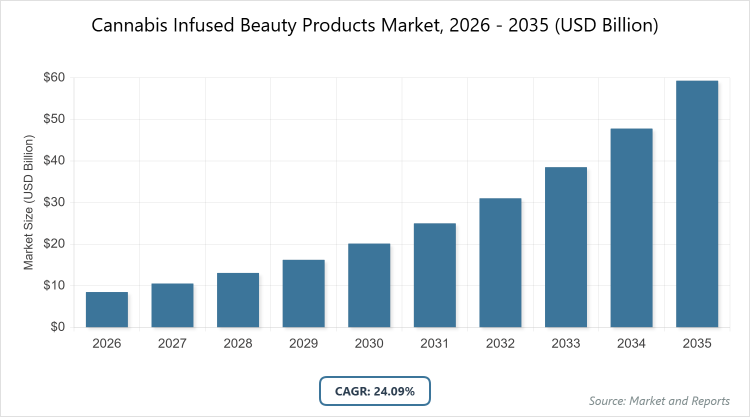
The global Cannabis Infused Beauty Products Market size was estimated at USD 8.5 Billion in 2025 and is expected to reach USD 59 Billion by 2035, growing at a CAGR of 24.09% from 2026 to 2035. The Cannabis Infused Beauty Products Market is primarily driven by increasing consumer demand for natural, therapeutic skincare solutions and the global expansion of legal frameworks for hemp-derived ingredients.
What are the Key Insights?
- Market Value in 2026: USD 8.5 Billion
- Market Value in 2035: USD 59 Billion
- CAGR (2026-2035): 24.09%
- Dominant Subsegment in Product Type: Skincare
- Second Dominant Subsegment in Product Type: Makeup & Haircare
- Dominant Subsegment in Source: Hemp
- Second Dominant Subsegment in Source: Marijuana
- Dominant Subsegment in Distribution Channel: Online Retailers
- Second Dominant Subsegment in Distribution Channel: Specialty Stores
- Dominant Region: North America
Industry Overview
The Cannabis Infused Beauty Products Market encompasses a diverse range of skincare, haircare, makeup, and fragrance items that incorporate cannabinoids such as CBD or THC derived from hemp or marijuana plants, designed to leverage their potential anti-inflammatory, antioxidant, and soothing properties for enhancing skin health, reducing acne, alleviating irritation, and promoting overall wellness. This market represents the intersection of the beauty industry with the burgeoning cannabis sector, focusing on natural and plant-based formulations that appeal to consumers seeking holistic, clean, and therapeutic alternatives to traditional cosmetics, often emphasizing vegan, cruelty-free, and sustainable attributes to align with modern preferences for ethical and environmentally conscious personal care solutions.
What are the Market Dynamics?
Growth Drivers
The growth of the Cannabis Infused Beauty Products Market is primarily fueled by increasing consumer awareness of the therapeutic benefits of cannabinoids like CBD, which offer anti-inflammatory and antioxidant effects that address common skin concerns such as acne, eczema, and aging, coupled with a broader shift toward natural, organic, and plant-based ingredients in beauty routines; regulatory advancements, including the legalization of hemp-derived CBD in regions like North America and Europe, have reduced barriers and encouraged product innovation, while rising demand for holistic wellness products and the expansion of e-commerce platforms have made these items more accessible, driving adoption among health-conscious demographics and boosting market expansion through collaborations between beauty brands and cannabis researchers.
Restraints
The market faces significant restraints due to varying and often stringent regulatory frameworks across regions, where prohibitions or ambiguous guidelines on cannabis derivatives can limit product development, marketing claims, and distribution, particularly in areas with bans on THC or unapproved CBD in cosmetics; additionally, consumer skepticism stemming from limited scientific validation of efficacy, potential stigma associated with cannabis, and higher production costs for high-quality, compliant ingredients can hinder widespread acceptance and slow penetration in conservative or emerging markets, creating operational uncertainties for manufacturers and retailers alike.
Opportunities
Opportunities in the Cannabis Infused Beauty Products Market abound with the potential for expansion into untapped emerging economies where rising disposable incomes and growing interest in natural skincare are opening doors for localized product adaptations and partnerships; innovations in formulations, such as combining CBD with trending ingredients like retinol or niacinamide, along with the rise of personalized beauty solutions and subscription models, present avenues for differentiation, while increasing regulatory relaxations and research collaborations could enable broader market access, especially in men’s grooming and multifunctional products that cater to specific skin types or concerns, fostering long-term growth through enhanced consumer trust and brand loyalty.
Challenges
Challenges persist in navigating the complex supply chain for cannabis-derived ingredients, where ensuring consistent quality, purity, and traceability amid fluctuating raw material availability and compliance with diverse international standards poses logistical hurdles; moreover, intense competition from both established beauty giants and niche startups, coupled with the need for substantial R&D investments to substantiate health claims and combat counterfeit products, can strain resources, while evolving consumer preferences and potential oversaturation in mature markets demand continuous adaptation to maintain relevance and profitability in this dynamic landscape.
Cannabis Infused Beauty Products Market: Report Scope
| Report Attributes | Report Details |
| Report Name | Cannabis Infused Beauty Products Market |
| Market Size 2025 | USD 8.5 Billion |
| Market Forecast 2035 | USD 59 Billion |
| Growth Rate | CAGR of 24.09% |
| Report Pages | 230 |
| Key Companies Covered |
Lord Jones, Kiehl’s, Cannuka, Hempz, Milk Makeup, Charlotte’s Web, and Estée Lauder Companies. |
| Segments Covered | By Product Type, By Source, By Distribution Channel, By Region |
| Regions Covered | Asia Pacific, North America, Europe, Latin America, The Middle East and Africa |
| Base Year | 2025 |
| Historical Year | 2020 – 2024 |
| Forecast Year | 2026 – 2035 |
| Customization Scope | Avail customized purchase options to meet your exact research needs. |
What is the Market Segmentation?
Product Type Segmentation
In the product type segmentation, skincare emerges as the most dominant category, commanding approximately 46% market share due to its broad appeal in addressing everyday concerns like inflammation, hydration, and anti-aging through CBD’s soothing properties, which drives the overall market by attracting wellness-oriented consumers seeking effective, natural alternatives to chemical-laden products and fueling innovation in creams and serums that integrate seamlessly into daily routines. The second most dominant is makeup & haircare, which holds significant traction for its multifunctional benefits in color cosmetics and scalp treatments, dominating through versatile applications that enhance user experience with added therapeutic effects, thereby propelling market growth by expanding into lifestyle segments where consumers prioritize products that combine aesthetics with health benefits.
Source Segmentation
Hemp stands out as the most dominant source, capturing around 56-85% of the market owing to its legal advantages with THC levels below 0.3%, making it widely accessible and compliant in many regions, which drives the market by enabling mass production of safe, non-psychoactive products that appeal to a broad audience concerned about purity and regulations. Marijuana follows as the second dominant, valued for its full-spectrum cannabinoid profiles that offer enhanced efficacy in targeted therapies, dominating through premium positioning in legalized markets and contributing to market expansion by catering to niche consumers seeking potent formulations for specific skin conditions.
Distribution Channel Segmentation
Online retailers dominate the distribution channel with over 50% share, driven by convenience, wide product variety, and direct-to-consumer models that leverage digital marketing and e-commerce growth, which propels the market by reaching tech-savvy millennials and Gen Z who prefer seamless shopping experiences with reviews and subscriptions. Specialty retail stores and pharmacies rank second, excelling in providing expert advice and in-person trials, dominating through trust-building in health-focused outlets and aiding market growth by bridging the gap for consumers seeking validated, high-quality products in physical settings.
What are the Recent Developments?
- In April 2025, Glass House Brands partnered with the University of California, Berkeley, to advance research on cannabis-derived ingredients for cosmetics, aiming to enhance formulation efficacy and substantiate health claims, which could accelerate innovation and regulatory acceptance in the industry.
- In January 2025, Carolina Dream launched its Magic Sauce, a new CBD-infused topical product line targeting skincare enthusiasts, emphasizing natural healing properties and expanding the brand’s portfolio to capture growing demand for multifunctional beauty solutions.
- Major players like L’Oréal, Estée Lauder, and Unilever introduced new CBD-infused cosmetic ranges in 2025, focusing on premium skincare lines that incorporate broad-spectrum CBD for anti-aging benefits, reflecting a trend toward mainstream adoption and boosting market visibility through high-profile marketing campaigns.
- In 2025, several acquisitions occurred, with large suppliers buying smaller CBD brands to broaden their reach, such as Estée Lauder’s integration of niche players to strengthen their position in the holistic beauty segment and drive consolidated growth.
What is the Regional Analysis?
North America Regional Analysis
North America dominates the global market with approximately 42-60% share, propelled by progressive legalization in the US and Canada, where over 24 US states have fully legalized cannabis, fostering a robust ecosystem for product innovation and consumer adoption; the United States stands as the dominating country, driven by high awareness of CBD’s benefits, a mature cosmetics industry, and key hubs like California and Colorado that host major players such as Lord Jones and Charlotte’s Web, enabling widespread distribution through online and specialty channels while addressing diverse skin concerns amid a culture emphasizing wellness and natural ingredients.
Europe Regional Analysis
Europe holds a significant 25-30% market share, emerging as a key growth area due to increasing acceptance of natural cosmetics and regulatory clarity, such as the EU’s inclusion of CBD in its CosIng database for safe use; Germany leads as the dominating country, supported by strong demand for organic skincare, a large consumer base prioritizing sustainability, and presence of brands like Kiehl’s and Cannuka, which capitalize on e-commerce expansion and collaborations to penetrate markets with rising disposable incomes and preferences for vegan products.
Asia Pacific Regional Analysis
Asia Pacific represents 10-15% of the market but is the fastest-growing region at a CAGR of around 16-22.8%, fueled by rising incomes, urbanization, and interest in natural beauty solutions despite regulatory hurdles like China’s ban; Japan emerges as the dominating country, bolstered by advanced skincare culture, legalization of hemp-derived CBD, and innovations from local and international brands targeting anti-aging and hydration needs in populous markets like South Korea and Australia.
South America Regional Analysis
South America accounts for a smaller share but shows potential with gradual legalization shifts, such as in Brazil and Argentina, where growing awareness of CBD’s therapeutic properties is driving adoption in skincare; Brazil dominates the region, leveraging its large population and expanding beauty industry to introduce affordable, natural products that address tropical climate-related skin issues through emerging online channels and partnerships.
Middle East and Africa Regional Analysis
The Middle East and Africa hold about 5% share, remaining nascent due to strict regulations but with untapped opportunities in natural wellness trends; South Africa leads as the dominating country, supported by progressive cannabis policies, a focus on organic ingredients, and brands exploring local markets for anti-inflammatory products suited to diverse skin types amid increasing urbanization and e-commerce penetration.
Who are the Key Market Players and Their Strategies?
Lord Jones: This player employs a premium positioning strategy, focusing on high-potency CBD formulations in luxury skincare and bath products, leveraging celebrity endorsements and direct-to-consumer sales to build brand loyalty and expand into international markets through strategic partnerships.
Kiehl’s: As part of L’Oréal, Kiehl’s integrates CBD into its heritage skincare lines, emphasizing clinical testing and natural ingredients to target urban consumers, with strategies centered on retail expansion in specialty stores and digital marketing to highlight efficacy for sensitive skin.
Cannuka: Cannuka combines CBD with manuka honey for unique therapeutic blends, adopting a clean beauty approach with transparent sourcing, and pursues growth through e-commerce dominance and collaborations with wellness influencers to educate consumers and drive online sales.
Hempz: Specializing in hemp-derived products, Hempz focuses on affordable, everyday beauty items like lotions, using mass-market distribution in pharmacies and supermarkets, with strategies involving product diversification and sustainability certifications to appeal to eco-conscious buyers.
Milk Makeup: This brand innovates with CBD-infused makeup for multifunctional use, targeting younger demographics via social media and Sephora partnerships, employing agile marketing and limited-edition launches to capitalize on trends like clean and vegan cosmetics.
Charlotte’s Web: Known for high-quality hemp extracts, Charlotte’s Web extends into beauty with topical solutions, prioritizing third-party testing and educational content, with strategies aimed at building trust through pharmacy channels and expanding into men’s grooming segments.
Estée Lauder Companies: Through acquisitions and in-house development, Estée Lauder incorporates CBD into premium lines, focusing on R&D for advanced formulations and global retail presence to lead in innovation and capture high-end market share.
What are the Market Trends?
- Increasing emphasis on clean and sustainable beauty, with consumers demanding ethically sourced, vegan, and cruelty-free cannabis-infused products that align with environmental consciousness.
- Rise of personalized skincare solutions, incorporating CBD tailored to individual skin types, concerns, or demographics like men’s grooming for irritation relief.
- Growth in e-commerce and digital marketing, driven by influencer partnerships, social media, and subscription models for convenient access to diverse product ranges.
- Innovation in formulations, such as combining CBD with complementary ingredients like retinol or niacinamide for enhanced efficacy in anti-aging and acne treatments.
- Shift toward THC-free options like broad-spectrum or isolate CBD to broaden appeal and comply with regulations in conservative markets.
- Expansion of holistic wellness integration, where beauty products emphasize mental health benefits alongside physical, intersecting with self-care trends.
What Market Segments are Covered in the Report?
By Product Type
- Skincare
- Makeup & Haircare
- Fragrances
- Others
By Source
- Hemp and Marijuana
By Distribution Channel
- Online Retailers
- Specialty Stores
- Supermarkets & Hypermarkets
- Pharmacies & Drugstores
- Others
By Region
-
- North America
- U.S.
- Canada
- Europe
- UK
- Germany
- France
- Rest of Europe
- Asia Pacific
- China
- India
- Japan
- Rest of Asia Pacific
- Latin America
- Brazil
- Mexico
- Rest of Latin America
- Middle East & Africa
- UAE
- South Africa
- Rest of Middle East & Africa
- North America
Chapter 1. Preface
Chapter 2. Executive Summary
Chapter 3. Global Cannabis Infused Beauty Products Market - Industry Analysis
Chapter 4. Global Cannabis Infused Beauty Products Market- Competitive Landscape
Chapter 5. Global Cannabis Infused Beauty Products Market - Product Type Analysis
Chapter 6. Global Cannabis Infused Beauty Products Market - Source Analysis
Chapter 7. Global Cannabis Infused Beauty Products Market - Distribution Channel Analysis
Chapter 8. Cannabis Infused Beauty Products Market - Regional Analysis
Chapter 9. Company Profiles
Frequently Asked Questions
The Cannabis Infused Beauty Products Market refers to the sector involving cosmetics and personal care items infused with cannabinoids like CBD or THC from hemp or marijuana, aimed at providing therapeutic benefits such as anti-inflammation and hydration for skin and hair.
Key factors include regulatory relaxations, rising consumer demand for natural and therapeutic ingredients, product innovations, e-commerce expansion, and increasing awareness of CBD's skin health benefits.
The market is projected to grow from approximately USD 8.5 billion in 2026 to USD 59 billion by 2035.
The CAGR is expected to be 24.09% during 2026-2035.
North America will contribute notably, holding the largest share due to favorable regulations and high consumer adoption.
Major players include Lord Jones, Kiehl's, Cannuka, Hempz, Milk Makeup, Charlotte's Web, and Estée Lauder Companies.
The report provides comprehensive insights into market size, growth projections, segmentation, regional analysis, key players, dynamics, trends, and recent developments.
The value chain includes raw material sourcing (hemp/marijuana cultivation), extraction and processing of cannabinoids, product formulation and manufacturing, packaging, distribution through channels like online and retail, and end-consumer marketing.
Trends are shifting toward sustainable, personalized, and clean beauty products, with preferences for THC-free options, holistic wellness integration, and e-commerce convenience.
Regulatory factors include varying legalization statuses and compliance requirements, while environmental factors involve sustainable sourcing demands and eco-friendly packaging to meet consumer expectations for green products.