
Cannabis in Food and Beverage Market Size, Share and Trends 2026 to 2035
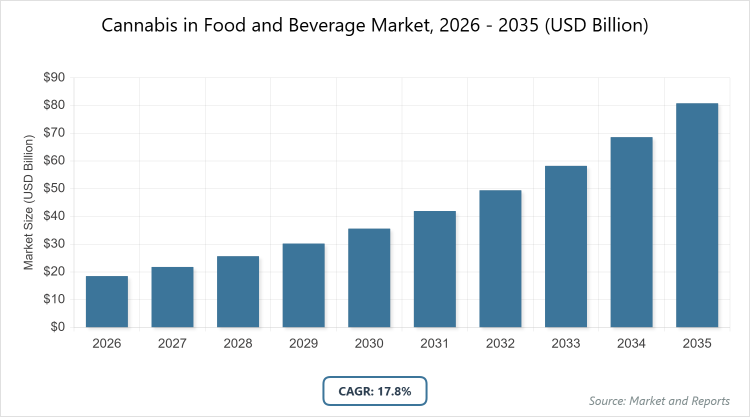
According to MarketnReports, the global Cannabis in Food and Beverage market size was estimated at USD 18.5 billion in 2025 and is expected to reach USD 95.2 billion by 2035, growing at a CAGR of 17.8% from 2026 to 2035. Cannabis in Food and Beverage Market is driven by increasing legalization and consumer demand for alternative wellness products.
What is the Overview of Cannabis in Food and Beverage Market?
The cannabis in food and beverage market refers to the industry involved in the production, distribution, and consumption of edible and drinkable products infused with cannabis compounds such as THC, CBD, or other cannabinoids, designed to deliver therapeutic or recreational effects through ingestion. This market encompasses a variety of formats including gummies, chocolates, teas, sodas, and baked goods, leveraging extraction technologies to ensure consistent dosing and flavor masking while complying with evolving regulations. Market definition includes all cannabis-infused consumables that blend culinary innovation with cannabis science, catering to consumers seeking discreet, smoke-free alternatives for relaxation, pain relief, or health benefits, and it intersects with the broader food, beverage, and wellness sectors to address shifting preferences toward natural and functional ingredients.
What are the Key Insights into Cannabis in Food and Beverage Market?
- The global cannabis in food and beverage market was valued at USD 18.5 billion in 2025 and is projected to reach USD 95.2 billion by 2035.
- The market is expected to grow at a CAGR of 17.8% during the forecast period from 2026 to 2035.
- The market is driven by progressive legalization in key regions and rising consumer interest in health-focused, non-alcoholic alternatives.
- In the product type segment, edibles dominate with a 65% share.
- This dominance is due to their discreet consumption, precise dosing, and wide variety appealing to new users, driving market growth by expanding accessibility and encouraging mainstream adoption.
- In the application segment, recreational dominates with a 55% share.
- This is attributed to increasing social acceptance and entertainment-oriented products, fueling expansion through innovative flavors and social consumption trends.
- In the distribution channel segment, dispensaries dominate with a 45% share.
- This stems from regulatory requirements and specialized expertise, propelling the market by ensuring compliance and building consumer trust in product quality.
- North America dominates the global market with a 68% share.
- This is owing to widespread legalization, robust infrastructure, and high consumer spending in the United States.
What are the Market Dynamics in Cannabis in Food and Beverage?
Growth Drivers
Growth drivers in the cannabis in food and beverage market are primarily propelled by the ongoing wave of legalization across various regions, which opens new markets and reduces stigma, allowing for broader consumer access and product innovation. The shift toward health and wellness trends has boosted demand for CBD-infused products that offer benefits like anxiety relief and pain management without psychoactive effects, attracting health-conscious demographics. Technological advancements in extraction and nano-emulsification enable better bioavailability and taste profiles, making these products more appealing than traditional cannabis consumption methods. Additionally, partnerships between cannabis companies and established food brands facilitate market entry and scale, while e-commerce growth enhances distribution efficiency, collectively driving robust expansion.
Restraints
Restraints in the cannabis in food and beverage market include inconsistent regulatory frameworks across countries and states, which create compliance challenges, limit interstate commerce, and increase operational costs for manufacturers navigating varying THC limits and labeling requirements. Consumer concerns over dosing accuracy and potential overconsumption due to delayed onset effects pose safety risks, leading to hesitancy among new users and potential backlash from health authorities. High production costs associated with quality control, testing, and sourcing premium ingredients further strain margins, particularly for smaller players. Moreover, banking restrictions and limited access to traditional financing in some regions hinder investment and growth for emerging companies.
Opportunities
Opportunities in the cannabis in food and beverage market arise from the expanding legalization in emerging markets like Europe and Asia-Pacific, where untapped consumer bases offer potential for customized products tailored to local tastes and cultural preferences. The rise of functional beverages and edibles infused with minor cannabinoids like CBG or CBN presents avenues for differentiation, targeting niche segments such as sleep aids or energy boosters. Collaborations with celebrity chefs and influencers can enhance brand visibility and drive premium product lines. Furthermore, advancements in sustainable packaging and organic sourcing align with eco-conscious trends, enabling companies to capture the growing segment of environmentally aware consumers.
Challenges
Challenges in the cannabis in food and beverage market encompass supply chain complexities, including sourcing consistent, high-quality cannabis extracts amid fluctuating agricultural yields and regulatory scrutiny on cultivation practices. Maintaining product stability and shelf life is difficult due to cannabinoid degradation, requiring ongoing R&D investments in formulation technologies. Intense competition from unregulated or black-market products undermines pricing and trust in legal offerings. Additionally, educational gaps among consumers regarding effects and dosages necessitate robust marketing efforts, while potential federal reclassifications could disrupt established state-level operations.
Cannabis in Food and Beverage Market: Report Scope
| Report Attributes | Report Details |
| Report Name | Cannabis in Food and Beverage Market |
| Market Size 2025 | USD 18.5 Billion |
| Market Forecast 2035 | USD 95.2 Billion |
| Growth Rate | CAGR of 17.8% |
| Report Pages | 220 |
| Key Companies Covered | Canopy Growth Corporation, Tilray Brands, Aurora Cannabis, Cronos Group, Green Thumb Industries, and Others |
| Segments Covered | By Product Type, By Application, By Distribution Channel, and By Region |
| Regions Covered | North America, Europe, Asia Pacific (APAC), Latin America, and The Middle East and Africa (MEA) |
| Base Year | 2025 |
| Historical Year | 2020 – 2024 |
| Forecast Year | 2026 – 2035 |
| Customization Scope | Avail customized purchase options to meet your exact research needs. |
The Cannabis in Food and Beverage market is segmented by product type, application, distribution channel, and region.
Based on Product Type Segment, the most dominant subsegment is edibles, while the second most dominant is beverages. Edibles lead due to their popularity for discreet and controlled consumption, offering diverse forms like gummies and chocolates that appeal to a broad audience, thereby driving market growth through high repeat purchases and integration into daily routines; beverages rank second as they provide a social, alcohol-alternative experience with rapid innovation in flavors and low-calorie options, contributing to expansion by attracting millennials and health-focused users seeking refreshing, functional drinks.
Based on Application Segment, the most dominant subsegment is recreational, while the second most dominant is medical. Recreational dominates owing to liberalization laws and cultural shifts toward casual use, propelling market growth via party-oriented products and experiential marketing that boost social consumption; medical follows as the second dominant, driven by therapeutic benefits for conditions like chronic pain, enhancing the market through physician endorsements and pharmaceutical-grade formulations that validate efficacy.
Based on Distribution Channel Segment, the most dominant subsegment is dispensaries, while the second most dominant is online retail. Dispensaries dominate because of their role in providing expert guidance and regulatory compliance, fueling market growth by building consumer confidence and facilitating impulse buys in controlled environments; online retail ranks second with the convenience of discreet delivery and wide selection, advancing the market through digital platforms that reach remote areas and younger demographics.
What are Recent Developments in Cannabis in Food and Beverage?
- In 2025, Canopy Growth launched a new line of THC-infused seltzers in collaboration with a major beverage company, focusing on low-dose options to appeal to wellness consumers and expand into mainstream retail channels.
- In late 2024, Tilray acquired a craft brewery to integrate cannabis infusions, introducing hybrid beer-cannabis products aimed at reducing alcohol consumption trends.
- In 2025, Aurora Cannabis partnered with celebrity chefs for premium edible collections, emphasizing organic ingredients to target high-end markets and boost brand prestige.
- In 2024, Cronos Group invested in nano-emulsion technology for faster-acting beverages, enhancing product efficacy and addressing consumer demands for quicker onset effects.
What is the Regional Analysis for Cannabis in Food and Beverage Market?
- North America to dominate the global market.
North America maintains dominance in the cannabis in food and beverage market, supported by comprehensive legalization in key states and provinces, fostering a mature ecosystem of innovation and consumer education. The region’s growth is driven by high disposable incomes, diverse product offerings, and strong retail infrastructure. The United States dominates within North America, propelled by state-level regulations enabling massive scaling in California and Colorado, where companies like Canopy Growth thrive amid recreational demand; Canada contributes through federal legalization and export capabilities, while Mexico explores emerging reforms, though challenges include federal-state conflicts.
Europe exhibits promising growth in the cannabis in food and beverage market, with increasing decriminalization and medical approvals paving the way for market entry. The focus on CBD-dominant products aligns with health trends, supported by EU harmonization efforts. Germany leads as the dominating country, driven by its large medical cannabis program and pharmacies dispensing edibles, with companies like Aurora expanding operations; the UK and Netherlands follow with progressive policies, while Eastern Europe offers low-cost production potential, despite varying legalization paces.
Asia Pacific shows rapid potential in the cannabis in food and beverage market, fueled by shifting attitudes and pilot programs in select countries. Wellness-oriented CBD products gain traction amid urbanization. Thailand dominates the region, with recent legalization boosting tourism-infused edibles and local manufacturing; India explores traditional hemp uses, Japan focuses on non-THC innovations, but stringent drug laws in many areas pose restraints.
Latin America is emerging in the cannabis in food and beverage market, benefiting from agricultural advantages and reform movements. Medical applications drive initial growth. Uruguay dominates as the pioneering full-legalizer, supporting export-oriented edibles; Brazil advances medical access, Colombia leverages cultivation expertise, though political instability challenges progress.
The Middle East and Africa (MEA) region is nascent in the cannabis in food and beverage market, with limited legalization but growing interest in medical CBD. Investments in cultivation hubs emerge. South Africa dominates within MEA, with decriminalization enabling local edibles production; Morocco focuses on traditional hashish derivatives, UAE explores luxury wellness, but cultural and legal barriers persist.
Who are the Key Market Players in Cannabis in Food and Beverage?
Canopy Growth Corporation employs strategies of strategic acquisitions and product diversification, focusing on low-dose edibles and beverages to penetrate mainstream markets while investing in R&D for enhanced bioavailability.
Tilray Brands pursues global expansion through mergers with beverage firms, emphasizing sustainable sourcing and premium THC-infused drinks to capture health-conscious consumers.
Aurora Cannabis leverages partnerships with food innovators for medical-grade edibles, prioritizing compliance and clinical trials to build trust in therapeutic applications.
Cronos Group focuses on technology-driven innovations like nano-emulsions, targeting recreational beverages with flavor variety to appeal to younger demographics.
Green Thumb Industries adopts a vertically integrated approach, controlling supply chains for consistent quality in gummies and snacks, enhancing retail presence in dispensaries.
Curaleaf Holdings emphasizes wellness-oriented CBD products, using digital marketing and e-commerce to expand reach in emerging legal markets.
What are the Market Trends in Cannabis in Food and Beverage?
– Increasing popularity of microdosing in edibles and beverages for controlled effects.
- Rise in functional infusions with added vitamins or adaptogens for wellness benefits.
- Shift toward non-alcoholic cannabis drinks as social alternatives.
- Growth in sustainable and organic cannabis sourcing for eco-friendly products.
- Expansion of celebrity-endorsed lines for premium market segments.
- Adoption of advanced extraction for faster-onset beverages.
- Focus on diverse flavors to mask cannabis taste effectively.
- Surge in hybrid products blending THC and CBD for balanced experiences.
What Market Segments and Subsegments are Covered in the Cannabis in Food and Beverage Report?
By Product Type
-
- Edibles
- Beverages
- Oils & Tinctures
- Capsules
- Baked Goods
- Gummies
- Chocolates
- Candies
- Snacks
- Teas
- Others
By Application
-
- Recreational
- Medical
- Wellness
- Pain Management
- Anxiety Relief
- Appetite Stimulation
- Sleep Aid
- Anti-Inflammatory
- Nausea Relief
- Mood Enhancement
- Others
By Distribution Channel
-
- Dispensaries
- Online Retail
- Supermarkets/Hypermarkets
- Specialty Stores
- Convenience Stores
- Pharmacies
- Cafes/Bars
- Health Food Stores
- Mass Merchandisers
- Direct Sales
- Others
By Region
-
- North America
- U.S.
- Canada
- Europe
- UK
- Germany
- France
- Rest of Europe
- Asia Pacific
- China
- India
- Japan
- Rest of Asia Pacific
- Latin America
- Brazil
- Mexico
- Rest of Latin America
- Middle East & Africa
- UAE
- South Africa
- Rest of Middle East & Africa
- North America
Chapter 1. Preface
Chapter 2. Executive Summary
Chapter 3. Global Cannabis in Food and Beverage Market - Industry Analysis
Chapter 4. Global Cannabis in Food and Beverage Market- Competitive Landscape
Chapter 5. Global Cannabis in Food and Beverage Market - Product Type Analysis
Chapter 6. Global Cannabis in Food and Beverage Market - Application Analysis
Chapter 7. Global Cannabis in Food and Beverage Market - Distribution Channel Analysis
Chapter 8. Cannabis in Food and Beverage Market - Regional Analysis
Chapter 9. Company Profiles
Frequently Asked Questions
Cannabis in food and beverage refers to products infused with cannabis compounds like THC or CBD, including edibles and drinks for recreational or therapeutic use.
Key factors include further legalization, consumer health trends, product innovation, and expanding distribution channels.
The Cannabis in Food and Beverage market is projected to grow from approximately USD 18.5 billion in 2025 to USD 95.2 billion by 2035.
The Cannabis in Food and Beverage market is expected to register a CAGR of 17.8% during the forecast period from 2026 to 2035.
North America will contribute notably, holding around 68% of the market share due to advanced legalization and infrastructure.
Major players include Canopy Growth Corporation, Tilray Brands, Aurora Cannabis, Cronos Group, Green Thumb Industries, and Curaleaf Holdings, driving growth through innovation and expansions.
The report provides detailed analysis of market size, trends, segmentation, regional insights, key players, and forecasts for strategic planning.
The value chain includes cultivation, extraction, formulation, manufacturing, packaging, distribution, and retail consumption.
Trends are evolving toward microdosing, functional wellness products, and sustainable options, with preferences shifting to discreet, flavorful alternatives.
Regulatory factors include varying legalization and dosing limits, while environmental factors involve sustainable farming practices to reduce water usage and carbon footprints.