
Candle Market Size, Share and Trends 2026 to 2035
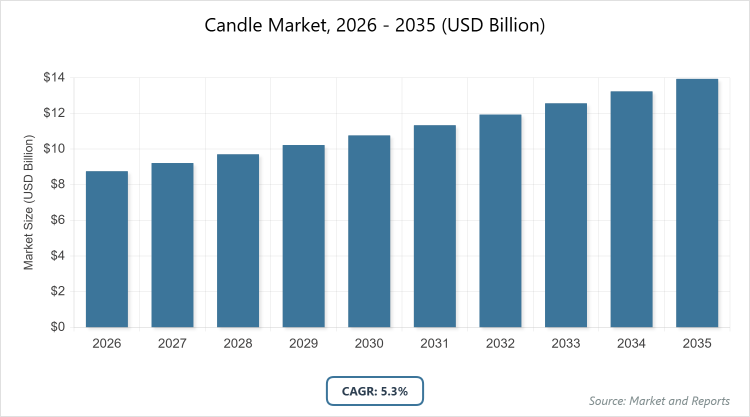
According to MarketnReports, the global Candle market size was estimated at USD 8.76 billion in 2025 and is expected to reach USD 14.68 billion by 2035, growing at a CAGR of 5.3% from 2026 to 2035. Candle Market is driven by increasing consumer demand for home decor, wellness products, and eco-friendly alternatives.
Key Insights
- The global candle market was valued at USD 8.76 billion in 2025 and is projected to reach USD 14.68 billion by 2035.
- The market is expected to grow at a CAGR of 5.3% during the forecast period from 2026 to 2035.
- The market is driven by rising demand for aromatherapy, home decor, and sustainable products.
- In the type segment, container candles dominate with a 35% share due to their convenience, safety, and versatility in scent retention.
- In the wax type segment, paraffin dominates with a 50% share owing to its low cost, ease of molding, and widespread availability.
- In the application segment, home decoration dominates with a 40% share because of increasing consumer focus on creating personalized and relaxing living spaces.
- In the distribution channel segment, offline dominates with a 60% share as consumers prefer in-store experiences for scent testing and immediate purchases.
- North America dominates the global market with a 32% share, driven by high disposable incomes, strong wellness trends, and seasonal holiday demand.
What is Candle Market?
The candle market encompasses the production, distribution, and consumption of various types of candles used for lighting, decoration, ambiance enhancement, religious purposes, and aromatherapy. Market definition includes products made from waxes like paraffin, soy, or beeswax, often infused with scents or colors, catering to residential and commercial needs across global regions.
What drives the Candle market growth?
Growth Drivers
The primary growth driver in the candle market is the surging demand for aromatherapy and wellness products, as consumers increasingly seek candles infused with essential oils to promote relaxation, reduce stress, and enhance mental well-being amid busy lifestyles and rising awareness of self-care practices.
Restraints
A key restraint is the fluctuation in raw material prices, particularly for natural waxes like soy and beeswax, which are affected by agricultural yields, supply chain disruptions, and global commodity markets, leading to higher production costs and pricing challenges for manufacturers.
Opportunities
Significant opportunities arise from the expanding e-commerce channels, enabling smaller artisanal brands to reach global audiences with customizable and eco-friendly candles, tapping into the growing online shopping trend and direct-to-consumer models for personalized experiences.
Challenges
The market faces challenges from safety concerns and regulatory standards, including fire hazards and emissions from certain waxes, which necessitate compliance with stringent environmental and health regulations, potentially increasing R&D costs and limiting innovation for smaller players.
Candle Market: Report Scope
| Report Attributes | Report Details |
| Report Name | Candle Market |
| Market Size 2025 | USD 8.76 Billion |
| Market Forecast 2035 | USD 14.68 Billion |
| Growth Rate | CAGR of 5.3% |
| Report Pages | 240 |
| Key Companies Covered |
Yankee Candle Company, Bath & Body Works, Inc., Diptyque S.A.S., Bridgewater Candle Company, Colonial Candle, and Others |
| Segments Covered | By Type, By Wax Type, By Application, By Distribution Channel, and By Region |
| Regions Covered | North America, Europe, Asia Pacific (APAC), Latin America, and The Middle East and Africa (MEA) |
| Base Year | 2025 |
| Historical Year | 2020 – 2024 |
| Forecast Year | 2026 – 2035 |
| Customization Scope | Avail customized purchase options to meet your exact research needs. |
How is the Candle market segmented?
The Candle market is segmented by type, wax type, application, distribution channel, and region.
Based on Type Segment, container candles emerge as the most dominant subsegment, followed by pillar candles as the second most dominant. Container candles lead due to their spill-proof design, longer burn time, and ability to hold complex scents effectively, driving market growth by appealing to urban consumers seeking convenient home fragrance solutions without mess.
Based on Wax Type Segment, paraffin is the most dominant subsegment, with soy wax as the second most dominant. Paraffin’s dominance stems from its affordability, high melting point for durability, and excellent fragrance throw, fueling market expansion by enabling mass production of cost-effective candles for everyday use.
Based on Application Segment, home decoration is the most dominant subsegment, followed by aromatherapy. Home decoration drives the market through its role in enhancing aesthetics and ambiance in modern interiors, with consumers prioritizing scented and designer candles to personalize spaces and create inviting atmospheres.
Based on Distribution Channel Segment, offline is the most dominant subsegment, with online as the second most dominant. Offline channels dominate by offering tactile shopping experiences like scent sampling in stores, which boosts impulse buys and supports market growth through established retail networks in high-traffic areas.
What are the recent developments in the Candle market?
- In August 2025, Bath & Body Works launched its Ceramic Candles collection, featuring timeless craftsmanship and transformative fragrances to cater to the growing demand for premium, decorative home products.
- In June 2025, Jo Malone collaborated with Little Greene to release a limited-edition candle collection, combining beloved scents with inspired colors and patterns, enhancing consumer appeal through fusion of fragrance and design.
- In February 2024, Le Labo expanded its candle lineup with AMBROXYDE 17, a new scent related to its popular ANOTHER 13, targeting wellness enthusiasts seeking unique aromatherapy options.
How is the regional analysis of the Candle market?
North America to dominate the global market.
North America leads the candle market, primarily driven by high consumer spending on home decor and wellness in the United States, where seasonal holidays like Christmas and Halloween boost demand, supported by major players like Yankee Candle innovating in scents and sustainability.
Europe holds a significant share, with Germany and the UK as dominant countries, fueled by cultural traditions in religious and festive uses, alongside a shift toward eco-friendly soy and beeswax candles amid stringent environmental regulations promoting natural products.
Asia Pacific is experiencing rapid growth, led by China and India, where urbanization and rising disposable incomes drive adoption of scented candles for home ambiance and gifting, with local manufacturers focusing on affordable, mass-market options to capture emerging middle-class consumers.
Latin America shows steady expansion, with Brazil dominating due to vibrant cultural festivals and religious practices requiring candles, complemented by increasing interest in aromatherapy products as wellness trends gain traction in urban areas.
The Middle East and Africa represent emerging markets, with South Africa leading through growing tourism and hospitality sectors using candles for ambiance, while religious and traditional uses in countries like Saudi Arabia support demand for unscented, functional varieties.
Who are the key players in the Candle market?
- Yankee Candle Company focuses on innovation through seasonal fragrance collections and sustainable wax blends, leveraging strong brand loyalty and extensive retail partnerships to maintain market leadership in scented and premium segments.
- Bath & Body Works, Inc. emphasizes product diversification with eco-friendly materials and limited-edition launches, utilizing robust e-commerce platforms and in-store experiences to drive consumer engagement and expand globally.
- Diptyque S.A.S. prioritizes luxury positioning with high-quality natural ingredients and artisanal craftsmanship, targeting affluent consumers through exclusive collaborations and boutique distributions to enhance brand prestige.
- Bridgewater Candle Company adopts strategies centered on affordable wellness products and private-label partnerships, focusing on clean-burning soy waxes to appeal to environmentally conscious buyers in mass-market channels.
- Colonial Candle invests in traditional designs with modern twists, such as unscented tapers for decorative purposes, while expanding online presence to capture niche markets in home decor and events.
What are the Candle market trends?
- Increasing shift toward sustainable and eco-friendly candles made from soy, beeswax, or recycled materials to meet consumer demands for environmentally responsible products.
- Rising popularity of personalized and customizable candles, allowing consumers to select scents, colors, and designs for gifting or home use.
- Growth in aromatherapy-focused candles infused with essential oils for wellness benefits like stress relief and improved sleep.
- Expansion of online sales channels, enabling direct-to-consumer models and broader access to artisanal and niche brands.
- Emergence of smart candles integrated with technology, such as app-controlled flameless options for safety and convenience.
What are the market segments and subsegments covered in the report?
- By Type
- Votive
- Container Candle
- Pillar
- Taper
- Tea Light
- Floating
- Birthday
- Scented
- Unscented
- Decorative
- Others
- By Wax Type
- Paraffin
- Soy Wax
- Beeswax
- Palm Wax
- Stearin
- Gel
- Synthetic
- Vegetable
- Animal
- Blend
- Others
- By Application
- Home Decoration
- Aromatherapy
- Religious Ceremonies
- Hospitality
- Gifting
- Wellness
- Spa
- Restaurants
- Events
- Festivals
- Others
- By Distribution Channel
- Online
- Offline Specialty Stores
- Supermarkets & Hypermarkets
- Department Stores
- Gift Shops
- Convenience Stores
- Direct Sales
- E-commerce Platforms
- Wholesale
- Retail
- Others
By Region
- North America
- U.S.
- Canada
- Europe
- UK
- Germany
- France
- Rest of Europe
- Asia Pacific
- China
- India
- Japan
- Rest of Asia Pacific
- Latin America
- Brazil
- Mexico
- Rest of Latin America
- Middle East & Africa
- UAE
- South Africa
- Rest of Middle East & Africa
Frequently Asked Questions
Candles are wax-based products designed for illumination, fragrance, or decorative purposes, typically featuring a wick that burns to produce light and often infused with scents for ambiance enhancement.
Key factors include rising demand for aromatherapy, home decor trends, eco-friendly materials, seasonal festivities, and expanding online retail channels.
The market is projected to grow from USD 8.76 billion in 2025 to USD 14.68 billion by 2035.
The CAGR is expected to be 5.3% from 2026 to 2035.
North America will contribute notably, holding around 32% of the market share due to high consumer spending on wellness and decor.
Major players include Yankee Candle Company, Bath & Body Works, Inc., Diptyque S.A.S., Bridgewater Candle Company, and Colonial Candle.
The report provides in-depth analysis of market size, trends, segments, regional insights, key players, and forecasts from 2026 to 2035.
Stages include raw material sourcing (wax, wicks, fragrances), manufacturing and molding, packaging, distribution through retail channels, and end-consumer usage.
Trends are shifting toward sustainable, natural waxes and personalized scents, with consumers preferring eco-friendly, wellness-oriented products over traditional options.
Regulations on emissions, fire safety standards, and bans on certain synthetic materials are pushing manufacturers toward cleaner, natural alternatives to comply with environmental policies.