
Calcium Carbonate Market Size, Share and Trends 2026 to 2035
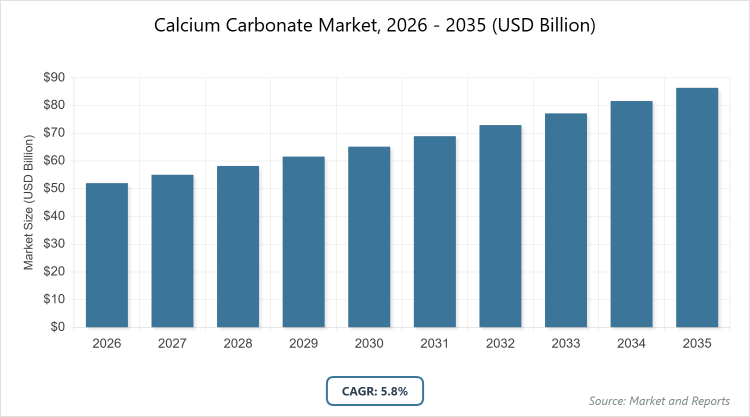
The global Calcium Carbonate Market size was estimated at USD 52 Billion in 2025 and is expected to reach USD 92 Billion by 2035, growing at a CAGR of 5.8% from 2026 to 2035. The calcium carbonate market is primarily driven by the rising demand for cost-effective fillers and pigments in the paper, plastics, construction, and pharmaceutical industries, further accelerated by global urbanization and the shift toward sustainable packaging solutions.
What are the Key Insights?
- The global calcium carbonate market is projected to grow from approximately USD 52 billion in 2026 to USD 92 billion by 2035, reflecting robust demand across diverse applications.
- The market is expected to register a compound annual growth rate (CAGR) of around 5.8% during the forecast period from 2026 to 2035.
- In the type segment, ground calcium carbonate dominates as the leading subsegment due to its cost-effectiveness and widespread use in bulk applications.
- In the application segment, paper and pulp holds the dominant position, driven by its role in enhancing paper brightness and opacity.
- Asia-Pacific emerges as the dominated region, accounting for over 50% of the global market share owing to rapid industrialization and abundant resources.
What is the Industry Overview?
The calcium carbonate market encompasses the production, distribution, and utilization of calcium carbonate, a naturally occurring mineral compound with the chemical formula CaCO3, derived primarily from limestone, marble, or chalk through mining and processing. It serves as a versatile raw material across various industries, functioning as a filler, extender, and pigment due to its properties such as high brightness, purity, and particle size control. This market involves both ground calcium carbonate, which is mechanically crushed and classified, and precipitated calcium carbonate, produced through chemical processes for finer and more uniform particles. It plays a crucial role in enhancing product performance, reducing costs, and improving sustainability in end-use applications, while being influenced by global supply chains, raw material availability, and evolving industrial demands without reliance on specific quantitative metrics.
What are the Market Dynamics?
Growth Drivers
The calcium carbonate market is propelled by surging demand from key industries such as paper and pulp, plastics, and construction, where it acts as an essential filler to enhance product quality and reduce manufacturing costs; additionally, the shift towards eco-friendly and sustainable materials in packaging and automotive sectors boosts its adoption as a bio-based alternative to synthetic fillers, supported by growing infrastructure development in emerging economies and advancements in processing technologies that improve particle fineness and purity for specialized applications.
Restraints
Market growth faces hurdles from fluctuating raw material prices, particularly limestone and energy costs, which increase production expenses and disrupt supply chains; environmental regulations on mining activities and carbon emissions pose compliance challenges, limiting expansion in certain regions, while competition from alternative fillers like kaolin and talc erodes market share in price-sensitive segments.
Opportunities
Emerging opportunities lie in the development of nano-calcium carbonate for high-value applications in pharmaceuticals and electronics, offering enhanced properties like better dispersion and reactivity; the rising focus on recycled and sustainable calcium carbonate products aligns with circular economy initiatives, opening avenues in green building materials and bioplastics, especially in regions investing in renewable resources.
Challenges
The industry contends with stringent environmental standards that demand investments in cleaner extraction and processing methods, potentially straining smaller players; supply chain vulnerabilities due to geopolitical tensions and transportation issues affect global distribution, compounded by the need to balance cost-efficiency with quality control amid increasing consumer preferences for premium-grade products.
Calcium Carbonate Market: Report Scope
| Report Attributes | Report Details |
| Report Name | Calcium Carbonate Market |
| Market Size 2025 | USD 52 Billion |
| Market Forecast 2035 | USD 92 Billion |
| Growth Rate | CAGR of 5.8% |
| Report Pages | 215 |
| Key Companies Covered |
Omya AG, Imerys, Minerals Technologies Inc., Huber Engineered Materials, and Carmeuse. |
| Segments Covered | By Type, By Application, By End-User Industry, By Region |
| Regions Covered | Asia Pacific, North America, Europe, Latin America, The Middle East and Africa |
| Base Year | 2025 |
| Historical Year | 2020 – 2024 |
| Forecast Year | 2026 – 2035 |
| Customization Scope | Avail customized purchase options to meet your exact research needs. |
What is the Market Segmentation?
The type segmentation divides the market into ground calcium carbonate (GCC) and precipitated calcium carbonate (PCC). Ground calcium carbonate is the most dominant segment, commanding around 70% of the market share, primarily because of its economical production through simple mechanical grinding of natural sources like limestone, which makes it ideal for high-volume industries such as construction and plastics where cost efficiency is paramount; this dominance drives the overall market by enabling large-scale adoption in filler applications, reducing dependency on more expensive alternatives and supporting sustainable resource utilization. Precipitated calcium carbonate ranks as the second most dominant, valued for its superior purity and finer particle size achieved via chemical precipitation, which caters to premium sectors like pharmaceuticals and coatings; its growth contributes to market expansion by fulfilling demands for high-performance materials that improve product aesthetics and functionality, thus attracting investments in specialized manufacturing.
Applications segment the market into paper and pulp, plastics, paints and coatings, adhesives and sealants, construction, pharmaceuticals, and others. The paper and pulp application is the most dominant, holding over 40% share, as calcium carbonate enhances paper quality by providing brightness, smoothness, and printability while serving as a cost-effective substitute for wood pulp, thereby driving market growth through increased efficiency in the publishing and packaging industries amid rising digital alternatives. Plastics follows as the second most dominant, benefiting from calcium carbonate’s role as a reinforcing filler that improves rigidity and reduces resin usage, promoting its adoption in automotive and consumer goods; this segment propels the market by aligning with the global push for lightweight and recyclable materials, fostering innovation in polymer composites.
End-user industries include manufacturing, construction, healthcare, agriculture, pulp and paper, and others. Pulp and paper dominates this segmentation, similar to the application overlap, due to its massive consumption for filler and coating purposes that optimize production costs and environmental impact, steering market dynamics towards sustainable practices. Construction is the second most dominant, utilizing calcium carbonate in cement, concrete, and building materials to enhance durability and workability; its prominence accelerates market growth by capitalizing on urbanization trends, ensuring steady demand in infrastructure projects worldwide.
What are the Recent Developments?
- In February 2024, Omya AG launched its Omyaloop product line, consisting of 100% recycled calcium carbonate certified by Bureau Veritas, aimed at promoting sustainability in packaging and construction applications by reducing virgin material usage and lowering carbon footprints.
- In 2025, Minerals Technologies Inc. expanded its precipitated calcium carbonate production capacity in the United States to meet growing demand from the paper industry, incorporating advanced purification technologies to enhance product quality and efficiency. Imerys announced a strategic partnership in mid-2025 with a leading plastics manufacturer to develop bio-based calcium carbonate composites, focusing on reducing plastic waste and improving recyclability in automotive components. Carmeuse invested in eco-friendly mining operations in Europe during late 2024, upgrading facilities to comply with stricter environmental regulations and increase output of high-purity ground calcium carbonate for pharmaceutical uses.
What is the Regional Analysis?
Asia-Pacific stands as the leading region in the calcium carbonate market, driven by rapid industrialization, abundant limestone reserves, and high demand from paper, plastics, and construction sectors; China dominates this region with over 60% share, owing to its massive manufacturing base, government support for infrastructure, and export-oriented production that fuels global supply chains, while India contributes significantly through growing pharmaceutical and agricultural applications.
North America exhibits steady growth supported by advanced technological integrations and a focus on sustainable materials; the United States leads here, accounting for about 70% of regional demand, propelled by innovations in coatings and adhesives industries alongside stringent quality standards that encourage investments in precipitated calcium carbonate.
Europe emphasizes environmental compliance and high-value applications, with Germany as the dominant country holding around 25% share, benefiting from its strong automotive and paper sectors that prioritize recycled and low-emission products. Latin America shows emerging potential through resource-rich mining, where Brazil dominates with roughly 50% share, driven by construction booms and agricultural uses that leverage local limestone deposits for cost advantages.
The Middle East and Africa region grows moderately, led by Saudi Arabia’s 40% dominance, fueled by oil-related industries and construction projects that utilize calcium carbonate in paints and plastics amid diversification efforts.
Who are the Key Market Players and Their Strategies?
Omya AG focuses on sustainability through innovations like recycled calcium carbonate products and global expansions to enhance supply chain efficiency and meet eco-friendly demands.
Imerys employs strategies centered on mergers and acquisitions to broaden its mineral portfolio, alongside R&D investments in nano-calcium carbonate for high-tech applications.
Minerals Technologies Inc. prioritizes capacity expansions and technological advancements in precipitation processes to cater to premium markets like pharmaceuticals and coatings.
Huber Engineered Materials adopts a customer-centric approach with customized solutions and sustainability initiatives, including reduced-carbon production methods.
Carmeuse emphasizes vertical integration from mining to processing, coupled with partnerships for bio-based applications to strengthen its position in construction and agriculture.
What are the Market Trends?
- Increasing adoption of sustainable and recycled calcium carbonate to align with circular economy principles and reduce environmental impact.
- Rising demand for nano-calcium carbonate in advanced applications like drug delivery and electronics for enhanced performance.
- Shift towards bio-based plastics incorporating calcium carbonate fillers to promote lightweight and eco-friendly materials.
- Growing use in water treatment and agriculture as soil conditioners and pH adjusters amid climate change concerns.
- Technological advancements in particle size control and surface modification to improve compatibility in high-end coatings and adhesives.
What Market Segments are Covered in the Report?
Type
- Ground Calcium Carbonate
- Precipitated Calcium Carbonate
Application
- Paper and Pulp
- Plastics
- Paints and Coatings
- Adhesives and Sealants
- Construction
- Pharmaceuticals
- Others
End-User Industry
- Manufacturing
- Construction
- Healthcare
- Agriculture
- Pulp and Paper
- Others
By Region
-
- North America
- U.S.
- Canada
- Europe
- UK
- Germany
- France
- Rest of Europe
- Asia Pacific
- China
- India
- Japan
- Rest of Asia Pacific
- Latin America
- Brazil
- Mexico
- Rest of Latin America
- Middle East & Africa
- UAE
- South Africa
- Rest of Middle East & Africa
- North America
Chapter 1. Preface
Chapter 2. Executive Summary
Chapter 3. Global Calcium Carbonate Market - Industry Analysis
Chapter 4. Global Calcium Carbonate Market- Competitive Landscape
Chapter 5. Global Calcium Carbonate Market - Type Analysis
Chapter 6. Global Calcium Carbonate Market - Application Analysis
Chapter 7. Global Calcium Carbonate Market - End-User Industry Analysis
Chapter 8. Calcium Carbonate Market - Regional Analysis
Chapter 9. Company Profiles
Frequently Asked Questions
The calcium carbonate market refers to the global industry involved in the extraction, processing, and distribution of calcium carbonate, a versatile mineral used as a filler, pigment, and extender in sectors like paper, plastics, and construction.
Key factors include rising demand from end-use industries, advancements in sustainable production, regulatory pressures on environmental compliance, and fluctuations in raw material prices.
The market is projected to grow from approximately USD 52 billion in 2026 to around USD 92 billion by 2035.
The CAGR is expected to be around 5.8% during the forecast period.
Asia-Pacific will contribute notably, driven by high industrialization and resource availability.
Major players include Omya AG, Imerys, Minerals Technologies Inc., Huber Engineered Materials, and Carmeuse.
The report provides comprehensive insights into market size, trends, segments, regional analysis, key players, and future projections.
The value chain includes raw material extraction, processing and refining, manufacturing of end products, distribution, and end-use application.
Trends are shifting towards sustainable and recycled products, with consumers preferring eco-friendly materials in packaging and construction.
Stringent mining regulations, carbon emission standards, and sustainability mandates are influencing production methods and market expansion.