
Cable Cars and Ropeways Market Size, Share and Trends 2026 to 2035
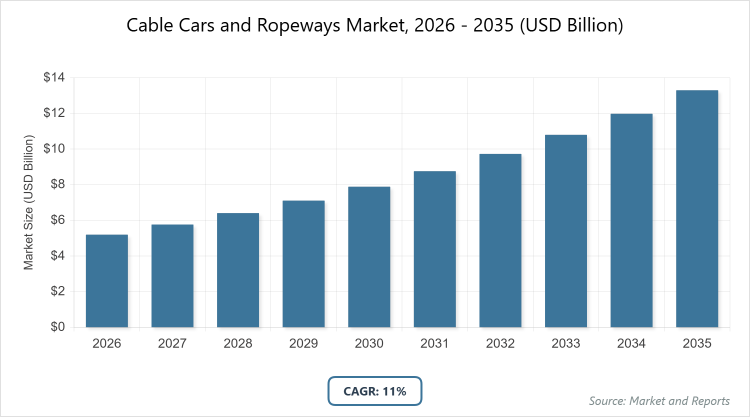
According to MarketnReports, the global Cable Cars and Ropeways market size was estimated at USD 5.2 billion in 2025 and is expected to reach USD 14.8 billion by 2035, growing at a CAGR of 11% from 2026 to 2035. Cable Cars and Ropeways Market is driven by increasing demand for sustainable and efficient transportation solutions in tourism and urban areas.
What are the Key Insights into the Cable Cars and Ropeways Market?
- The global cable cars and ropeways market was valued at USD 5.2 billion in 2025 and is projected to reach USD 14.8 billion by 2035.
- The market is expected to grow at a CAGR of 11% during the forecast period from 2026 to 2035.
- The market is driven by rising tourism activities, urbanization demands for efficient transport, and the push for sustainable mobility solutions.
- In the product type segment, aerial tramways dominate with a 39% share due to their high-capacity transport capabilities over long distances and rugged terrains, making them ideal for mountainous regions and urban crossings.
- In the application segment, tourism holds the leading position with 59% share because it enhances scenic experiences in popular destinations like ski resorts and national parks, driving revenue through increased visitor accessibility.
- In the end-user segment, ski resorts are the dominant subsegment with approximately 45% share, as they rely heavily on ropeways for efficient uphill transport, supporting winter sports and year-round tourism.
- Europe dominates the regional market with a 40% share owing to its extensive alpine infrastructure, strong tourism industry, and established manufacturing base in countries like Austria and Switzerland.
What is the Industry Overview of the Cable Cars and Ropeways Market?
The cable cars and ropeways market encompasses aerial transportation systems that utilize cables and ropes to transport passengers or materials across challenging terrains, such as mountains, urban landscapes, or industrial sites. This market includes various systems like gondolas, chairlifts, and funiculars, which provide efficient, eco-friendly alternatives to traditional ground-based transport. Market definition refers to the design, manufacturing, installation, and maintenance of these suspended transport mechanisms, serving sectors from tourism to public transit and material handling, emphasizing safety, sustainability, and accessibility in regions where conventional infrastructure is impractical.
What are the Market Dynamics of the Cable Cars and Ropeways Market?
Growth Drivers
The growth of the cable cars and ropeways market is primarily fueled by the surge in global tourism and adventure activities, where these systems offer unique, scenic, and efficient access to remote or elevated locations. Increasing investments in infrastructure development, particularly in emerging economies, are integrating ropeways into urban transport networks to alleviate traffic congestion and reduce carbon emissions. Technological advancements, such as energy-efficient electric propulsion and automated safety features, are enhancing system reliability and appeal, attracting both public and private sector funding. Additionally, the emphasis on sustainable transport aligns with global environmental goals, positioning cable cars as a low-impact alternative to road expansions in ecologically sensitive areas.
Restraints
High initial capital costs associated with the installation and engineering of cable cars and ropeways pose a significant barrier, especially in developing regions with limited budgets for infrastructure projects. Dependency on weather conditions, such as high winds or heavy snowfall, can disrupt operations and require costly maintenance, impacting reliability and profitability. Stringent regulatory approvals and safety standards add complexity and delays to project timelines, deterring potential investments. Moreover, in urban settings, land acquisition challenges and integration with existing transport systems can hinder widespread adoption, limiting market expansion in densely populated areas.
Opportunities
Opportunities in the cable cars and ropeways market are emerging from the rapid urbanization in Asia-Pacific and Latin America, where ropeways can provide cost-effective solutions for public transit in hilly or congested cities. Innovations in hybrid and solar-powered systems open doors for eco-friendly applications in remote areas, aligning with renewable energy trends. Expanding adventure tourism and ski resort developments in untapped markets like the Middle East and Africa present growth potential through new installations. Partnerships between governments and private firms for smart city initiatives could accelerate adoption, while retrofitting existing systems with digital technologies offers avenues for upgrades and aftermarket services.
Challenges
Challenges include ensuring consistent safety and maintenance in harsh environmental conditions, which demands advanced monitoring technologies and skilled labor, increasing operational expenses. Geopolitical tensions and supply chain disruptions can affect the availability of specialized components like cables and cabins, leading to project delays. Public perception issues regarding safety, especially following rare incidents, require robust communication and certification to build trust. Finally, competition from alternative transport modes, such as drones or high-speed rails, in certain applications may challenge market share, necessitating continuous innovation to maintain relevance.
Cable Cars and Ropeways Market: Report Scope
| Report Attributes | Report Details |
| Report Name | Cable Cars and Ropeways Market |
| Market Size 2025 | USD 5.2 Billion |
| Market Forecast 2035 | USD 14.8 Billion |
| Growth Rate | CAGR of 11% |
| Report Pages | 250 |
| Key Companies Covered | Doppelmayr/Garaventa Group, Leitner Group, POMA, Bartholet Maschinenbau AG, MND Group, Nippon Cable Co., Ltd., and Others |
| Segments Covered | By Product Type, By Application, By End-User, and By Region |
| Regions Covered | North America, Europe, Asia Pacific (APAC), Latin America, and The Middle East and Africa (MEA) |
| Base Year | 2025 |
| Historical Year | 2020 – 2024 |
| Forecast Year | 2026 – 2035 |
| Customization Scope | Avail customized purchase options to meet your exact research needs. |
How is the Market Segmentation of the Cable Cars and Ropeways Market?
The Cable Cars and Ropeways market is segmented by type, application, end-user, and region.
Based on Product Type Segment. The most dominant subsegment is aerial tramways, holding a significant market share due to their ability to cover long distances with high passenger capacity, making them essential for mountainous tourism and urban connectivity; the second most dominant is gondola lifts, which drive the market by offering enclosed, weather-protected transport that enhances user comfort and accessibility in ski resorts and cities, contributing to overall growth through increased adoption in diverse terrains.
Based on Application Segment. Tourism emerges as the most dominant subsegment, capturing the largest share as it provides scenic and efficient access to attractions, boosting visitor numbers and revenue in global hotspots; public transportation is the second most dominant, driving market expansion by addressing urban mobility challenges in congested areas, reducing emissions, and integrating seamlessly with public transit systems to promote sustainable city development.
Based on End-User Segment. Ski resorts dominate this segment with the highest share, as ropeways are critical for uphill transport, enabling year-round operations and attracting winter sports enthusiasts; urban transport authorities rank second, propelling market growth by deploying cable cars to overcome geographical barriers in cities, improving commute times, and supporting eco-friendly urban planning initiatives.
Based on Region Segment. Regional segmentation includes North America, Europe, Asia Pacific, Latin America, and the Middle East and Africa, with each analyzed for growth potential and market drivers.
What are the Recent Developments in the Cable Cars and Ropeways Market?
- In April 2024, Faber Leisure Group launched the futuristic SkyOrb cable cars, featuring the world’s first chrome-finished spherical cabins, enhancing passenger experience with panoramic views and improved aesthetics in Singapore.
- In May 2024, the Jordan Free and Development Zones Group unveiled a new website for the Ajloun cable car, aimed at streamlining bookings and providing detailed information to boost tourism engagement both domestically and internationally.
- In January 2025, the Himachal government in India launched a ropeway project between Shimla and Parwanoo to reduce traffic congestion and travel time, with plans to float global tenders for efficient implementation.
- In February 2025, the Sikkim government initiated efforts to develop cable cars as an alternative public transport mode in Gangtok, addressing growing traffic issues and limited road expansion space.
- In May 2025, Leitner introduced the ROPERA standard for monocable ropeways, focusing on noise reduction, simplified maintenance, and enhanced safety to meet modern operational demands.
How is the Regional Analysis of the Cable Cars and Ropeways Market?
Europe to dominate the global market
Europe holds the dominant position in the cable cars and ropeways market, driven by its robust tourism infrastructure in the Alps and a long history of aerial transport innovation. Countries like Austria and Switzerland lead with advanced systems supporting ski resorts and urban links, benefiting from government support for sustainable tourism. The region’s emphasis on eco-friendly technologies and high safety standards further solidifies its market share, with ongoing expansions in popular destinations enhancing accessibility and economic growth.
Asia Pacific is experiencing rapid growth due to urbanization and increasing tourism investments, particularly in China and India. China dominates this region with massive projects like the Zhangjiajie Glass Bridge cable car, addressing mountainous terrains and boosting eco-tourism. The push for efficient public transport in hilly cities, combined with rising disposable incomes, drives adoption, while government initiatives for infrastructure development position the region for substantial market expansion.
North America shows steady progress, fueled by ski resort developments and urban mobility trials in the United States and Canada. The US leads with installations in areas like Colorado’s Rocky Mountains, where ropeways support winter sports and year-round attractions. Growing interest in sustainable transport alternatives amid environmental concerns is accelerating projects, though regulatory hurdles temper pace compared to other regions.
Latin America is emerging as a key market, with Bolivia and Colombia at the forefront through urban cable car systems like La Paz’s Mi Teleférico. Bolivia dominates regionally, using ropeways to connect underserved hilly neighborhoods, reducing commute times and emissions. Tourism growth in Andean countries further supports demand, with investments focusing on affordable, inclusive transport solutions.
The Middle East and Africa are witnessing nascent but promising growth, led by Saudi Arabia’s initiatives like the planned cable car to the Cave of Hira. Saudi Arabia dominates, leveraging tourism diversification under Vision 2030 to develop aerial systems in desert and mountainous areas. In Africa, projects in South Africa and Morocco aim at enhancing safari and adventure tourism, though infrastructure challenges limit broader adoption.
Who are the Key Market Players and Strategies in the Cable Cars and Ropeways Market?
- Doppelmayr/Garaventa Group focuses on innovation through sustainable technologies, such as energy-efficient detachable gondolas and automated systems, while expanding globally via strategic partnerships and acquisitions to strengthen its leadership in tourism and urban projects.
- Leitner Group emphasizes eco-friendly solutions like the ROPERA standard for noise reduction and maintenance efficiency, investing in R&D for hybrid propulsion and collaborating with governments on urban mobility initiatives to capture emerging markets.
- POMA prioritizes customization and safety enhancements, developing high-capacity aerial tramways for ski resorts and material handling, with a strategy centered on regional expansions in Asia and Latin America through joint ventures.
- Bartholet Maschinenbau AG (BMF) adopts a focus on modular designs for quick installations, integrating digital monitoring for predictive maintenance, and targets growth in adventure tourism by partnering with resort developers in Europe and North America.
- MND Group pursues diversification into urban and industrial applications, leveraging expertise in chairlifts and funiculars, with strategies including sustainability certifications and investments in solar-powered systems to appeal to environmentally conscious clients.
- Nippon Cable Co., Ltd. concentrates on technological advancements in bi-cable and tri-cable systems for seismic-prone areas, expanding in Asia Pacific through local manufacturing and collaborations with tourism boards to drive market penetration.
What are the Market Trends in the Cable Cars and Ropeways Market?
- Shift toward fully electric and energy-regenerative propulsion systems to reduce environmental impact and operational costs.
- Integration of smart technologies, including IoT for real-time monitoring and predictive maintenance, enhancing safety and efficiency.
- Growing adoption in urban areas as sustainable public transport alternatives to combat traffic congestion and pollution.
- Emphasis on innovative cabin designs, such as panoramic and climate-controlled units, to improve passenger experience in tourism applications.
- Expansion of hybrid ropeway systems combining traditional cables with modern automation for versatile use in diverse terrains.
- Increasing focus on accessibility features for inclusive transport, catering to elderly and disabled users in public and tourist settings.
What Market Segments and their Subsegments are Covered in the Cable Cars and Ropeways Report?
By Product Type
- Aerial Tramways
- Gondola Lifts
- Chair Lifts
- Surface Lifts
- Funicular Railways
- Detachable Chairlifts
- Fixed Grip Chairlifts
- Material Ropeways
- Bi-cable Ropeways
- Tri-cable Ropeways
- Others
By Application
- Tourism
- Public Transportation
- Material Handling
- Urban Mobility
- Skiing
- Mining
- Amusement Parks
- Mountain Access
- Industrial
- Agriculture
- Others
By End-User
- Ski Resorts
- Urban Transport Authorities
- Mining Companies
- Theme Parks
- Tourist Attractions
- Municipalities
- Hotels and Resorts
- Construction Sites
- Agricultural Farms
- Industrial Facilities
- Others
By Region
- North America
- U.S.
- Canada
- Europe
- UK
- Germany
- France
- Rest of Europe
- Asia Pacific
- China
- India
- Japan
- Rest of Asia Pacific
- Latin America
- Brazil
- Mexico
- Rest of Latin America
- Middle East & Africa
- UAE
- South Africa
- Rest of Middle East & Africa
Frequently Asked Questions
Cable cars and ropeways are aerial transportation systems using suspended cables to move cabins or chairs across terrains, serving purposes like tourism, urban transit, and material transport.
Key factors include rising tourism, urbanization demands, technological advancements in sustainability, and government investments in eco-friendly infrastructure.
The market is projected to grow from approximately USD 5.8 billion in 2026 to USD 14.8 billion by 2035.
The market is expected to grow at a CAGR of 11% from 2026 to 2035.
Europe will contribute notably, holding around 40% of the market value due to its strong alpine tourism and infrastructure.
Major players include Doppelmayr/Garaventa Group, Leitner Group, POMA, Bartholet Maschinenbau AG, MND Group, and Nippon Cable Co., Ltd.
The report provides comprehensive analysis including market size, trends, segmentation, key players, regional insights, and forecasts from 2026 to 2035.
Stages include raw material sourcing, design and manufacturing, installation, operation and maintenance, and end-user application.
Trends are shifting toward eco-friendly electric systems and smart technologies, while consumers prefer enhanced safety, comfort, and scenic experiences.
Stringent safety regulations, environmental policies promoting low-emission transport, and climate change considerations are key influencers.