
C1 Inhibitors Market Size, Share and Trends 2026 to 2035
According to MarketnReports, the global C1 Inhibitors market size was estimated at USD 4.0 billion in 2025 and is expected to reach USD 9.8 billion by 2035, growing at a CAGR of 9.5% from 2026 to 2035. C1 Inhibitors Market is driven by rising prevalence of hereditary angioedema and advancements in recombinant therapies.
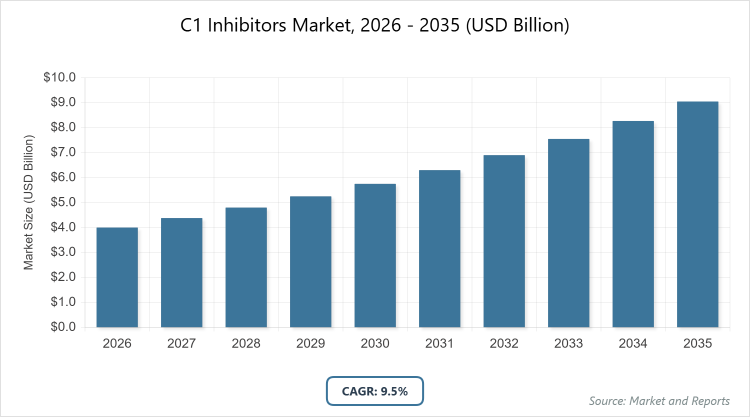
What are the Key Insights of the C1 Inhibitors Market?
- The global C1 inhibitors market was valued at USD 4.0 billion in 2025 and is projected to reach USD 9.8 billion by 2035.
- The market is expected to grow at a CAGR of 9.5% during the forecast period from 2026 to 2035.
- The market is driven by increasing awareness of hereditary angioedema, favorable orphan drug incentives, and the shift toward home-based subcutaneous and oral therapies.
- C1 esterase inhibitors dominate the drug class segment with approximately 55% market share due to their established efficacy in both acute and prophylactic treatment, supported by extensive clinical data and regulatory approvals for diverse patient populations including children and pregnant individuals.
- Kallikrein inhibitors hold the second-largest share at around 25% in the drug class segment, fueled by the convenience of oral formulations that improve patient adherence and reduce injection-related barriers.
- Lyophilized powder leads the dosage form segment with about 52% share, owing to its extended shelf life and stability during distribution, making it ideal for emergency stockpiling in healthcare settings.
- Liquid injections are the second-dominant in dosage form at roughly 30%, driven by prefilled syringes that enable rapid self-administration and minimize preparation time during acute attacks.
- Hospital pharmacies dominate the distribution channel with over 40% share, as they handle complex biologics requiring cold-chain logistics and serve as primary points for acute care infusions.
- Specialty pharmacies follow with about 28% in distribution, excelling in patient education, reimbursement navigation, and direct delivery for chronic prophylactic therapies.
- North America dominates the regional market with around 45% share, attributed to high HAE diagnosis rates, advanced healthcare infrastructure, and strong presence of key manufacturers offering comprehensive reimbursement programs.
What is the C1 Inhibitors Market Overview?
The C1 inhibitors market encompasses therapeutic agents that regulate the complement system by inhibiting the C1 esterase protein, primarily used to manage hereditary angioedema (HAE), a rare genetic disorder causing recurrent swelling attacks in various body parts, including the airways, abdomen, and extremities. Market definition includes both plasma-derived and recombinant C1 inhibitors, which restore deficient or dysfunctional C1-INH levels to prevent or treat acute episodes, as well as prophylactic regimens. This market addresses unmet needs in rare disease management, extending to potential applications in autoimmune disorders, ischemia-reperfusion injuries, and sepsis, driven by biotechnological innovations that enhance drug stability, administration ease, and patient compliance.
What are the Market Dynamics in the C1 Inhibitors Market?
Growth Drivers
The primary growth drivers in the C1 inhibitors market include the rising global prevalence of hereditary angioedema, estimated to affect 1 in 50,000 individuals, coupled with improved diagnostic capabilities through genetic testing and biomarker analysis, leading to earlier interventions and expanded patient pools. Biotechnological advancements, such as recombinant production methods that reduce dependency on human plasma donations, enhance supply chain reliability and minimize risks of pathogen transmission, further propelling market expansion. Favorable regulatory environments, including orphan drug designations that provide market exclusivity and tax incentives, encourage investment in R&D for novel formulations like long-acting subcutaneous options, which improve patient quality of life by reducing treatment frequency.
Restraints
High treatment costs, often exceeding USD 500,000 annually per patient for prophylactic regimens, pose significant restraints, limiting accessibility in low- and middle-income regions and straining healthcare budgets even in developed markets despite reimbursement programs. Plasma supply shortages, exacerbated by donor recruitment challenges and geopolitical disruptions, hinder the production of plasma-derived inhibitors, creating bottlenecks in meeting demand for acute therapies. Stringent regulatory requirements for biologics, including extensive clinical trials to demonstrate long-term safety in rare disease populations, delay product launches and increase development expenses, deterring smaller players from entering the market.
Opportunities
Emerging opportunities lie in expanding indications beyond hereditary angioedema, such as exploring C1 inhibitors for complement-mediated conditions like neuromyelitis optica or COVID-19-related complications, which could broaden the addressable market through off-label use and new clinical trials. Growing adoption in Asia-Pacific and Latin America, driven by rising healthcare investments and awareness campaigns, presents untapped potential for market penetration via partnerships with local distributors and affordable pricing strategies. Innovations in gene therapy and personalized medicine, including CRISPR-based approaches to correct C1-INH deficiencies at the genetic level, offer long-term curative prospects that could transform the market landscape.
Challenges
Key challenges include reimbursement hurdles in fragmented healthcare systems, where payers demand robust health-economic data to justify coverage for high-cost orphan drugs, potentially restricting access for underserved populations. Competition from alternative pathways, such as kallikrein and bradykinin inhibitors, intensifies as oral options gain traction for their convenience, eroding share from traditional C1-INH therapies. Intellectual property disputes and biosimilar entries, particularly in Europe, threaten pricing power for incumbents, while ensuring equitable global access amid varying diagnostic infrastructure remains a persistent issue.
C1 Inhibitors Market: Report Scope
| Report Attributes | Report Details |
| Report Name | C1 Inhibitors Market |
| Market Size 2025 | USD 4.0 Billion |
| Market Forecast 2035 | USD 9.8 Billion |
| Growth Rate | CAGR of 9.5% |
| Report Pages | 220 |
| Key Companies Covered | CSL Behring, Takeda Pharmaceutical, Pharming Group, BioCryst Pharmaceuticals, Ionis Pharmaceuticals, and Others |
| Segments Covered | By Drug Class, By Dosage Form, By Distribution Channel, and By Region |
| Regions Covered | North America, Europe, Asia Pacific (APAC), Latin America, and The Middle East and Africa (MEA) |
| Base Year | 2025 |
| Historical Year | 2020 – 2024 |
| Forecast Year | 2026 – 2035 |
| Customization Scope | Avail customized purchase options to meet your exact research needs. |
How is the Market Segmentation Structured in the C1 Inhibitors Market?
The C1 Inhibitors market is segmented by drug class, dosage form, distribution channel, and region.
Based on Drug Class Segment. C1 esterase inhibitors emerge as the most dominant subsegment, commanding approximately 55% market share, due to their direct mechanism in replacing deficient C1-INH protein, which effectively controls complement cascade overactivation in HAE patients; this dominance drives the market by providing reliable acute and prophylactic options that reduce hospitalization rates and improve long-term outcomes. Kallikrein inhibitors rank as the second most dominant at around 25%, leveraging targeted inhibition of plasma kallikrein to prevent bradykinin overproduction, which helps propel market growth through enhanced patient adherence via non-invasive oral delivery, expanding treatment accessibility for chronic management.
Based on Dosage Form Segment. Lyophilized powder holds the dominant position with about 52% share, valued for its stability and ease of reconstitution in clinical settings, driving market expansion by enabling efficient storage and rapid deployment during emergencies, thus minimizing attack severity in HAE scenarios. Liquid injections follow as the second dominant at roughly 30%, offering immediate bioavailability through prefilled devices that facilitate self-administration, contributing to market growth by supporting home-based prophylaxis and reducing healthcare visits.
Based on Distribution Channel Segment. Hospital pharmacies lead with over 40% market share, as they specialize in handling biologics with specific storage needs, driving the market by ensuring timely access for inpatient acute treatments and integrating with multidisciplinary care teams. Specialty pharmacies are the second dominant at about 28%, focusing on rare disease expertise and patient support programs, which fuel growth by streamlining reimbursement and delivering personalized therapy plans directly to homes.
What are the Recent Developments in the C1 Inhibitors Market?
- In 2024, Takeda Pharmaceutical expanded its portfolio through the acquisition of additional rights for a next-generation subcutaneous C1-INH formulation, aiming to enhance prophylactic efficacy with reduced dosing frequency, which received breakthrough therapy designation from the FDA to accelerate access for pediatric HAE patients.
- BioCryst Pharmaceuticals announced positive Phase III results for an oral kallikrein inhibitor extension in early 2025, demonstrating sustained attack reduction over 24 months, positioning it as a competitive alternative to injectable C1 inhibitors and potentially capturing market share in adherence-challenged demographics.
- CSL Behring launched a global awareness initiative in collaboration with patient advocacy groups in late 2024, focusing on undiagnosed HAE in emerging markets, which included diagnostic toolkits and led to increased screening rates, indirectly boosting demand for their plasma-derived C1-INH products.
- Pharming Group received European Medicines Agency approval for a recombinant C1-INH autoinjector in 2025, designed for on-demand treatment with improved portability, addressing patient feedback on administration convenience and expected to drive adoption in outpatient settings.
How Does Regional Analysis Impact the C1 Inhibitors Market?
North America to dominate the global market.
North America holds the dominant position with approximately 45% market share, driven by high HAE prevalence rates, robust reimbursement frameworks, and advanced healthcare systems; the United States stands out as the leading country, benefiting from FDA orphan drug incentives that foster innovation and rapid adoption of therapies like subcutaneous prophylactics, resulting in reduced emergency interventions.
Europe follows as a key region, supported by comprehensive rare disease registries and universal healthcare access, with Germany emerging as the dominant country due to its strong biopharma industry and government-funded research, enabling widespread use of recombinant C1 inhibitors that enhance patient outcomes through personalized dosing.
Asia Pacific is experiencing rapid growth, fueled by increasing awareness and improving diagnostic infrastructure, where Japan leads with its aging population and investments in biotechnology, promoting the uptake of oral alternatives to traditional injections for better compliance in chronic management.
Latin America presents emerging potential amid rising healthcare expenditures, with Brazil as the frontrunner through public health initiatives targeting genetic disorders, facilitating access to plasma-derived therapies that address acute needs in underserved rural areas.
The Middle East and Africa region, though smaller, is gaining traction via international aid programs, led by South Africa with its focus on specialty clinics for rare diseases, driving gradual adoption of cost-effective generics to manage HAE episodes effectively.
Who are the Key Market Players and Their Strategies in the C1 Inhibitors Market?
- CSL Behring focuses on expanding its plasma-derived and recombinant C1-INH portfolio through strategic acquisitions and R&D investments in long-acting formulations, emphasizing global supply chain optimization to ensure product availability and partnering with patient organizations for awareness campaigns that boost market penetration.
- Takeda Pharmaceutical employs a strategy of portfolio diversification via mergers, such as integrating Shire’s assets, to strengthen its prophylactic offerings with subcutaneous options, while prioritizing real-world evidence generation to support reimbursement negotiations and targeting emerging markets with localized pricing models.
- Pharming Group leverages its recombinant technology platform to develop user-friendly delivery systems like autoinjectors, pursuing regulatory approvals in multiple regions and collaborating with biotech firms for combination therapies that address broader complement disorders.
- BioCryst Pharmaceuticals concentrates on oral kallikrein inhibitors as a differentiator, investing in clinical trials for expanded indications and forming alliances with distributors in Asia-Pacific to accelerate adoption among patients seeking non-injectable alternatives.
- Ionis Pharmaceuticals adopts an antisense oligonucleotide approach to target underlying genetic causes, advancing pipeline candidates through partnerships with larger pharma entities for commercialization, while focusing on precision medicine to tailor treatments for specific HAE subtypes.
What are the Market Trends in the C1 Inhibitors Market?
- Shift toward subcutaneous and oral formulations for improved patient convenience and adherence in prophylactic care.
- Increasing focus on recombinant therapies to mitigate plasma supply risks and enhance safety profiles.
- Expansion into new therapeutic indications beyond HAE, such as autoimmune and inflammatory conditions.
- Growing emphasis on personalized medicine through genetic profiling for optimized dosing.
- Rising investments in emerging markets with awareness programs to boost diagnosis rates.
- Adoption of home-based self-administration to reduce healthcare costs and improve quality of life.
What Market Segments and Their Subsegments are Covered in the C1 Inhibitors Report?
By Drug Class
- C1 Esterase Inhibitors
- Kallikrein Inhibitors
- Bradykinin B2 Receptor Antagonists
- Selective Serotonin Reuptake Inhibitors
- Monoclonal Antibodies
- Small Molecule Inhibitors
- Plasma-Derived Therapies
- Recombinant Therapies
- Gene Therapies
- Antisense Oligonucleotides
- Others
By Dosage Form
- Lyophilized Powder
- Liquid Injection
- Subcutaneous Injection
- Intravenous Injection
- Oral Tablets
- Prefilled Syringes
- Autoinjectors
- Freeze-Dried Powder
- Room-Temperature Stable Formulations
- Long-Acting Formulations
- Others
By Distribution Channel
- Hospital Pharmacies
- Retail Pharmacies
- Specialty Pharmacies
- Online Pharmacies
- Clinics
- Homecare Settings
- Research Institutes
- Government Procurement
- Direct-to-Patient Channels
- Mail-Order Services
- Others
By Region
- North America
- U.S.
- Canada
- Europe
- UK
- Germany
- France
- Rest of Europe
- Asia Pacific
- China
- India
- Japan
- Rest of Asia Pacific
- Latin America
- Brazil
- Mexico
- Rest of Latin America
- Middle East & Africa
- UAE
- South Africa
- Rest of Middle East & Africa
Frequently Asked Questions
C1 inhibitors are therapeutic proteins or compounds that regulate the complement system by inhibiting C1 esterase, primarily used to prevent and treat swelling attacks in hereditary angioedema and potentially other complement-related disorders.
Key factors include rising HAE awareness, biotechnological advancements in recombinant and oral therapies, orphan drug incentives, and expansion into emerging markets with improving healthcare access.
The market is projected to grow from an estimated USD 4.3 billion in 2026 to USD 9.8 billion by 2035.
The market is expected to register a CAGR of 9.5% from 2026 to 2035.
North America will contribute notably, holding around 45% of the global market value due to high diagnosis rates and strong reimbursement support.
Major players include CSL Behring, Takeda Pharmaceutical, Pharming Group, BioCryst Pharmaceuticals, and Ionis Pharmaceuticals, driving growth through innovative formulations and strategic expansions.
The report provides comprehensive analysis including market size, trends, segmentation, regional insights, key players, and forecasts, offering actionable data for stakeholders.
Stages include raw material sourcing (plasma collection or recombinant production), manufacturing and formulation, clinical testing and regulatory approval, distribution through specialty channels, and end-user administration with patient support services.
Trends are shifting toward convenient oral and subcutaneous options, with consumers preferring home-based therapies for better adherence and reduced lifestyle disruptions.
Regulatory factors like orphan drug designations accelerate approvals, while environmental concerns over plasma sourcing drive shifts to sustainable recombinant methods amid supply chain vulnerabilities.