
Bulletproof Glass Market Size, Share and Trends 2026 to 2035
According to MarketnReports, the global Bulletproof Glass market size was estimated at USD 9.5 billion in 2025 and is expected to reach USD 27 billion by 2035, growing at a CAGR of 11.2% from 2026 to 2035. Bulletproof Glass Market is driven by increasing security concerns, geopolitical tensions, rising military spending, and the need for protection against violent incidents and terrorism.
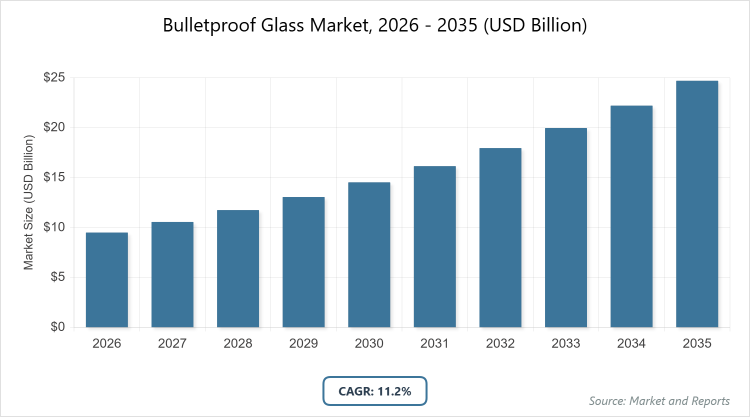
What are the Key Insights in the Bulletproof Glass Market?
- The global Bulletproof Glass market was valued at USD 9.5 billion in 2025 and is projected to reach USD 27 billion by 2035.
- The market is expected to grow at a CAGR of 11.2% from 2026 to 2035.
- The market is driven by rising security threats, geopolitical conflicts, increased military expenditures, and growing demand for protective measures in high-risk environments.
- Automotive segment dominated the end-use category with over 52% revenue share, as it is preferred for armored vehicles used by high-profile individuals, security firms, and in high-crime regions, while also providing benefits like enhanced structural integrity, crash resistance, and UV protection.
- Defense & VIP Vehicles dominated the application segment with the largest revenue share, driven by extensive use in armored military vehicles, tanks, and VIP transport to prevent bullet penetration and protect occupants from ballistic threats.
- North America dominated the regional market with approximately 38% share, owing to high firearm ownership rates, frequent violent incidents including mass shootings, and substantial investments in security across banking, government, and military sectors.
What is the Bulletproof Glass Industry Overview?
Bulletproof glass, also known as ballistic-resistant or transparent armor glass, is a specialized protective material engineered to resist penetration by bullets and other projectiles while maintaining transparency. It is typically composed of multiple layers of tempered glass bonded with interlayers of polycarbonate, acrylic, or other polymers that absorb and dissipate impact energy, preventing shattering and spalling. The market encompasses the design, manufacturing, and supply of such glass for applications requiring high-level security and safety. It addresses needs in environments vulnerable to armed attacks, terrorism, robberies, and espionage, offering not only ballistic protection but also added benefits such as acoustic insulation, UV resistance, and structural reinforcement. The industry serves diverse sectors including defense, automotive, banking, construction, and government, where safety and asset protection are paramount.
What are the Market Dynamics in the Bulletproof Glass Market?
Growth Drivers
The Bulletproof Glass market experiences robust growth due to escalating global security threats, including terrorist activities, armed robberies, civil unrest, and geopolitical conflicts that compel governments, businesses, and individuals to invest in advanced protective solutions. Rising military expenditures worldwide, particularly in response to international tensions, drive demand for bulletproof glass in armored vehicles, military installations, and command centers. Additionally, increasing violent incidents in public spaces, schools, and commercial areas, coupled with high-profile crime statistics, push sectors like banking, automotive, and construction to adopt bulletproof glass for personnel and asset protection. Technological advancements in materials that offer lighter weight, better clarity, and multi-hit resistance further accelerate adoption across applications.
Restraints
Certain factors restrain market expansion, notably fluctuations and occasional declines in defense budgets in key countries, which reduce procurement of bulletproof glass for military vehicles and infrastructure. High production costs associated with specialized materials and manufacturing processes can limit accessibility, particularly for smaller end-users or in price-sensitive markets. Economic uncertainties and budget constraints in public and private sectors may also delay or scale back investments in high-security upgrades, impacting overall demand.
Opportunities
Significant opportunities arise from growing awareness of safety in educational institutions, public buildings, and commercial spaces vulnerable to active shooter incidents or violence, creating demand for retrofitting and new installations. Emerging markets in developing regions with rising urbanization, infrastructure development, and increasing security needs present untapped potential for expansion. Innovations in lighter, thinner, and more cost-effective bulletproof glass technologies could broaden applications in residential and civilian sectors, while collaborations between manufacturers and security firms open avenues for customized solutions.
Challenges
The market faces challenges from supply chain disruptions affecting raw materials like polycarbonate and specialized glass, which can increase costs and delay production. Stringent regulatory standards and certification requirements for ballistic performance vary by region and application, complicating compliance and market entry. Competition from alternative security measures, such as advanced composites or electronic surveillance, poses a threat to traditional bulletproof glass adoption in some use cases.
Bulletproof Glass Market: Report Scope
| Report Attributes | Report Details |
| Report Name | Bulletproof Glass Market |
| Market Size 2025 | USD 9.5 Billion |
| Market Forecast 2035 | USD 27 Billion |
| Growth Rate | CAGR of 11.2% |
| Report Pages | 217 |
| Key Companies Covered | Apogee Enterprises, Inc., Saint Gobain S.A., Guardian Industries, Nippon Sheet Glass Co. Ltd., China Specialty Glass Co. Ltd., and Others |
| Segments Covered | By Type, By Application, By End-Use, and By Region |
| Regions Covered | North America, Europe, Asia Pacific (APAC), Latin America, and The Middle East and Africa (MEA) |
| Base Year | 2025 |
| Historical Year | 2020 – 2024 |
| Forecast Year | 2026 – 2035 |
| Customization Scope | Avail customized purchase options to meet your exact research needs. |
How is the Bulletproof Glass Market Segmented?
The Bulletproof Glass market is segmented by type, application, end-use, and region.
Based on Type Segment Polycarbonate Glass is the most dominant segment due to its superior impact resistance, lightweight properties, flexibility in design, and ability to provide high-level ballistic protection without excessive thickness, making it ideal for automotive, defense, and architectural applications where weight reduction and multi-hit capability are critical, thereby driving market growth through broader adoption. The second most dominant is Laminated Glass, which remains widely used for its cost-effectiveness, established manufacturing processes, and reliable performance in lower to medium threat levels, particularly in banking and construction, supporting steady demand and contributing to overall market stability.
Based on Application Segment Defense & VIP Vehicles is the most dominant segment, holding the largest share because of extensive deployment in military armored vehicles, tanks, tactical carriers, and high-profile transport to safeguard against ammunition and ballistic threats in conflict zones and security operations, significantly propelling market expansion through sustained government and defense contracts. The second most dominant is Cash-In-Transit Vehicles, driven by the persistent risk of armed robberies in financial logistics, where bulletproof glass ensures secure transportation of valuables, contributing to market growth by addressing ongoing needs in banking and security services.
Based on End-Use Segment Automotive is the most dominant segment with over 52% share, as it benefits from strong demand for armored vehicles among VIPs, security personnel, and individuals in high-risk areas, while offering ancillary advantages like improved vehicle rigidity, crash protection, and UV blocking, fueling market growth through rising personalization and security upgrades in luxury and commercial vehicles. The second most dominant is Military, propelled by global defense modernization programs and the need for transparent armor in fighting vehicles and installations, supporting market expansion via increased budgets and focus on troop safety.
What are the Recent Developments in the Bulletproof Glass Market?
- In June 2024, Vedanta acquired a 46.5% stake in AvanStrate Inc., a Japan-based glass substrate manufacturer, enhancing its capabilities in advanced glass production potentially applicable to security solutions.
- In June 2024, Allegion plc acquired Unicel Architectural Corp., a Canada-based producer of advanced glass and aluminum products, strengthening its portfolio in architectural and security glazing applications.
Which Region Dominates the Bulletproof Glass Market?
- North America to dominate the global market.
North America holds the leading position in the global Bulletproof Glass market due to exceptionally high demand stemming from prevalent gun violence, including frequent mass shootings and homicides, alongside robust investments in security infrastructure across banking, government facilities, military bases, and commercial spaces. The United States, as the primary contributor, benefits from elevated firearm ownership rates and proactive measures to counter threats, driving consistent adoption in automotive armoring, law enforcement vehicles, and public safety applications.
Europe is experiencing the fastest growth, fueled by stringent safety regulations, increasing concerns over terrorism and civil unrest, and a focus on innovation and high-quality protective materials. Countries like Germany, the UK, and Russia prioritize advanced security solutions in government buildings, financial institutions, and luxury vehicles, supported by strong regulatory frameworks and emphasis on durable, compliant products.
Asia Pacific demonstrates strong growth potential driven by rapid urbanization, booming construction activities in China and India, economic expansion, and rising security requirements in commercial, residential, and infrastructure projects amid growing crime and geopolitical tensions. Demand is further amplified by increasing military modernization and automotive sector growth in emerging economies.
Latin America shows steady demand influenced by high crime rates in certain countries, including armed robberies and violence, prompting greater use of bulletproof glass in banking, cash-in-transit, and VIP protection. Brazil and other nations invest in security enhancements for financial and government sectors to mitigate risks.
Middle East and Africa exhibit growth driven by geopolitical instability, ongoing conflicts, and elevated defense spending in several countries, leading to procurement for military vehicles, government installations, and high-security buildings. Security concerns in urban areas and critical infrastructure further support market expansion.
Who are the Key Market Players and Strategies in the Bulletproof Glass Market?
- Apogee Enterprises, Inc.: Focuses on architectural and security glazing solutions, emphasizing innovation in durable, high-performance bulletproof products for commercial and institutional applications.
- Armar Glass: Specializes in customized ballistic glass systems, prioritizing advanced lamination technologies for defense and automotive sectors to meet stringent protection standards.
- China Specialty Glass Co. Ltd.: Manufactures a range of security glass including bulletproof variants for construction, automotive, and defense, leveraging cost-effective production and broad application expertise.
- Consolidated Glass Holdings Inc.: Provides high-security glazing solutions with emphasis on customization and compliance with ballistic testing for banking, government, and military uses.
- D.W. Price Security: Delivers specialized bulletproof glass installations, focusing on architectural integration and rapid deployment for high-threat environments.
- Guardian Industries: Offers advanced glass technologies including ballistic-resistant options, supported by global manufacturing and R&D for automotive and construction security.
- National Glass: Supplies durable bulletproof glazing for various sectors, emphasizing reliability and performance in high-security installations.
- Nippon Sheet Glass Co. Ltd.: Develops innovative glass products including security glazing, with strong focus on automotive and architectural applications through technological advancements.
- Saint Gobain S.A.: A global leader in materials, producing bulletproof glass for construction, automotive, and defense, leveraging extensive R&D, worldwide presence, and diverse portfolio to address evolving security needs.
What are the Market Trends in the Bulletproof Glass Market?
- Increasing adoption of lighter and thinner materials to improve vehicle fuel efficiency and ease of installation.
- Growing integration of bulletproof glass with smart technologies, such as switchable opacity for privacy.
- Rising demand for multi-hit resistant and transparent armor in defense applications amid ongoing conflicts.
- Shift toward sustainable and eco-friendly interlayers in manufacturing processes.
- Expansion in civilian and residential sectors due to heightened personal safety awareness.
- Enhanced focus on customization for specific threat levels and aesthetic requirements.
What Market Segments and their Subsegments are Covered in the Report?
By Type
- Laminated Glass
- Polycarbonate Glass
- Acrylic Glass
- Glass-Clad Polycarbonate
- Others
By Application
- Defense & VIP Vehicles
- Cash-In-Transit Vehicles
- Bank Security System
- Government & Law Enforcement
- Others
By End-Use
- Automotive
- Banking & Finance
- Construction
- Military
- Others
By Region
- North America
- U.S.
- Canada
- Europe
- UK
- Germany
- France
- Rest of Europe
- Asia Pacific
- China
- India
- Japan
- Rest of Asia Pacific
- Latin America
- Brazil
- Mexico
- Rest of Latin America
- Middle East & Africa
- UAE
- South Africa
- Rest of Middle East & Africa
Chapter 1. Preface
1.1 Report Description and Scope1.2 Research Scope1.3 Research Methodology1.3.1 Market Research Type1.3.2 Market Research MethodologyChapter 2. Executive Summary
2.1 Global Bulletproof Glass Market, (2026 - 2035) (USD Billion)2.2 Global Bulletproof Glass Market: SnapshotChapter 3. Global Bulletproof Glass Market - Industry Analysis
3.1 Bulletproof Glass Market: Market Dynamics3.2 Market Drivers3.2.1 The bulletproof glass market is driven by rising global security threats, increasing military and defense spending, growing demand for public and commercial safety, and technological advances in lightweight, high-strength protective materials.3.3 Market Restraints3.3.1 The bulletproof glass market is restrained by fluctuating defense budgets, high production costs, and economic uncertainties that limit large-scale investments in advanced security solutions.3.4 Market Opportunities3.4.1 The bulletproof glass market offers opportunities through rising safety demand in public and educational spaces, expansion in emerging markets, innovation in lightweight and cost-effective materials, and strategic collaborations for customized security solutions.3.5 Market Challenges3.5.1 The bulletproof glass market faces challenges from raw material supply chain disruptions, complex regional certification and regulatory requirements, and competition from alternative security technologies and materials.3.6 Porter’s Five Forces Analysis3.7 Market Attractiveness Analysis3.7.1 Market Attractiveness Analysis By Type3.7.2 Market Attractiveness Analysis By Application3.7.3 Market Attractiveness Analysis By End-UseChapter 4. Global Bulletproof Glass Market- Competitive Landscape
4.1 Company Market Share Analysis4.1.1 Global Bulletproof Glass Market: Company Market Share, 20254.2 Strategic Development4.2.1 Acquisitions & mergers4.2.2 New Product launches4.2.3 Agreements, partnerships, collaborations, and joint ventures4.2.4 Research and development and regional expansion4.3 Price Trend AnalysisChapter 5. Global Bulletproof Glass Market - Type Analysis
5.1 Global Bulletproof Glass Market Overview: Type5.1.1 Global Bulletproof Glass Market share, By Type, 2025 and 20355.2 Laminated Glass5.2.1 Global Bulletproof Glass Market by Laminated Glass, 2026 - 2035 (USD Billion)5.3 Polycarbonate Glass5.3.1 Global Bulletproof Glass Market by Polycarbonate Glass, 2026 - 2035 (USD Billion)5.4 Acrylic Glass5.4.1 Global Bulletproof Glass Market by Acrylic Glass, 2026 - 2035 (USD Billion)5.5 Glass-Clad Polycarbonate5.5.1 Global Bulletproof Glass Market by Glass-Clad Polycarbonate, 2026 - 2035 (USD Billion)5.6 Others5.6.1 Global Bulletproof Glass Market by Others, 2026 - 2035 (USD Billion)Chapter 6. Global Bulletproof Glass Market - Application Analysis
6.1 Global Bulletproof Glass Market Overview: Application6.1.1 Global Bulletproof Glass Market Share, By Application, 2025 and 20356.2 Defense & VIP Vehicles6.2.1 Global Bulletproof Glass Market by Defense & VIP Vehicles, 2026 - 2035 (USD Billion)6.3 Cash-In-Transit Vehicles6.3.1 Global Bulletproof Glass Market by Cash-In-Transit Vehicles, 2026 - 2035 (USD Billion)6.4 Bank Security System6.4.1 Global Bulletproof Glass Market by Bank Security System, 2026 - 2035 (USD Billion)6.5 Government & Law Enforcement6.5.1 Global Bulletproof Glass Market by Government & Law Enforcement, 2026 - 2035 (USD Billion)6.6 Others6.6.1 Global Bulletproof Glass Market by Others, 2026 - 2035 (USD Billion)Chapter 7. Global Bulletproof Glass Market - End-Use Analysis
7.1 Global Bulletproof Glass Market Overview: End-Use7.1.1 Global Bulletproof Glass Market Share, By End-Use, 2025 and 20357.2 Automotive7.2.1 Global Bulletproof Glass Market by Automotive, 2026 - 2035 (USD Billion)7.3 Banking & Finance7.3.1 Global Bulletproof Glass Market by Banking & Finance, 2026 - 2035 (USD Billion)7.4 Construction7.4.1 Global Bulletproof Glass Market by Construction, 2026 - 2035 (USD Billion)7.5 Military7.5.1 Global Bulletproof Glass Market by Military, 2026 - 2035 (USD Billion)7.6 Others7.6.1 Global Bulletproof Glass Market by Others, 2026 - 2035 (USD Billion)Chapter 8. Bulletproof Glass Market - Regional Analysis
8.1 Global Bulletproof Glass Market Regional Overview8.2 Global Bulletproof Glass Market Share, by Region, 2025 & 2035 (USD Billion)8.3 North America8.3.1 North America Bulletproof Glass Market, 2026 - 2035 (USD Billion)8.3.1.1 North America Bulletproof Glass Market, by Country, 2026 - 2035 (USD Billion)8.3.2 North America Bulletproof Glass Market, by Type, 2026 - 20358.3.2.1 North America Bulletproof Glass Market, by Type, 2026 - 2035 (USD Billion)8.3.3 North America Bulletproof Glass Market, by Application, 2026 - 20358.3.3.1 North America Bulletproof Glass Market, by Application, 2026 - 2035 (USD Billion)8.3.4 North America Bulletproof Glass Market, by End-Use, 2026 - 20358.3.4.1 North America Bulletproof Glass Market, by End-Use, 2026 - 2035 (USD Billion)8.4 Europe8.4.1 Europe Bulletproof Glass Market, 2026 - 2035 (USD Billion)8.4.1.1 Europe Bulletproof Glass Market, by Country, 2026 - 2035 (USD Billion)8.4.2 Europe Bulletproof Glass Market, by Type, 2026 - 20358.4.2.1 Europe Bulletproof Glass Market, by Type, 2026 - 2035 (USD Billion)8.4.3 Europe Bulletproof Glass Market, by Application, 2026 - 20358.4.3.1 Europe Bulletproof Glass Market, by Application, 2026 - 2035 (USD Billion)8.4.4 Europe Bulletproof Glass Market, by End-Use, 2026 - 20358.4.4.1 Europe Bulletproof Glass Market, by End-Use, 2026 - 2035 (USD Billion)8.5 Asia Pacific8.5.1 Asia Pacific Bulletproof Glass Market, 2026 - 2035 (USD Billion)8.5.1.1 Asia Pacific Bulletproof Glass Market, by Country, 2026 - 2035 (USD Billion)8.5.2 Asia Pacific Bulletproof Glass Market, by Type, 2026 - 20358.5.2.1 Asia Pacific Bulletproof Glass Market, by Type, 2026 - 2035 (USD Billion)8.5.3 Asia Pacific Bulletproof Glass Market, by Application, 2026 - 20358.5.3.1 Asia Pacific Bulletproof Glass Market, by Application, 2026 - 2035 (USD Billion)8.5.4 Asia Pacific Bulletproof Glass Market, by End-Use, 2026 - 20358.5.4.1 Asia Pacific Bulletproof Glass Market, by End-Use, 2026 - 2035 (USD Billion)8.6 Latin America8.6.1 Latin America Bulletproof Glass Market, 2026 - 2035 (USD Billion)8.6.1.1 Latin America Bulletproof Glass Market, by Country, 2026 - 2035 (USD Billion)8.6.2 Latin America Bulletproof Glass Market, by Type, 2026 - 20358.6.2.1 Latin America Bulletproof Glass Market, by Type, 2026 - 2035 (USD Billion)8.6.3 Latin America Bulletproof Glass Market, by Application, 2026 - 20358.6.3.1 Latin America Bulletproof Glass Market, by Application, 2026 - 2035 (USD Billion)8.6.4 Latin America Bulletproof Glass Market, by End-Use, 2026 - 20358.6.4.1 Latin America Bulletproof Glass Market, by End-Use, 2026 - 2035 (USD Billion)8.7 The Middle-East and Africa8.7.1 The Middle-East and Africa Bulletproof Glass Market, 2026 - 2035 (USD Billion)8.7.1.1 The Middle-East and Africa Bulletproof Glass Market, by Country, 2026 - 2035 (USD Billion)8.7.2 The Middle-East and Africa Bulletproof Glass Market, by Type, 2026 - 20358.7.2.1 The Middle-East and Africa Bulletproof Glass Market, by Type, 2026 - 2035 (USD Billion)8.7.3 The Middle-East and Africa Bulletproof Glass Market, by Application, 2026 - 20358.7.3.1 The Middle-East and Africa Bulletproof Glass Market, by Application, 2026 - 2035 (USD Billion)8.7.4 The Middle-East and Africa Bulletproof Glass Market, by End-Use, 2026 - 20358.7.4.1 The Middle-East and Africa Bulletproof Glass Market, by End-Use, 2026 - 2035 (USD Billion)Chapter 9. Company Profiles
9.1 Apogee Enterprises Inc.9.1.1 Overview9.1.2 Financials9.1.3 Product Portfolio9.1.4 Business Strategy9.1.5 Recent Developments9.2 Saint Gobain S.A.9.2.1 Overview9.2.2 Financials9.2.3 Product Portfolio9.2.4 Business Strategy9.2.5 Recent Developments9.3 Guardian Industries9.3.1 Overview9.3.2 Financials9.3.3 Product Portfolio9.3.4 Business Strategy9.3.5 Recent Developments9.4 Nippon Sheet Glass Co. Ltd.9.4.1 Overview9.4.2 Financials9.4.3 Product Portfolio9.4.4 Business Strategy9.4.5 Recent Developments9.5 China Specialty Glass Co. Ltd.9.5.1 Overview9.5.2 Financials9.5.3 Product Portfolio9.5.4 Business Strategy9.5.5 Recent Developments
Frequently Asked Questions
Bulletproof glass is a multi-layered protective material designed to resist bullet penetration and ballistic impacts. It combines glass with polymer interlayers like polycarbonate to absorb and disperse energy from projectiles, preventing breakthrough while preserving visibility.
Key factors include escalating geopolitical tensions, rising military budgets, increasing incidents of violence and terrorism, advancements in lightweight materials, growing urbanization in emerging economies, and heightened security requirements in automotive, banking, and public sectors.
The market is projected to grow from approximately USD 9.5 billion in 2025 to USD 27 billion by 2035, reflecting cumulative expansion driven by sustained demand across key applications and regions.
The market is expected to register a CAGR of 11.2% during the forecast period from 2026 to 2035.
North America will contribute notably, holding a significant share due to high security needs, prevalent gun violence, and strong investments in protective measures, particularly in the United States.
Major players include Saint Gobain S.A., Guardian Industries, Nippon Sheet Glass Co. Ltd., Apogee Enterprises, Inc., and China Specialty Glass Co. Ltd., among others, through innovation, global reach, and customized solutions.
The report provides comprehensive analysis of market size, growth forecasts, segmentation, regional insights, competitive landscape, key trends, drivers, restraints, opportunities, recent developments, and strategic recommendations for stakeholders.
The value chain includes raw material suppliers (glass, polycarbonate, interlayers), manufacturing and lamination processes, quality testing and certification for ballistic standards, distribution through specialized channels, integration into end-products by OEMs, and final installation or aftermarket services.
Trends show a shift toward lighter, thinner, and more transparent solutions with multi-hit capabilities, increasing demand for integrated smart features, greater emphasis on sustainability in materials, and growing civilian adoption for personal and residential security beyond traditional institutional uses.
Regulatory factors include varying ballistic certification standards (e.g., NIJ, EN, UL) across regions, building codes mandating safety glass in high-risk structures, and defense procurement regulations. Environmental factors involve pressure for recyclable or low-impact materials, waste management in production, and sustainability initiatives influencing material selection and manufacturing practices.