
Building Information Modeling (BIM) Market Size, Share and Trends 2026 to 2035
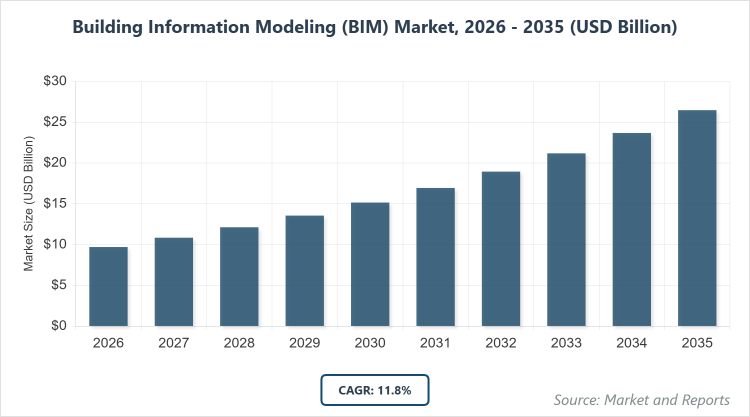
According to MarketnReports, the global Building Information Modeling (BIM) market size was estimated at USD 9.7 billion in 2025 and is expected to reach USD 29.7 billion by 2035, growing at a CAGR of 11.8% from 2026 to 2035. Building Information Modeling (BIM) Market is driven by increasing government mandates and digital transformation in the construction industry.
What are the Key Insights in the BIM Market?
- The global Building Information Modeling (BIM) market was valued at USD 9.7 billion in 2025 and is projected to reach USD 29.7 billion by 2035.
- The market is expected to grow at a CAGR of 11.8% during the forecast period from 2026 to 2035.
- The market is driven by government mandates for BIM adoption, integration of AI and ML technologies, and the shift toward cloud-based solutions for enhanced collaboration.
- In the component segment, software dominated with over 66.0% revenue share, while services held the remaining share.
- Software dominates due to its advanced design tools, cloud integration, AI/ML capabilities, and 4D/5D functionalities that enable precise modeling and efficiency in construction processes.
- In the deployment segment, on-premises dominated, while cloud was the second largest.
- On-premises dominates because of its advantages in data security, regulatory compliance, customization, and integration with legacy systems, making it preferred for sensitive projects.
- In the project lifecycle segment, pre-construction dominated, while operation was the second largest.
- Pre-construction dominates as it allows for accuracy in design, clash detection, and cost control, reducing errors and rework in early project stages.
- In the application segment, designing dominated with over 42.0% revenue share, while planning and modeling was the second largest.
- Designing dominates owing to its role in providing precision, real-time collaboration, and conflict detection, which streamlines workflows and minimizes project delays.
- In the building type segment, commercial dominated, while residential was the second largest.
- Commercial dominates due to the complexity of projects like office towers and mixed-use developments that require sophisticated BIM tools for coordination and optimization.
- North America dominated the regional market with 46.5% revenue share.
- North America dominates because of strong government mandates, mature AEC industry, infrastructure upgrades, and widespread adoption of AI and digital twins, particularly in the U.S.
What is the Industry Overview of BIM?
Building Information Modeling (BIM) refers to a digital representation of the physical and functional characteristics of a building or infrastructure project, serving as a shared knowledge resource for information about a facility forming a reliable basis for decisions during its lifecycle. The BIM market encompasses software and services that facilitate the creation, management, and utilization of these digital models throughout the planning, design, construction, and operation phases of building projects. It integrates multidisciplinary data to produce a virtual model that enhances collaboration among architects, engineers, contractors, and owners, leading to improved efficiency, reduced costs, and better project outcomes. The market definition includes tools for 3D modeling, simulation, and data management, enabling stakeholders to visualize and analyze projects in a virtual environment before physical implementation, thereby minimizing risks and promoting sustainable practices in the construction industry.
What are the Market Dynamics in BIM?
Growth Drivers
The growth of the Building Information Modeling (BIM) market is propelled by the increasing integration of artificial intelligence (AI) and machine learning (ML) technologies, which automate processes such as clash detection, predictive maintenance, and design optimization, thereby enhancing accuracy and reducing project timelines. Government mandates across various countries, such as the UK’s Level 2 BIM requirement for public projects and similar initiatives in Singapore and the UAE, are compelling the construction industry to adopt BIM for improved transparency, standardization, and efficiency. Additionally, the shift toward cloud-based platforms facilitates real-time collaboration among global teams, cost-effective scalability, and seamless data sharing, further accelerated by the demand for sustainable building practices that incorporate energy modeling and lifecycle assessments. The expansion of BIM applications beyond design into asset management and operations, coupled with the rise of smart city initiatives, is driving widespread adoption in both public and private sectors, fostering innovation and productivity gains.
Restraints
Despite its advantages, the BIM market faces restraints primarily from data security concerns, especially with the growing adoption of cloud-based solutions, where vulnerabilities to cyber threats and compliance with stringent regulations like GDPR can hinder implementation. The high initial costs associated with software licenses, training, and integration with existing legacy systems pose barriers for small and medium-sized enterprises (SMEs) in the construction sector, limiting market penetration in developing regions. Furthermore, the lack of skilled professionals proficient in BIM tools and methodologies creates a talent gap, leading to resistance in traditional workflows and slower adoption rates. Interoperability issues between different BIM software platforms also restrain seamless collaboration, as incompatible formats can result in data loss or inefficiencies during project handovers.
Opportunities
Opportunities in the BIM market abound with the expansion into emerging areas such as digital twins, Internet of Things (IoT) integration, and robotics, which enable advanced simulations and real-time monitoring for predictive analytics and enhanced facility management. The rise of Software as a Service (SaaS) models offers agile, subscription-based access to BIM tools, making them more accessible to SMEs and promoting broader market growth. Increasing focus on environmental, social, and governance (ESG) criteria in construction projects opens avenues for BIM to support green building certifications through energy-efficient designs and material optimization. Moreover, rapid urbanization in developing economies presents opportunities for BIM in large-scale infrastructure projects, including smart cities and affordable housing, where it can address labor shortages and improve project sustainability.
Challenges
The BIM market encounters challenges from the increasing complexity of construction projects, which demand specialized services for implementation, integration, and ongoing support, often overwhelming organizations without adequate resources. The need for continuous upskilling of the workforce to handle evolving BIM technologies, such as 4D/5D modeling and AI-driven tools, poses a significant hurdle, exacerbating the global shortage of qualified professionals. Shifting from traditional 2D workflows to intelligent, data-centric platforms amid legacy system dependencies creates integration challenges, potentially leading to project disruptions. Additionally, varying regional regulatory environments and the absence of universal standards can complicate cross-border collaborations, while economic uncertainties may delay investments in BIM adoption.
Building Information Modeling (BIM) Market: Report Scope
| Report Attributes | Report Details |
| Report Name | Building Information Modeling (BIM) Market |
| Market Size 2025 | USD 9.7 Billion |
| Market Forecast 2035 | USD 29.7 Billion |
| Growth Rate | CAGR of 11.8% |
| Report Pages | 210 |
| Key Companies Covered | Autodesk Inc., Bentley Systems, Trimble Inc., Dassault Systèmes, Nemetschek Group, Hexagon AB, Topcon Positioning Systems Inc., AVEVA Group PLC, Asite Solutions Ltd., Beck Technology, Bimeye Inc., ACCA Software, and Others |
| Segments Covered | By Component, By Deployment, By Project Lifecycle, By Application, By Building Type, and By Region |
| Regions Covered | North America, Europe, Asia Pacific (APAC), Latin America, and The Middle East and Africa (MEA) |
| Base Year | 2025 |
| Historical Year | 2020 – 2024 |
| Forecast Year | 2026 – 2035 |
| Customization Scope | Avail customized purchase options to meet your exact research needs. |
What is the Market Segmentation in BIM?
The Building Information Modeling (BIM) market is segmented by component, deployment mode, project lifecycle, application, building type, and region.
Based on Component Segment, the most dominant subsegment is software, holding over 66.0% revenue share, due to its critical role in providing advanced design tools, cloud integration, AI/ML capabilities, and 4D/5D functionalities that enable precise virtual modeling, error reduction, and streamlined workflows, driving the market by enhancing overall project efficiency and collaboration. The second most dominant is services, which supports the market growth through consulting, training, and integration needs arising from project complexities and digital transformation, helping to bridge skill gaps and ensure successful BIM implementation across the construction lifecycle.
Based on Deployment Mode Segment, the most dominant subsegment is on-premises, preferred for its robust data security, compliance with regulations, customization options, and seamless integration with legacy systems, driving the market by addressing concerns in sensitive industries like government and healthcare where control over data is paramount. The second most dominant is cloud, which accelerates market expansion through cost efficiency, scalability, real-time updates, and remote collaboration features, enabling global teams to work efficiently and adapt to dynamic project requirements.
Based on Project Lifecycle Segment, the most dominant subsegment is pre-construction, facilitating accuracy in design, clash detection, and cost estimation, which drives the market by minimizing rework, optimizing resources, and ensuring projects start on a strong foundation. The second most dominant is operation, contributing to growth through asset management, energy efficiency, and predictive maintenance capabilities, helping to extend building lifespans and reduce long-term operational costs.
Based on Application Segment, the most dominant subsegment is designing, capturing over 42.0% revenue share with its precision, collaboration tools, and conflict detection features, driving the market by improving design quality and reducing errors in complex projects. The second most dominant is planning and modeling, which supports market advancement by enabling detailed simulations and visualizations that aid in decision-making and stakeholder alignment throughout project phases.
Based on Building Type Segment, the most dominant subsegment is commercial, suited for intricate projects like office complexes and retail spaces, driving the market through enhanced coordination, sustainability features, and efficiency in high-stake developments. The second most dominant is residential, boosting growth via applications in affordable housing, space optimization, and urbanization-driven demands, where BIM helps in customizing designs to meet diverse consumer needs.
What are the Recent Developments in BIM?
- In April 2025, Conch Group partnered with China Building Materials Federation and Huawei to launch an AI model for the cement industry, focusing on optimizing processes such as clinker prediction and anomaly detection, which enhances BIM integration for sustainable material management in construction projects.
- In March 2025, IFMA and Autodesk launched the Building Lifecycle Management Initiative (BLMI), aimed at promoting data interoperability using BIM, digital twins, and AI to reduce costs and support decarbonization efforts across the facility management sector.
- In March 2025, Motif introduced a cloud-based collaboration platform that integrates 2D/3D workflows for real-time feedback, improving design team efficiency and aligning with the growing trend of remote BIM collaboration in global projects.
What is the Regional Analysis of BIM?
- North America to dominate the global market.
North America. This region held the largest revenue share of 46.5% in 2025, driven by advanced infrastructure upgrades, widespread adoption of AI and digital twins, and strong government mandates for BIM in public projects. The United States dominates within the region with over 66.0% share, owing to its mature architecture, engineering, and construction (AEC) industry, federal initiatives for smart cities, and investments in technology integration that enhance project efficiency and sustainability. Canada and Mexico contribute through growing urbanization and cross-border collaborations, where BIM supports complex infrastructure developments like transportation networks and energy systems.
Europe. Europe is poised for steady growth with a CAGR over 10.0% from 2026 to 2035, fueled by digitalization in public infrastructure such as railways and energy sectors, along with national BIM roadmaps emphasizing standardization and collaboration. Germany dominates the region due to its comprehensive BIM implementation strategy for public buildings, supported by industry 4.0 initiatives that integrate BIM with manufacturing processes for precision and efficiency. The UK follows closely with its Level 2 BIM mandate, promoting transparency in government-funded projects, while France advances through sustainability-focused regulations that leverage BIM for green building certifications.
Asia Pacific. The Asia Pacific region is expected to witness the fastest growth with a CAGR over 16.0% during the forecast period, attributed to massive infrastructure investments, smart city developments, and a focus on sustainability amid rapid urbanization. China dominates with its government mandates for BIM in large-scale projects, including high-speed rail and urban planning, where it optimizes labor and resources through automation. Japan contributes significantly by addressing labor shortages with BIM-integrated robotics and AI, enhancing precision in earthquake-resistant designs, while India and South Korea grow through affordable housing initiatives and tech-driven construction efficiencies.
Latin America. Latin America shows promising growth potential, driven by increasing adoption of BIM in infrastructure and commercial projects to improve efficiency and reduce costs in emerging economies. Brazil dominates the region with investments in urban development and transportation, where BIM aids in managing complex mega-projects like stadiums and highways amid regulatory pushes for digital tools. The region’s focus on sustainable practices further supports BIM use in addressing environmental challenges, though adoption varies due to economic fluctuations.
Middle East and Africa (MEA). The MEA region is expanding through government-led initiatives in smart cities and infrastructure, with BIM playing a key role in optimizing designs for harsh environments and resource management. The UAE dominates with ambitious projects like Dubai’s smart city vision, incorporating BIM for iconic structures and sustainability goals. Saudi Arabia follows with Vision 2030-driven developments, while South Africa advances in public sector mandates for efficient building operations.
Who are the Key Market Players in BIM?
Autodesk Inc.. As a market leader, Autodesk Inc. employs strategies focused on cloud-based solutions like BIM 360, AI integration for automation, and sustainability tools in products such as Revit and AutoCAD, enabling comprehensive lifecycle management and collaboration to maintain its dominant position through continuous innovation and partnerships.
Bentley Systems. Bentley Systems emphasizes open-source platforms and digital twins, with strategies centered on infrastructure-specific tools that integrate with IoT for real-time data, driving growth through acquisitions and focus on large-scale projects in transportation and utilities.
Trimble Inc.. Trimble Inc. leverages hardware-software synergy in products like Tekla Structures and SketchUp, with strategies involving precision positioning and construction management solutions to enhance on-site efficiency and reduce errors via connected workflows.
Dassault Systèmes. Dassault Systèmes pursues strategies of 3D experience platforms, integrating BIM with simulation and collaboration tools to support end-to-end project delivery, emphasizing industry-specific applications in aerospace and construction.
Nemetschek Group. Nemetschek Group focuses on specialized software for architecture and engineering, with strategies including modular tools for design and analysis, promoting interoperability to capture market share in creative and technical segments.
Hexagon AB. Hexagon AB adopts strategies of geospatial and industrial solutions, combining BIM with sensor data for smart manufacturing and construction, aiming at accuracy and productivity through data-driven insights.
Topcon Positioning Systems Inc.. Topcon Positioning Systems Inc. strategizes around surveying and positioning technologies integrated with BIM, enhancing site preparation and monitoring to support precise execution in infrastructure projects.
AVEVA Group PLC. AVEVA Group PLC employs industrial software strategies, linking BIM with plant design and operations for energy and marine sectors, focusing on digital transformation to optimize asset performance.
Asite Solutions Ltd.. Asite Solutions Ltd. concentrates on collaborative platforms for data sharing, with strategies emphasizing cloud-based common data environments to facilitate stakeholder communication and project transparency.
Beck Technology. Beck Technology targets pre-construction estimation, with strategies involving cost modeling tools integrated with BIM to provide accurate budgeting and risk assessment for developers.
Bimeye Inc.. Bimeye Inc. focuses on cloud data management, strategizing around bridging information gaps in BIM workflows to ensure data accessibility and integrity across project teams.
ACCA Software. ACCA Software pursues affordable BIM tools for SMEs, with strategies including user-friendly interfaces for design and compliance, expanding access in residential and small-scale projects.
What are the Market Trends in BIM?
- Integration of AI and ML for automated clash detection, predictive maintenance, and design optimization to enhance decision-making and reduce errors.
- Shift toward cloud and SaaS models enabling real-time collaboration, improved security, and scalable access for global teams.
- Growing government mandates promoting BIM for transparency, standardization, and efficiency in public infrastructure projects.
- Expansion of BIM applications into asset management and operations, supporting energy efficiency and lifecycle assessments.
- Emphasis on sustainability through energy modeling and green building practices aligned with ESG criteria.
- Adoption in residential sectors for affordable housing and urbanization, optimizing space and customization.
- Incorporation of digital twins, IoT, and robotics for advanced simulations and real-time project monitoring.
What Market Segments and Subsegments are Covered in the BIM Report?
By Component
-
Software
-
Services
- Professional Services
- Managed Services
By Deployment Mode
- On-premises
- Cloud
By Project Lifecycle
- Pre-construction
- Construction
- Operation
By Application
- Designing
- Planning and Modeling
- Asset Management
- Others
By Building Type
- Commercial
- Residential
- Industrial
- Government
By Region
- North America
- U.S.
- Canada
- Europe
- UK
- Germany
- France
- Rest of Europe
- Asia Pacific
- China
- India
- Japan
- Rest of Asia Pacific
- Latin America
- Brazil
- Mexico
- Rest of Latin America
- Middle East & Africa
- UAE
- South Africa
- Rest of Middle East & Africa
Chapter 1. Preface
1.1 Report Description and Scope1.2 Research Scope1.3 Research Methodology1.3.1 Market Research Type1.3.2 Market Research MethodologyChapter 2. Executive Summary
2.1 Global Building Information Modeling (BIM) Market, (2026 - 2035) (USD Billion)2.2 Global Building Information Modeling (BIM) Market: SnapshotChapter 3. Global Building Information Modeling (BIM) Market - Industry Analysis
3.1 Building Information Modeling (BIM) Market: Market Dynamics3.2 Market Drivers3.2.1 The BIM market is driven by AI/ML integration, government mandates, cloud-based collaboration, sustainable construction demands, smart city development, and the expansion of BIM from design into asset management and operations.3.3 Market Restraints3.3.1 The BIM market is restrained by data security concerns, high implementation and training costs, skill shortages, legacy system integration challenges, and interoperability issues between different BIM platforms.3.4 Market Opportunities3.4.1 Opportunities in the BIM market arise from digital twins, IoT and robotics integration, SaaS-based adoption, ESG-driven green construction, and rapid urbanization fueling smart city and large-scale infrastructure projects.3.5 Market Challenges3.5.1 The BIM market faces challenges from project complexity, workforce skill gaps, integration with legacy systems, lack of universal standards, regulatory variations, and economic uncertainties that can delay adoption.3.6 Porter’s Five Forces Analysis3.7 Market Attractiveness Analysis3.7.1 Market Attractiveness Analysis By Component3.7.2 Market Attractiveness Analysis By Deployment3.7.3 Market Attractiveness Analysis By Project Lifecycle3.7.4 Market Attractiveness Analysis By Application3.7.5 Market Attractiveness Analysis By Building TypeChapter 4. Global Building Information Modeling (BIM) Market- Competitive Landscape
4.1 Company Market Share Analysis4.1.1 Global Building Information Modeling (BIM) Market: Company Market Share, 20254.2 Strategic Development4.2.1 Acquisitions & mergers4.2.2 New Product launches4.2.3 Agreements, partnerships, collaborations, and joint ventures4.2.4 Research and development and regional expansion4.3 Price Trend AnalysisChapter 5. Global Building Information Modeling (BIM) Market - Component Analysis
5.1 Global Building Information Modeling (BIM) Market Overview: Component5.1.1 Global Building Information Modeling (BIM) Market share, By Component, 2025 and 20355.2 Software5.2.1 Global Building Information Modeling (BIM) Market by Software, 2026 - 2035 (USD Billion)5.3 Services5.3.1 Global Building Information Modeling (BIM) Market by Services, 2026 - 2035 (USD Billion)Chapter 6. Global Building Information Modeling (BIM) Market - Deployment Analysis
6.1 Global Building Information Modeling (BIM) Market Overview: Deployment6.1.1 Global Building Information Modeling (BIM) Market Share, By Deployment, 2025 and 20356.2 On-premises6.2.1 Global Building Information Modeling (BIM) Market by On-premises, 2026 - 2035 (USD Billion)6.3 Cloud6.3.1 Global Building Information Modeling (BIM) Market by Cloud, 2026 - 2035 (USD Billion)Chapter 7. Global Building Information Modeling (BIM) Market - Project Lifecycle Analysis
7.1 Global Building Information Modeling (BIM) Market Overview: Project Lifecycle7.1.1 Global Building Information Modeling (BIM) Market Share, By Project Lifecycle, 2025 and 20357.2 Pre-construction7.2.1 Global Building Information Modeling (BIM) Market by Pre-construction, 2026 - 2035 (USD Billion)7.3 Construction7.3.1 Global Building Information Modeling (BIM) Market by Construction, 2026 - 2035 (USD Billion)7.4 Operation7.4.1 Global Building Information Modeling (BIM) Market by Operation, 2026 - 2035 (USD Billion)Chapter 8. Global Building Information Modeling (BIM) Market - Application Analysis
8.1 Global Building Information Modeling (BIM) Market Overview: Application8.1.1 Global Building Information Modeling (BIM) Market Share, By Application, 2025 and 20358.2 Designing8.2.1 Global Building Information Modeling (BIM) Market by Designing, 2026 - 2035 (USD Billion)8.3 Planning and Modeling8.3.1 Global Building Information Modeling (BIM) Market by Planning and Modeling, 2026 - 2035 (USD Billion)8.4 Asset Management8.4.1 Global Building Information Modeling (BIM) Market by Asset Management, 2026 - 2035 (USD Billion)8.5 Others8.5.1 Global Building Information Modeling (BIM) Market by Others, 2026 - 2035 (USD Billion)Chapter 9. Global Building Information Modeling (BIM) Market - Building Type Analysis
9.1 Global Building Information Modeling (BIM) Market Overview: Building Type9.1.1 Global Building Information Modeling (BIM) Market Share, By Building Type, 2025 and 20359.2 Commercial9.2.1 Global Building Information Modeling (BIM) Market by Commercial, 2026 - 2035 (USD Billion)9.3 Residential9.3.1 Global Building Information Modeling (BIM) Market by Residential, 2026 - 2035 (USD Billion)9.4 Industrial9.4.1 Global Building Information Modeling (BIM) Market by Industrial, 2026 - 2035 (USD Billion)9.5 Government9.5.1 Global Building Information Modeling (BIM) Market by Government, 2026 - 2035 (USD Billion)Chapter 10. Building Information Modeling (BIM) Market - Regional Analysis
10.1 Global Building Information Modeling (BIM) Market Regional Overview10.2 Global Building Information Modeling (BIM) Market Share, by Region, 2025 & 2035 (USD Billion)10.3 North America10.3.1 North America Building Information Modeling (BIM) Market, 2026 - 2035 (USD Billion)10.3.1.1 North America Building Information Modeling (BIM) Market, by Country, 2026 - 2035 (USD Billion)10.3.2 North America Building Information Modeling (BIM) Market, by Component, 2026 - 203510.3.2.1 North America Building Information Modeling (BIM) Market, by Component, 2026 - 2035 (USD Billion)10.3.3 North America Building Information Modeling (BIM) Market, by Deployment, 2026 - 203510.3.3.1 North America Building Information Modeling (BIM) Market, by Deployment, 2026 - 2035 (USD Billion)10.3.4 North America Building Information Modeling (BIM) Market, by Project Lifecycle, 2026 - 203510.3.4.1 North America Building Information Modeling (BIM) Market, by Project Lifecycle, 2026 - 2035 (USD Billion)10.3.5 North America Building Information Modeling (BIM) Market, by Application, 2026 - 203510.3.5.1 North America Building Information Modeling (BIM) Market, by Application, 2026 - 2035 (USD Billion)10.3.6 North America Building Information Modeling (BIM) Market, by Building Type, 2026 - 203510.3.6.1 North America Building Information Modeling (BIM) Market, by Building Type, 2026 - 2035 (USD Billion)10.4 Europe10.4.1 Europe Building Information Modeling (BIM) Market, 2026 - 2035 (USD Billion)10.4.1.1 Europe Building Information Modeling (BIM) Market, by Country, 2026 - 2035 (USD Billion)10.4.2 Europe Building Information Modeling (BIM) Market, by Component, 2026 - 203510.4.2.1 Europe Building Information Modeling (BIM) Market, by Component, 2026 - 2035 (USD Billion)10.4.3 Europe Building Information Modeling (BIM) Market, by Deployment, 2026 - 203510.4.3.1 Europe Building Information Modeling (BIM) Market, by Deployment, 2026 - 2035 (USD Billion)10.4.4 Europe Building Information Modeling (BIM) Market, by Project Lifecycle, 2026 - 203510.4.4.1 Europe Building Information Modeling (BIM) Market, by Project Lifecycle, 2026 - 2035 (USD Billion)10.4.5 Europe Building Information Modeling (BIM) Market, by Application, 2026 - 203510.4.5.1 Europe Building Information Modeling (BIM) Market, by Application, 2026 - 2035 (USD Billion)10.4.6 Europe Building Information Modeling (BIM) Market, by Building Type, 2026 - 203510.4.6.1 Europe Building Information Modeling (BIM) Market, by Building Type, 2026 - 2035 (USD Billion)10.5 Asia Pacific10.5.1 Asia Pacific Building Information Modeling (BIM) Market, 2026 - 2035 (USD Billion)10.5.1.1 Asia Pacific Building Information Modeling (BIM) Market, by Country, 2026 - 2035 (USD Billion)10.5.2 Asia Pacific Building Information Modeling (BIM) Market, by Component, 2026 - 203510.5.2.1 Asia Pacific Building Information Modeling (BIM) Market, by Component, 2026 - 2035 (USD Billion)10.5.3 Asia Pacific Building Information Modeling (BIM) Market, by Deployment, 2026 - 203510.5.3.1 Asia Pacific Building Information Modeling (BIM) Market, by Deployment, 2026 - 2035 (USD Billion)10.5.4 Asia Pacific Building Information Modeling (BIM) Market, by Project Lifecycle, 2026 - 203510.5.4.1 Asia Pacific Building Information Modeling (BIM) Market, by Project Lifecycle, 2026 - 2035 (USD Billion)10.5.5 Asia Pacific Building Information Modeling (BIM) Market, by Application, 2026 - 203510.5.5.1 Asia Pacific Building Information Modeling (BIM) Market, by Application, 2026 - 2035 (USD Billion)10.5.6 Asia Pacific Building Information Modeling (BIM) Market, by Building Type, 2026 - 203510.5.6.1 Asia Pacific Building Information Modeling (BIM) Market, by Building Type, 2026 - 2035 (USD Billion)10.6 Latin America10.6.1 Latin America Building Information Modeling (BIM) Market, 2026 - 2035 (USD Billion)10.6.1.1 Latin America Building Information Modeling (BIM) Market, by Country, 2026 - 2035 (USD Billion)10.6.2 Latin America Building Information Modeling (BIM) Market, by Component, 2026 - 203510.6.2.1 Latin America Building Information Modeling (BIM) Market, by Component, 2026 - 2035 (USD Billion)10.6.3 Latin America Building Information Modeling (BIM) Market, by Deployment, 2026 - 203510.6.3.1 Latin America Building Information Modeling (BIM) Market, by Deployment, 2026 - 2035 (USD Billion)10.6.4 Latin America Building Information Modeling (BIM) Market, by Project Lifecycle, 2026 - 203510.6.4.1 Latin America Building Information Modeling (BIM) Market, by Project Lifecycle, 2026 - 2035 (USD Billion)10.6.5 Latin America Building Information Modeling (BIM) Market, by Application, 2026 - 203510.6.5.1 Latin America Building Information Modeling (BIM) Market, by Application, 2026 - 2035 (USD Billion)10.6.6 Latin America Building Information Modeling (BIM) Market, by Building Type, 2026 - 203510.6.6.1 Latin America Building Information Modeling (BIM) Market, by Building Type, 2026 - 2035 (USD Billion)10.7 The Middle-East and Africa10.7.1 The Middle-East and Africa Building Information Modeling (BIM) Market, 2026 - 2035 (USD Billion)10.7.1.1 The Middle-East and Africa Building Information Modeling (BIM) Market, by Country, 2026 - 2035 (USD Billion)10.7.2 The Middle-East and Africa Building Information Modeling (BIM) Market, by Component, 2026 - 203510.7.2.1 The Middle-East and Africa Building Information Modeling (BIM) Market, by Component, 2026 - 2035 (USD Billion)10.7.3 The Middle-East and Africa Building Information Modeling (BIM) Market, by Deployment, 2026 - 203510.7.3.1 The Middle-East and Africa Building Information Modeling (BIM) Market, by Deployment, 2026 - 2035 (USD Billion)10.7.4 The Middle-East and Africa Building Information Modeling (BIM) Market, by Project Lifecycle, 2026 - 203510.7.4.1 The Middle-East and Africa Building Information Modeling (BIM) Market, by Project Lifecycle, 2026 - 2035 (USD Billion)10.7.5 The Middle-East and Africa Building Information Modeling (BIM) Market, by Application, 2026 - 203510.7.5.1 The Middle-East and Africa Building Information Modeling (BIM) Market, by Application, 2026 - 2035 (USD Billion)10.7.6 The Middle-East and Africa Building Information Modeling (BIM) Market, by Building Type, 2026 - 203510.7.6.1 The Middle-East and Africa Building Information Modeling (BIM) Market, by Building Type, 2026 - 2035 (USD Billion)Chapter 11. Company Profiles
11.1 Autodesk Inc.11.1.1 Overview11.1.2 Financials11.1.3 Product Portfolio11.1.4 Business Strategy11.1.5 Recent Developments11.2 Bentley Systems11.2.1 Overview11.2.2 Financials11.2.3 Product Portfolio11.2.4 Business Strategy11.2.5 Recent Developments11.3 Trimble Inc.11.3.1 Overview11.3.2 Financials11.3.3 Product Portfolio11.3.4 Business Strategy11.3.5 Recent Developments11.4 Dassault Systèmes11.4.1 Overview11.4.2 Financials11.4.3 Product Portfolio11.4.4 Business Strategy11.4.5 Recent Developments11.5 Nemetschek Group11.5.1 Overview11.5.2 Financials11.5.3 Product Portfolio11.5.4 Business Strategy11.5.5 Recent Developments11.6 Hexagon AB11.6.1 Overview11.6.2 Financials11.6.3 Product Portfolio11.6.4 Business Strategy11.6.5 Recent Developments11.7 Topcon Positioning Systems Inc.11.7.1 Overview11.7.2 Financials11.7.3 Product Portfolio11.7.4 Business Strategy11.7.5 Recent Developments11.8 AVEVA Group PLC11.8.1 Overview11.8.2 Financials11.8.3 Product Portfolio11.8.4 Business Strategy11.8.5 Recent Developments11.9 Asite Solutions Ltd.11.9.1 Overview11.9.2 Financials11.9.3 Product Portfolio11.9.4 Business Strategy11.9.5 Recent Developments11.10 Beck Technology11.10.1 Overview11.10.2 Financials11.10.3 Product Portfolio11.10.4 Business Strategy11.10.5 Recent Developments11.11 Bimeye Inc.11.11.1 Overview11.11.2 Financials11.11.3 Product Portfolio11.11.4 Business Strategy11.11.5 Recent Developments11.12 ACCA Software11.12.1 Overview11.12.2 Financials11.12.3 Product Portfolio11.12.4 Business Strategy11.12.5 Recent Developments
Frequently Asked Questions
Building Information Modeling (BIM) is a digital process that creates and manages a virtual representation of a building's physical and functional characteristics, facilitating collaboration and decision-making throughout its lifecycle from design to operation.
Key factors include government mandates for BIM adoption, integration of AI and ML technologies, cloud-based collaboration, sustainability demands, and expansion into asset management and smart city projects.
The market is projected to grow from USD 9.7 billion in 2025 to USD 29.7 billion by 2035.
The CAGR is expected to be 11.8% during the forecast period.
North America will contribute notably, holding the largest share due to advanced infrastructure and technological adoption.
Major players include Autodesk Inc., Bentley Systems, Trimble Inc., Dassault Systèmes, Nemetschek Group, Hexagon AB, Topcon Positioning Systems Inc., AVEVA Group PLC, Asite Solutions Ltd., Beck Technology, Bimeye Inc., and ACCA Software.
The report provides market size, forecasts, segmentation analysis, drivers, restraints, opportunities, regional insights, key player profiles, trends, and recent developments.
The value chain includes software development, deployment and integration services, project planning and design, construction execution, operation and maintenance, and end-user adoption across building types.
Trends are evolving toward AI-driven automation, cloud collaboration, and sustainability, with consumers preferring integrated tools for efficiency, cost savings, and eco-friendly project outcomes.
Regulatory factors include government mandates for BIM in public projects, while environmental factors involve ESG criteria and green building standards promoting energy-efficient designs and sustainable practices.