
Blood Glucose Monitoring System Market Size, Share and Trends 2026 to 2035
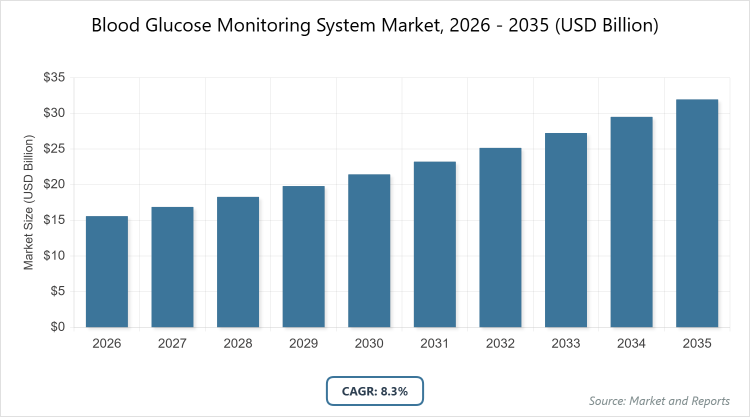
According to MarketnReports, the global Blood Glucose Monitoring System Market size was estimated at USD 15.6 billion in 2025 and is expected to reach USD 34.7 billion by 2035, growing at a CAGR of 8.3% from 2026 to 2035. Blood Glucose Monitoring System Market is driven by the rising global prevalence of diabetes and advancements in continuous glucose monitoring technologies.
What are the Key Insights into the Blood Glucose Monitoring System Market?
- The global Blood Glucose Monitoring System Market was valued at USD 15.6 billion in 2025.
- The market is projected to grow at a CAGR of 8.3% from 2026 to 2035.
- The Blood Glucose Monitoring System Market is driven by increasing diabetes incidence, technological innovations in CGM devices, and growing adoption of home-based monitoring solutions.
- Self-Monitoring Blood Glucose Systems dominate the Product Type segment with approximately 66% share because of their affordability, ease of use, and widespread availability for daily testing among type 2 diabetes patients.
- Type 2 Diabetes Management dominates the Application segment with around 70% share as the majority of diabetes cases are type 2, requiring regular monitoring to manage lifestyle and medication effectively.
- Home Care Settings dominate the End-User segment with over 50% share since they enable patient self-management, reduce hospital visits, and align with preferences for convenient, at-home care.
- North America dominates the global market with 40% share due to high diabetes prevalence, advanced healthcare infrastructure, favorable reimbursement policies, and strong presence of key innovators in the United States.
What is the Industry Overview of the Blood Glucose Monitoring System Market?
The Blood Glucose Monitoring System Market encompasses devices and systems designed to measure and track blood sugar levels in individuals, primarily those with diabetes, through invasive, minimally invasive, or non-invasive methods to facilitate effective disease management and prevent complications. This market includes self-monitoring tools like glucometers and test strips, as well as advanced continuous monitoring systems with sensors and digital integrations for real-time data analysis and alerts. The market definition focuses on technologies that empower patients and healthcare providers with accurate, timely glucose insights to optimize insulin therapy, dietary adjustments, and lifestyle interventions, driven by the need for personalized care amid escalating chronic disease burdens worldwide.
What are the Market Dynamics of the Blood Glucose Monitoring System Market?
Growth Drivers
The Blood Glucose Monitoring System Market is bolstered by the surging global diabetes epidemic, with millions newly diagnosed annually, necessitating reliable monitoring tools to avert severe complications like neuropathy and cardiovascular issues. Innovations such as smartphone-integrated CGM systems and AI-driven predictive analytics enhance user compliance and accuracy, while government health initiatives and insurance expansions in developed nations improve affordability, driving widespread adoption and market expansion through empowered patient-centric care models.
Restraints
High costs of advanced CGM devices and recurring expenses for sensors and strips pose significant barriers, particularly in low-income regions, limiting access for underserved populations. Additionally, concerns over device accuracy in extreme conditions, regulatory hurdles for new approvals, and patient discomfort with invasive methods restrain broader penetration, compounded by inadequate healthcare infrastructure in developing areas.
Opportunities
Opportunities flourish with the emergence of non-invasive monitoring technologies like optical sensors and wearables, potentially revolutionizing accessibility for needle-averse users, alongside integration with telehealth platforms for remote consultations. Expanding markets in Asia Pacific, fueled by urbanization and rising middle-class health spending, offer growth potential through localized manufacturing and digital health partnerships to address unmet needs in diabetes management.
Challenges
Challenges include ensuring data privacy and cybersecurity in connected devices amid increasing digital integrations, as well as addressing variability in glucose readings across diverse patient demographics. Supply chain disruptions for components, competition from alternative therapies like insulin pumps, and the need for continuous education on device usage further complicate market dynamics, requiring robust strategies for standardization and user training.
Blood Glucose Monitoring System Market: Report Scope
| Report Attributes | Report Details |
| Report Name | Blood Glucose Monitoring System Market |
| Market Size 2025 | USD 15.6 Billion |
| Market Forecast 2035 | USD 34.7 Billion |
| Growth Rate | CAGR of 8.3% |
| Report Pages | 220 |
| Key Companies Covered |
Abbott Laboratories, Dexcom, Inc., Medtronic plc, F. Hoffmann-La Roche Ltd., Ascensia Diabetes Care. and Others. |
| Segments Covered | By Product Type, By Application, By End-User, and By Region. |
| Regions Covered | North America, Europe, Asia Pacific (APAC), Latin America, and The Middle East and Africa (MEA) |
| Base Year | 2025 |
| Historical Year | 2020 - 2024 |
| Forecast Year | 2026 - 2035 |
| Customization Scope | Avail customized purchase options to meet your exact research needs. |
What is the Market Segmentation of the Blood Glucose Monitoring System Market?
The Blood Glucose Monitoring System Market is segmented by Product Type, Application, End-User, and region.
By Product Type Segment, Self-Monitoring Blood Glucose Systems represent the most dominant segment while Continuous Glucose Monitoring Systems stand as the second most dominant. Self-Monitoring Blood Glucose Systems lead due to their cost-effectiveness, portability, and established use in routine checks for the vast type 2 diabetes population, driving market growth by facilitating affordable self-care and reducing healthcare system burdens through preventive monitoring.
By Application Segment, Type 2 Diabetes Management is the most dominant segment followed by Type 1 Diabetes Management as the second most dominant. Type 2 Diabetes Management dominates because it affects the majority of diabetics globally, with systems enabling lifestyle-integrated tracking that prevents escalations, thereby propelling market expansion via high-volume demand and supportive public health policies.
By End-User Segment, Home Care Settings is the most dominant while Hospitals and Clinics constitute the second most dominant. Home Care Settings prevail as they support independent living and real-time data sharing with providers, boosting market growth by aligning with telemedicine trends and lowering long-term costs for chronic disease management.
What are the Recent Developments in the Blood Glucose Monitoring System Market?
- In 2025, Abbott launched an upgraded FreeStyle Libre 3 system with enhanced AI-driven insights for predictive hypoglycemia alerts, improving user safety and adoption rates among type 1 diabetics.
- Dexcom partnered with Google in early 2026 to integrate its G7 CGM with Android Health platforms, enabling seamless data syncing and expanding accessibility through mobile ecosystems.
- Medtronic received FDA approval for its Guardian 4 sensor in late 2025, featuring no-fingerstick calibration and extended wear time, addressing user convenience and driving competitive advancements.
- Roche Diagnostics expanded its Accu-Chek portfolio with a new connected meter app in 2026, focusing on data analytics for personalized diabetes coaching to enhance patient engagement.
What is the Regional Analysis of the Blood Glucose Monitoring System Market?
North America to dominate the global market
North America holds the leading share in the Blood Glucose Monitoring System Market, dominated by the United States, where high diabetes rates, advanced R&D, and comprehensive insurance coverage like Medicare facilitate widespread CGM adoption, supported by key players' innovations and public awareness campaigns.
Europe maintains steady growth, led by Germany and the UK, with universal healthcare systems and EU regulations promoting accurate devices, emphasizing integrated care for aging populations amid rising type 2 diabetes cases.
Asia Pacific is the fastest-growing region, spearheaded by China and India, driven by urbanization, dietary shifts increasing diabetes prevalence, and government initiatives for affordable SMBG devices to enhance rural access.
Latin America shows emerging potential, with Brazil and Mexico at the forefront through improving healthcare reforms and private investments, though affordability challenges persist in addressing the growing diabetic burden.
The Middle East and Africa are gradually expanding, led by the UAE and South Africa, via international partnerships and oil-funded health programs, but limited by infrastructure gaps and economic disparities in widespread adoption.
Who are the Key Market Players in the Blood Glucose Monitoring System Market?
Abbott Laboratories focuses on expanding its FreeStyle Libre series with over-the-counter approvals and digital integrations, aiming to capture home users through affordability and app-based analytics.
Dexcom, Inc. prioritizes CGM advancements like the G7 with direct-to-watch connectivity, pursuing global expansions and partnerships for real-time data sharing to enhance type 1 management.
Medtronic plc emphasizes hybrid closed-loop systems combining CGM with insulin pumps, investing in AI for predictive algorithms to reduce hypoglycemia risks and strengthen hospital integrations.
F. Hoffmann-La Roche Ltd. leverages its Accu-Chek brand for connected ecosystems, focusing on data platforms for healthcare providers to improve outcomes in type 2 diabetes care.
Ascensia Diabetes Care adopts user-centric designs in Contour meters, collaborating with tech firms for seamless app syncing to target emerging markets with cost-effective solutions.
What are the Market Trends in the Blood Glucose Monitoring System Market?
- Increasing adoption of continuous glucose monitoring systems with real-time alerts and smartphone integration for proactive diabetes management.
- Shift toward non-invasive and minimally invasive technologies to reduce patient discomfort and improve compliance.
- Growth in AI and machine learning applications for predictive analytics and personalized insulin recommendations.
- Expansion of over-the-counter availability for CGM devices to broaden consumer access without prescriptions.
- Rising focus on data interoperability with electronic health records and telehealth platforms for remote monitoring.
- Emphasis on affordable solutions in emerging markets through localized manufacturing and subsidies.
- Integration of wearables like smartwatches for seamless glucose tracking in daily life.
What Market Segments and their Subsegments are Covered in the Report?
By Product Type
- Self-Monitoring Blood Glucose Systems
- Continuous Glucose Monitoring Systems
- Lancets and Lancing Devices
- Test Strips
- Glucose Meters
- Sensors
- Transmitters
- Receivers
- Integrated Insulin Pumps
- Data Management Software
- Others
By Application
- Type 1 Diabetes Management
- Type 2 Diabetes Management
- Gestational Diabetes Monitoring
- Prediabetes Screening
- Hospital Monitoring
- Home-Based Monitoring
- Critical Care Monitoring
- Post-Surgical Monitoring
- Pediatric Diabetes Care
- Others
By End-User
- Hospitals and Clinics
- Home Care Settings
- Diagnostic Centers
- Ambulatory Surgical Centers
- Research Institutions
- Long-Term Care Facilities
- Pharmacies
- Government Health Organizations
- Corporate Wellness Programs
- Others
By Region
-
- North America
- U.S.
- Canada
- Europe
- UK
- Germany
- France
- Rest of Europe
- Asia Pacific
- China
- India
- Japan
- Rest of Asia Pacific
- Latin America
- Brazil
- Mexico
- Rest of Latin America
- Middle East & Africa
- UAE
- South Africa
- Rest of Middle East & Africa
- North America
Frequently Asked Questions
The Blood Glucose Monitoring System Market involves devices for measuring and tracking blood sugar levels, including SMBG and CGM systems, essential for diabetes management and prevention of complications.
Key factors include rising diabetes prevalence, technological advancements in CGM, increasing home care adoption, and supportive government policies for chronic disease management.
The market is projected to grow from approximately USD 15.6 billion in 2026 to USD 34.7 billion by 2035.
The CAGR is expected to be 8.3% during the forecast period.
North America will contribute notably, driven by high diabetes rates, advanced infrastructure, and reimbursement in the United States.
Major players include Abbott Laboratories, Dexcom, Inc., Medtronic plc, F. Hoffmann-La Roche Ltd., and Ascensia Diabetes Care.
The report offers comprehensive insights into market size, segmentation, dynamics, trends, regional analysis, competitive strategies, and forecasts.
Stages include component manufacturing, device assembly, quality testing, distribution, end-user training, and post-sale data services.
Trends emphasize connected devices and AI analytics, while consumers prefer user-friendly, non-invasive options for convenient self-monitoring.
Factors include FDA approvals for innovations, reimbursement policies, and sustainability in device materials amid eco-friendly manufacturing pushes.