
Biometric Payment Market Size, Share and Trends 2026 to 2035
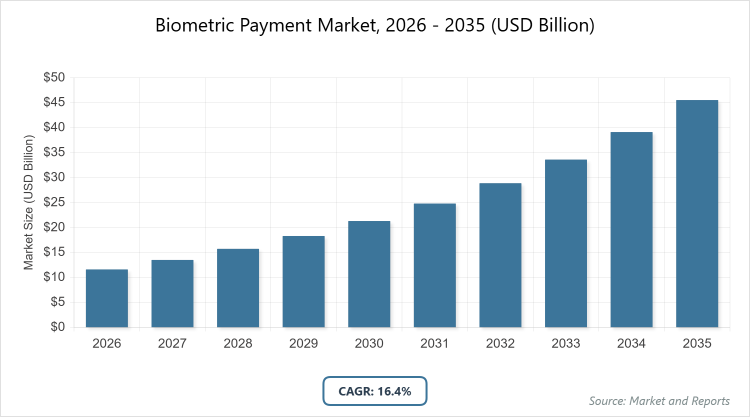
According to MarketnReports, the global Biometric Payment Market size was estimated at USD 11.61 billion in 2025 and is expected to reach USD 53 billion by 2035, growing at a CAGR of 16.4% from 2026 to 2035. Biometric Payment Market is driven by increasing demand for secure and contactless transaction methods.What are the Key Insights of the Biometric Payment Market?
- Market value estimated at USD 11.61 billion in 2025, projected to reach USD 53 billion by 2035.
- Compound annual growth rate (CAGR) of 16.4% during the forecast period from 2026 to 2035.
- Market is driven by rising cyber threats and adoption of contactless payments.
- Fingerprint Recognition dominates the biometric type segment with 45% share due to its widespread integration in smartphones and low-cost implementation.
- Hardware dominates the component segment with 50% share as it forms the foundational infrastructure for biometric scanning.
- BFSI dominates the application segment with 40% share owing to high security needs in financial transactions.
- North America dominates with 35% market share because of advanced technological adoption, strong regulatory frameworks, and presence of key innovators.
What is the Biometric Payment Market Industry Overview?
The Biometric Payment Market involves the integration of biometric authentication technologies, such as fingerprints, facial recognition, and iris scans, into payment systems to verify user identity and authorize transactions securely without traditional methods like PINs or cards. This market encompasses hardware like scanners and sensors, software for data processing and algorithms, and services for implementation and maintenance, aimed at enhancing fraud prevention and user convenience in digital and physical payment environments. Market definition refers to the ecosystem of solutions that leverage unique biological or behavioral traits for seamless, real-time payment verification, driven by advancements in AI and mobile integration, catering to sectors where security and speed are paramount, while addressing privacy concerns through encrypted data handling.
What are the Market Dynamics of the Biometric Payment Market?
Growth Drivers
The growth drivers of the Biometric Payment Market are primarily fueled by the escalating need for enhanced security in financial transactions amid rising incidents of identity theft and fraud, prompting banks and retailers to adopt biometric solutions that offer superior protection compared to traditional methods. Advancements in AI and machine learning have improved the accuracy and speed of biometric authentication, making it viable for high-volume applications like mobile wallets and point-of-sale systems, while the proliferation of smartphones with built-in sensors has lowered barriers to entry. Additionally, consumer preference for convenient, password-less experiences, coupled with government initiatives promoting digital economies and cashless societies, accelerates adoption across emerging markets, fostering innovation in multimodal biometrics for added reliability.
Restraints
Restraints in the Biometric Payment Market include privacy and data security concerns, as the storage of sensitive biometric information raises risks of breaches and misuse, leading to regulatory scrutiny and consumer hesitation in regions with strict data protection laws like GDPR. High initial deployment costs for hardware and infrastructure upgrades deter small businesses and developing economies from adoption, while technical limitations such as false positives in varying environmental conditions (e.g., lighting for facial recognition) undermine reliability. Furthermore, interoperability issues between different biometric systems and legacy payment infrastructures complicate widespread integration, slowing market penetration.
Opportunities
Opportunities in the Biometric Payment Market arise from the expanding e-commerce sector, where biometric solutions can streamline checkout processes and reduce cart abandonment through seamless authentication, opening avenues for partnerships between tech firms and online platforms. The integration of biometrics with blockchain for decentralized identity verification presents potential for ultra-secure, tamper-proof systems, appealing to high-stakes industries like healthcare and government services. Moreover, emerging markets in Asia Pacific offer growth through increasing smartphone penetration and financial inclusion programs, enabling scalable, affordable solutions tailored to mobile-first users.
Challenges
Challenges facing the Biometric Payment Market encompass ethical and inclusivity issues, as biometric systems may exhibit biases against certain demographics (e.g., skin tone variations in facial recognition), necessitating ongoing R&D for equitable algorithms to avoid discrimination and build trust. Regulatory fragmentation across countries complicates global standardization, requiring companies to navigate diverse compliance requirements that increase operational costs. Additionally, the vulnerability to sophisticated spoofing attacks, such as deepfakes or 3D-printed fingerprints, demands continuous innovation in liveness detection, while public education on biometric safety is essential to overcome adoption barriers.
Biometric Payment Market: Report Scope
| Report Attributes | Report Details |
| Report Name | Biometric Payment Market |
| Market Size 2025 | USD 11.61 Billion |
| Market Forecast 2035 | USD 53 Billion |
| Growth Rate | CAGR of 16.4% |
| Report Pages | 220 |
| Key Companies Covered |
Visa Inc., Mastercard, IDEMIA, Thales Group, NEC Corporation, Fingerprint Cards AB, Fujitsu Limited, Alibaba Group Holding Limited, VeriFone, Inc., Google LLC, and Others. |
| Segments Covered | By Biometric Type, By Component, By Application, and By Region. |
| Regions Covered | North America, Europe, Asia Pacific (APAC), Latin America, and The Middle East and Africa (MEA) |
| Base Year | 2025 |
| Historical Year | 2020 - 2024 |
| Forecast Year | 2026 - 2035 |
| Customization Scope | Avail customized purchase options to meet your exact research needs. |
What is the Market Segmentation of the Biometric Payment Market?
The Biometric Payment Market is segmented by biometric type, component, application, and region.By Biometric Type Segment, Fingerprint Recognition emerges as the most dominant subsegment, holding approximately 45% share, followed by Facial Recognition at 30%. Fingerprint Recognition dominates due to its mature technology, high accuracy, and easy integration into existing devices like smartphones and POS terminals, driving the market by enabling fast, cost-effective authentication that enhances user convenience and reduces fraud in high-traffic retail and banking environments.
By Component Segment, Hardware leads as the most dominant subsegment with 50% share, while Software ranks second at 35%. Hardware dominates because it provides the essential physical interfaces like scanners and sensors required for capturing biometric data, propelling market growth through advancements in compact, durable designs that support widespread deployment in contactless payment systems.
By Application Segment, BFSI stands out as the most dominant subsegment, capturing 40% share, with Retail & E-Commerce as the second at 25%. BFSI dominates owing to stringent security requirements for financial transactions and regulatory mandates for fraud prevention, fueling market expansion by facilitating secure digital banking and ATM access that builds consumer confidence.
What are the Recent Developments in the Biometric Payment Market?
- In 2025, Mastercard expanded its biometric payment program in Europe, partnering with major banks to pilot facial recognition for in-store transactions, aiming to reduce checkout times by 30%.
- In mid-2025, IDEMIA launched a new multimodal biometric platform integrating fingerprint and iris scanning for mobile payments, enhancing security for e-commerce platforms.
- In late 2025, Visa Inc. announced collaborations with smartphone manufacturers to embed voice recognition in digital wallets, targeting emerging markets for inclusive financial access.
What is the Regional Analysis of the Biometric Payment Market?
North America to dominate the global market.North America holds the dominant position in the Biometric Payment Market, accounting for about 35% share, with the United States as the leading country due to its early adoption of advanced technologies, robust financial infrastructure, and initiatives like the EMVCo standards that promote secure payments, supported by major players like Visa and Mastercard driving innovation.
Asia Pacific is experiencing the fastest growth, driven by rapid digitalization and mobile payment adoption, with China dominating through government-backed platforms like Alipay integrating facial recognition, leveraging a massive user base and investments in AI to enhance transaction security.
Europe maintains a strong presence, focusing on data privacy and regulatory compliance, with Germany as the key contributor via GDPR-aligned solutions and partnerships between banks and tech firms for contactless biometrics in retail.
Latin America shows emerging potential, propelled by financial inclusion efforts, led by Brazil with biometric ATMs and mobile banking apps, addressing unbanked populations through affordable hardware.
The Middle East and Africa region is nascent but growing, with the UAE dominating through smart city initiatives and collaborations with global firms for palm vein payments in hospitality.
Who are the Key Market Players and Strategies in the Biometric Payment Market?
Visa Inc. focuses on global partnerships with banks for biometric card integrations, emphasizing contactless solutions to expand market reach.
Mastercard invests in AI-enhanced multimodal biometrics, adopting pilot programs for facial and voice authentication in retail.
IDEMIA prioritizes hardware innovations like secure sensors, pursuing acquisitions to strengthen software capabilities for enterprise applications.
Thales Group leverages government contracts for identity solutions, focusing on privacy-compliant systems for BFSI sectors.
NEC Corporation develops advanced facial recognition algorithms, collaborating with Asian markets for mobile payment ecosystems.
Fingerprint Cards AB specializes in low-cost fingerprint modules, targeting smartphone integrations through OEM partnerships.
Fujitsu Limited emphasizes palm vein technology for high-security applications, investing in R&D for contactless hardware.
Alibaba Group Holding Limited integrates biometrics into e-commerce platforms, focusing on user data analytics for personalized security.
VeriFone, Inc. provides POS terminals with built-in biometrics, adopting cloud-based services for scalable retail solutions.
Google LLC advances voice and behavioral biometrics via Android ecosystems, partnering with financial apps for seamless authentication.
What are the Market Trends in the Biometric Payment Market?
- Rising adoption of contactless biometrics driven by post-pandemic hygiene concerns.
- Integration of AI for improved accuracy and anti-spoofing measures.
- Growth in multimodal systems combining multiple biometrics for enhanced security.
- Expansion of biometric solutions in e-commerce and mobile wallets.
- Focus on privacy-enhancing technologies like on-device processing.
- Increasing regulatory support for biometric standards in financial services.
- Emergence of behavioral biometrics for continuous authentication.
What Market Segments and their Subsegments are Covered in the Biometric Payment Market Report?
By Biometric Type
- Fingerprint Recognition
- Facial Recognition
- Iris Recognition
- Voice Recognition
- Palm Vein Recognition
- Behavioral Biometrics
- Vein Recognition
- Retina Recognition
- Signature Recognition
- Multimodal Biometrics
- Others
By Component
- Hardware
- Software
- Services
By Application
- BFSI
- Retail & E-Commerce
- Healthcare
- Transportation
- Government
- Hospitality
- Entertainment
- Education
- Automotive
- Others
By Region
- North America
- U.S.
- Canada
- Europe
- UK
- Germany
- France
- Rest of Europe
- Asia Pacific
- China
- India
- Japan
- Rest of Asia Pacific
- Latin America
- Brazil
- Mexico
- Rest of Latin America
- Middle East & Africa
- UAE
- South Africa
- Rest of Middle East & Africa
Frequently Asked Questions
The Biometric Payment Market involves technologies using biological traits like fingerprints or facial scans to authenticate and process payments securely.
Key factors include rising security needs, technological advancements in AI, increasing contactless payment adoption, and regulatory support for digital finance.
The market is projected to grow from approximately USD 11.61 billion in 2026 to USD 53 billion by 2035.
The CAGR is expected to be 16.4% from 2026 to 2035.
North America will contribute notably, holding around 35% of the market value due to technological leadership and infrastructure.
Major players include Visa Inc., Mastercard, IDEMIA, Thales Group, NEC Corporation, Fingerprint Cards AB, Fujitsu Limited, Alibaba Group Holding Limited, VeriFone, Inc., and Google LLC.
The report provides comprehensive analysis including market size, trends, segmentation, key players, regional insights, and forecasts from 2026 to 2035.
Stages include biometric data capture, processing and matching, authentication integration, transaction authorization, and data storage with security protocols.
Trends are shifting towards multimodal and contactless systems, while consumers prefer convenient, secure methods over traditional PINs.
Factors include data privacy regulations like GDPR and environmental considerations for energy-efficient hardware in payment devices.