
Bioelectric Medicine Market Size, Share and Trends 2026 to 2035
According to MarketnReports, the global Bioelectric Medicine market size was estimated at USD 25.9 billion in 2025 and is expected to reach USD 46.8 billion by 2035, growing at a CAGR of 6.1% from 2026 to 2035. Bioelectric Medicine Market is driven by the rising prevalence of chronic neurological and cardiovascular diseases, advancements in neuromodulation technologies, and the shift toward non-pharmacological personalized therapies.
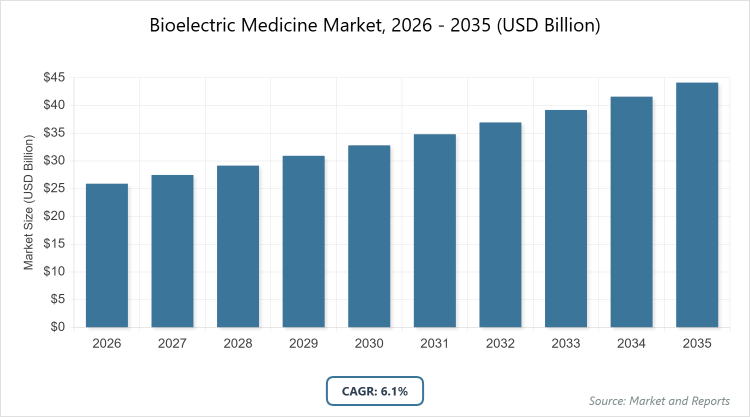
What are the Key Insights of Bioelectric Medicine Market?
- Market size valued at USD 25.9 billion in 2025 and projected to reach USD 46.8 billion by 2035
- CAGR of 6.1% during the forecast period 2026-2035
- Market is driven by increasing chronic disease burden, technological advancements in implantable devices, and growing preference for minimally invasive non-drug treatments
- Implantable bioelectric devices dominate the type segment with approximately 55% share due to their proven efficacy in long-term disease management and high adoption in cardiac and neurological applications
- Cardiac pacemakers and implantable cardioverter defibrillators dominate the product segment with around 34-35% combined share owing to widespread use in arrhythmia treatment and established reimbursement
- Arrhythmia dominates the application segment with significant share as it addresses the high global prevalence of cardiovascular disorders requiring rhythm management devices
- North America dominates with approximately 38% market share attributed to advanced healthcare infrastructure, high R&D investments, and presence of leading manufacturers
What is Bioelectric Medicine?
The bioelectric medicine market, also known as electroceuticals, involves the use of electrical impulses to modulate neural signals and treat various diseases by targeting the body’s electrical pathways rather than relying solely on pharmaceuticals. It encompasses implantable and non-invasive devices that deliver precise stimulation to nerves, organs, or tissues to restore normal function, manage symptoms, or alter disease progression. The market definition includes neuromodulation technologies such as vagus nerve stimulation, spinal cord stimulation, and cardiac rhythm management devices, offering targeted, side-effect-reduced alternatives for conditions like chronic pain, epilepsy, Parkinson’s disease, arrhythmia, and depression, driven by innovations in miniaturization, closed-loop systems, and AI integration.
What are the Market Dynamics in Bioelectric Medicine?
Growth Drivers
The growth drivers for the bioelectric medicine market are rooted in the escalating incidence of chronic conditions such as neurological disorders, cardiovascular diseases, and chronic pain, which traditional drug therapies often fail to manage effectively long-term. Advancements in neuromodulation, including miniaturized implantable devices, closed-loop feedback systems, and AI-enhanced precision stimulation, enable better patient outcomes with fewer side effects. An aging global population increases demand for therapies targeting age-related ailments like Parkinson’s and arrhythmia. Supportive regulatory pathways for breakthrough devices and rising investments in bioelectronics research further accelerate adoption by facilitating faster innovation and market entry.
Restraints
Restraints include the high costs associated with developing, implanting, and maintaining bioelectric devices, which limit accessibility in low-resource settings and for uninsured patients. Stringent regulatory approvals and lengthy clinical trial requirements delay product launches and increase development expenses. Potential risks such as device malfunctions, infections from implants, and limited long-term efficacy data in some applications create hesitation among providers and payers. Reimbursement challenges in certain regions further hinder widespread adoption despite clinical benefits.
Opportunities
Opportunities emerge from expanding applications beyond traditional areas into mental health conditions like treatment-resistant depression and inflammatory diseases through vagus nerve modulation. Integration of wireless powering, nanotechnology, and AI for adaptive, closed-loop systems promises more personalized and efficient therapies. Emerging markets in Asia Pacific and Latin America offer growth potential with improving healthcare access and rising chronic disease awareness. Collaborations between tech firms and medical device companies can drive innovation in non-invasive wearables, broadening consumer reach and preventive care.
Challenges
Challenges involve ensuring device biocompatibility, longevity of implants, and cybersecurity for connected systems amid rising digital threats. The need for specialized skilled personnel to implant and program devices poses training and workforce shortages. Variability in patient responses due to individual neural differences complicates standardization and outcomes prediction. Balancing innovation with ethical concerns around neural modulation and data privacy remains a persistent hurdle for sustained market trust and expansion.
Bioelectric Medicine Market: Report Scope
| Report Attributes | Report Details |
| Report Name | Bioelectric Medicine Market |
| Market Size 2025 | USD 25.9 Billion |
| Market Forecast 2035 | USD 46.8 Billion |
| Growth Rate | CAGR of 6.1% |
| Report Pages | 220 |
| Key Companies Covered | Medtronic plc, Abbott Laboratories, Boston Scientific Corporation, Cochlear Ltd., LivaNova PLC, Biotronik SE & Co. KG, Nevro Corp., electroCore, Inc., Sonova, Stimwave LLC, and Others |
| Segments Covered | By Product (Implantable Cardioverter Defibrillators, Cardiac Pacemakers, Cochlear Implants, Spinal Cord Stimulators, Deep Brain Stimulators, Vagus Nerve Stimulators, Sacral Nerve Stimulators, Transcutaneous Electrical Nerve Stimulators, Retinal Implants, Others), By Type (Implantable Bioelectric Devices, Non-Invasive Bioelectric Devices), By Application (Arrhythmia, Pain Management, Parkinson’s Disease, Epilepsy, Depression, Tremor, Urinary and Fecal Incontinence, Sensorineural Hearing Loss, Others), By End-User (Hospitals, Specialty Clinics, Ambulatory Surgical Centers, Home Healthcare Settings, Research Institutions, Others), and By Region |
| Regions Covered | North America, Europe, Asia Pacific (APAC), Latin America, and The Middle East and Africa (MEA) |
| Base Year | 2025 |
| Historical Year | 2020 – 2024 |
| Forecast Year | 2026 – 2035 |
| Customization Scope | Avail customized purchase options to meet your exact research needs. |
How is the Bioelectric Medicine Market Segmented?
The Bioelectric Medicine market is segmented by product, type, application, end-user, and region.
Based on Product Segment. Implantable cardioverter defibrillators and cardiac pacemakers are the most dominant combined, followed by cochlear implants and spinal cord stimulators as strong contenders. These cardiac devices dominate due to the massive global burden of arrhythmias and heart failure, driving market growth through life-saving interventions, established clinical evidence, broad reimbursement, and continuous technological refinements that improve reliability and patient survival rates.
Based on Type Segment. Implantable bioelectric devices are the most dominant with around 55% share, followed by non-invasive bioelectric devices. Implantables lead because they provide targeted, long-term modulation for severe chronic conditions where non-invasive options fall short, propelling market expansion via superior efficacy in neurological and cardiac applications, ongoing miniaturization advancements, and increasing surgeon familiarity with implantation procedures.
Based on Application Segment. Arrhythmia is the most dominant, followed by pain management and Parkinson’s disease. Arrhythmia’s dominance arises from the high prevalence of cardiovascular disorders worldwide, where devices like pacemakers offer reliable rhythm control, driving market growth by reducing mortality, hospital stays, and reliance on medications while benefiting from mature technology and strong payer support.
What are the Recent Developments in Bioelectric Medicine?
- In late 2025, Medtronic announced advancements in its closed-loop deep brain stimulation systems for Parkinson’s disease, incorporating AI-driven adaptive stimulation to personalize therapy based on real-time neural feedback, improving symptom control and battery life.
- In 2025, Abbott received expanded regulatory approvals for its neuromodulation portfolio, including next-generation dorsal root ganglion stimulators for chronic pain, enhancing precision targeting and patient comfort in non-opioid pain management.
- Boston Scientific launched an upgraded spinal cord stimulation platform with improved waveform options and app-based programming in 2025, aimed at better pain relief outcomes and easier clinician adjustments for chronic pain patients.
- LivaNova expanded its vagus nerve stimulation applications in 2025, with new clinical data supporting efficacy in treatment-resistant depression and epilepsy, driving broader adoption through evidence-based expansions.
How is the Regional Analysis for Bioelectric Medicine Market?
North America to dominate the global market.
North America dominates the bioelectric medicine market due to its advanced healthcare ecosystem, substantial R&D funding, high chronic disease prevalence, and favorable reimbursement policies for implantable devices. The United States leads as the dominating country, supported by major players headquartered there, robust FDA pathways for innovative therapies, and widespread clinical adoption in hospitals and specialty centers.
Europe holds a strong position with steady growth driven by aging populations, emphasis on minimally invasive treatments, and harmonized regulations across the EU. Germany dominates the region through its engineering prowess in medical devices and high adoption of neuromodulation for neurological disorders.
Asia Pacific exhibits the fastest growth potential fueled by rising healthcare investments, large patient pools with chronic conditions, and increasing awareness of advanced therapies. China dominates within the region with rapid infrastructure development, government support for medtech innovation, and expanding access to cardiac and neurological treatments.
Latin America shows gradual expansion through improving healthcare access and adoption of cost-effective devices for prevalent conditions like arrhythmia. Brazil leads the region with growing investments in public health systems and partnerships for device distribution.
The Middle East and Africa are emerging with focused growth in urban centers. The United Arab Emirates dominates through ambitious healthcare modernization projects incorporating advanced bioelectric solutions for chronic disease management.
Who are the Key Market Players in Bioelectric Medicine?
- Medtronic plc leads with a comprehensive portfolio of neuromodulation and cardiac rhythm devices, focusing on R&D in closed-loop systems and global expansions to address diverse chronic conditions.
- Abbott Laboratories emphasizes innovative neuromodulation for pain and movement disorders, with strategies centered on minimally invasive technologies and strong clinical evidence to expand market penetration.
- Boston Scientific Corporation specializes in spinal cord and deep brain stimulation, employing continuous product upgrades and partnerships to enhance pain management and neurological therapies.
- Cochlear Ltd. focuses on hearing restoration through advanced cochlear implants, with growth strategies involving technological refinements and emerging market expansions for sensorineural hearing loss.
- LivaNova PLC targets epilepsy and depression via vagus nerve stimulation, prioritizing clinical trials and regulatory approvals to broaden therapeutic indications.
- Biotronik SE & Co. KG concentrates on cardiac rhythm management devices, using remote monitoring integrations and MRI-conditional technologies to improve patient safety and outcomes.
- Nevro Corp. leads in high-frequency spinal cord stimulation for chronic pain, with strategies emphasizing superior pain relief data and non-opioid alternatives.
- electroCore, Inc. develops non-invasive vagus nerve stimulation, focusing on accessible, handheld devices for headache and inflammatory conditions.
- Sonova advances auditory solutions including cochlear implants, with emphasis on digital connectivity and personalized hearing restoration.
- Stimwave LLC innovates wireless neuromodulation platforms, targeting minimally invasive pain management with reduced surgical risks.
What are the Market Trends in Bioelectric Medicine?
- Adoption of closed-loop and AI-integrated devices for real-time adaptive stimulation
- Shift toward non-invasive and wearable bioelectric solutions for broader accessibility
- Expansion of applications into inflammatory and autoimmune diseases via nerve modulation
- Miniaturization of implants to reduce surgical risks and improve patient comfort
- Integration of wireless charging and remote monitoring for enhanced device longevity
- Growing focus on personalized neuromodulation based on patient-specific data
- Increased emphasis on value-based outcomes and cost-effectiveness versus pharmaceuticals
- Rise in combination therapies pairing bioelectric devices with digital health platforms
- Advancements in bioresorbable and flexible electronics for temporary interventions
- Strengthening regulatory support for breakthrough designations in novel indications
What Market Segments and Subsegments are Covered in the Bioelectric Medicine Report?
By Product
- Implantable Cardioverter Defibrillators
- Cardiac Pacemakers
- Cochlear Implants
- Spinal Cord Stimulators
- Deep Brain Stimulators
- Vagus Nerve Stimulators
- Sacral Nerve Stimulators
- Transcutaneous Electrical Nerve Stimulators
- Retinal Implants
- Others
By Type
- Implantable Bioelectric Devices
- Non-Invasive Bioelectric Devices
By Application
- Arrhythmia
- Pain Management
- Parkinson’s Disease
- Epilepsy
- Depression
- Tremor
- Urinary and Fecal Incontinence
- Sensorineural Hearing Loss
- Others
By End-User
- Hospitals
- Specialty Clinics
- Ambulatory Surgical Centers
- Home Healthcare Settings
- Research Institutions
- Others
By Region
- North America
- U.S.
- Canada
- Europe
- UK
- Germany
- France
- Rest of Europe
- Asia Pacific
- China
- India
- Japan
- Rest of Asia Pacific
- Latin America
- Brazil
- Mexico
- Rest of Latin America
- Middle East & Africa
- UAE
- South Africa
- Rest of Middle East & Africa
Frequently Asked Questions
Bioelectric medicine involves using targeted electrical impulses to modulate nerve activity and treat diseases, offering precise alternatives to drugs through devices like stimulators and implants for conditions such as pain, epilepsy, and arrhythmia.
Key factors include rising chronic disease prevalence, technological innovations in neuromodulation, aging populations, regulatory support for advanced devices, and increasing preference for non-pharmacological therapies.
The market is projected to grow from approximately USD 27.5 billion in 2026 to USD 46.8 billion by 2035.
The CAGR is expected to be 6.1% during 2026-2035.
North America will contribute notably, holding around 38% of the market share due to advanced infrastructure and high adoption.
Major players include Medtronic plc, Abbott Laboratories, Boston Scientific Corporation, Cochlear Ltd., LivaNova PLC, Biotronik SE & Co. KG, Nevro Corp., electroCore, Inc., Sonova, and Stimwave LLC.
The report delivers in-depth analysis of market size, growth drivers, segmentation, regional insights, competitive landscape, trends, and forecasts through 2035.
Stages encompass R&D and technology innovation, device manufacturing and component sourcing, regulatory approval and clinical testing, distribution and implantation services, patient monitoring and data analytics, and post-market support.
Trends are evolving toward personalized, AI-enhanced, and less invasive devices, with preferences shifting to non-drug options offering better quality of life, remote manageability, and reduced side effects.
Regulatory factors include streamlined breakthrough device approvals and safety standards, while environmental considerations involve sustainable manufacturing of implants and reducing electronic waste from medical devices.