
Biochar Market Size, Share and Trends 2026 to 2035
According to MarketnReports, the global Biochar market size was estimated at USD 0.70 billion in 2025 and is expected to reach USD 2.68 billion by 2035, growing at a CAGR of 14.5% from 2026 to 2035. Biochar Market is driven by increasing demand for organic food production and sustainable agricultural practices.
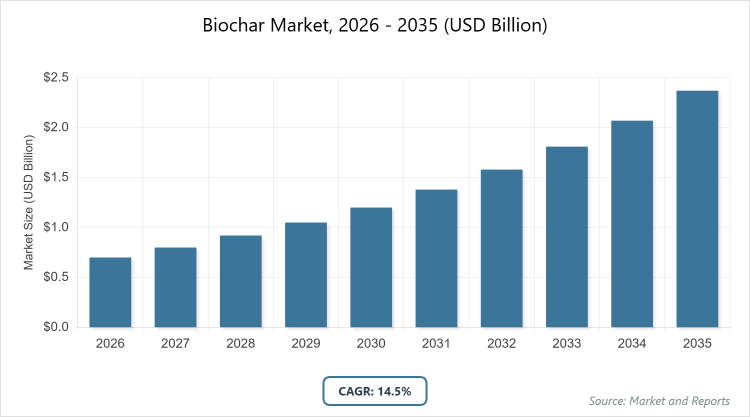
What are the Key Insights of the Biochar Market?
- The global Biochar market was valued at USD 0.70 billion in 2025 and is projected to reach USD 2.68 billion by 2035.
- The market is expected to grow at a CAGR of 14.5% during the forecast period from 2026 to 2035.
- The market is driven by rising consumption in organic food production, environmental awareness, and government support for waste management.
- In the technology segment, pyrolysis dominated with a 64.7% revenue share in 2025 due to its high yield of stable, high-carbon content products and widespread adoption by small-scale producers for profitability.
- In the feedstock segment, agricultural waste dominated with an estimated 40% share in 2025 because of its abundant availability from farming activities and cost-effectiveness in production processes.
- In the application segment, agriculture dominated with a 72.7% revenue share in 2025 owing to its effectiveness in enhancing soil fertility, crop yield, and carbon sequestration.
- North America dominated the regional market with a 57.64% revenue share in 2025 due to high concentration of manufacturers, strong demand for organic food, and advanced research initiatives.
What is the Industry Overview of the Biochar Market?
Biochar is defined as a stable, carbon-rich charcoal produced through the controlled pyrolysis or gasification of organic waste materials such as agricultural residues, wood waste, forest biomass, and animal manure. The Biochar market encompasses the production, distribution, and application of this material primarily as a soil amendment to improve fertility, retain moisture, and sequester carbon, while also extending to emerging uses in water treatment, textiles, and electronics. It represents a sustainable solution within the broader environmental and agricultural industries, addressing soil degradation, waste management, and climate change mitigation by converting biomass waste into a valuable resource that enhances ecosystem health without relying on chemical inputs.
What are the Market Dynamics in the Biochar Market?
Growth Drivers
The growth of the Biochar market is propelled by increasing global demand for organic food, driven by health consciousness and rising consumer spending on sustainable products. Biochar’s ability to enhance soil fertility, improve water and fertilizer retention, boost crop nutrition, and support carbon sequestration aligns with government initiatives promoting organic farming and regenerative agriculture. Additionally, abundant biomass availability from agricultural and forest waste, coupled with R&D efforts and awareness campaigns by institutions, further accelerates adoption. Climate policies emphasizing carbon reduction and waste-to-resource utilization, particularly in developed regions, contribute significantly to market expansion.
Restraints
Despite its potential, the Biochar market faces restraints from limited awareness of its long-term benefits, especially in regions like Asia Pacific and the Middle East, leading to slower adoption among farmers who prefer conventional methods for immediate higher yields. High capital investment required for producing high-quality Biochar has resulted in company exits and deterred new entrants. Uneven regulatory frameworks and infrastructure limitations in emerging markets, along with a lack of standardization, hinder widespread commercialization and scalability.
Opportunities
Opportunities in the Biochar market lie in expanding applications beyond agriculture, such as in textiles as fabric additives, building materials for construction, and electronics for electromagnetic shielding. Rising demand for water treatment in emerging economies like China and India presents growth avenues, supported by investments in hygiene and infrastructure. Development of blended products, integration into carbon credit programs, and pilot projects in arid regions for soil rehabilitation offer further potential. Production using biogas and crop residues, along with government support for smallholder farming and food security, can drive innovation and market penetration.
Challenges
Challenges include overcoming the high initial costs and technological barriers in manufacturing processes, which affect product quality and affordability. Regulatory hurdles, such as evolving standards from bodies like the EU Commission and U.S. EPA, require compliance that can delay market entry. Supply chain issues in sourcing consistent raw materials and competition from traditional soil amendments pose risks. Additionally, educating farmers and stakeholders on Biochar’s benefits amid climate variability and economic pressures in rural areas remains a key obstacle to broader acceptance.
Biochar Market: Report Scope
| Report Attributes | Report Details |
| Report Name | Biochar Market |
| Market Size 2025 | USD 0.70 Billion |
| Market Forecast 2035 | USD 2.68 Billion |
| Growth Rate | CAGR of 14.5% |
| Report Pages | 210 |
| Key Companies Covered | Biochar Products, Inc., Biochar Supreme, LLC, ArSta Eco, Carbon Gold Ltd, Airex Energy Inc., Pacific Biochar Benefit Corporation, Biochar Ireland, Swiss Biochar GmbH, Sonnenerde GmbH, Pyro Power, Stiesdal, Novocarbo, and Others |
| Segments Covered | By Technology, By Feedstock, By Application, and By Region |
| Regions Covered | North America, Europe, Asia Pacific (APAC), Latin America, and The Middle East and Africa (MEA) |
| Base Year | 2025 |
| Historical Year | 2020 – 2024 |
| Forecast Year | 2026 – 2035 |
| Customization Scope | Avail customized purchase options to meet your exact research needs. |
What is the Market Segmentation of the Biochar Market?
The Biochar market is segmented by technology, feedstock, application, and region.
Based on Technology Segment, the pyrolysis subsegment is the most dominant, holding 64.7% of the market share in 2025, followed by gasification as the second most dominant. Pyrolysis dominates due to its superior yield of high-carbon, stable Biochar products and process efficiency, which allows for cost-effective production and high profitability, especially among small-scale manufacturers in Asia Pacific; this drives the market by enabling widespread soil amendment applications and supporting sustainable waste conversion, while gasification contributes through energy co-production but is limited by lower Biochar stability for agricultural use.
Based on Feedstock Segment, agricultural waste is the most dominant subsegment, with an estimated 40% share in 2025, followed by wood waste as the second most dominant. Agricultural waste leads because of its plentiful supply from global farming operations, low procurement costs, and compatibility with pyrolysis processes, driving the market by facilitating large-scale Biochar production and reducing reliance on forest resources; wood waste supports growth through availability from timber industries but is secondary due to higher processing needs.
Based on Application Segment, agriculture is the most dominant, capturing 72.7% of the market in 2025, with water and waste treatment as the second most dominant. Agriculture prevails owing to Biochar’s proven benefits in improving soil health, crop yields, and carbon sequestration, which align with rising organic farming demands and drive overall market expansion by addressing food security; water and waste treatment grows through applications in emerging economies, aiding hygiene and environmental remediation.
What are the Recent Developments in the Biochar Market?
- In August 2022, the U.S. Department of Agriculture (USDA) announced a USD 300 million investment in the “Organic Transition Initiative” to bolster organic food markets, support farmer incomes, and promote sustainable practices, which is expected to increase Biochar adoption in agriculture.
- The EU Commission and U.S. Environmental Protection Agency (EPA) introduced new rules on Biochar production, agricultural use, and waste management, enhancing regulatory support and encouraging standardized manufacturing to drive market growth.
- The European Biochar Certificate implemented regulations for direct soil utilization in countries like Austria and Switzerland, fostering trust in product quality and expanding market access in Europe.
- Growing R&D activities in China and India focused on integrating Biochar for soil health improvement and pollution remediation, leading to increased awareness and potential for standardized adoption in Asia Pacific.
- Pilot projects in the Middle East and Africa targeted soil rehabilitation and carbon management in arid environments, providing low-cost solutions for degraded lands and supporting food security initiatives.
What is the Regional Analysis of the Biochar Market?
- North America to dominate the global market.
North America leads the Biochar market with over 57.64% revenue share in 2025, driven by a high concentration of manufacturers (over 80% of medium and large-scale producers), strong demand for organic food, and advanced research on climate-focused agriculture and carbon sequestration. The United States is the dominating country, expected to grow at a CAGR of 13.0% from 2026 to 2035, supported by initiatives in soil health, livestock management, environmental remediation, and integration into carbon credit programs, while Canada and Mexico contribute through biomass availability and emerging organic farming.
Europe represents an advanced market, characterized by stringent climate policies, certification standards like the European Biochar Certificate, and emphasis on sustainable agriculture and circular economy principles. Germany dominates the region, with adoption in horticulture, carbon-negative solutions, and urban soil restoration, enabling premium pricing and regulatory support; other countries like the UK, France, Sweden, and Denmark benefit from negative-emissions technologies and livestock applications, driving steady growth.
Asia Pacific is the fastest-growing region, fueled by large agricultural sectors in China and India, abundant biomass, and government initiatives raising awareness about soil degradation from intensive farming. China is the dominating country, with strong focus on soil amendment, pollution remediation, waste-to-resource utilization, and carbon reduction, as it ranks as the third-largest organic food producer; India, Japan, Australia, and Malaysia support expansion through R&D and adoption in general farming and water treatment.
Latin America is an emerging market, supported by vast agricultural economies, biomass availability, and needs for soil fertility enhancement in plantation crops. Brazil dominates the region, emphasizing sustainable farming, water retention, and fertilizer reduction, though commercialization is uneven due to limited regulations; Argentina and other countries contribute through focus on zero-tillage and biodynamic agriculture, presenting opportunities for growth amid environmental challenges.
Middle East and Africa (MEA) remains in a nascent stage, with demand centered on soil conditioning for desert agriculture, water retention, and low-cost solutions for degraded lands. South Africa dominates in Africa through smallholder farming support and food security efforts, while Saudi Arabia leads in the Middle East with pilot projects for arid soil rehabilitation and carbon management; overall, infrastructure constraints limit growth, but sustainable land management initiatives offer potential.
Who are the Key Market Players in the Biochar Market?
- Biochar Products, Inc. is a leading player, focusing on integrated production and sales strategies to supply high-quality Biochar for agricultural applications, collaborating with research institutions to innovate soil amendment solutions and expand market reach in North America.
- Biochar Supreme, LLC employs vertical integration in the value chain, from raw material sourcing to end-product distribution, emphasizing organic certification and sustainable practices to cater to the growing demand for premium Biochar in organic farming.
- ArSta Eco specializes in pyrolysis technology provision and waste-to-energy solutions, partnering with timber suppliers to utilize wood waste efficiently, driving cost reductions and environmental benefits in Europe and Asia Pacific.
- Carbon Gold Ltd adopts strategies centered on R&D for blended Biochar products, targeting agriculture and horticulture sectors with certified, carbon-sequestering materials to support regenerative farming initiatives.
- Airex Energy Inc. focuses on advanced gasification and pyrolysis systems, offering turnkey solutions for biomass conversion, which help in scaling production and addressing waste management in industrial applications.
- Pacific Biochar Benefit Corporation pursues community-based production models, collaborating with rural institutions in regions like Mexico and Brazil to produce Biochar from crop residues, promoting local economic value and carbon sequestration.
- Biochar Ireland implements strategies for small-scale manufacturing, emphasizing education and awareness campaigns to boost adoption in livestock farming and general agriculture across Europe.
- Swiss Biochar GmbH leverages certification standards to supply high-quality products for soil protection and organic food production, integrating into carbon credit programs for premium market positioning.
- Sonnenerde GmbH focuses on innovative applications in textiles and building materials, using Biochar as additives to expand beyond traditional uses and tap into emerging sectors.
- Pyro Power provides waste-to-energy technologies, partnering with energy firms to co-produce Biochar and electricity, enhancing profitability and sustainability in the market.
- Stiesdal employs strategies for large-scale production, targeting water treatment and environmental remediation, with emphasis on regulatory compliance to grow in MEA regions.
- Novocarbo integrates digital monitoring in production processes, offering customized Biochar solutions for electronics and health products, driving innovation and market differentiation.
What are the Market Trends in the Biochar Market?
- Shift towards regenerative agriculture and carbon sequestration integration, with Biochar playing a key role in climate mitigation programs.
- Increasing adoption in non-agricultural sectors, including textiles, building materials, and electronics for functional additives.
- Rise in small-scale production using alternative technologies like hydrothermal carbonization in developing regions.
- Growing emphasis on blended Biochar products for enhanced performance in soil and water applications.
- Expansion of carbon credit and certification schemes, enabling premium pricing and market incentives.
- Heightened focus on waste-to-resource models, utilizing biogas and crop residues for sustainable production.
- Evolving consumer preferences for organic and health-conscious products, boosting demand in food and beauty sectors.
What are the Market Segments and their Subsegments Covered in the Biochar Report?
By Technology
- Pyrolysis
- Gasification
- Hydrothermal Carbonization
- Acid Hydrolysis
- Cooking Stove
- Slow Pyrolysis
- Fast Pyrolysis
- Vacuum Pyrolysis
- Flash Pyrolysis
- Microwave Pyrolysis
- Others
By Feedstock
- Wood Waste
- Forest Waste
- Agricultural Waste
- Animal Manure
- Crop Residue
- Rice Husk
- Poultry Litter
- Sewage Sludge
- Municipal Solid Waste
- Energy Crops
- Others
By Application
- Agriculture
- Livestock Farming
- General Farming
- Water and Waste Treatment
- Textile
- Building Materials
- Electronics
- Food Sector
- Health & Beauty Products
- Animal Feed
- Others
By Region
- North America
- U.S.
- Canada
- Europe
- UK
- Germany
- France
- Rest of Europe
- Asia Pacific
- China
- India
- Japan
- Rest of Asia Pacific
- Latin America
- Brazil
- Mexico
- Rest of Latin America
- Middle East & Africa
- UAE
- South Africa
- Rest of Middle East & Africa
Chapter 1. Preface
1.1 Report Description and Scope1.2 Research Scope1.3 Research Methodology1.3.1 Market Research Type1.3.2 Market Research MethodologyChapter 2. Executive Summary
2.1 Global Biochar Market, (2026 - 2035) (USD Billion)2.2 Global Biochar Market: SnapshotChapter 3. Global Biochar Market - Industry Analysis
3.1 Biochar Market: Market Dynamics3.2 Market Drivers3.2.1 The biochar market is growing due to rising demand for organic food, government support for sustainable and regenerative agriculture, abundant biomass availability, increasing climate policies for carbon reduction, and growing awareness of soil health and carbon sequestration benefits.3.3 Market Restraints3.3.1 The biochar market is restrained by low awareness, high capital investment requirements, uneven regulations, lack of standardization, infrastructure limitations, and slow adoption in emerging regions.3.4 Market Opportunities3.4.1 Opportunities in the biochar market include expansion into textiles, construction, electronics, and water treatment, integration with carbon credit programs, development of blended products, and government-supported adoption in emerging economies for sustainability, soil rehabilitation, and food security.3.5 Market Challenges3.5.1 The biochar market faces challenges from high production costs and technological barriers, regulatory compliance hurdles, raw material supply chain issues, competition from traditional soil amendments, and the need for farmer education amid climate and economic pressures.3.6 Porter’s Five Forces Analysis3.7 Market Attractiveness Analysis3.7.1 Market Attractiveness Analysis By Technology3.7.2 Market Attractiveness Analysis By Feedstock3.7.3 Market Attractiveness Analysis By ApplicationChapter 4. Global Biochar Market- Competitive Landscape
4.1 Company Market Share Analysis4.1.1 Global Biochar Market: Company Market Share, 20254.2 Strategic Development4.2.1 Acquisitions & mergers4.2.2 New Product launches4.2.3 Agreements, partnerships, collaborations, and joint ventures4.2.4 Research and development and regional expansion4.3 Price Trend AnalysisChapter 5. Global Biochar Market - Technology Analysis
5.1 Global Biochar Market Overview: Technology5.1.1 Global Biochar Market share, By Technology, 2025 and 20355.2 Pyrolysis5.2.1 Global Biochar Market by Pyrolysis, 2026 - 2035 (USD Billion)5.3 Gasification5.3.1 Global Biochar Market by Gasification, 2026 - 2035 (USD Billion)5.4 Hydrothermal Carbonization5.4.1 Global Biochar Market by Hydrothermal Carbonization, 2026 - 2035 (USD Billion)5.5 Acid Hydrolysis5.5.1 Global Biochar Market by Acid Hydrolysis, 2026 - 2035 (USD Billion)5.6 Cooking Stove5.6.1 Global Biochar Market by Cooking Stove, 2026 - 2035 (USD Billion)5.7 Slow Pyrolysis5.7.1 Global Biochar Market by Slow Pyrolysis, 2026 - 2035 (USD Billion)5.8 Fast Pyrolysis5.8.1 Global Biochar Market by Fast Pyrolysis, 2026 - 2035 (USD Billion)5.9 Vacuum Pyrolysis5.9.1 Global Biochar Market by Vacuum Pyrolysis, 2026 - 2035 (USD Billion)5.10 Flash Pyrolysis5.10.1 Global Biochar Market by Flash Pyrolysis, 2026 - 2035 (USD Billion)5.11 Microwave Pyrolysis5.11.1 Global Biochar Market by Microwave Pyrolysis, 2026 - 2035 (USD Billion)Chapter 6. Global Biochar Market - Feedstock Analysis
6.1 Global Biochar Market Overview: Feedstock6.1.1 Global Biochar Market Share, By Feedstock, 2025 and 20356.2 Wood Waste6.2.1 Global Biochar Market by Wood Waste, 2026 - 2035 (USD Billion)6.3 Forest Waste6.3.1 Global Biochar Market by Forest Waste, 2026 - 2035 (USD Billion)6.4 Agricultural Waste6.4.1 Global Biochar Market by Agricultural Waste, 2026 - 2035 (USD Billion)6.5 Animal Manure6.5.1 Global Biochar Market by Animal Manure, 2026 - 2035 (USD Billion)6.6 Crop Residue6.6.1 Global Biochar Market by Crop Residue, 2026 - 2035 (USD Billion)6.7 Rice Husk6.7.1 Global Biochar Market by Rice Husk, 2026 - 2035 (USD Billion)6.8 Poultry Litter6.8.1 Global Biochar Market by Poultry Litter, 2026 - 2035 (USD Billion)6.9 Sewage Sludge6.9.1 Global Biochar Market by Sewage Sludge, 2026 - 2035 (USD Billion)6.10 Municipal Solid Waste6.10.1 Global Biochar Market by Municipal Solid Waste, 2026 - 2035 (USD Billion)6.11 Energy Crops6.11.1 Global Biochar Market by Energy Crops, 2026 - 2035 (USD Billion)Chapter 7. Global Biochar Market - Application Analysis
7.1 Global Biochar Market Overview: Application7.1.1 Global Biochar Market Share, By Application, 2025 and 20357.2 Agriculture7.2.1 Global Biochar Market by Agriculture, 2026 - 2035 (USD Billion)7.3 Livestock Farming7.3.1 Global Biochar Market by Livestock Farming, 2026 - 2035 (USD Billion)7.4 General Farming7.4.1 Global Biochar Market by General Farming, 2026 - 2035 (USD Billion)7.5 Water and Waste Treatment7.5.1 Global Biochar Market by Water and Waste Treatment, 2026 - 2035 (USD Billion)7.6 Textile7.6.1 Global Biochar Market by Textile, 2026 - 2035 (USD Billion)7.7 Building Materials7.7.1 Global Biochar Market by Building Materials, 2026 - 2035 (USD Billion)7.8 Electronics7.8.1 Global Biochar Market by Electronics, 2026 - 2035 (USD Billion)7.9 Food Sector7.9.1 Global Biochar Market by Food Sector, 2026 - 2035 (USD Billion)7.10 Health & Beauty Products7.10.1 Global Biochar Market by Health & Beauty Products, 2026 - 2035 (USD Billion)7.11 Animal Feed7.11.1 Global Biochar Market by Animal Feed, 2026 - 2035 (USD Billion)Chapter 8. Biochar Market - Regional Analysis
8.1 Global Biochar Market Regional Overview8.2 Global Biochar Market Share, by Region, 2025 & 2035 (USD Billion)8.3 North America8.3.1 North America Biochar Market, 2026 - 2035 (USD Billion)8.3.1.1 North America Biochar Market, by Country, 2026 - 2035 (USD Billion)8.3.2 North America Biochar Market, by Technology, 2026 - 20358.3.2.1 North America Biochar Market, by Technology, 2026 - 2035 (USD Billion)8.3.3 North America Biochar Market, by Feedstock, 2026 - 20358.3.3.1 North America Biochar Market, by Feedstock, 2026 - 2035 (USD Billion)8.3.4 North America Biochar Market, by Application, 2026 - 20358.3.4.1 North America Biochar Market, by Application, 2026 - 2035 (USD Billion)8.4 Europe8.4.1 Europe Biochar Market, 2026 - 2035 (USD Billion)8.4.1.1 Europe Biochar Market, by Country, 2026 - 2035 (USD Billion)8.4.2 Europe Biochar Market, by Technology, 2026 - 20358.4.2.1 Europe Biochar Market, by Technology, 2026 - 2035 (USD Billion)8.4.3 Europe Biochar Market, by Feedstock, 2026 - 20358.4.3.1 Europe Biochar Market, by Feedstock, 2026 - 2035 (USD Billion)8.4.4 Europe Biochar Market, by Application, 2026 - 20358.4.4.1 Europe Biochar Market, by Application, 2026 - 2035 (USD Billion)8.5 Asia Pacific8.5.1 Asia Pacific Biochar Market, 2026 - 2035 (USD Billion)8.5.1.1 Asia Pacific Biochar Market, by Country, 2026 - 2035 (USD Billion)8.5.2 Asia Pacific Biochar Market, by Technology, 2026 - 20358.5.2.1 Asia Pacific Biochar Market, by Technology, 2026 - 2035 (USD Billion)8.5.3 Asia Pacific Biochar Market, by Feedstock, 2026 - 20358.5.3.1 Asia Pacific Biochar Market, by Feedstock, 2026 - 2035 (USD Billion)8.5.4 Asia Pacific Biochar Market, by Application, 2026 - 20358.5.4.1 Asia Pacific Biochar Market, by Application, 2026 - 2035 (USD Billion)8.6 Latin America8.6.1 Latin America Biochar Market, 2026 - 2035 (USD Billion)8.6.1.1 Latin America Biochar Market, by Country, 2026 - 2035 (USD Billion)8.6.2 Latin America Biochar Market, by Technology, 2026 - 20358.6.2.1 Latin America Biochar Market, by Technology, 2026 - 2035 (USD Billion)8.6.3 Latin America Biochar Market, by Feedstock, 2026 - 20358.6.3.1 Latin America Biochar Market, by Feedstock, 2026 - 2035 (USD Billion)8.6.4 Latin America Biochar Market, by Application, 2026 - 20358.6.4.1 Latin America Biochar Market, by Application, 2026 - 2035 (USD Billion)8.7 The Middle-East and Africa8.7.1 The Middle-East and Africa Biochar Market, 2026 - 2035 (USD Billion)8.7.1.1 The Middle-East and Africa Biochar Market, by Country, 2026 - 2035 (USD Billion)8.7.2 The Middle-East and Africa Biochar Market, by Technology, 2026 - 20358.7.2.1 The Middle-East and Africa Biochar Market, by Technology, 2026 - 2035 (USD Billion)8.7.3 The Middle-East and Africa Biochar Market, by Feedstock, 2026 - 20358.7.3.1 The Middle-East and Africa Biochar Market, by Feedstock, 2026 - 2035 (USD Billion)8.7.4 The Middle-East and Africa Biochar Market, by Application, 2026 - 20358.7.4.1 The Middle-East and Africa Biochar Market, by Application, 2026 - 2035 (USD Billion)Chapter 9. Company Profiles
9.1 Biochar Products Inc.9.1.1 Overview9.1.2 Financials9.1.3 Product Portfolio9.1.4 Business Strategy9.1.5 Recent Developments9.2 Biochar Supreme LLC9.2.1 Overview9.2.2 Financials9.2.3 Product Portfolio9.2.4 Business Strategy9.2.5 Recent Developments9.3 ArSta Eco9.3.1 Overview9.3.2 Financials9.3.3 Product Portfolio9.3.4 Business Strategy9.3.5 Recent Developments9.4 Carbon Gold Ltd9.4.1 Overview9.4.2 Financials9.4.3 Product Portfolio9.4.4 Business Strategy9.4.5 Recent Developments9.5 Airex Energy Inc.9.5.1 Overview9.5.2 Financials9.5.3 Product Portfolio9.5.4 Business Strategy9.5.5 Recent Developments9.6 Pacific Biochar Benefit Corporation9.6.1 Overview9.6.2 Financials9.6.3 Product Portfolio9.6.4 Business Strategy9.6.5 Recent Developments9.7 Biochar Ireland9.7.1 Overview9.7.2 Financials9.7.3 Product Portfolio9.7.4 Business Strategy9.7.5 Recent Developments9.8 Swiss Biochar GmbH9.8.1 Overview9.8.2 Financials9.8.3 Product Portfolio9.8.4 Business Strategy9.8.5 Recent Developments9.9 Sonnenerde GmbH9.9.1 Overview9.9.2 Financials9.9.3 Product Portfolio9.9.4 Business Strategy9.9.5 Recent Developments9.10 Pyro Power9.10.1 Overview9.10.2 Financials9.10.3 Product Portfolio9.10.4 Business Strategy9.10.5 Recent Developments9.11 Stiesdal9.11.1 Overview9.11.2 Financials9.11.3 Product Portfolio9.11.4 Business Strategy9.11.5 Recent Developments9.12 Novocarbo9.12.1 Overview9.12.2 Financials9.12.3 Product Portfolio9.12.4 Business Strategy9.12.5 Recent Developments
Frequently Asked Questions
Biochar is a charcoal-like substance produced by heating organic waste materials such as agricultural residues, wood, forest waste, and animal manure in a controlled environment with limited oxygen, used primarily to amend soil, sequester carbon, and support sustainable applications.
Key factors include rising demand for organic food, government support for sustainable agriculture, advancements in production technologies, environmental regulations promoting carbon sequestration, and expanding applications in water treatment and other industries.
The Biochar market is projected to grow from USD 0.70 billion in 2025 to USD 2.68 billion by 2035.
The CAGR value will be 14.5% during 2026-2035.
North America will contribute notably, holding the largest share due to advanced manufacturing, research initiatives, and high demand for organic products.
Major players include Biochar Products, Inc., Biochar Supreme, LLC, ArSta Eco, Carbon Gold Ltd, Airex Energy Inc., Pacific Biochar Benefit Corporation, Biochar Ireland, Swiss Biochar GmbH, Sonnenerde GmbH, Pyro Power, Stiesdal, and Novocarbo.
The report provides comprehensive analysis including market size, forecasts, segmentation, dynamics, regional insights, competitive landscape, trends, and strategic recommendations for stakeholders.
The value chain includes raw material sourcing from suppliers like timber and agricultural waste providers, manufacturing through pyrolysis or gasification, distribution via integrated companies or technology providers, and end-use applications in agriculture, water treatment, and other sectors, often involving research collaborations.
Trends are shifting towards regenerative practices and non-agricultural uses, with consumers preferring sustainable, organic products that support health and environmental goals, leading to increased demand for certified Biochar in food and beauty sectors.
Regulatory factors include new EPA and EU Commission rules on production and waste management, certification standards like the European Biochar Certificate, and environmental policies promoting carbon sequestration and sustainable land use, which boost adoption but require compliance investments.