
Autonomous Delivery Robots Market Size, Share and Trends 2026 to 2035
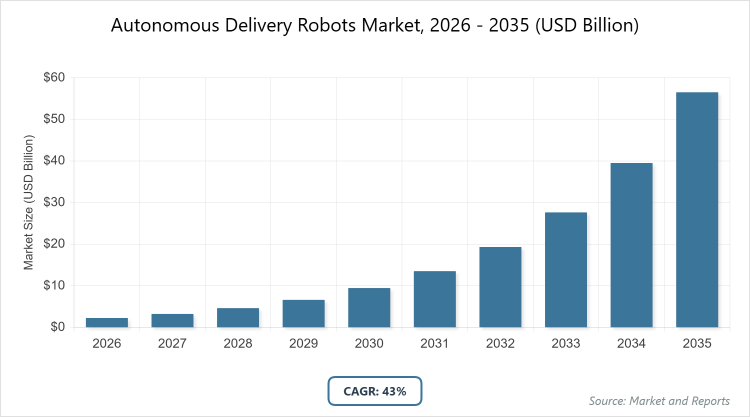
According to MarketnReports, the global Autonomous Delivery Robots market size was estimated at USD 2.26 billion in 2025 and is expected to reach USD 79.97 billion by 2035, growing at a CAGR of 43.0% from 2026 to 2035. Autonomous Delivery Robots Market is driven by increasing demand for efficient last-mile delivery solutions in e-commerce.
What are the Key Insights of the Autonomous Delivery Robots Market?
- Market Size in 2025: USD 2.26 Billion; Market Forecast in 2035: USD 79.97 Billion.
- CAGR: 43.0% during 2026-2035.
- The market is driven by rising consumer expectations for quicker deliveries, proliferation of e-commerce, and innovations in last-mile delivery efficiency.
- Dominated subsegment in Component: Hardware with approximately 60% share.
- Hardware dominates due to the essential role of physical components like sensors, cameras, and chassis in enabling autonomous navigation and operation, driving market growth through technological advancements in durability and integration.
- Dominated subsegment in Robot Type: Autonomous Sidewalk Robots with approximately 70% share.
- Autonomous Sidewalk Robots dominate because they are optimized for urban last-mile deliveries, offering cost-effective, low-speed navigation on pedestrian paths, which helps drive the market by addressing e-commerce demands for contactless and efficient local deliveries.
- Dominated subsegment in Payload Capacity: Up to 10 Kg with approximately 50% share.
- Up to 10 Kg dominates as it caters to the majority of small parcel deliveries in e-commerce and retail, enabling lightweight, agile robots that reduce costs and enhance speed, thereby propelling market expansion.
- Dominated subsegment in Number of Wheels: 4 Wheels with approximately 60% share.
- 4 Wheels dominates owing to superior stability and maneuverability on varied terrains, allowing reliable performance in urban environments, which supports market growth by improving safety and efficiency in deliveries.
- Dominated subsegment in Speed Limit: 3.1-6 Km/Hr with approximately 50% share.
- 3.1-6 Km/Hr dominates as it balances safety with efficiency on sidewalks and pedestrian areas, complying with regulations while enabling timely deliveries, thus contributing to market advancement.
- Dominated subsegment in End-User Industry: Healthcare with approximately 35% share.
- Healthcare dominates due to the need for sophisticated, sanitary, low-noise robots for medical supply deliveries, which drives the market by ensuring reliable and contactless transport in sensitive environments.
- Dominated region: North America with approximately 45% share; it dominates due to the presence of cutting-edge startups, strong precision manufacturing, and supportive ancillary businesses fostering innovation and adoption.
What is the Industry Overview of the Autonomous Delivery Robots Market?
The Autonomous Delivery Robots market encompasses the development, production, and deployment of robotic systems designed for last-mile delivery services. These robots operate autonomously or semi-autonomously to transport goods, primarily in urban and suburban areas, addressing the challenges of traditional delivery methods. Market definition: Autonomous Delivery Robots (ADRs) are self-navigating machines equipped with sensors, AI, and navigation technologies to deliver packages, food, or medical supplies without human intervention, aiming to reduce costs, enhance efficiency, and minimize environmental impact by lowering carbon emissions. This market is characterized by rapid technological advancements, increasing integration with e-commerce platforms, and a focus on contactless solutions post-pandemic, positioning it as a key component of modern logistics and supply chain management.
What are the Market Dynamics of the Autonomous Delivery Robots Market?
Growth Drivers
The growth of the Autonomous Delivery Robots market is primarily propelled by the surging demand for efficient last-mile delivery solutions amid the boom in e-commerce. Advancements in AI, machine learning, and sensor technologies have enabled robots to navigate complex urban environments safely and reliably, reducing delivery times and operational costs. Additionally, the emphasis on sustainability, with robots offering lower carbon emissions compared to traditional vehicles, aligns with global environmental goals. Rising labor shortages in logistics and the need for contactless deliveries, accelerated by health concerns, further drive adoption across sectors like retail and healthcare, fostering innovation and market expansion.
Restraints
High production costs associated with advanced components such as LiDAR sensors and AI systems pose significant restraints to the Autonomous Delivery Robots market, particularly in developing nations where budget constraints limit widespread adoption. Regulatory hurdles, including varying safety standards and permissions for sidewalk or road operations, delay deployment and increase compliance expenses. Limited awareness and infrastructure readiness in certain regions also hinder growth, as does the challenge of integrating robots into existing logistics networks without disrupting operations.
Opportunities
Opportunities in the Autonomous Delivery Robots market abound with the proliferation of e-commerce and the push for smarter cities. Expanding applications in healthcare for sanitary deliveries and in hospitality for enhanced customer experiences open new avenues. Technological improvements in battery life and navigation allow penetration into underserved areas, while partnerships between startups and established logistics firms can accelerate scaling. Emerging markets in Asia Pacific present untapped potential due to urbanization and rising online shopping trends.
Challenges
Challenges in the Autonomous Delivery Robots market include overcoming technical limitations in adverse weather conditions and crowded urban settings, which can affect navigation accuracy and safety. Cybersecurity risks, as robots rely on connected systems, pose threats to data and operations. Public acceptance and trust issues, stemming from concerns over job displacement and robot reliability, require addressed through education and successful pilots. Scaling production while maintaining quality and affordability remains a hurdle for manufacturers.
Autonomous Delivery Robots Market: Report Scope
| Report Attributes | Report Details |
| Report Name | Autonomous Delivery Robots Market |
| Market Size 2025 | USD 2.26 Billion |
| Market Forecast 2035 | USD 79.97 Billion |
| Growth Rate | CAGR of 43.0% |
| Report Pages | 210 |
| Key Companies Covered | Starship Technologies, Marble Robot Inc., Tele Retail, Postmates Inc., Robby Technologies, Robocar Inc., Kibibit, Dual Inc., Savio Inc., Segway Robotics Inc., Noro Inc., Clever on AS, Heliport, Anionics AG, Box Bot Inc., Noelia, Efference, Anthon Inc., and Others |
| Segments Covered | By Component, By Robot Type, By Payload Capacity, By Number of Wheels, By Speed Limit, By End-User Industry, and By Region |
| Regions Covered | North America, Europe, Asia Pacific (APAC), Latin America, and The Middle East and Africa (MEA) |
| Base Year | 2025 |
| Historical Year | 2020 – 2024 |
| Forecast Year | 2026 – 2035 |
| Customization Scope | Avail customized purchase options to meet your exact research needs. |
What is the Market Segmentation of the Autonomous Delivery Robots Market?
The Autonomous Delivery Robots market is segmented by Component, Robot Type, Payload Capacity, Number of Wheels, Speed Limit, End-User Industry, and region.
Based on Component Segment, the most dominant is Hardware, followed by Software as the second most dominant. Hardware dominates because it forms the foundational physical elements like sensors and actuators essential for robot functionality, driving the market through innovations in durability and integration that enable reliable autonomous operations; Software, as the second, complements by providing AI-driven control and optimization, enhancing efficiency and adaptability in dynamic environments.
Based on Robot Type Segment, the most dominant is Autonomous Sidewalk Robots, followed by Self-driving Delivery Vans as the second most dominant. Autonomous Sidewalk Robots dominate due to their suitability for short-distance urban deliveries, offering low-cost, eco-friendly solutions that reduce traffic congestion and support e-commerce growth; Self-driving Delivery Vans, as the second, provide higher capacity for bulk deliveries, driving the market by addressing longer-range needs in logistics with advanced autonomy features.
Based on Payload Capacity Segment, the most dominant is Up to 10 Kg, followed by 10.01-50 Kg as the second most dominant. Up to 10 Kg dominates as it handles the majority of small e-commerce parcels efficiently with agile, compact robots, propelling market growth through cost savings and speed; 10.01-50 Kg, as the second, caters to medium-sized goods in retail and healthcare, contributing by enabling versatile applications that expand market reach.
Based on Number of Wheels Segment, the most dominant is 4 Wheels, followed by 6 Wheels as the second most dominant. 4 Wheels dominates owing to optimal balance of stability and maneuverability on urban paths, driving the market with reliable performance in varied conditions; 6 Wheels, as the second, offers enhanced traction for rough terrains, supporting growth in diverse delivery scenarios.
Based on Speed Limit Segment, the most dominant is 3.1-6 Km/Hr, followed by Up to 3 Km/Hr as the second most dominant. 3.1-6 Km/Hr dominates as it ensures safe, efficient sidewalk travel compliant with regulations, boosting market adoption for timely urban deliveries; Up to 3 Km/Hr, as the second, suits highly pedestrian areas, aiding growth by prioritizing safety in dense environments.
Based on End-User Industry Segment, the most dominant is Healthcare, followed by Retail and Logistics as the second most dominant. Healthcare dominates due to requirements for sanitary, precise deliveries of medical supplies, driving the market with innovations in low-noise, smooth navigation robots; Retail and Logistics, as the second, leverages e-commerce boom for package handling, propelling growth through contactless efficiency.
What are the Recent Developments in the Autonomous Delivery Robots Market?
- In August 2024, Grubhub and Starship Technologies launched a robot food delivery service on The University of New Mexico’s campus in partnership with UNM Food, enhancing campus convenience with autonomous technology.
- In April 2024, Kiwibot acquired Auto Mobility Solutions, a chip producer for robotics and autonomous driving, to bolster its technological capabilities and supply chain.
- In February 2024, Nuro partnered with Arm Limited to develop its third-generation autonomous vehicle, advancing hardware for safer and more efficient deliveries.
- In January 2024, JD.com expanded its logistics services to North America and Europe, launching international express delivery to enhance global reach.
- In August 2023, Peachtree Corners introduced the “Clevon” underground autonomous robot delivery system for timely retailer-to-consumer deliveries.
- In July 2024, Vayu Robotics debuted the Vayu One, an AI-powered on-road delivery robot using passive sensors to reduce costs.
- In May 2025, Amazon unveiled seven new robots at its Dortmund delivery station to accelerate package handling and improve safety.
- In January 2025, Zebra Technologies launched Zebra Symmetry™ Fulfillment, featuring AI-driven AMRs to boost warehouse productivity.
What is the Regional Analysis of the Autonomous Delivery Robots Market?
- North America to dominate the global market.
North America leads the Autonomous Delivery Robots market, with the United States as the dominating country, driven by a robust ecosystem of innovative startups like Starship Technologies and Nuro, coupled with advanced manufacturing capabilities and favorable regulations. The region’s emphasis on e-commerce integration and pilot programs in states like California and Texas accelerates adoption, supported by high investment in AI and robotics, resulting in efficient last-mile solutions that reduce costs and emissions.
Asia Pacific exhibits rapid growth in the Autonomous Delivery Robots market, with China as the dominating country, fueled by urbanization, massive e-commerce platforms like JD.com, and government support for smart city initiatives. Collaborations in retail and hospitality for prototype testing enhance market penetration, while advancements in affordable technology address labor shortages, positioning the region for high CAGR through scalable, contactless delivery systems.
Europe shows steady progress in the Autonomous Delivery Robots market, with Germany as the dominating country, benefiting from strong engineering expertise and EU regulations promoting sustainable transport. Innovations in precision navigation and partnerships with logistics firms drive adoption in urban areas, focusing on environmental benefits and efficiency in e-commerce, though regulatory harmonization remains key to further expansion.
Latin America is emerging in the Autonomous Delivery Robots market, with Brazil as the dominating country, driven by growing e-commerce and urban density in cities like Sao Paulo. Challenges like infrastructure and costs are offset by opportunities in retail deliveries, with local startups exploring affordable models to improve last-mile efficiency and reduce reliance on traditional methods.
Middle East and Africa presents nascent opportunities in the Autonomous Delivery Robots market, with the UAE as the dominating country, leveraging smart city projects in Dubai to pilot advanced robotics. Focus on hospitality and retail sectors, combined with investments in technology hubs, aims to overcome high costs and awareness gaps, fostering growth in contactless deliveries amid urbanization.
Who are the Key Market Players and Strategies in the Autonomous Delivery Robots Market?
Starship Technologies employs strategies focused on partnerships with universities and food delivery services, such as collaborations with Grubhub, to expand pilot programs and gather real-world data for refining AI navigation, emphasizing scalability and safety in urban environments.
Marble Robot Inc. pursues innovation in multi-terrain navigation technologies, partnering with logistics firms to integrate robots into supply chains, aiming to reduce delivery costs through efficient, infrastructure-light solutions.
Tele Retail adopts a strategy of developing customizable robot platforms for retail applications, forming alliances with e-commerce giants to enhance last-mile efficiency and contactless options.
Postmates Inc. leverages acquisitions and tech integrations to advance autonomous fleet management, focusing on urban deployment to meet rising demand for quick deliveries.
Robby Technologies emphasizes R&D in sensor fusion and AI for obstacle avoidance, collaborating with hospitality sectors to deploy quiet, sanitary robots for indoor-outdoor transitions.
Robocar Inc. implements expansion strategies through international pilots, optimizing payload and speed for diverse markets to capitalize on e-commerce growth.
Kibibit focuses on software-driven strategies, offering AI platforms for robot coordination, partnering with manufacturers to improve fleet interoperability.
Dual Inc. employs dual-mode (autonomous/manual) strategies to ensure reliability, targeting healthcare for precise, low-noise deliveries.
Savio Inc. strategizes on affordability by using modular designs, forming regional partnerships to penetrate developing markets.
Segway Robotics Inc. utilizes its mobility expertise for wheeled robot innovations, collaborating with retail for seamless integration into existing logistics.
Noro Inc. adopts sustainability-focused strategies, developing eco-friendly batteries and materials to appeal to green-conscious sectors.
Clever on AS pursues European market strategies with regulatory compliance emphasis, piloting in smart cities for data-driven improvements.
Heliport focuses on aerial-ground hybrid strategies, partnering for comprehensive delivery networks.
Anionics AG implements advanced battery tech strategies to extend range, targeting long-haul applications.
Box Bot Inc. strategizes on secure, tamper-proof designs for high-value deliveries, collaborating with e-commerce for trust-building.
Noelia employs AI optimization strategies for route planning, expanding through hospitality integrations.
Efference focuses on sensor advancements for adverse conditions, partnering for healthcare deployments.
Anthon Inc. adopts cost-reduction strategies via mass production, aiming at emerging markets for broad adoption.
What are the Market Trends in the Autonomous Delivery Robots Market?
- Increasing adoption of AI and machine learning for enhanced navigation and obstacle detection.
- Growing emphasis on sustainability with low-emission, battery-powered robots.
- Expansion of pilot programs in urban areas for e-commerce and food deliveries.
- Rise in partnerships between startups and established logistics companies.
- Advancements in sensor technologies for better performance in varied weather.
- Focus on contactless deliveries driven by health and safety concerns.
- Integration with smart city infrastructure for optimized operations.
- Development of hybrid models combining ground and aerial capabilities.
- Emphasis on cybersecurity to protect connected robot systems.
- Shift towards modular designs for easier customization and maintenance.
What are the Market Segments and their Subsegments Covered in the Autonomous Delivery Robots Report?
By Component
- Hardware
- Software
- Others
By Robot Type
- Self-driving Delivery Vans
- Autonomous Sidewalk Robots
- Legged Robots
- Hybrid Robots
- Others
By Payload Capacity
- Up to 10 Kg
- 10.01-50 Kg
- More Than 50 Kg
- Others
By Number of Wheels
- 3 Wheels
- 4 Wheels
- 6 Wheels
- Others
By Speed Limit
- Up to 3 Km/Hr
- 3.1-6 Km/Hr
- Higher Than 6 Km/Hr
- Others
By End-User Industry
- Healthcare
- Hospitality
- Retail and Logistics
- Others
By Region
- North America
- U.S.
- Canada
- Europe
- UK
- Germany
- France
- Rest of Europe
- Asia Pacific
- China
- India
- Japan
- Rest of Asia Pacific
- Latin America
- Brazil
- Mexico
- Rest of Latin America
- Middle East & Africa
- UAE
- South Africa
- Rest of Middle East & Africa
Frequently Asked Questions
Autonomous Delivery Robots are self-navigating robotic systems designed to transport goods for last-mile delivery, utilizing AI, sensors, and navigation technologies to operate without human intervention, focusing on efficiency, safety, and reduced environmental impact.
Key factors include rising e-commerce demands, advancements in AI and robotics, labor shortages in logistics, emphasis on contactless deliveries, and regulatory support for sustainable transport solutions.
The market is expected to grow from USD 2.26 billion in 2025 to USD 79.97 billion by 2035.
The CAGR is projected at 43.0%.
North America will contribute notably, holding the highest market share due to technological innovations and strong adoption.
Major players include Starship Technologies, Marble Robot Inc., Tele Retail, Postmates Inc., Robby Technologies, Robocar Inc., Kibibit, Dual Inc., Savio Inc., Segway Robotics Inc., Noro Inc., Clever on AS, Heliport, Anionics AG, Box Bot Inc., Noelia, Efference, and Anthon Inc.
The report provides comprehensive analysis, including market size, forecasts, segmentation, dynamics, regional insights, key players, trends, and strategic recommendations.
Stages include research and development, component manufacturing, robot assembly, software integration, testing and certification, distribution, deployment, and end-user application with maintenance.
Trends are shifting towards AI-enhanced navigation, sustainable designs, and hybrid models; consumer preferences favor faster, contactless, and eco-friendly deliveries integrated with smart apps.
Regulatory factors include safety standards for autonomous operations and sidewalk usage permissions; environmental factors involve incentives for low-emission technologies and compliance with carbon reduction goals.