
Automotive Transmission Market Size, Share and Trends 2026 to 2035
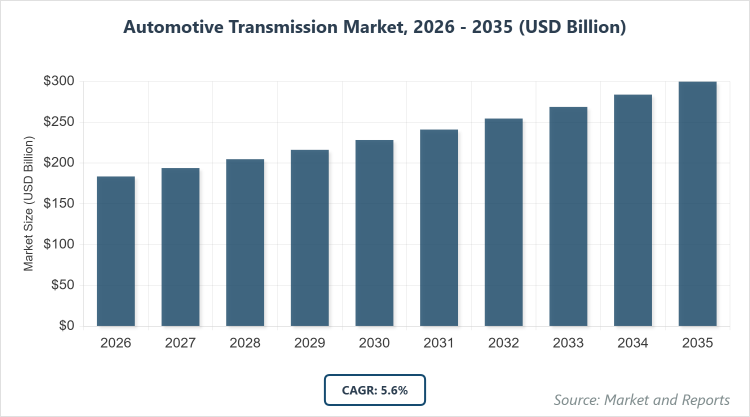
According to MarketnReports, the global Automotive Transmission Market size was estimated at USD 183.5 Billion in 2025 and is expected to reach USD 311.5 Billion by 2035, growing at a CAGR of 5.6% from 2026 to 2035. Automotive Transmission Market is driven by the increasing demand for fuel-efficient vehicles and the rise in electric vehicle adoption.
What is the Automotive Transmission Industry Overview?
The automotive transmission market encompasses the systems and components responsible for transferring power from the engine to the wheels, enabling vehicle movement at varying speeds and torques. This market includes a range of transmission types designed to optimize performance, fuel efficiency, and driving experience across different vehicle categories. Market definition refers to the global industry involved in the design, manufacturing, and distribution of transmission systems, including manual, automatic, and advanced variants like CVT and DCT, catering to passenger cars, commercial vehicles, and emerging electric mobility solutions. It plays a crucial role in the broader automotive ecosystem by addressing evolving demands for smoother shifts, reduced emissions, and integration with hybrid and electric powertrains.
What are the Key Insights in Automotive Transmission?
The global automotive transmission market was valued at USD 183.5 billion in 2025 and is projected to reach USD 311.5 billion by 2035.
- The market is anticipated to grow at a CAGR of 5.6% during the forecast period from 2026 to 2035.
- The market is driven by rising demand for fuel-efficient vehicles, advancements in electric and hybrid powertrains, and stringent emission regulations.
- In the transmission type segment, automatic transmission dominates with a 41% share due to its convenience in urban driving and widespread adoption in passenger vehicles.
- In the vehicle type segment, passenger cars dominate with a 58% share owing to high production volumes and consumer preference for comfort-oriented features.
- In the fuel type segment, gasoline dominates with a 52% share because of its established infrastructure and affordability in emerging markets.
- Asia Pacific dominates the market with a 47% share attributed to massive automotive manufacturing hubs in China and India, along with rapid urbanization driving vehicle sales.
What are the Automotive Transmission Market Dynamics?
Growth Drivers
The growth drivers of the automotive transmission market are primarily fueled by the global push toward electrification and sustainability. As governments worldwide implement stricter fuel economy and emission standards, automakers are increasingly adopting advanced transmission technologies like CVT and DCT to enhance efficiency without compromising performance. The surge in electric vehicle (EV) production necessitates specialized single-speed or multi-speed transmissions tailored for electric motors, further propelling market expansion. Additionally, rising consumer demand for seamless driving experiences in congested urban areas boosts the adoption of automatic transmissions, while technological innovations such as integrated electronics and lightweight materials reduce overall vehicle weight and improve fuel savings.
Restraints
Restraints in the automotive transmission market include high development and manufacturing costs associated with advanced systems like hybrid-compatible transmissions, which can deter adoption in price-sensitive emerging markets. Supply chain disruptions, particularly for rare earth materials used in electric transmission components, pose significant challenges, leading to production delays and increased prices. Moreover, the complexity of integrating new transmission technologies with existing vehicle architectures requires substantial R&D investment, slowing down market penetration for smaller manufacturers. Consumer hesitation toward EVs due to range anxiety and inadequate charging infrastructure also limits the growth of electric-specific transmissions.
Opportunities
Opportunities abound in the automotive transmission market with the rapid advancement of autonomous and connected vehicles, which demand sophisticated transmission controls for optimal power management and safety. Emerging markets in Asia and Latin America present untapped potential due to increasing vehicle ownership and infrastructure development, creating demand for affordable yet efficient transmission solutions. Partnerships between automakers and tech firms for software-defined transmissions open avenues for innovation, such as over-the-air updates for performance enhancements. Furthermore, the shift toward sustainable manufacturing practices, including recyclable materials in transmission components, aligns with global environmental goals and attracts eco-conscious consumers.
Challenges
Challenges facing the automotive transmission market involve the transition from traditional internal combustion engine (ICE) systems to electric and hybrid variants, requiring workforce reskilling and factory retooling. Regulatory inconsistencies across regions complicate compliance, as varying emission standards demand customized transmission designs. Intense competition from low-cost manufacturers in Asia pressures profit margins for established players, while cybersecurity threats to electronically controlled transmissions raise concerns about vehicle safety. Additionally, fluctuating raw material prices, such as steel and aluminum, impact production costs and supply stability.
Automotive Transmission Market Report Scope
| Report Attributes | Report Details |
| Report Name | Automotive Transmission Market |
| Market Size 2025 | USD 183.5 Billion |
| Market Forecast 2035 | USD 311.5 Billion |
| Growth Rate | CAGR of 5.6% |
| Report Pages | 220 |
| Key Companies Covered | Aisin Corporation, ZF Friedrichshafen AG, Magna International Inc., BorgWarner Inc., Hyundai Transys, and Others |
| Segments Covered | By Transmission Type, By Vehicle Type, By Fuel Type, and By Region |
| Regions Covered | North America, Europe, Asia Pacific (APAC), Latin America, and The Middle East and Africa (MEA) |
| Base Year | 2025 |
| Historical Year | 2020 – 2024 |
| Forecast Year | 2026 – 2035 |
| Customization Scope | Avail customized purchase options to meet your exact research needs. |
What is the Automotive Transmission Market Segmentation?
The Automotive Transmission Market is segmented by transmission type, vehicle type, fuel type, and region. All the segments have been analyzed based on present and future trends and the market is estimated from 2026 to 2035.
Based on Transmission Type Segment, Automatic transmission emerges as the most dominant subsegment, holding approximately 41% market share, driven by its superior convenience, reduced driver fatigue, and integration with advanced driver-assistance systems (ADAS), which collectively enhance vehicle safety and fuel efficiency, thereby accelerating overall market growth through increased adoption in premium and mid-range vehicles. Dual-clutch transmission (DCT) is the second most dominant, with around 20% share, owing to its quick shift times and performance-oriented design favored in sports and luxury cars, contributing to market expansion by bridging the gap between manual efficiency and automatic ease, thus appealing to enthusiasts and supporting higher torque applications in hybrids.
Based on Vehicle Type Segment, Passenger cars dominate this segment with a 58% share, attributed to high global production rates, diverse model offerings, and consumer demand for comfort features like automatic shifting, which drives the market by boosting volume sales and enabling economies of scale in transmission manufacturing. Light commercial vehicles (LCVs) are the second most dominant at about 25%, due to the booming e-commerce sector requiring reliable, fuel-efficient transmissions for urban deliveries, helping propel the market through increased fleet modernization and adaptation to emission norms.
Based on Fuel Type Segment, Gasoline leads with a 52% share, thanks to widespread availability, lower upfront costs compared to alternatives, and compatibility with various transmission types, driving market growth by sustaining demand in developing regions where infrastructure favors ICE vehicles. Diesel is the second most dominant at 28%, valued for its torque efficiency in commercial applications and better fuel economy, contributing to the market by supporting heavy-duty segments and gradual hybridization to meet environmental regulations.
What are the Recent Developments in Automotive Transmission?
- In 2025, ZF Friedrichshafen announced the launch of its next-generation 9-speed automatic transmission designed for hybrid vehicles, incorporating advanced torque management for improved efficiency, which is expected to strengthen its position in the EV transition.
- Aisin Corporation partnered with Toyota in late 2025 to develop a compact CVT system for small electric vehicles, aiming to reduce weight by 15% and enhance range, marking a significant step toward affordable electrification.
- BorgWarner acquired a startup specializing in electric transmission software in 2025, integrating AI-driven shift algorithms to optimize power delivery in EVs, enhancing its portfolio for autonomous driving applications.
What is the Automotive Transmission Regional Analysis?
Asia Pacific to dominate the global market.
Asia Pacific holds the largest share at 47%, driven by robust automotive manufacturing in countries like China, which alone accounts for over 30% of global vehicle production, benefiting from low-cost labor, government incentives for EVs, and rapid urbanization increasing vehicle demand.
North America follows with a 25% share, where the U.S. dominates due to high SUV and truck sales, supported by stringent CAFE standards pushing for efficient transmissions and a strong presence of key players like BorgWarner.
Europe captures 20%, led by Germany with its focus on premium vehicles and advanced DCT systems, propelled by EU emission regulations and investments in hybrid technologies from companies like ZF.
Latin America accounts for 5%, with Brazil as the leading country, growing through export-oriented production and adoption of AMT in entry-level cars to address affordability and fuel efficiency.
The Middle East and Africa hold 3%, dominated by South Africa, where market growth is tied to mining sector demands for durable HCV transmissions and gradual EV infrastructure development.
Who are the Key Automotive Transmission Market Players?
Aisin Corporation. Aisin Corporation employs strategies focused on innovation in hybrid and electric transmissions, including collaborations with automakers like Toyota for CVT development, emphasizing lightweight materials and electronic integration to capture the growing EV market share.
ZF Friedrichshafen AG. ZF Friedrichshafen AG pursues expansion through acquisitions and R&D in multi-speed EV transmissions, partnering with BMW for advanced DCT systems, while investing in sustainable manufacturing to comply with global regulations and enhance competitiveness.
Magna International Inc. Magna International Inc. adopts a diversification strategy by supplying modular transmission components to multiple OEMs, leveraging its expertise in all-wheel-drive systems and focusing on cost-effective solutions for emerging markets to drive revenue growth.
BorgWarner Inc. BorgWarner Inc. emphasizes technological leadership in turbocharged and electrified transmissions, acquiring firms for software capabilities and forming joint ventures in Asia to localize production and meet regional demand efficiently.
Hyundai Transys. Hyundai Transys implements vertical integration strategies within the Hyundai Group, developing in-house 8-speed automatics for hybrids, while expanding exports to Europe and North America to broaden its global footprint.
What are the Automotive Transmission Market Trends?
- Shift toward multi-speed transmissions for electric vehicles to improve efficiency and range.
- Increasing adoption of lightweight materials like composites to reduce vehicle weight and emissions.
- Integration of AI and software for predictive shifting and over-the-air updates.
- Growing demand for hybrid-compatible systems bridging ICE and electric powertrains.
- Emphasis on sustainable manufacturing practices, including recyclable components.
What are the Automotive Transmission Market Segments Covered?
By Transmission Type
- Manual Transmission
- Automatic Transmission
- Automated Manual Transmission (AMT)
- Dual-Clutch Transmission (DCT)
- Continuously Variable Transmission (CVT)
- Others
By Vehicle Type
- Passenger Cars
- Light Commercial Vehicles
- Heavy Commercial Vehicles
- Electric Vehicles
- Others
By Fuel Type
- Gasoline
- Diesel
- Hybrid
- Electric
- Others
By Region
-
- North America
- U.S.
- Canada
- Europe
- UK
- Germany
- France
- Rest of Europe
- Asia Pacific
- China
- India
- Japan
- Rest of Asia Pacific
- Latin America
- Brazil
- Mexico
- Rest of Latin America
- Middle East & Africa
- UAE
- South Africa
- Rest of Middle East & Africa
- North America
Frequently Asked Questions
The automotive transmission market refers to the industry segment focused on systems that transfer engine power to wheels, including manual, automatic, and advanced types like CVT and DCT, essential for vehicle performance and efficiency.
Key factors include rising EV adoption, stringent emission regulations, technological advancements in transmission efficiency, and increasing demand for fuel-efficient vehicles in emerging markets.
The market was valued at USD 183.5 billion in 2025 and is projected to reach USD 311.5 billion by 2035.
The CAGR is expected to be 5.6% from 2026 to 2035.
Asia Pacific will contribute notably, holding a 47% share due to high vehicle production in China and India.
Major players include Aisin Corporation, ZF Friedrichshafen AG, Magna International Inc., BorgWarner Inc., and Hyundai Transys.
The report provides in-depth analysis of market size, trends, segments, regional insights, key players, and forecasts from 2026 to 2035.
Stages include raw material procurement, component manufacturing, assembly, distribution to OEMs, and aftermarket services.
Trends are shifting toward electrified and automated systems, with consumers preferring seamless, efficient transmissions for better driving comfort and sustainability.
Stringent global emission standards and incentives for EVs are pushing innovation in efficient, low-emission transmissions, while environmental concerns drive the use of sustainable materials.