
Automotive Lighting Market Size, Share and Trends 2026 to 2035
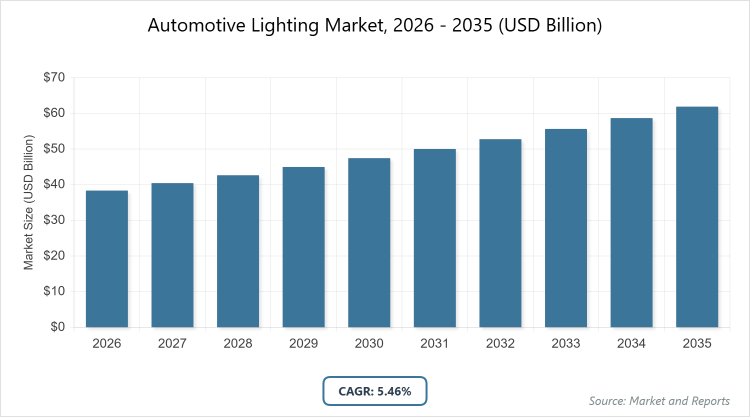
According to MarketnReports, the global Automotive Lighting Market size was estimated at USD 38.36 billion in 2025 and is expected to reach USD 65.25 billion by 2035, growing at a CAGR of 5.46% from 2026 to 2035. Automotive Lighting Market is driven by increasing demand for advanced safety features and energy-efficient lighting solutions.What are the Key Insights of the Automotive Lighting Market?
- The global automotive lighting market was valued at USD 38.36 billion in 2025 and is projected to reach USD 65.25 billion by 2035.
- The market is anticipated to grow at a CAGR of 5.46% during the forecast period from 2026 to 2035.
- The market is driven by rising vehicle production, stringent safety regulations, and adoption of energy-efficient LED technologies.
- In technology, halogen dominates with a 45% share due to its low cost, easy availability, and widespread use in entry-level vehicles, enabling affordable safety compliance.
- In application, rear lighting dominates with a 35% share because it includes multiple components like taillights and brake lights essential for signaling and visibility, reducing accident risks.
- In vehicle type, passenger vehicles dominate with a 60% share owing to high global production volumes and consumer demand for advanced lighting features in personal cars.
- Asia Pacific dominates the regional market with a 40% share, attributed to massive automotive manufacturing hubs in China and India, supported by economic growth and increasing vehicle sales.
What is the Industry Overview of the Automotive Lighting Market?
The automotive lighting market encompasses the design, production, and distribution of lighting systems used in vehicles to enhance visibility, safety, and aesthetics. This includes exterior lights such as headlamps, taillights, and fog lamps, as well as interior illumination for dashboards and cabins. Market definition refers to components like halogen, LED, and xenon technologies that comply with regulatory standards for road safety, while adapting to trends in vehicle electrification and autonomous driving, serving original equipment manufacturers and aftermarket needs across passenger, commercial, and electric vehicles.
What are the Market Dynamics of the Automotive Lighting Market?
Growth Drivers
The growth drivers in the automotive lighting market are propelled by surging global automobile production, particularly in emerging economies, coupled with heightened emphasis on road safety through government mandates for advanced lighting systems. Innovations in LED technology offer superior energy efficiency, longer lifespan, and better illumination, making them ideal for electric vehicles where battery conservation is crucial. Rising consumer preferences for premium features like adaptive headlights and ambient lighting in luxury cars further accelerate demand. Additionally, the integration of smart technologies such as AI-driven adaptive beams enhances visibility in adverse conditions, driving market expansion as automakers prioritize differentiation and compliance with international safety standards.
Restraints
Restraints in the automotive lighting market stem from the high initial costs associated with advanced technologies like LED and laser systems, which can deter adoption in price-sensitive markets and entry-level vehicles. The excessive heat generation in traditional halogen lights limits their efficiency and leads to regulatory scrutiny for energy waste. Supply chain disruptions, including shortages of semiconductors and raw materials like rare earth elements for LEDs, increase production costs and delay timelines. Moreover, varying regional standards for lighting performance create compliance challenges for global manufacturers, potentially slowing market penetration in underdeveloped areas.
Opportunities
Opportunities in the automotive lighting market arise from the rapid electrification of vehicles, where energy-efficient LEDs and smart systems can optimize power usage in EVs and hybrids, opening avenues for innovation in connected lighting. Expanding aftermarket sales, driven by frequent replacements due to accidents and wear, present growth potential especially in regions with high vehicle density. Advancements in AI and IoT enable intelligent features like gesture-controlled interior lights and real-time adaptive exteriors, attracting tech-savvy consumers. Emerging markets in Latin America and Africa offer untapped potential as infrastructure improves and safety norms tighten, fostering partnerships for localized production.
Challenges
Challenges in the automotive lighting market include the slow transition from halogen to advanced technologies in developing regions, where cost barriers and limited infrastructure hinder widespread adoption. Ensuring compatibility of new lighting systems with autonomous driving features requires extensive testing, increasing R&D expenses. Environmental concerns over the disposal of non-biodegradable components like LEDs pose sustainability issues, prompting the need for eco-friendly alternatives. Intense competition among players demands continuous innovation, while geopolitical tensions can disrupt global supply chains for critical materials.
Automotive Lighting Market: Report Scope
| Report Attributes | Report Details |
| Report Name | Automotive Lighting Market |
| Market Size 2025 | USD 38.36 Billion |
| Market Forecast 2035 | USD 65.25 Billion |
| Growth Rate | CAGR of 5.46% |
| Report Pages | 220 |
| Key Companies Covered |
Osram, Valeo, Hella, Koito Manufacturing, Koninklijke Philips N.V., Stanley Electric, and Others. |
| Segments Covered | By Technology, By Application, By Vehicle Type, and By Region. |
| Regions Covered | North America, Europe, Asia Pacific (APAC), Latin America, and The Middle East and Africa (MEA) |
| Base Year | 2025 |
| Historical Year | 2020 - 2024 |
| Forecast Year | 2026 - 2035 |
| Customization Scope | Avail customized purchase options to meet your exact research needs. |
What is the Market Segmentation of the Automotive Lighting Market?
The Automotive Lighting Market is segmented by type123, application123, end-user123, and region.ByType123 Segment, halogen emerges as the most dominant subsegment, holding approximately 45% market share, followed by LED as the second most dominant with around 30%. Halogen dominates due to its cost-effectiveness and broad availability, making it a staple in budget vehicles worldwide, which drives the market by enabling mass adoption in high-volume segments like passenger cars in emerging economies, thus ensuring compliance with basic safety standards without significant price hikes; this subsegment supports overall growth by maintaining accessibility while paving the way for upgrades to advanced technologies. LED, the second dominant, gains prominence for its energy efficiency and durability, propelling market expansion through integration in electric vehicles where power savings extend battery life and enhance features like adaptive lighting, attracting premium buyers and aligning with global sustainability goals.
By Application123 Segment, rear lighting stands out as the most dominant subsegment with a 35% share, while front headlamps follow as the second most dominant at about 30%. Rear lighting's dominance stems from its critical role in signaling and preventing collisions, encompassing taillights, brake lights, and indicators that are mandatory across all vehicle types, driving the market by improving road safety and meeting regulatory requirements; this helps propel growth by facilitating aftermarket replacements and innovations in LED integrations for better visibility. Front headlamps, as the second dominant, benefit from advancements in adaptive and matrix technologies that enhance nighttime driving, advancing the market through safety-focused R&D that supports autonomous vehicle development and consumer demand for intelligent features.
By End-User123 Segment, passenger vehicles is the most dominant subsegment, capturing 60% of the market, with commercial vehicles as the second most dominant at 20%. Passenger vehicles lead due to soaring global sales driven by urbanization and rising disposable incomes, incorporating diverse lighting for aesthetics and safety; this dominance drives the market by boosting demand for premium features like ambient interiors, encouraging technological upgrades that expand revenue streams in both OEM and aftermarket channels. Commercial vehicles, the second dominant, utilize robust lighting for heavy-duty operations, supporting market growth by addressing fleet safety needs in logistics and transportation, where durable LEDs reduce maintenance costs and improve operational efficiency.
What are the Recent Developments in the Automotive Lighting Market?
- In December 2025, Toyoda Gosei Co., Ltd. developed a new LED lamp unit that projects dynamic shadowy illumination patterns in vehicle interiors, enhancing ambient lighting experiences and targeting premium automakers for improved cabin aesthetics.
- In December 2025, Llink Technologies was awarded the 2025 AutoTech Outlook Top Remanufactured Automotive Lighting Assembly Solution, recognizing its circular supply chain model that enables OEMs to reuse lighting components, reducing waste and costs in the aftermarket.
- In late 2025, Valeo secured a major contract for car interior lighting solutions using TactoTek's IMSE technology, entering high-volume production to integrate electronics and lighting into unified panels for a premium global automaker, focusing on innovative and space-efficient designs.
What is the Regional Analysis of the Automotive Lighting Market?
Asia Pacific to dominate the global market.Asia Pacific leads the automotive lighting market, holding over 40% share, driven by explosive vehicle production and sales in densely populated countries amid rapid economic growth. China stands out as the dominating country, with its massive manufacturing base producing millions of vehicles annually, supported by government incentives for EV adoption and local suppliers like Koito and Stanley; this dominance is reinforced by investments in LED and adaptive technologies to meet export demands and domestic safety regulations, positioning the region as a global hub for cost-effective innovations. India contributes significantly through rising middle-class demand for affordable cars with enhanced lighting, while Japan excels in R&D for advanced systems.
North America exhibits strong growth in the automotive lighting market, fueled by stringent safety standards and high adoption of EVs and ADAS technologies. The United States dominates this region, leveraging its robust automotive industry with companies like Valeo and Hella leading in intelligent lighting integrations for luxury and electric models; this leadership drives expansion through federal regulations like FMVSS promoting LED efficiency, enabling retrofits in the aftermarket and collaborations with tech firms for AI-enhanced features. Canada supports through supply chain strengths in components, aiding in sustainable production.
Europe is a key player in the automotive lighting market, emphasized by rigorous EU directives on emissions and safety that accelerate LED and adaptive system uptake. Germany dominates, as home to premium manufacturers like BMW and Mercedes-Benz, which integrate cutting-edge lighting from players like Osram and ZKW; this supremacy stems from heavy R&D investments in autonomous-ready technologies, driving market growth by exporting high-value systems and complying with Euro NCAP standards for better visibility. The UK and France add through EV initiatives, fostering innovation in energy-efficient designs.
Latin America shows emerging potential in the automotive lighting market, supported by increasing vehicle assembly and urbanization trends. Brazil dominates, with its growing automotive sector focusing on affordable lighting solutions for passenger cars amid economic recovery; this position is strengthened by partnerships with global firms like Philips for local production, driving development by addressing aftermarket needs from road accidents and integrating LEDs for fuel efficiency in commercial fleets. Mexico contributes as a manufacturing exporter to North America, enhancing supply chains.
The Middle East and Africa region is progressively advancing in the automotive lighting market, though challenged by infrastructure gaps. The UAE emerges as the dominating country, with its advanced luxury vehicle market and early adoption of smart lighting in high-end models; this leadership is driven by investments in infrastructure and partnerships with international suppliers like Hella, helping diversify oil-dependent economies while improving road safety through adaptive systems in commercial and off-road vehicles. South Africa supports through assembly plants, focusing on durable solutions for rugged terrains.
Who are the Key Market Players and Strategies in the Automotive Lighting Market?
Osram focuses on leading in LED and laser technologies through heavy R&D investments, expanding its portfolio with energy-efficient solutions for headlamps and interiors, while forming strategic partnerships with automakers to integrate intelligent systems for enhanced safety and connectivity.
Valeo employs a strategy of innovation in adaptive and connected lighting, leveraging acquisitions and collaborations like with TactoTek for integrated electronics, aiming to dominate in EVs by offering comprehensive systems that reduce weight and improve functionality.
Hella prioritizes high-performance modules and ECUs, investing in adaptive headlights and rear combinations, with a focus on global expansion and sustainability to meet regulatory demands and capture aftermarket shares through reliable, durable products.
Koito Manufacturing pursues OEM partnerships and technological advancements in LED headlamps and DRLs, emphasizing cost optimization and quality to strengthen its position in Asia Pacific while expanding into emerging markets for adaptive systems.
Koninklijke Philips N.V. adopts a customer-centric approach with a broad range of halogen, LED, and xenon products, focusing on aftermarket innovation and performance upgrades to build brand loyalty and penetrate premium segments.
Stanley Electric leverages its expertise in optics and reliability, strategies include diversifying into EV-specific lighting and collaborating with startups for smart features, targeting high-volume production to maintain competitiveness.
What are the Market Trends in the Automotive Lighting Market?
- Shift from halogen to LED technologies for energy savings and constant illumination in diverse applications.
- Integration of AI and sensors in exterior lighting for object detection and enhanced safety.
- Adoption of IoT and gesture control in interior lighting for smart, user-interactive features.
- Growing penetration of adaptive headlamps in EVs to optimize visibility and battery efficiency.
- Expansion of aftermarket sales driven by replaceable parts and rising road accidents.
- Focus on sustainable materials and circular supply chains in lighting manufacturing.
- Rise in laser and OLED technologies for premium and autonomous vehicles.
- Increasing demand for ambient and dynamic illumination in vehicle cabins.
What Market Segments and their Subsegments are Covered in the Report for the Automotive Lighting Market?
By Technology- Halogen
- LED
- Xenon/HID
- Laser
- OLED
- Matrix LED
- Adaptive Lighting
- Bi-LED
- Projection LED
- Ambient LED
- Others
- Front Headlamps
- Rear Taillights
- Fog Lights
- Interior Lights
- Daytime Running Lights
- Brake Lights
- Turn Indicators
- Side Marker Lights
- License Plate Lights
- Trunk Lights
- Others
- Passenger Cars
- Light Commercial Vehicles
- Heavy Commercial Vehicles
- Battery Electric Vehicles
- Hybrid Electric Vehicles
- Plug-in Hybrid Electric Vehicles
- Two-Wheelers
- Off-Road Vehicles
- Buses
- Trucks
- Others
By Region
- North America
- U.S.
- Canada
- Europe
- UK
- Germany
- France
- Rest of Europe
- Asia Pacific
- China
- India
- Japan
- Rest of Asia Pacific
- Latin America
- Brazil
- Mexico
- Rest of Latin America
- Middle East & Africa
- UAE
- South Africa
- Rest of Middle East & Africa
Frequently Asked Questions
The automotive lighting market involves the production and sale of vehicle lighting systems for safety, visibility, and aesthetics, including exterior and interior components using technologies like LED and halogen.
Key factors include rising vehicle production, safety regulations, LED adoption, vehicle electrification, and advancements in smart lighting technologies.
The market is projected to grow from USD 38.36 billion in 2026 to USD 65.25 billion by 2035.
The CAGR is expected to be 5.46% during 2026-2035.
Asia Pacific will contribute notably, driven by high production and sales in China and India.
Major players include Osram, Valeo, Hella, Koito Manufacturing, Koninklijke Philips N.V., and Stanley Electric.
The report provides detailed analysis of market size, trends, segments, regional insights, key players, and forecasts.
Stages include raw material sourcing, component manufacturing, assembly, distribution to OEMs, and aftermarket services.
Trends are moving towards LED and smart systems, with consumers preferring energy-efficient, customizable lighting for safety and aesthetics.
Strict safety regulations like FMVSS and EU directives, plus environmental pushes for low-energy LEDs, are boosting adoption of advanced technologies.