
Automotive HMI Market Size, Share and Trends 2026 to 2035
According to MarketnReports, the global Automotive HMI market size was estimated at USD 29.43 billion in 2025 and is expected to reach USD 89.58 billion by 2035, growing at a CAGR of 11.8% from 2026 to 2035. Automotive HMI Market is driven by the increasing adoption of advanced driver assistance systems and connected vehicle technologies.
What are the Key Insights for Automotive HMI Market?
- The global Automotive HMI market was valued at USD 29.43 billion in 2025 and is projected to reach USD 89.58 billion by 2035.
- The market is anticipated to grow at a CAGR of 11.8% during the forecast period from 2026 to 2035.
- The market is driven by rising demand for enhanced in-vehicle user experiences, integration of AI and IoT in vehicles, and the shift towards electric and autonomous mobility.
- Central Displays dominate the Product segment with a 42% share due to their central role in integrating multiple vehicle functions and providing intuitive access to infotainment and controls.
- Infotainment dominates the Application segment with a 35% share because it caters to consumer preferences for connectivity, entertainment, and real-time information, boosting overall vehicle appeal.
- Passenger Cars dominate the End-User segment with a 65% share owing to higher production volumes and consumer demand for advanced features in personal transportation.
- Asia Pacific dominates the regional landscape with a 52% share, attributed to rapid automotive production growth in countries like China and India, coupled with increasing adoption of electric vehicles.
What is Automotive HMI Market?
The Automotive HMI Market encompasses the technologies and systems that facilitate interaction between vehicle occupants and the automobile’s various functions, including infotainment, navigation, and safety features. This market includes interfaces such as displays, voice controls, and gesture recognition, designed to enhance user experience while minimizing driver distraction. Market definition refers to the integration of hardware and software solutions that enable seamless communication between humans and vehicle systems, driven by advancements in connectivity and autonomous driving capabilities.
What drives Automotive HMI Market dynamics?
Growth Drivers
The primary growth drivers in the Automotive HMI Market include the surging demand for connected vehicles and advanced infotainment systems, which are pushing automakers to integrate sophisticated interfaces for better user engagement. Technological advancements in AI, machine learning, and augmented reality are enabling more intuitive and personalized interactions, reducing cognitive load on drivers and enhancing safety. Additionally, the global shift towards electric and autonomous vehicles necessitates advanced HMIs to manage complex functions like battery monitoring and autonomous navigation, further accelerating market expansion. Regulatory mandates emphasizing driver safety and reduced distractions are also compelling manufacturers to innovate in voice and gesture-based controls.
Restraints
Restraints in the Automotive HMI Market stem from high development and integration costs, which can limit adoption among budget-conscious manufacturers and in emerging markets. Cybersecurity concerns arise as connected HMIs become more prevalent, posing risks of data breaches and vehicle hacking that could undermine consumer trust. Compatibility issues with legacy vehicle systems and the complexity of ensuring seamless integration across diverse platforms also hinder progress. Moreover, the lack of standardized regulations across regions can create barriers to global scalability, slowing down innovation and market penetration.
Opportunities
Opportunities abound in the Automotive HMI Market with the rise of over-the-air (OTA) updates, allowing for continuous improvement and customization of interfaces post-purchase, which can generate recurring revenue streams. The expansion of 5G connectivity opens doors for real-time data exchange and enhanced AR/VR experiences in vehicles. Emerging markets in Asia and Latin America present untapped potential due to increasing vehicle ownership and demand for affordable yet advanced HMIs. Partnerships between tech firms and automakers for AI-driven personalization further create avenues for differentiation and market leadership.
Challenges
Challenges in the Automotive HMI Market include balancing innovation with user safety, as overly complex interfaces can lead to driver distraction despite regulatory efforts. Supply chain disruptions, particularly in semiconductor components essential for displays and sensors, impact production timelines and costs. Ensuring accessibility for diverse user groups, including those with disabilities, requires inclusive design without compromising functionality. Rapid technological evolution demands constant R&D investment, posing a challenge for smaller players to keep pace with industry giants.
Automotive HMI Market: Report Scope
| Report Attributes | Report Details |
| Report Name | Automotive HMI Market |
| Market Size 2025 | USD 29.43 Billion |
| Market Forecast 2035 | USD 89.58 Billion |
| Growth Rate | CAGR of 11.8% |
| Report Pages | 220 |
| Key Companies Covered |
Continental AG, Robert Bosch GmbH, Denso Corporation, Visteon Corporation, Aptiv PLC, Harman International, and Others 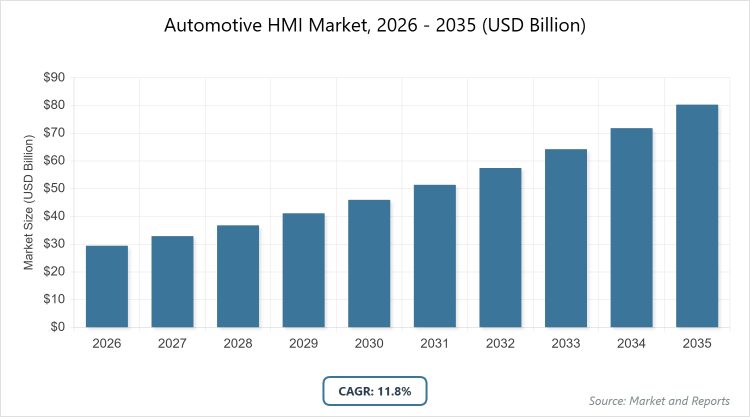 |
| Segments Covered | By Product, By Application, By End-User, and By Region |
| Regions Covered | North America, Europe, Asia Pacific (APAC), Latin America, and The Middle East and Africa (MEA) |
| Base Year | 2025 |
| Historical Year | 2020 – 2024 |
| Forecast Year | 2026 – 2035 |
| Customization Scope | Avail customized purchase options to meet your exact research needs. |
How is Automotive HMI Market segmented?
The Automotive HMI market is segmented by Product, Application, End-User, and region.
Based on Product Segment, Central Displays emerge as the most dominant, holding approximately 42% market share, followed by Instrument Clusters at around 25%. Central Displays dominate due to their versatility in consolidating infotainment, navigation, and vehicle controls into a single, user-friendly interface, which significantly enhances driver convenience and reduces the need for multiple physical buttons, thereby driving market growth through improved safety and aesthetics. Instrument Clusters, the second most dominant, support this by providing critical real-time data visualization, aiding in quick decision-making and complementing central systems to propel overall HMI adoption.
Based on Application Segment, Infotainment leads as the most dominant with about 35% share, while Navigation ranks second at roughly 20%. Infotainment’s dominance stems from consumer demand for seamless connectivity and entertainment options like streaming and smartphone integration, which elevate the in-vehicle experience and encourage premium vehicle purchases, thus fueling market expansion. Navigation, as the second dominant, contributes by offering precise, real-time guidance that integrates with ADAS, reducing driver stress and enhancing safety, which in turn supports broader HMI ecosystem growth.
Based on End-User Segment, Passenger Cars are the most dominant, capturing around 65% share, with Commercial Vehicles as the second at about 15%. Passenger Cars dominate owing to high global sales volumes and consumer preferences for tech-laden personal vehicles, where HMIs add value through personalization and comfort, driving demand and market revenues. Commercial Vehicles, the second dominant, help by requiring robust interfaces for fleet management and efficiency, integrating telematics to optimize operations and safety, thereby expanding HMI applications in professional sectors.
What are recent developments in Automotive HMI Market?
- In 2025, Continental AG unveiled an advanced multimodal HMI system incorporating AI-driven voice and gesture recognition for enhanced driver interaction in electric vehicles, aiming to reduce distractions and improve usability.
- Bosch announced a collaboration with a major EV manufacturer to integrate haptic feedback displays into next-generation instrument clusters, focusing on tactile responses for safer operation during autonomous modes.
- Visteon Corporation launched a new AR-based head-up display technology that overlays navigation and safety alerts directly onto the windshield, receiving positive feedback for its role in advancing ADAS integration.
- Aptiv introduced an updated central display platform with 5G connectivity, enabling real-time OTA updates and personalized user profiles, targeting premium passenger car segments.
- Harman International expanded its portfolio with voice recognition enhancements powered by natural language processing, partnering with automakers to embed these in infotainment systems for better accessibility.
Which region dominates Automotive HMI Market?
Asia Pacific to dominate the global market.
Asia Pacific holds the largest share in the Automotive HMI Market, driven by booming automotive production in China, which dominates the region due to its massive manufacturing base, government incentives for EVs, and rapid adoption of connected technologies, fostering innovation in affordable HMIs.
North America follows with strong growth, led by the United States, where emphasis on autonomous vehicles and regulatory focus on safety propel HMI advancements, supported by tech hubs and high consumer spending on premium features.
Europe exhibits robust demand, with Germany as the leading country, owing to its automotive heritage, strict emission standards pushing EV HMIs, and collaborations between OEMs and tech firms for sophisticated interfaces.
Latin America shows emerging potential, dominated by Brazil, where increasing vehicle electrification and urbanization drive HMI integration for enhanced user experiences in passenger cars.
The Middle East and Africa lag but are growing, with South Africa leading through investments in commercial vehicle fleets requiring advanced telematics and safety-focused HMIs.
Who are key players in Automotive HMI Market?
- Continental AG. Continental AG focuses on developing integrated HMI solutions that combine displays, voice, and gesture controls, emphasizing safety and user-centric design through partnerships with automakers for seamless ADAS integration.
- Robert Bosch GmbH. Robert Bosch GmbH employs strategies centered on AI-enhanced HMIs, investing in haptic and acoustic interfaces to improve driver interaction, while expanding through acquisitions in connectivity tech.
- Denso Corporation. Denso Corporation prioritizes energy-efficient HMIs for EVs, leveraging its expertise in sensor fusion to create multimodal systems that support autonomous driving features.
- Visteon Corporation. Visteon Corporation adopts a modular approach to HMI platforms, enabling customization for various vehicle types and focusing on AR HUDs to differentiate in premium markets.
- Aptiv PLC. Aptiv PLC pursues electrification strategies, developing software-defined HMIs that allow OTA updates and integration with cloud services for personalized experiences.
- Harman International. Harman International specializes in infotainment-driven HMIs, incorporating audio and voice technologies from its Samsung parent, targeting connected vehicle ecosystems.
What are trends shaping Automotive HMI Market?
- Integration of artificial intelligence for predictive and personalized user interfaces.
- Adoption of augmented reality in head-up displays for enhanced navigation and safety alerts.
- Shift towards multimodal HMIs combining voice, touch, and gesture for intuitive interactions.
- Emphasis on cybersecurity measures to protect connected HMI systems from threats.
- Growth in haptic feedback technologies to provide tactile responses without visual distraction.
- Expansion of over-the-air updates for continuous HMI feature enhancements.
- Focus on sustainable materials and energy-efficient designs in HMI components.
- Increasing use of natural language processing in voice recognition systems.
- Collaboration between automakers and tech firms for advanced software platforms.
- Rise of gesture control in premium vehicles for contactless operation.
What segments are covered in Automotive HMI Market report?
By Product
-
Central Displays
-
Instrument Clusters
-
Head-Up Displays
-
Voice Recognition Systems
-
Gesture Recognition Systems
-
Touch Screen Displays
-
Steering Mounted Controls
-
Multifunction Switches
-
Rear Seat Entertainment Displays
-
Haptic Feedback Systems
-
Others
By Application
- Infotainment
- Navigation
- Climate Control
- Driver Assistance
- Entertainment
- Communication
- Safety Systems
- Vehicle Diagnostics
- Telematics
- Augmented Reality Integration
- Others
By End-User
- Passenger Cars
- Commercial Vehicles
- Electric Vehicles
- Autonomous Vehicles
- Luxury Vehicles
- Economy Vehicles
- Mid-Priced Vehicles
- OEMs
- Aftermarket
- Fleet Operators
- Others
By Region
- North America
- U.S.
- Canada
- Europe
- UK
- Germany
- France
- Rest of Europe
- Asia Pacific
- China
- India
- Japan
- Rest of Asia Pacific
- Latin America
- Brazil
- Mexico
- Rest of Latin America
- Middle East & Africa
- UAE
- South Africa
- Rest of Middle East & Africa
Frequently Asked Questions
Automotive HMI refers to the interfaces that enable interaction between vehicle users and systems, including displays, voice controls, and gesture recognition for functions like infotainment and safety.
Key factors include advancements in AI and connectivity, rising demand for autonomous vehicles, regulatory emphasis on safety, and consumer preferences for personalized in-vehicle experiences.
The market is projected to grow from an estimated value post-2025 to USD 89.58 billion by 2035.
The CAGR is expected to be 11.8% during this period.
Asia Pacific will contribute notably, driven by high automotive production and EV adoption.
Major players include Continental AG, Robert Bosch GmbH, Denso Corporation, Visteon Corporation, Aptiv PLC, and Harman International.
The report provides comprehensive analysis including market size, trends, segmentation, key players, regional insights, and forecasts.
Stages include component manufacturing, software development, system integration, OEM assembly, distribution, and aftermarket services.
Trends evolve toward touchless AI interfaces, personalization, AR visuals, and sustainability; consumers prefer intuitive, distraction-free, connected experiences.
Regulations like NHTSA/EU distraction rules and UNECE R171 promote safe HMIs; environmental push favors energy-efficient, recyclable displays.