
Artisanal Ice Cream Market Size, Share and Trends 2026 to 2035
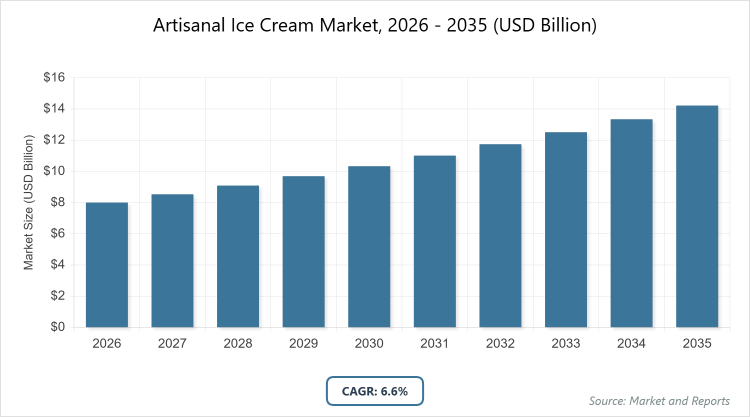
According to MarketnReports, the global Artisanal Ice Cream market size was estimated at USD 8.0 billion in 2025 and is expected to reach USD 15.1 billion by 2035, growing at a CAGR of 6.6% from 2026 to 2035. Artisanal Ice Cream Market is driven by increasing consumer demand for premium, natural, and unique flavored ice creams.
What are the Key Insights of the Artisanal Ice Cream Market?
- The global artisanal ice cream market was valued at USD 8.0 billion in 2025 and is projected to reach USD 15.1 billion by 2035.
- The market is expected to grow at a CAGR of 6.6% from 2026 to 2035.
- The market is driven by rising consumer preferences for premium, high-quality, and unique flavor experiences using natural ingredients.
- In the flavor segment, the fruits & nuts subsegment dominated with a 44.9% share, while in the type segment, conventional dominated with the largest revenue share, and in the distribution channel segment, specialty stores dominated with the leading share.
- The fruits & nuts subsegment dominates due to consumer preference for healthier, natural options with enhanced nutritional profiles and clean-label trends; the conventional type dominates owing to its authenticity, craftsmanship, and appeal as comfort food; specialty stores dominate because they offer unique shopping experiences, curated selections, and opportunities for flavor sampling.
- North America dominated the market with a 37.7% revenue share due to strong preferences for premium products, innovation in diverse flavors, and established brands emphasizing artisanal quality.
What is the Industry Overview of the Artisanal Ice Cream Market?
The artisanal ice cream market encompasses premium, handcrafted frozen desserts produced in small batches using high-quality, natural ingredients, often sourced locally or organically, with an emphasis on craftsmanship, unique flavors, and traditional methods to differentiate from mass-produced alternatives. This industry focuses on delivering authentic taste experiences that appeal to consumers seeking indulgence, novelty, and health-conscious options, including dairy-free varieties, while supporting local producers and incorporating cultural or regional influences in flavor profiles. Market definition refers to the sector involving the production, distribution, and consumption of these specialty ice creams, characterized by innovation, sustainability, and a shift away from artificial additives toward clean-label products that align with evolving consumer lifestyles and preferences for experiential foods.
What are the Market Dynamics in the Artisanal Ice Cream Market?
Growth Drivers
The growth of the artisanal ice cream market is propelled by a surge in consumer demand for premium and distinctive flavor profiles that offer novel taste experiences beyond traditional options. This is fueled by a broader trend toward indulgence in high-quality comfort foods, particularly post-pandemic, where individuals seek familiar yet elevated treats made with natural, additive-free ingredients. Additionally, increasing health awareness has boosted the appeal of organic and locally sourced components, encouraging innovation such as incorporating cultural flavors like matcha or durian in emerging markets. The expansion of accessible distribution channels, including online platforms and specialty outlets, further drives market penetration by making these products available to a wider audience, supported by rising disposable incomes in developing regions and a preference for supporting small, independent businesses that emphasize sustainability and craftsmanship.
Restraints
Market expansion faces hurdles from intense competition with mass-produced ice creams that offer lower prices and wider availability, potentially limiting artisanal products’ reach in price-sensitive segments. Supply chain disruptions for high-quality, natural ingredients can increase production costs, making it challenging for smaller producers to maintain affordability while upholding quality standards. Limited shelf life and the need for specialized storage also pose logistical challenges, particularly in regions with inadequate cold chain infrastructure. Moreover, fluctuating raw material prices, such as dairy or exotic fruits, combined with economic uncertainties, can restrain consumer spending on premium items, slowing adoption in emerging markets where awareness of artisanal benefits remains nascent.
Opportunities
Opportunities abound in tailoring products to regional tastes and cultural preferences, such as developing Asian-inspired flavors like black sesame or lychee to capture growing middle-class populations in Asia Pacific. The rising prevalence of lactose intolerance opens avenues for expanding lactose-free and dairy-free lines, attracting health-conscious consumers seeking inclusive options. Partnerships and collaborations, like those with pet brands or e-commerce platforms, can diversify offerings and tap into niche markets. Furthermore, the acceleration of online sales provides a platform for global reach, enabling small artisans to access international customers, while sustainability initiatives, such as eco-friendly packaging, can appeal to environmentally aware buyers, fostering brand loyalty and market differentiation.
Challenges
Challenges in the artisanal ice cream market include the need for continuous innovation to keep pace with rapidly evolving consumer preferences, which demands significant investment in research and development for new flavors and formulations. Maintaining product authenticity while scaling operations poses difficulties for small producers facing pressure from larger corporations entering the premium space. Regulatory compliance regarding food safety, labeling, and ingredient sourcing adds complexity, especially across international borders. Additionally, seasonal demand fluctuations and the impact of climate on ingredient availability can disrupt supply, while educating consumers on the value of artisanal over conventional products remains a barrier in less mature markets.
Artisanal Ice Cream Market: Report Scope
| Report Attributes | Report Details |
| Report Name | Artisanal Ice Cream Market |
| Market Size 2025 | USD 8.0 Billion |
| Market Forecast 2035 | USD 15.1 Billion |
| Growth Rate | CAGR of 6.6% |
| Report Pages | 214 |
| Key Companies Covered | Unilever, Nestlé, Van Leeuwen Ice Cream, Nye’s Cream Sandwiches, McConnell’s Fine Ice Creams, Carmela Ice Cream, Toscanini’s, L’Artisan des Glaces, Gelato Messina, and Others |
| Segments Covered | By Flavor, By Type, By Distribution Channel, and By Region |
| Regions Covered | North America, Europe, Asia Pacific (APAC), Latin America, and The Middle East and Africa (MEA) |
| Base Year | 2025 |
| Historical Year | 2020 – 2024 |
| Forecast Year | 2026 – 2035 |
| Customization Scope | Avail customized purchase options to meet your exact research needs. |
What is the Market Segmentation of the Artisanal Ice Cream Market?
The Artisanal Ice Cream market is segmented by flavor, type, distribution channel, and region.
Based on Flavor Segment, the fruits & nuts subsegment is the most dominant, holding a 44.9% share in 2023, followed by chocolate as the second most dominant with strong growth projections. The dominance of fruits & nuts stems from consumer shifts toward healthier, nutrient-rich options featuring natural fruits like strawberries, mangoes, and blueberries combined with nuts such as almonds and pistachios, aligning with clean-label trends and wellness preferences; this drives the market by appealing to health-conscious buyers seeking indulgent yet beneficial treats, boosting overall demand for premium products. Chocolate’s position is supported by its timeless appeal, premium varieties like dark or single-origin, and perceived health benefits from antioxidants, helping to expand the market through versatile innovations that attract a broad audience and encourage repeat purchases.
Based on Type Segment, the conventional subsegment is the most dominant, capturing the largest revenue share in 2023, with lactose-free as the second most dominant and fastest-growing. Conventional’s leadership is due to its focus on traditional recipes using high-quality, locally sourced dairy ingredients, offering authenticity and craftsmanship that resonate as comfort foods, particularly post-pandemic; this propels market growth by maintaining core consumer loyalty and enabling premium pricing. Lactose-free’s rise is driven by increasing dietary needs and health awareness, providing dairy alternatives that broaden accessibility, thus driving the market by inclusively targeting lactose-intolerant consumers and expanding into wellness-oriented demographics.
Based on Distribution Channel Segment, specialty stores are the most dominant, leading the market in 2023, followed by online as the second most dominant with the fastest projected growth. Specialty stores dominate because they provide immersive experiences like curated selections, flavor sampling, and expert guidance, exemplified by brands like Salt & Straw in the U.S., fostering customer engagement and premium perceptions; this contributes to market growth by enhancing brand storytelling and encouraging higher spending. The online channel’s momentum comes from convenience, widespread internet access, and delivery services accelerated by COVID-19, allowing global reach via platforms like Amazon, thereby driving the market through increased accessibility and enabling small producers to compete effectively.
What are the Recent Developments in the Artisanal Ice Cream Market?
- In June 2024, Bidcorp UK acquired Northern Bloc Ice Cream Ltd. to expand its manufacturing capabilities and integrate premium artisanal offerings into its existing food solutions network, enhancing distribution and product diversity in the UK market.
- In May 2024, Van Leeuwen partnered with Ollie to introduce dog-friendly ice cream flavors like Peanut Butter and Banana, made with pet-safe ingredients such as coconut cream and oat milk, available at scoop shops and Petco, tapping into the niche pet treat segment for broader consumer appeal.
What is the Regional Analysis of the Artisanal Ice Cream Market?
- North America to dominate the global market.
North America leads the artisanal ice cream market with a 37.7% revenue share, driven by a robust food culture emphasizing premium quality, innovation, and diverse flavors that cater to indulgent yet health-focused consumers. The region’s dominance is supported by high disposable incomes enabling spending on artisanal products, competitive landscapes fostering exotic introductions like honey lavender, and strong brand presence highlighting craftsmanship and sustainability. The United States stands as the dominating country, owing to its large market size, widespread adoption of premium desserts, and initiatives by local artisans to incorporate unique, regionally inspired ingredients, further bolstered by extensive retail networks and online accessibility.
Europe represents a lucrative market with a strong tradition in artisanal food production, where consumers prioritize natural ingredients, authenticity, and culinary heritage through establishments like gelaterias in Italy and France. Growth is fueled by demand for premium, additive-free products using traditional methods and locally sourced components, with increasing availability in supermarkets and specialty stores. The United Kingdom emerges as the dominating country in terms of rapid growth, propelled by heightened health and wellness awareness, support for independent makers offering natural flavors, and brands like Jude’s expanding through retail partnerships, capitalizing on preferences for ethical and local sourcing.
Asia Pacific is poised for the fastest growth at a CAGR of 7.6%, attributed to an expanding middle class, rising disposable incomes, and a surge in interest for premium desserts infused with local flavors such as matcha in Japan or durian in China. The region’s potential lies in innovation blending traditional Asian ingredients with artisanal techniques, alongside increasing urbanization and e-commerce adoption. China holds a substantial share as the dominating country, thanks to its vast population, growing demand for high-quality natural products, and brands like Zhong Xue Gao introducing unique offerings like black sesame, which align with cultural tastes and drive premium segment expansion.
Latin America shows promising growth through cultural affinity for flavorful desserts, with consumers embracing artisanal options made from local fruits and natural ingredients amid rising urbanization and retail expansion. Challenges include economic variability, but opportunities arise from tailoring products to regional preferences like tropical flavors. Brazil dominates the region, leveraging its large consumer base, increasing middle-class spending on premium indulgences, and integration of local elements such as acai, supported by growing specialty outlets and online platforms.
Middle East and Africa (MEA) experiences gradual adoption driven by urbanization, tourism, and a shift toward premium imported or locally crafted desserts incorporating flavors like saffron. Growth is hampered by infrastructural limitations but boosted by rising affluence in key areas. Saudi Arabia leads as the dominating country, fueled by economic diversification, increasing disposable incomes, and demand for high-quality, halal-certified artisanal products in urban centers, with expanding retail chains facilitating market penetration.
Who are the Key Market Players in the Artisanal Ice Cream Market?
Unilever leads the market with a significant share, employing strategies focused on innovation in premium lines, sustainability through natural ingredient sourcing, and global distribution expansion to set industry trends and capture diverse consumer preferences.
Nye’s Cream Sandwiches differentiates itself via handcrafted ice cream sandwiches featuring chef-inspired flavors and homemade cookies, with strategies centered on unique product offerings, targeted marketing to indulgence seekers, and partnerships for retail presence.
Van Leeuwen Ice Cream emphasizes premium ingredients and ethical sourcing, utilizing strategies like strategic collaborations (e.g., pet-friendly lines), scoop shop expansions, and e-commerce growth to build brand loyalty and tap into niche markets.
Nestlé holds a major market position, leveraging strategies such as product diversification into artisanal segments, investment in R&D for flavor innovation, and extensive supply chain networks to influence trends and maintain competitive dominance.
Carmela Ice Cream focuses on authentic, small-batch production, with strategies involving local ingredient emphasis, community engagement, and selective distribution to specialty outlets for building a loyal customer base.
Toscanini’s prioritizes traditional Italian gelato techniques, employing strategies like flavor experimentation with natural elements, boutique store expansions, and branding around heritage to appeal to premium-seeking consumers.
McConnell’s Fine Ice Creams offers unique flavors like Eureka Lemon & Marionberries, with strategies including organic and dairy-free extensions, direct-to-consumer sales, and marketing highlighting California-sourced ingredients for market differentiation.
L’Artisan des Glaces specializes in French-style artisanal creations, using strategies such as seasonal flavor rotations, high-end retail partnerships, and emphasis on craftsmanship to attract gourmet enthusiasts.
Gelato Messina innovates with bold, creative flavors, implementing strategies like international franchise growth, social media-driven hype, and collaborations to expand reach and engage younger demographics.
What are the Market Trends in the Artisanal Ice Cream Market?
- Increasing preference for premium and unique flavors inspired by local cultures and regions, such as kokum in India or saffron in Italy.
- Growing demand for natural, organic, and locally sourced ingredients free from artificial additives to align with clean-label trends.
- Rise in health-conscious options, including lactose-free and dairy-free varieties catering to dietary restrictions.
- Acceleration of online shopping and delivery services, enhancing accessibility and convenience for consumers.
- Emphasis on supporting local, independent businesses that highlight sustainability and artisanal craftsmanship.
- Innovation in niche products, such as pet-friendly ice creams or functional additions like antioxidants in chocolate.
- Post-pandemic surge in indulgence for comfort foods with nostalgic or familiar profiles.
What Market Segments and their Subsegments are Covered in the Artisanal Ice Cream Report?
By Flavor
- Fruits & Nuts
- Chocolate
- Vanilla
- Others
By Type
- Conventional
- Lactose-free
- Others
By Distribution Channel
- Specialty Stores
- Hypermarket & Supermarket
- Convenience Stores
- Online
- Others
By Region
- North America
- U.S.
- Canada
- Europe
- UK
- Germany
- France
- Rest of Europe
- Asia Pacific
- China
- India
- Japan
- Rest of Asia Pacific
- Latin America
- Brazil
- Mexico
- Rest of Latin America
- Middle East & Africa
- UAE
- South Africa
- Rest of Middle East & Africa
Chapter 1. Preface
1.1 Report Description and Scope1.2 Research Scope1.3 Research Methodology1.3.1 Market Research Type1.3.2 Market Research MethodologyChapter 2. Executive Summary
2.1 Global Artisanal Ice Cream Market, (2026 - 2035) (USD Billion)2.2 Global Artisanal Ice Cream Market: SnapshotChapter 3. Global Artisanal Ice Cream Market - Industry Analysis
3.1 Artisanal Ice Cream Market: Market Dynamics3.2 Market Drivers3.2.1 The artisanal ice cream market is growing due to rising consumer demand for premium, unique flavors, natural and organic ingredients, culturally inspired innovations, wider distribution channels, and support for sustainable, small-scale producers.3.3 Market Restraints3.3.1 The artisanal ice cream market is restrained by intense competition from mass-produced brands, high ingredient and production costs, limited shelf life, specialized storage needs, fluctuating raw material prices, and economic uncertainties that limit premium product adoption.3.4 Market Opportunities3.4.1 Opportunities in the artisanal ice cream market include creating region-specific flavors, expanding lactose-free and dairy-free options, forming strategic partnerships, leveraging e-commerce for global reach, and adopting sustainable practices to attract eco-conscious consumers.3.5 Market Challenges3.5.1 The artisanal ice cream market faces challenges from the need for constant innovation, scaling while maintaining authenticity, regulatory compliance, seasonal and climate-related supply issues, and consumer education in less mature markets.3.6 Porter’s Five Forces Analysis3.7 Market Attractiveness Analysis3.7.1 Market Attractiveness Analysis By Flavor3.7.2 Market Attractiveness Analysis By Type3.7.3 Market Attractiveness Analysis By Distribution ChannelChapter 4. Global Artisanal Ice Cream Market- Competitive Landscape
4.1 Company Market Share Analysis4.1.1 Global Artisanal Ice Cream Market: Company Market Share, 20254.2 Strategic Development4.2.1 Acquisitions & mergers4.2.2 New Product launches4.2.3 Agreements, partnerships, collaborations, and joint ventures4.2.4 Research and development and regional expansion4.3 Price Trend AnalysisChapter 5. Global Artisanal Ice Cream Market - Flavor Analysis
5.1 Global Artisanal Ice Cream Market Overview: Flavor5.1.1 Global Artisanal Ice Cream Market share, By Flavor, 2025 and 20355.2 Fruits & Nuts5.2.1 Global Artisanal Ice Cream Market by Fruits & Nuts, 2026 - 2035 (USD Billion)5.3 Chocolate5.3.1 Global Artisanal Ice Cream Market by Chocolate, 2026 - 2035 (USD Billion)5.4 Vanilla5.4.1 Global Artisanal Ice Cream Market by Vanilla, 2026 - 2035 (USD Billion)5.5 Others5.5.1 Global Artisanal Ice Cream Market by Others, 2026 - 2035 (USD Billion)Chapter 6. Global Artisanal Ice Cream Market - Type Analysis
6.1 Global Artisanal Ice Cream Market Overview: Type6.1.1 Global Artisanal Ice Cream Market Share, By Type, 2025 and 20356.2 Conventional6.2.1 Global Artisanal Ice Cream Market by Conventional, 2026 - 2035 (USD Billion)6.3 Lactose-free6.3.1 Global Artisanal Ice Cream Market by Lactose-free, 2026 - 2035 (USD Billion)6.4 Others6.4.1 Global Artisanal Ice Cream Market by Others, 2026 - 2035 (USD Billion)Chapter 7. Global Artisanal Ice Cream Market - Distribution Channel Analysis
7.1 Global Artisanal Ice Cream Market Overview: Distribution Channel7.1.1 Global Artisanal Ice Cream Market Share, By Distribution Channel, 2025 and 20357.2 Specialty Stores7.2.1 Global Artisanal Ice Cream Market by Specialty Stores, 2026 - 2035 (USD Billion)7.3 Hypermarket & Supermarket7.3.1 Global Artisanal Ice Cream Market by Hypermarket & Supermarket, 2026 - 2035 (USD Billion)7.4 Convenience Stores7.4.1 Global Artisanal Ice Cream Market by Convenience Stores, 2026 - 2035 (USD Billion)7.5 Online7.5.1 Global Artisanal Ice Cream Market by Online, 2026 - 2035 (USD Billion)7.6 Others7.6.1 Global Artisanal Ice Cream Market by Others, 2026 - 2035 (USD Billion)Chapter 8. Artisanal Ice Cream Market - Regional Analysis
8.1 Global Artisanal Ice Cream Market Regional Overview8.2 Global Artisanal Ice Cream Market Share, by Region, 2025 & 2035 (USD Billion)8.3 North America8.3.1 North America Artisanal Ice Cream Market, 2026 - 2035 (USD Billion)8.3.1.1 North America Artisanal Ice Cream Market, by Country, 2026 - 2035 (USD Billion)8.3.2 North America Artisanal Ice Cream Market, by Flavor, 2026 - 20358.3.2.1 North America Artisanal Ice Cream Market, by Flavor, 2026 - 2035 (USD Billion)8.3.3 North America Artisanal Ice Cream Market, by Type, 2026 - 20358.3.3.1 North America Artisanal Ice Cream Market, by Type, 2026 - 2035 (USD Billion)8.3.4 North America Artisanal Ice Cream Market, by Distribution Channel, 2026 - 20358.3.4.1 North America Artisanal Ice Cream Market, by Distribution Channel, 2026 - 2035 (USD Billion)8.4 Europe8.4.1 Europe Artisanal Ice Cream Market, 2026 - 2035 (USD Billion)8.4.1.1 Europe Artisanal Ice Cream Market, by Country, 2026 - 2035 (USD Billion)8.4.2 Europe Artisanal Ice Cream Market, by Flavor, 2026 - 20358.4.2.1 Europe Artisanal Ice Cream Market, by Flavor, 2026 - 2035 (USD Billion)8.4.3 Europe Artisanal Ice Cream Market, by Type, 2026 - 20358.4.3.1 Europe Artisanal Ice Cream Market, by Type, 2026 - 2035 (USD Billion)8.4.4 Europe Artisanal Ice Cream Market, by Distribution Channel, 2026 - 20358.4.4.1 Europe Artisanal Ice Cream Market, by Distribution Channel, 2026 - 2035 (USD Billion)8.5 Asia Pacific8.5.1 Asia Pacific Artisanal Ice Cream Market, 2026 - 2035 (USD Billion)8.5.1.1 Asia Pacific Artisanal Ice Cream Market, by Country, 2026 - 2035 (USD Billion)8.5.2 Asia Pacific Artisanal Ice Cream Market, by Flavor, 2026 - 20358.5.2.1 Asia Pacific Artisanal Ice Cream Market, by Flavor, 2026 - 2035 (USD Billion)8.5.3 Asia Pacific Artisanal Ice Cream Market, by Type, 2026 - 20358.5.3.1 Asia Pacific Artisanal Ice Cream Market, by Type, 2026 - 2035 (USD Billion)8.5.4 Asia Pacific Artisanal Ice Cream Market, by Distribution Channel, 2026 - 20358.5.4.1 Asia Pacific Artisanal Ice Cream Market, by Distribution Channel, 2026 - 2035 (USD Billion)8.6 Latin America8.6.1 Latin America Artisanal Ice Cream Market, 2026 - 2035 (USD Billion)8.6.1.1 Latin America Artisanal Ice Cream Market, by Country, 2026 - 2035 (USD Billion)8.6.2 Latin America Artisanal Ice Cream Market, by Flavor, 2026 - 20358.6.2.1 Latin America Artisanal Ice Cream Market, by Flavor, 2026 - 2035 (USD Billion)8.6.3 Latin America Artisanal Ice Cream Market, by Type, 2026 - 20358.6.3.1 Latin America Artisanal Ice Cream Market, by Type, 2026 - 2035 (USD Billion)8.6.4 Latin America Artisanal Ice Cream Market, by Distribution Channel, 2026 - 20358.6.4.1 Latin America Artisanal Ice Cream Market, by Distribution Channel, 2026 - 2035 (USD Billion)8.7 The Middle-East and Africa8.7.1 The Middle-East and Africa Artisanal Ice Cream Market, 2026 - 2035 (USD Billion)8.7.1.1 The Middle-East and Africa Artisanal Ice Cream Market, by Country, 2026 - 2035 (USD Billion)8.7.2 The Middle-East and Africa Artisanal Ice Cream Market, by Flavor, 2026 - 20358.7.2.1 The Middle-East and Africa Artisanal Ice Cream Market, by Flavor, 2026 - 2035 (USD Billion)8.7.3 The Middle-East and Africa Artisanal Ice Cream Market, by Type, 2026 - 20358.7.3.1 The Middle-East and Africa Artisanal Ice Cream Market, by Type, 2026 - 2035 (USD Billion)8.7.4 The Middle-East and Africa Artisanal Ice Cream Market, by Distribution Channel, 2026 - 20358.7.4.1 The Middle-East and Africa Artisanal Ice Cream Market, by Distribution Channel, 2026 - 2035 (USD Billion)Chapter 9. Company Profiles
9.1 Unilever9.1.1 Overview9.1.2 Financials9.1.3 Product Portfolio9.1.4 Business Strategy9.1.5 Recent Developments9.2 Nestlé9.2.1 Overview9.2.2 Financials9.2.3 Product Portfolio9.2.4 Business Strategy9.2.5 Recent Developments9.3 Van Leeuwen Ice Cream9.3.1 Overview9.3.2 Financials9.3.3 Product Portfolio9.3.4 Business Strategy9.3.5 Recent Developments9.4 Nye’s Cream Sandwiches9.4.1 Overview9.4.2 Financials9.4.3 Product Portfolio9.4.4 Business Strategy9.4.5 Recent Developments9.5 McConnell’s Fine Ice Creams9.5.1 Overview9.5.2 Financials9.5.3 Product Portfolio9.5.4 Business Strategy9.5.5 Recent Developments9.6 Carmela Ice Cream9.6.1 Overview9.6.2 Financials9.6.3 Product Portfolio9.6.4 Business Strategy9.6.5 Recent Developments9.7 Toscanini’s9.7.1 Overview9.7.2 Financials9.7.3 Product Portfolio9.7.4 Business Strategy9.7.5 Recent Developments9.8 L'Artisan des Glaces9.8.1 Overview9.8.2 Financials9.8.3 Product Portfolio9.8.4 Business Strategy9.8.5 Recent Developments9.9 Gelato Messina9.9.1 Overview9.9.2 Financials9.9.3 Product Portfolio9.9.4 Business Strategy9.9.5 Recent Developments
Frequently Asked Questions
Artisanal ice cream refers to premium, handcrafted frozen desserts made in small batches using high-quality, natural ingredients, often locally sourced, with an emphasis on unique flavors, traditional methods, and authenticity to distinguish from mass-produced varieties.
Key factors include rising consumer demand for premium and unique flavors, health-conscious preferences for natural and lactose-free options, expansion of online distribution channels, innovation in regional tastes, and increasing disposable incomes in emerging markets like Asia Pacific.
The market is projected to grow from approximately USD 8.0 billion in 2025 to USD 15.1 billion by 2035.
The CAGR is expected to be 6.6% during 2026-2035.
North America will contribute notably, maintaining dominance with strong preferences for premium products and innovation, followed by rapid growth in Asia Pacific.
Major players include Unilever, Nestlé, Van Leeuwen Ice Cream, Nye’s Cream Sandwiches, McConnell’s Fine Ice Creams, and others, driving growth through innovation, partnerships, and premium positioning.
The report provides comprehensive analysis including market size, trends, segmentation, regional insights, key players, drivers, restraints, opportunities, and forecasts from 2026 to 2035.
The value chain includes sourcing of natural ingredients, small-batch production and craftsmanship, packaging with sustainability focus, distribution through specialty and online channels, and retail to end consumers emphasizing quality and experience.
Trends are shifting toward natural, organic ingredients and unique cultural flavors, while consumers increasingly prefer health-focused options like lactose-free varieties, online convenience, and support for sustainable, local producers.
Regulatory factors include food safety and labeling standards for natural claims, while environmental factors involve sustainable sourcing to meet eco-conscious demands and reduce carbon footprints in supply chains.