
Artificial Intelligence in Medicine Market Size, Share and Trends 2026 to 2035
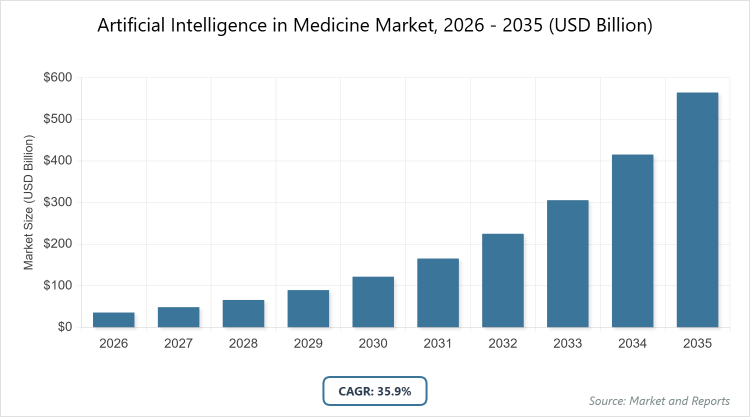
According to MarketnReports, the global Artificial Intelligence in Medicine Market size was estimated at USD 35.71 billion in 2025 and is expected to reach USD 765.12 billion by 2035, growing at a CAGR of 35.9% from 2026 to 2035. Artificial Intelligence in Medicine Market is driven by advancements in machine learning and big data analytics.What are the Key Insights of the Artificial Intelligence in Medicine Market?
- The global artificial intelligence in medicine market was valued at USD 35.71 billion in 2025 and is projected to reach USD 765.12 billion by 2035.
- The market is anticipated to grow at a CAGR of 35.9% during the forecast period from 2026 to 2035.
- The market is driven by increasing adoption of AI for diagnostics, rising healthcare data volumes, and advancements in precision medicine.
- In component, software dominates with a 60% share due to its role in developing algorithms and platforms that enable scalable AI applications across healthcare systems.
- In application, diagnostics dominates with a 40% share because of AI's ability to analyze medical images and data for accurate disease detection, reducing errors and speeding up processes.
- In end-user, hospitals dominate with a 50% share owing to their need for efficient patient management and integration of AI tools in clinical workflows.
- North America dominates the regional market with a 40% share, attributed to advanced technological infrastructure, high R&D investments, and supportive government policies in the United States.
What is the Industry Overview of the Artificial Intelligence in Medicine Market?
The artificial intelligence in medicine market involves the integration of AI technologies such as machine learning, natural language processing, and computer vision into healthcare practices to enhance diagnostics, treatment planning, drug discovery, and patient management. This market focuses on leveraging data-driven algorithms to improve accuracy, efficiency, and personalization in medical services, addressing challenges like rising healthcare costs and aging populations. Market definition encompasses software, hardware, and services that enable predictive analytics, robotic surgery, virtual assistants, and administrative automation, positioning AI as a transformative tool for healthcare providers, researchers, and patients while emphasizing ethical, regulatory, and data privacy considerations.
What are the Market Dynamics of the Artificial Intelligence in Medicine Market?
Growth Drivers
The growth drivers in the artificial intelligence in medicine market are primarily propelled by the explosion of healthcare data from electronic health records, wearables, and imaging devices, enabling AI algorithms to provide actionable insights for personalized treatment and early disease detection. Advancements in machine learning and deep learning technologies have improved diagnostic accuracy, reducing human error and healthcare costs while addressing the global shortage of medical professionals. Rising chronic diseases and an aging population increase demand for efficient, scalable solutions like AI-powered virtual assistants and predictive analytics. Government initiatives and funding for digital health, coupled with collaborations between tech giants and healthcare providers, further accelerate adoption, fostering innovation in areas like drug discovery and telemedicine.
Restraints
Restraints in the artificial intelligence in medicine market include stringent data privacy regulations such as HIPAA and GDPR, which limit data sharing and AI training, increasing compliance costs and slowing development. High initial investment for AI infrastructure and integration with legacy systems poses barriers for smaller healthcare facilities, while the lack of standardized data formats leads to interoperability issues. Ethical concerns over bias in AI algorithms, potential job displacement for healthcare workers, and limited explainability of AI decisions erode trust among practitioners and patients. Moreover, cybersecurity risks associated with handling sensitive medical data further hinder widespread implementation.
Opportunities
Opportunities in the artificial intelligence in medicine market emerge from the integration of AI with emerging technologies like 5G and IoT for real-time remote monitoring and telemedicine, expanding access in underserved regions. The push for precision medicine opens avenues for AI in genomics and personalized drug therapies, while partnerships with pharmaceutical companies can accelerate clinical trials through predictive modeling. Growing investments in AI startups and government grants for healthcare innovation provide funding for R&D in agentic AI systems that automate complex workflows. Additionally, the adoption of generative AI for medical education and simulation training offers new revenue streams, particularly in developing economies with rising healthcare demands.
Challenges
Challenges in the artificial intelligence in medicine market involve addressing algorithmic bias and ensuring fairness across diverse patient populations, requiring robust validation and diverse datasets to avoid disparities in care. Integrating AI into existing clinical workflows demands extensive training for healthcare professionals, while regulatory approval processes for AI medical devices are lengthy and vary by region, delaying market entry. Data scarcity in rare diseases and ethical dilemmas around AI decision-making in life-critical scenarios pose ongoing hurdles. Finally, maintaining patient trust amid concerns over data security and AI transparency necessitates transparent governance and continuous ethical oversight as the technology evolves.
Artificial Intelligence in Medicine Market: Report Scope
| Report Attributes | Report Details |
| Report Name | Artificial Intelligence in Medicine Market |
| Market Size 2025 | USD 35.71 Billion |
| Market Forecast 2035 | USD 765.12 Billion |
| Growth Rate | CAGR of 35.9% |
| Report Pages | 220 |
| Key Companies Covered |
IBM, Google, NVIDIA, Microsoft, Siemens Healthineers, GE Healthcare, and Others. |
| Segments Covered | By Component, By Application, By End-User, and By Region. |
| Regions Covered | North America, Europe, Asia Pacific (APAC), Latin America, and The Middle East and Africa (MEA) |
| Base Year | 2025 |
| Historical Year | 2020 - 2024 |
| Forecast Year | 2026 - 2035 |
| Customization Scope | Avail customized purchase options to meet your exact research needs. |
What is the Market Segmentation of the Artificial Intelligence in Medicine Market?
The Artificial Intelligence in Medicine Market is segmented by type123, application123, end-user123, and region.By Type123 Segment, software emerges as the most dominant subsegment, holding approximately 60% market share, followed by services as the second most dominant with around 25%. Software dominates due to its core role in powering AI algorithms for data analysis and decision support, offering scalability and customization that integrate seamlessly with healthcare systems; this subsegment drives the market by enabling rapid deployment of tools like predictive models, reducing development time and costs while fostering innovation in diagnostics and treatment planning. Services, the second dominant, provide essential implementation, training, and maintenance support, propelling market growth by ensuring effective adoption and optimization in resource-limited settings.
By Application123 Segment, diagnostics stands out as the most dominant subsegment with a 40% share, while drug discovery follows as the second most dominant at about 20%. Diagnostics' dominance stems from AI's precision in analyzing medical images and patient data for early detection, minimizing errors and improving outcomes; this helps drive the market by addressing rising disease burdens through efficient tools that enhance radiologist productivity and support telemedicine. Drug discovery, as the second dominant, accelerates pharmaceutical R&D by simulating trials and identifying candidates, advancing the market through cost savings and faster time-to-market for new therapies.
By End-User123 Segment, hospitals is the most dominant subsegment, capturing 50% of the market, with pharmaceutical companies as the second most dominant at 20%. Hospitals lead due to their frontline role in patient care, utilizing AI for workflow optimization and real-time decision-making; this dominance drives the market by improving efficiency in high-volume environments, reducing wait times, and integrating with electronic health records. Pharmaceutical companies, the second dominant, leverage AI for research and development, supporting market expansion by streamlining drug pipelines and personalized medicine initiatives.
What are the Recent Developments in the Artificial Intelligence in Medicine Market?
- In December 2025, Mass General Brigham announced predictions for AI in medicine, highlighting a shift to agentic systems that orchestrate complex clinical workflows, aiming to enhance efficiency in patient care.
- In December 2025, Wolters Kluwer released insights on 2026 healthcare AI trends, emphasizing rapid adoption of generative AI and evolving governance frameworks to support clinical decision-making.
- In January 2026, Healthcare Dive reported on top AI trends, noting intensified competition from electronic health record providers and evolving use in health systems for fragmented data management.
What is the Regional Analysis of the Artificial Intelligence in Medicine Market?
North America to dominate the global market.North America leads the artificial intelligence in medicine market with a 40% share, driven by cutting-edge research institutions and substantial venture capital in AI health startups. The United States dominates the region, contributing the majority through tech hubs like Silicon Valley and policies from the FDA accelerating AI approvals; this dominance is bolstered by collaborations between companies like Google and hospitals, fostering innovations in diagnostics and precision medicine that set global standards. Canada supports through government-funded AI initiatives in genomics, enhancing regional growth.
Europe exhibits strong growth in the artificial intelligence in medicine market, supported by EU funding for digital health and strict data protection under GDPR. Germany stands out as the dominating country, with Siemens Healthineers leading in AI imaging tools; this leadership stems from robust pharmaceutical R&D and public-private partnerships, driving expansion in drug discovery and telemedicine. The UK and France contribute through national AI strategies focusing on ethical implementations.
Asia Pacific is rapidly emerging in the artificial intelligence in medicine market, fueled by large patient datasets and government investments in health tech. China dominates the region, with massive AI adoption in hospitals via companies like Tencent; this supremacy arises from national plans like Healthy China 2030, boosting diagnostics and remote care. Japan and India follow with advancements in robotics and affordable AI solutions.
Latin America shows promising potential in the artificial intelligence in medicine market, benefiting from telemedicine growth amid healthcare access challenges. Brazil dominates, leveraging public health systems for AI in disease surveillance; this position is strengthened by partnerships with global firms, driving development in administrative automation. Mexico supports through cross-border collaborations with the US.
The Middle East and Africa region is gradually advancing in the artificial intelligence in medicine market, focused on addressing resource gaps. The UAE emerges as the dominating country, with investments in AI hubs like Dubai Health; this leadership is driven by vision 2031 plans, promoting precision medicine and virtual care. South Africa contributes through AI in epidemic management.
Who are the Key Market Players and Strategies in the Artificial Intelligence in Medicine Market?
IBM employs a strategy of leveraging Watson Health for AI-driven diagnostics and partnerships with hospitals to integrate cognitive computing in oncology and genomics.
Google focuses on DeepMind's AI for protein folding and collaborations with healthcare providers to advance predictive analytics in patient care.
NVIDIA pursues hardware optimization for AI training, offering GPUs and platforms like Clara for medical imaging and drug discovery acceleration.
Microsoft adopts cloud-based solutions via Azure AI, emphasizing secure data handling and tools for virtual health assistants in telemedicine.
Siemens Healthineers prioritizes AI in radiology, developing algorithms for MRI and CT scans to enhance diagnostic accuracy and workflow efficiency.
GE Healthcare strategies include integrating AI in ultrasound and monitoring devices, focusing on real-time analytics for critical care settings.
What are the Market Trends in the Artificial Intelligence in Medicine Market?
- Shift towards agentic AI systems for orchestrating complex clinical workflows.
- Rapid adoption of generative AI for medical education and simulation training.
- Increased focus on ethical AI governance and bias mitigation in diagnostics.
- Growth in AI-powered telemedicine and remote patient monitoring.
- Integration of AI with IoT for real-time health data analysis.
- Rise in AI applications for drug repurposing and personalized therapies.
- Expansion of computer vision in medical imaging for faster detections.
- Emphasis on sustainable AI practices amid environmental concerns.
What Market Segments and their Subsegments are Covered in the Report for the Artificial Intelligence in Medicine Market?
By Component- Software
- Hardware
- Services
- Machine Learning
- Natural Language Processing
- Computer Vision
- Deep Learning
- Robotics
- Data Analytics
- Cloud
- Others
- Diagnostics
- Drug Discovery
- Precision Medicine
- Medical Imaging
- Robot-Assisted Surgery
- Virtual Assistants
- Administrative Workflow Assistance
- Fraud Detection
- Clinical Trials
- Personalized Medicine
- Others
- Hospitals
- Pharmaceutical Companies
- Research Institutes
- Diagnostic Centers
- Clinics
- Insurance Companies
- Government Organizations
- Academic Institutions
- Biotechnology Companies
- Patients
- Others
By Region
- North America
- U.S.
- Canada
- Europe
- UK
- Germany
- France
- Rest of Europe
- Asia Pacific
- China
- India
- Japan
- Rest of Asia Pacific
- Latin America
- Brazil
- Mexico
- Rest of Latin America
- Middle East & Africa
- UAE
- South Africa
- Rest of Middle East & Africa
Frequently Asked Questions
The artificial intelligence in medicine market integrates AI technologies to enhance healthcare through diagnostics, treatment, and management.
Key factors include data proliferation, technological advancements, regulatory support, and demand for personalized care.
The market is projected to grow from post-2025 values USD 35.71 billion in 2025 and is projected to reach USD 765.12 billion by 2035.
The CAGR is expected to be 35.9% during 2026-2035.
North America will contribute notably, driven by innovation and investments.
Major players include IBM, Google, NVIDIA, Microsoft, Siemens Healthineers, and GE Healthcare.
The report provides in-depth analysis of size, trends, segments, regions, players, and forecasts.
Stages include data collection, AI development, integration, deployment, and maintenance.
Trends favor agentic AI and generative tools, with preferences for personalized and ethical solutions.
Regulations on data privacy and AI ethics promote growth, while sustainability focuses on energy-efficient computing.