
Anti-counterfeit Packaging Market Size, Share and Trends 2026 to 2035
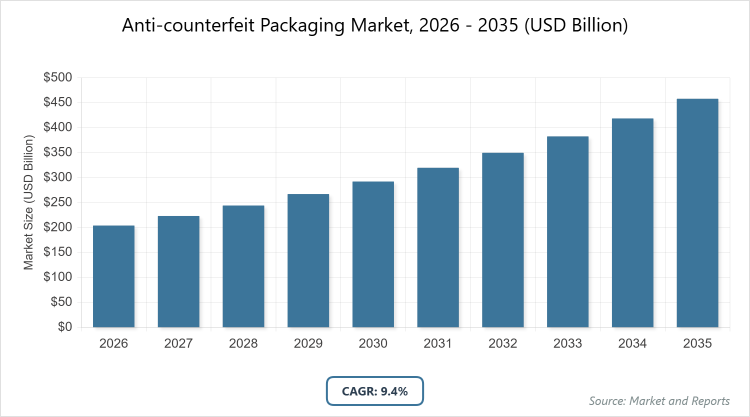
According to MarketnReports, the global Anti-counterfeit Packaging Market size was estimated at USD 204 billion in 2025 and is expected to reach USD 500 billion by 2035, growing at a CAGR of 9.4% from 2026 to 2035. Anti-counterfeit Packaging Market is driven by rising incidents of counterfeiting and stringent regulatory requirements for product authentication.
What are the Key Insights into the Anti-counterfeit Packaging Market?
- The global anti-counterfeit packaging market size was valued at USD 204 billion in 2025 and is projected to reach USD 500 billion by 2035.
- The market is expected to grow at a CAGR of 9.4% during the forecast period from 2026 to 2035.
- The market is driven by escalating counterfeiting activities, strict government regulations on product traceability, and growing demand for brand integrity in pharmaceuticals and consumer goods.
- In the technology segment, track & trace dominates with a 35% share due to its capability for real-time monitoring and compliance with serialization standards.
- In the application segment, pharmaceuticals dominate with a 40% share owing to the severe health risks posed by fake medicines and mandatory authentication protocols.
- In the end-use segment, bottles & jars dominate with a 29% share because of their prevalent use in high-risk industries requiring robust tamper-evident mechanisms.
- North America dominates the regional market with a 35% share, driven by advanced regulatory environments, technological innovation, and high counterfeiting awareness.
What is the Industry Overview of the Anti-counterfeit Packaging Market?
The anti-counterfeit packaging market involves the creation and deployment of specialized packaging solutions aimed at preventing the duplication and unauthorized distribution of goods, thereby safeguarding product authenticity, consumer safety, and brand value. This market spans multiple technologies that integrate security elements to deter counterfeiting, a pervasive problem impacting sectors like healthcare, consumer electronics, and luxury items. Market definition pertains to the array of packaging innovations employing visible, hidden, analytical, or digital tracking methods to confirm product legitimacy, facilitating consumer protection against substandard replicas and supporting efficient supply chain oversight.
What are the Market Dynamics in the Anti-counterfeit Packaging Market?
Growth Drivers
The anti-counterfeit packaging market's growth is propelled by the surge in counterfeit products globally, which undermines consumer trust and causes substantial economic losses, prompting industries to adopt sophisticated packaging technologies. Regulatory bodies are enforcing rigorous standards, such as serialization in pharmaceuticals, to ensure traceability and authenticity, thereby boosting demand for solutions like RFID and blockchain. The proliferation of online retail has heightened vulnerability to fakes, encouraging investments in digital verification tools that integrate seamlessly with e-commerce platforms. Technological progress in AI-driven detection and sustainable materials also contributes, allowing for cost-effective and environmentally compliant anti-counterfeit measures that appeal to eco-conscious brands.
Restraints
High implementation costs for advanced anti-counterfeit technologies, including RFID systems and forensic markers, act as a major restraint, particularly for SMEs in developing regions where budget constraints limit adoption. Integration challenges with legacy supply chain infrastructures can lead to operational disruptions and require extensive staff training, further escalating expenses. Inconsistent international standards create compliance difficulties for multinational companies, potentially delaying market entry and increasing legal risks. Additionally, the rapid evolution of counterfeiting techniques demands continuous updates to security features, straining R&D budgets and possibly deterring smaller players from competing effectively.
Opportunities
Emerging markets in Asia Pacific and Latin America present significant opportunities due to rapid urbanization, expanding middle-class populations, and increasing e-commerce penetration, which amplify the need for reliable anti-counterfeit solutions. Innovations in smart packaging, such as NFC and QR codes, enable direct consumer interaction for authenticity checks, opening avenues for enhanced marketing and data collection. The emphasis on sustainability offers prospects for developing biodegradable security features that meet green regulations and consumer demands. Partnerships between tech firms and packaging manufacturers can foster tailored solutions for underserved sectors like agriculture, driving expansion through customized, scalable anti-counterfeit strategies.
Challenges
The anti-counterfeit packaging market faces challenges from increasingly sophisticated counterfeiters who replicate advanced security features, requiring perpetual innovation and investment to maintain efficacy. Low awareness in certain regions about verification methods can reduce the effectiveness of deployed technologies, as consumers and businesses may not utilize them properly. Infrastructure limitations in emerging economies hinder the deployment of digital tracking systems, affecting global supply chain uniformity. Balancing enhanced security with user-friendly and cost-effective packaging designs remains difficult, as overly complex features may impact production speeds and increase waste, conflicting with efficiency and sustainability goals.
Anti-counterfeit Packaging Market: Report Scope
| Report Attributes | Report Details |
| Report Name | Anti-counterfeit Packaging Market |
| Market Size 2025 | USD 204 Billion |
| Market Forecast 2035 | USD 500 Billion |
| Growth Rate | CAGR of 9.4% |
| Report Pages | 220 |
| Key Companies Covered |
Avery Dennison Corporation, 3M Company, CCL Industries Inc., Zebra Technologies Corp., SICPA HOLDING SA, and Others |
| Segments Covered | By Technology, By Application, By End-Use, and By Region |
| Regions Covered | North America, Europe, Asia Pacific (APAC), Latin America, and The Middle East and Africa (MEA) |
| Base Year | 2025 |
| Historical Year | 2020 - 2024 |
| Forecast Year | 2026 - 2035 |
| Customization Scope | Avail customized purchase options to meet your exact research needs. |
How is the Market Segmentation Structured in the Anti-counterfeit Packaging Market?
The Anti-counterfeit Packaging Market is segmented by technology, application, end-use, and region.
By Technology Segment, the market is divided into various categories where track & trace emerges as the most dominant subsegment, followed by holograms as the second most dominant. Track & trace's dominance stems from its superior traceability and integration with global supply chains, enabling precise monitoring that combats counterfeiting effectively; this drives the market by ensuring regulatory compliance and reducing financial losses in critical industries like pharmaceuticals. Holograms, the second dominant, provide affordable visual deterrence that's hard to duplicate, propelling market growth through widespread adoption in consumer goods for immediate authenticity verification and brand enhancement.
By on Application Segment, pharmaceuticals stand out as the most dominant subsegment, with food & beverage as the second most dominant. Pharmaceuticals dominate because of the dire consequences of counterfeit drugs on public health and the enforcement of strict traceability laws; this segment drives the market by prioritizing patient safety and fostering demand for advanced packaging innovations. Food & beverage, the second dominant, addresses tampering risks and quality assurance needs, contributing to overall market expansion by aligning with food safety regulations and consumer trust-building initiatives.
By End-Use Segment, bottles & jars are the most dominant subsegment, while labels rank as the second most dominant. Bottles & jars dominate due to their essential role in packaging liquids in pharmaceuticals and beverages, where tamper-evident features are vital; this drives the market by providing secure containment that prevents adulteration and supports industry-wide anti-counterfeit efforts. Labels, as second dominant, offer versatile application across products for security inks and holograms, aiding market growth through easy integration and cost-effective authentication in diverse sectors.
What are the Recent Developments in the Anti-counterfeit Packaging Market?
- In April 2024, Avery Dennison expanded its AD Pure range with fully plastic-free RFID inlays and tags using paper-based antenna technology, promoting sustainability in anti-counterfeit solutions.
- In January 2024, Avery Dennison launched the AD 2Metal Rock M781 RFID tag, designed for challenging surfaces like metals and liquids, enhancing durability in supply chain tracking.
- In February 2025, Crane NXT acquired OpSec Security to integrate authentication platforms, strengthening brand protection capabilities.
- In February 2025, 3M joined the US-JOINT semiconductor consortium to advance materials for AI-driven anti-counterfeit applications.
- In September 2024, Berry Global introduced the Pical Pouring Closure, a tamper-evident solution for food products like oils and sauces.
What is the Regional Analysis of the Anti-counterfeit Packaging Market?
North America to dominate the global market.
North America maintains leadership in the anti-counterfeit packaging market, supported by comprehensive regulations like the Drug Supply Chain Security Act and a strong focus on innovation in sectors such as pharmaceuticals and electronics. The United States dominates the region, thanks to its extensive R&D ecosystem, presence of key players like Avery Dennison and 3M, and high adoption of technologies like RFID, which drive growth through improved traceability and counterfeiting prevention.
Europe exhibits strong growth in the anti-counterfeit packaging market, influenced by directives like the Falsified Medicines Directive emphasizing serialization. Germany leads as the dominating country, leveraging its robust manufacturing in automotive and healthcare, where firms like Schreiner Group deploy advanced holographic and tamper-evident solutions, contributing to regional advancement via quality control and anti-tampering emphasis.
Asia Pacific emerges as the fastest-growing region for anti-counterfeit packaging, driven by industrial expansion, e-commerce boom, and rising counterfeiting threats. China dominates, fueled by large-scale production in electronics and consumer goods, alongside government pushes for serialization, accelerating the uptake of QR codes and RFID to ensure compliance and safety in exports and local markets.
Latin America is gaining traction in the anti-counterfeit packaging market, aided by trade agreements and increasing regulatory focus. Brazil stands out as the dominating country, propelled by pharmaceutical and food sector mandates against fakes, utilizing tamper-evident packaging and track-and-trace to bolster consumer protection and market integrity amid economic growth.
The Middle East and Africa region is developing in the anti-counterfeit packaging market, with potential from regulatory enhancements and luxury goods trade. Saudi Arabia dominates, supported by SFDA initiatives for pharmaceutical traceability and investments in high-value product security, employing forensic and holographic technologies to tackle counterfeiting issues effectively.
Who are the Key Market Players in the Anti-counterfeit Packaging Market?
Avery Dennison Corporation emphasizes RFID and sustainable labeling solutions, with strategies including acquisitions like Silver Crystal Group and R&D in plastic-free tags to expand in pharmaceuticals and apparel for superior traceability.
3M Company offers holographic films and verification apps, focusing on partnerships like US-JOINT and innovations in AI materials to enhance security in electronics and healthcare sectors.
CCL Industries Inc. provides security labels with microtext and inks, pursuing growth via diversification and compliance-oriented developments for food & beverage and personal care applications.
Zebra Technologies Corp. specializes in barcode and RFID systems, employing acquisitions and real-time tracking advancements to optimize automotive and luxury goods supply chains.
SICPA HOLDING SA delivers secure inks and integrated platforms, leveraging collaborations for quantum dot tech and forensic solutions in high-security pharmaceutical and luxury markets.
What are the Market Trends Shaping the Anti-counterfeit Packaging Market?
- Integration of AI and machine learning for predictive counterfeiting detection and automated supply chain monitoring.
- Shift towards sustainable anti-counterfeit materials, including recyclable holograms and eco-friendly RFID tags.
- Increased adoption of blockchain for transparent, end-to-end product provenance in pharmaceuticals and luxury goods.
- Rise in digital watermarking and NFC technologies for consumer-enabled authenticity verification via mobile devices.
- Expansion of IoT-enabled smart packaging combining security with real-time data analytics for enhanced engagement.
What Market Segments and Their Subsegments are Covered in the Anti-counterfeit Packaging Market Report?
By Technology- Holograms
- RFID
- Mass Encoding
- Forensic Markers
- Tamper Evidence
- Security Labels
- Invisible Printing
- Color-Shifting Inks
- QR Codes
- Barcodes
- Others
- Pharmaceutical
- Food & Beverage
- Apparel & Footwear
- Automotive
- Personal Care
- Electrical & Electronics
- Luxury Goods
- Tobacco
- Agriculture
- Medical Devices
- Others
- Bottles & Jars
- Vials & Ampoules
- Blisters
- Trays
- Pouches & Sachets
- Tubes
- Syringes
- Cartons
- Labels
- Films
- Others
By Region
- North America
- U.S.
- Canada
- Europe
- UK
- Germany
- France
- Rest of Europe
- Asia Pacific
- China
- India
- Japan
- Rest of Asia Pacific
- Latin America
- Brazil
- Mexico
- Rest of Latin America
- Middle East & Africa
- UAE
- South Africa
- Rest of Middle East & Africa
Frequently Asked Questions
The anti-counterfeit packaging market comprises technologies and packaging methods designed to prevent product duplication, incorporating features like track & trace and holograms to ensure authenticity across industries.
Key factors encompass rising counterfeiting threats, regulatory mandates for traceability, technological advancements in digital solutions, e-commerce expansion, and demand for sustainable packaging.
The market is anticipated to grow from around USD 204 billion in 2026 to USD 500 billion by 2035.
The CAGR is projected at 9.4% during 2026-2035.
North America will contribute notably, capturing approximately 35% of the market value through strong regulations and innovation.
Major players include Avery Dennison Corporation, 3M Company, CCL Industries Inc., Zebra Technologies Corp., and SICPA HOLDING SA.
The report offers in-depth analysis of market size, segmentation, trends, regional outlooks, key players, and forecasts from 2026 to 2035.
Stages involve raw material procurement, technology R&D, packaging production, supply chain integration, distribution, and consumer verification.
Trends are evolving towards digital and sustainable solutions, with consumers favoring app-based verification and eco-friendly materials for authenticity assurance.
Stringent regulations like serialization laws and environmental pushes for recyclable materials are key drivers influencing growth and innovation.