
Animal Healthcare Market Size, Share and Trends 2026 to 2035
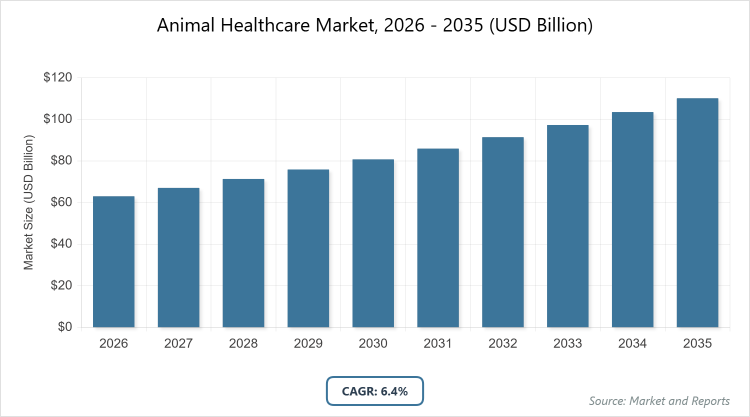
According to MarketnReports, the global Animal Healthcare Market size was estimated at USD 63.03 Billion in 2025 and is expected to reach USD 117.21 Billion by 2035, growing at a CAGR of 6.4% from 2026 to 2035. Animal Healthcare Market is driven by increasing prevalence of zoonotic diseases and rising global pet ownership.
What is the Animal Healthcare Market?
The animal healthcare market encompasses the provision of medical products, services, and technologies aimed at preventing, diagnosing, and treating diseases in both companion and production animals to ensure their overall well-being and productivity.
The market includes a wide array of pharmaceuticals, vaccines, diagnostics, and feed additives designed to address health issues in livestock and pets, driven by the need for food security, animal welfare, and zoonotic disease control.
What are the Key Insights for the Animal Healthcare Market?
- The global animal healthcare market size was estimated at USD 63.03 Billion in 2025 and is expected to reach USD 117.21 Billion by 2035.
- The market is projected to grow at a CAGR of 6.4% during the forecast period from 2026 to 2035.
- The market is driven by increasing prevalence of zoonotic diseases, rising pet ownership, and growing demand for animal-derived protein products.
- The pharmaceuticals subsegment dominates the product type segment with a 44% share due to its widespread use in treating a variety of infections, inflammations, and chronic conditions in animals, offering immediate therapeutic benefits and supporting large-scale livestock operations.
- The production animals subsegment dominates the animal type segment with a 64% share owing to the high global demand for meat, dairy, and other animal products, necessitating robust health management to ensure productivity and food safety.
- The veterinary hospitals and clinics subsegment dominates the end-user segment with a 80% share because they serve as primary points for comprehensive animal care, including surgeries, diagnostics, and emergency treatments, supported by advanced infrastructure.
- North America dominates the regional market with a 35% share attributed to its advanced veterinary infrastructure, high pet adoption rates, and significant investments in animal health research and development.
What are the Market Dynamics in the Animal Healthcare Market?
Growth Drivers
The surge in pet humanization and ownership worldwide has significantly boosted the animal healthcare market, as owners increasingly treat pets as family members, leading to higher spending on preventive care, vaccines, and treatments. This trend is particularly evident in urban areas where companion animals provide emotional support, driving demand for premium healthcare products and services. Additionally, advancements in veterinary medicine, such as biologics and personalized treatments, enhance efficacy and attract more investment into the sector.
Rising global demand for animal-derived proteins, including meat, milk, and eggs, propels the need for effective healthcare solutions in livestock to maintain productivity and prevent disease outbreaks. Governments and organizations are implementing stringent food safety regulations, encouraging farmers to adopt vaccines and feed additives. Technological innovations in diagnostics and monitoring tools further support efficient herd management, reducing economic losses from diseases.
The increasing prevalence of zoonotic diseases, which can transmit from animals to humans, underscores the importance of animal healthcare in public health. Initiatives by global health bodies to control outbreaks like avian flu and rabies have led to widespread vaccination programs. This not only protects animal populations but also mitigates human health risks, fostering collaborations between veterinary and human medicine sectors.
Restraints
Stringent regulatory approvals for animal health products pose a significant barrier, as they require extensive clinical trials and compliance with varying international standards, delaying market entry and increasing development costs. This can deter smaller companies from innovating, limiting the availability of new treatments and potentially stifling market growth in emerging regions with less streamlined regulatory processes.
High costs associated with advanced veterinary treatments and products restrict accessibility, particularly in developing countries where farmers and pet owners have limited disposable income. This leads to underutilization of preventive care and reliance on traditional methods, exacerbating disease spread and reducing overall market penetration in price-sensitive markets.
The rise of antibiotic resistance due to overuse in livestock farming presents a challenge, prompting bans and restrictions on certain drugs. This necessitates the development of alternative therapies, which can be time-consuming and expensive, impacting the profitability of established products and requiring industry-wide shifts in practices.
Opportunities
Expansion into emerging markets in Asia-Pacific and Latin America offers substantial growth potential, driven by rising incomes, urbanization, and increasing livestock production. Investments in local manufacturing and distribution networks can tap into underserved areas, while partnerships with governments for disease control programs enhance market presence.
Advancements in digital health technologies, such as telemedicine and wearable devices for animals, open new avenues for remote monitoring and early disease detection. These innovations improve efficiency in veterinary practices and appeal to tech-savvy pet owners, creating opportunities for data-driven insights and personalized care solutions.
The growing focus on sustainable and organic animal health products aligns with consumer preferences for eco-friendly options, encouraging the development of natural feed additives and biologics. This trend can differentiate companies in competitive markets and attract premium pricing, supported by regulatory incentives for green practices.
Challenges
Supply chain disruptions, exacerbated by global events like pandemics or trade conflicts, affect the availability of raw materials and finished products, leading to shortages and price volatility. This challenges consistent supply to remote or international markets, impacting farmer productivity and market trust.
Counterfeit animal health products undermine market integrity, posing risks to animal health and eroding consumer confidence. In regions with weak enforcement, fake drugs lead to treatment failures and resistance issues, requiring enhanced authentication technologies and regulatory vigilance.
A shortage of skilled veterinary professionals in rural and developing areas limits the delivery of quality care, hindering the adoption of advanced treatments. This gap necessitates investment in education and training programs to build capacity and ensure effective implementation of health strategies.
Animal Healthcare Market: Report Scope
| Report Attributes | Report Details |
| Report Name | Animal Healthcare Market |
| Market Size 2025 | USD 63.03 Billion |
| Market Forecast 2035 | USD 117.21 Billion |
| Growth Rate | CAGR of 6.4% |
| Report Pages | 220 |
| Key Companies Covered |
Zoetis, Merck Animal Health, Boehringer Ingelheim, Elanco, Virbac, Ceva Santé Animale, Vetoquinol, Dechra Pharmaceuticals, IDEXX Laboratories, Phibro Animal Health, and Others |
| Segments Covered | By Product Type, By Animal Type, By End-User, and By Region |
| Regions Covered | North America, Europe, Asia Pacific (APAC), Latin America, and The Middle East and Africa (MEA) |
| Base Year | 2025 |
| Historical Year | 2020 – 2024 |
| Forecast Year | 2026 – 2035 |
| Customization Scope | Avail customized purchase options to meet your exact research needs. |
What is the Market Segmentation of the Animal Healthcare Market?
The Animal Healthcare Market is segmented by product type, animal type, end-user, and region. All the segments have been analyzed based on present and future trends and the market is estimated from 2026 to 2035.
Based on Product Type Segment, the pharmaceuticals subsegment is the most dominant, followed by vaccines as the second most dominant. Pharmaceuticals dominate due to their essential role in treating acute and chronic conditions across various animal species, driving market growth through high demand for anti-infectives and parasiticides that ensure rapid recovery and prevent economic losses in livestock farming.
Based on Animal Type Segment, the production animals subsegment is the most dominant, followed by companion animals as the second most dominant. Production animals lead because of the global reliance on livestock for food production, where health management directly impacts yield and quality, propelling the market through large-scale vaccination and nutrition programs that enhance productivity and meet rising protein demands.
Based on End-User Segment, the veterinary hospitals and clinics subsegment is the most dominant, followed by reference laboratories as the second most dominant. Veterinary hospitals and clinics are primary due to their comprehensive service offerings, including diagnostics and surgeries, which drive market expansion by providing accessible, specialized care that improves animal outcomes and encourages preventive health practices among owners.
What are the Recent Developments in the Animal Healthcare Market?
- In November 2025, Zoetis Inc. expanded its animal vaccine production facility in America to meet growing demand for livestock immunization and companion animal health solutions, enhancing capacity for innovative biologics.
- In May 2025, OS Therapies announced the launch of a wholly owned subsidiary, OS Animal Health, Inc., focused on developing treatments for canine osteosarcoma, advancing personalized therapies in veterinary oncology.
- In April 2025, a collaboration between epiq Animal Health and Interpath Global was announced to distribute advanced veterinary pharmaceuticals, improving access to high-quality products in emerging markets.
- In March 2025, Privo Technologies launched BeneVet Oncology, a subsidiary aimed at improving companion animal health through targeted cancer treatments, leveraging nanotechnology for better efficacy.
What is the Regional Analysis of the Animal Healthcare Market?
North America to dominate the global market.
North America holds the largest share in the animal healthcare market, driven by advanced veterinary infrastructure and high pet ownership rates. The United States dominates within the region, with significant investments in research and a strong focus on zoonotic disease prevention, supported by organizations like the USDA.
Europe follows closely, with robust regulations promoting animal welfare and sustainable farming. Germany leads the region, benefiting from innovative pharmaceutical developments and a high concentration of key players, emphasizing preventive care in livestock.
Asia-Pacific is the fastest-growing region, fueled by expanding livestock production and rising disposable incomes. China dominates here, with government initiatives enhancing food security through vaccination programs and modernizing veterinary services.
Latin America shows steady growth, driven by agricultural exports and increasing pet adoption. Brazil is the leading country, focusing on disease control in cattle herds to support its meat industry.
The Middle East and Africa present emerging opportunities, with investments in veterinary infrastructure. South Africa leads, addressing wildlife and livestock health amid challenges like disease outbreaks.
Who are the Key Market Players in the Animal Healthcare Market?
Zoetis focuses on innovation through R&D investments in vaccines and diagnostics, expanding its portfolio via acquisitions like that of diagnostic firms to enhance companion animal care and strengthen its global market position.
Merck Animal Health emphasizes sustainable solutions, developing antibiotic alternatives and partnering with tech companies for digital health tools, aiming to reduce resistance and improve livestock productivity worldwide.
Boehringer Ingelheim prioritizes biologics and preventive care, launching new vaccines for emerging diseases and collaborating with academic institutions to advance research in pet and livestock health.
Elanco adopts a strategy of diversification, acquiring nutrition brands and investing in e-commerce platforms to reach more customers, focusing on emerging markets for growth in feed additives.
Virbac concentrates on dermatology and parasitology products, expanding through regional partnerships and emphasizing eco-friendly formulations to meet regulatory demands and consumer preferences.
Ceva Santé Animale invests in poultry and swine health solutions, developing autogenous vaccines and forming alliances with farmers’ associations to tailor products for specific regional needs.
Vetoquinol pursues growth via targeted acquisitions in companion animal segments, enhancing its pharmaceutical offerings with innovative delivery systems for better compliance.
Dechra Pharmaceuticals specializes in endocrinology and cardiology for pets, expanding its specialist product line through vet clinic partnerships and educational programs.
IDEXX Laboratories leads in diagnostics, integrating AI into testing platforms and expanding lab networks globally to provide faster, more accurate results.
Phibro Animal Health focuses on nutritional health products, developing medicated feed additives and collaborating with feed manufacturers to optimize animal performance.
What are the Market Trends in the Animal Healthcare Market?
- Increasing adoption of AI and telemedicine for remote diagnostics and monitoring in veterinary practices.
- Growing demand for biologics and gene therapies as alternatives to traditional antibiotics.
- Rise in sustainable and organic animal health products aligning with eco-conscious consumer preferences.
- Expansion of pet insurance coverage encouraging higher spending on preventive care.
- Enhanced focus on zoonotic disease surveillance through global health initiatives.
- Integration of wearable devices for real-time animal health tracking in livestock.
- Shift towards personalized medicine tailored to specific animal breeds and conditions.
- Increased investments in emerging markets for localized production and distribution.
- Development of multi-valent vaccines to address multiple diseases efficiently.
- Emphasis on mental health solutions for companion animals amid humanization trends.
What are the Market Segments and their Subsegments Covered in the Animal Healthcare Market Report?
- By Product Type
- Parasiticides
- Anti-infectives
- Anti-inflammatories
- Analgesics
- Sedatives
- Vaccines
- Feed Additives
- Diagnostics Instruments
- Diagnostics Consumables
- Medical Devices
- Others
- By Animal Type
- Dogs
- Cats
- Horses
- Poultry
- Swine
- Cattle
- Sheep
- Goats
- Fish
- Equine
- Others
- By End-User
-
- Veterinary Hospitals
- Veterinary Clinics
- Farms
- Reference Laboratories
- In-house Testing
- Retail Pharmacies
- E-commerce
- Animal Care Centers
- Diagnostic Centers
- Rehabilitation Centers
- Others
By Region
-
- North America
- U.S.
- Canada
- Europe
- UK
- Germany
- France
- Rest of Europe
- Asia Pacific
- China
- India
- Japan
- Rest of Asia Pacific
- Latin America
- Brazil
- Mexico
- Rest of Latin America
- Middle East & Africa
- UAE
- South Africa
- Rest of Middle East & Africa
- North America
-
Chapter 1. Preface
Chapter 2. Executive Summary
Chapter 3. Global Animal Healthcare Market - Industry Analysis
Chapter 4. Global Animal Healthcare Market- Competitive Landscape
Chapter 5. Global Animal Healthcare Market - Product Type Analysis
Chapter 6. Global Animal Healthcare Market - Animal Type Analysis
Chapter 7. Animal Healthcare Market - Regional Analysis
Chapter 8. Company Profiles
Frequently Asked Questions
The animal healthcare market involves the development, production, and distribution of products and services aimed at maintaining and improving the health of animals, including pharmaceuticals, vaccines, diagnostics, and feed additives for both companion and production animals.
Key factors include rising pet ownership, increasing demand for animal protein, prevalence of zoonotic diseases, technological advancements in veterinary medicine, and expanding investments in emerging markets.
The market value is estimated at USD 63.03 Billion in 2025 and is projected to reach USD 117.21 Billion by 2035.
The market is expected to grow at a CAGR of 6.4% from 2026 to 2035.
North America will contribute notably, holding a 35% share due to its advanced infrastructure and high focus on animal welfare.
Major players include Zoetis, Merck Animal Health, Boehringer Ingelheim, Elanco, and Virbac, driving growth through innovation and strategic expansions.
The report provides detailed analysis of market size, trends, segments, regional insights, key players, and forecasts from 2026 to 2035.
The value chain includes research and development, manufacturing, distribution, veterinary services, and end-user application in animal care.
Trends are shifting towards sustainable products, digital health solutions, and personalized care, with consumers preferring eco-friendly and tech-integrated options for pet humanization.
Regulations on antibiotic use, environmental concerns over waste, and sustainability mandates are pushing innovations in biologics and green practices, impacting growth positively through compliance-driven advancements.