
Allergy Diagnostics Market Size, Share and Trends 2026 to 2035
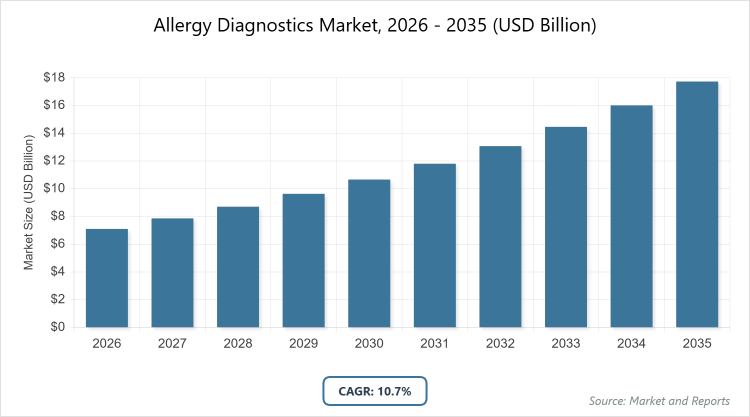
According to MarketnReports, the global Allergy Diagnostics Market size was estimated at USD 7.1 billion in 2025 and is expected to reach USD 19.5 billion by 2035, growing at a CAGR of 10.7% from 2026 to 2035. Allergy Diagnostics Market is driven by rising prevalence of allergic diseases worldwide.What are the Key Insights of the Allergy Diagnostics Market?
- Market value estimated at USD 7.1 billion in 2025, projected to reach USD 19.5 billion by 2035.
- Compound annual growth rate (CAGR) of 10.7% during the forecast period from 2026 to 2035.
- Market is driven by increasing incidence of allergies due to environmental factors and urbanization.
- Consumables dominates the products and services segment with 60% share due to recurring demand for reagents and test kits in routine diagnostics.
- In Vivo Tests dominates the test type segment with 55% share as they offer quick, cost-effective results through skin prick methods.
- Inhaled Allergens dominates the allergen segment with 54% share owing to high prevalence of respiratory allergies like asthma and rhinitis.
- North America dominates with 40% market share because of advanced healthcare infrastructure, high awareness, and strong R&D investments.
What is the Allergy Diagnostics Market Industry Overview?
The Allergy Diagnostics Market encompasses tools, kits, and services used to identify and confirm allergic sensitivities through methods like skin tests, blood assays, and challenge tests, aiding in the diagnosis of conditions such as asthma, rhinitis, eczema, and food allergies by detecting specific IgE antibodies or reactions to allergens. This market includes consumables like reagents and instruments such as immunoassay analyzers, focused on providing accurate, timely results to guide treatment and management. Market definition refers to the ecosystem of diagnostic solutions for allergy detection, emphasizing precision, safety, and accessibility, driven by advancements in molecular techniques and point-of-care devices that enhance patient outcomes while addressing the growing burden of allergic disorders in diverse populations.
What are the Market Dynamics of the Allergy Diagnostics Market?
Growth Drivers
The growth drivers of the Allergy Diagnostics Market are primarily propelled by the escalating global prevalence of allergic disorders, influenced by environmental pollution, dietary changes, and urbanization, which heighten the need for accurate diagnostic tools to manage conditions like food allergies and atopic dermatitis effectively. Technological advancements, such as multiplex assays and AI-integrated platforms, enhance test sensitivity and specificity, enabling faster, more reliable results that support personalized medicine and early intervention. Additionally, increasing healthcare expenditure and awareness campaigns by organizations like WHO promote screening, while collaborations between diagnostic firms and research institutions accelerate innovation, expanding access in emerging markets and driving overall market expansion.
Restraints
Restraints in the Allergy Diagnostics Market include the high costs associated with advanced testing kits and instruments, which limit adoption in low-income regions and resource-constrained healthcare settings, exacerbating disparities in allergy management. Regulatory hurdles for approval of new diagnostics, coupled with varying reimbursement policies across countries, delay market entry and increase development expenses. Furthermore, the risk of false positives or negatives in tests, particularly in complex cases, undermines clinician confidence, while limited awareness among patients in developing areas hinders demand, collectively impeding broader market penetration.
Opportunities
Opportunities in the Allergy Diagnostics Market emerge from the rising demand for point-of-care and at-home testing solutions, which offer convenience and rapid results, opening avenues for portable devices integrated with mobile apps for remote monitoring and telemedicine integration. The expansion of molecular diagnostics, like component-resolved testing, allows for precise allergen profiling, benefiting immunotherapy development and attracting investments in biotech. Moreover, untapped potential in Asia Pacific and Latin America, driven by improving healthcare infrastructure and growing middle-class populations, presents growth through localized manufacturing and partnerships, fostering inclusive access to advanced diagnostics.
Challenges
Challenges facing the Allergy Diagnostics Market involve ensuring test accuracy across diverse populations, as genetic variations and environmental factors can affect results, requiring ongoing validation and standardization to avoid misdiagnosis. Data privacy concerns with digital platforms and AI tools necessitate robust cybersecurity measures to comply with regulations like HIPAA. Additionally, supply chain disruptions for reagents and the shortage of skilled allergists in rural areas pose logistical barriers, while competition from alternative therapies like over-the-counter antihistamines reduces the perceived need for diagnostics, demanding education efforts to highlight their value.
Allergy Diagnostics Market: Report Scope
| Report Attributes | Report Details |
| Report Name | Allergy Diagnostics Market |
| Market Size 2025 | USD 7.1 Billion |
| Market Forecast 2035 | USD 19.5 Billion |
| Growth Rate | CAGR of 10.7% |
| Report Pages | 220 |
| Key Companies Covered |
Thermo Fisher Scientific Inc., Siemens Healthineers, Danaher Corporation, bioMérieux, HOB Biotech Group Co, Hycor Biomedical Inc., Stallergenes Greer, R-Biopharm AG, Lincoln Diagnostics Inc., and Others. |
| Segments Covered | By Products and Services, By Test Type, By Allergen, and By Region. |
| Regions Covered | North America, Europe, Asia Pacific (APAC), Latin America, and The Middle East and Africa (MEA) |
| Base Year | 2025 |
| Historical Year | 2020 - 2024 |
| Forecast Year | 2026 - 2035 |
| Customization Scope | Avail customized purchase options to meet your exact research needs. |
What is the Market Segmentation of the Allergy Diagnostics Market?
The Allergy Diagnostics Market is segmented by products and services, test type, allergen, and region.By Products and Services Segment, consumables emerges as the most dominant subsegment, holding approximately 60% share, followed by instruments at 25%. Consumables dominates due to their essential, recurring use in high-volume testing for reagents and kits, driving the market by enabling cost-effective, scalable diagnostics that support widespread screening and contribute to revenue stability through repeat purchases.
By Test Type Segment, in vivo tests leads as the most dominant subsegment with 55% share, while in vitro tests ranks second at 45%. In vivo tests dominates because of their simplicity, immediacy, and low cost in detecting skin reactions, propelling market growth by facilitating quick clinical decisions and broadening access in outpatient settings.
By Allergen Segment, inhaled allergens stands out as the most dominant subsegment, capturing 54% share, with food allergens as the second at 30%. Inhaled allergens dominates owing to the high incidence of respiratory conditions like asthma, fueling market expansion by increasing demand for targeted tests that aid in environmental management and treatment planning.
What are the Recent Developments in the Allergy Diagnostics Market?
- In April 2025, Beckman Coulter Life Sciences launched its next-generation Basophil Activation Test, offering a safer alternative to oral food challenges for allergy research and diagnostics.
- In October 2024, ALK introduced new allergy skin testing devices including AllerTest-1, -8, and -10, designed to improve diagnostic efficiency in clinical settings.
What is the Regional Analysis of the Allergy Diagnostics Market?
North America to dominate the global market.North America holds the dominant position in the Allergy Diagnostics Market, accounting for about 40% share, with the United States as the leading country due to its advanced healthcare system, high allergy prevalence, substantial R&D funding, and widespread adoption of innovative tests like molecular diagnostics, supported by favorable reimbursement policies.
Asia Pacific is experiencing the fastest growth, driven by increasing urbanization and pollution-related allergies, with China dominating through expanding healthcare access, rising awareness, and investments in diagnostic infrastructure to address a large patient base.
Europe maintains a strong presence, emphasizing regulatory compliance and research, with Germany as the key contributor via robust pharmaceutical collaborations and high adoption of in vitro tests for precise allergen identification.
Latin America shows emerging potential, fueled by improving medical facilities, led by Brazil with growing food allergy cases and government initiatives for public health screening.
The Middle East and Africa region is nascent but growing, with the UAE dominating through healthcare investments and tourism-driven demand for advanced diagnostics in urban centers.
Who are the Key Market Players and Strategies in the Allergy Diagnostics Market?
Thermo Fisher Scientific Inc. focuses on expanding immunoassay platforms with AI integration, investing in acquisitions to enhance molecular testing capabilities for personalized allergy management.
Siemens Healthineers prioritizes point-of-care innovations, partnering with clinics for rapid in vivo test deployments to capture emerging markets.
Danaher Corporation leverages its diagnostics portfolio through R&D in multiplex assays, emphasizing cost-effective consumables for high-volume labs.
bioMérieux develops microbial allergen detection tools, adopting digital solutions for data analytics to improve test accuracy.
HOB Biotech Group Co. targets Asia with affordable kits, focusing on inhaled allergen panels through local manufacturing.
Hycor Biomedical Inc. specializes in automated systems, pursuing FDA approvals for new food allergy tests to expand in North America.
Stallergenes Greer invests in immunotherapy-linked diagnostics, collaborating with research institutes for clinical trials.
R-Biopharm AG emphasizes ELISA-based kits, adopting sustainable practices in reagent production for European compliance.
Lincoln Diagnostics Inc. innovates skin prick devices, focusing on user-friendly designs for pediatric applications.
What are the Market Trends in the Allergy Diagnostics Market?
- Increasing adoption of molecular diagnostics for precise allergen component identification.
- Growth in point-of-care and at-home testing kits for convenience.
- Integration of AI for predictive analytics and result interpretation.
- Rise of multiplex assays enabling simultaneous testing of multiple allergens.
- Focus on PFAS-free and sustainable diagnostic materials.
- Expansion of telemedicine-linked diagnostics for remote consultations.
- Emphasis on personalized medicine through genetic profiling.
What Market Segments and their Subsegments are Covered in the Allergy Diagnostics Market Report?
By Products and Services
- Consumables
- Instruments
- Services
By Test Type
- In Vivo Tests
- In Vitro Tests
By Allergen
- Inhaled Allergens
- Food Allergens
- Drug Allergens
- Other Allergens
By Region
- North America
- U.S.
- Canada
- Europe
- UK
- Germany
- France
- Rest of Europe
- Asia Pacific
- China
- India
- Japan
- Rest of Asia Pacific
- Latin America
- Brazil
- Mexico
- Rest of Latin America
- Middle East & Africa
- UAE
- South Africa
- Rest of Middle East & Africa
Frequently Asked Questions
The Allergy Diagnostics Market involves tools and services for identifying allergic sensitivities through tests like skin pricks and blood assays.
Key factors include rising allergy prevalence, technological advancements, increasing awareness, and expanding healthcare access.
The market is projected to grow from approximately USD 7.1 billion in 2026 to USD 19.5 billion by 2035.
The CAGR is expected to be 10.7% from 2026 to 2035.
North America will contribute notably, holding around 40% of the market value due to advanced infrastructure and high prevalence.
Major players include Thermo Fisher Scientific Inc., Siemens Healthineers, Danaher Corporation, bioMérieux, HOB Biotech Group Co, Hycor Biomedical Inc., Stallergenes Greer, R-Biopharm AG, and Lincoln Diagnostics Inc.
The report provides comprehensive analysis including market size, trends, segmentation, key players, regional insights, and forecasts from 2026 to 2035.
Stages include raw material sourcing, test kit manufacturing, quality assurance, distribution to labs, and end-user application with result interpretation.
Trends are shifting towards AI-integrated and point-of-care tests, while preferences favor non-invasive, accurate diagnostics for convenience.
Factors include stringent FDA approvals for test accuracy and environmental pushes for sustainable, chemical-free diagnostic materials.