
Air Filter Market Size, Share and Trends 2026 to 2035
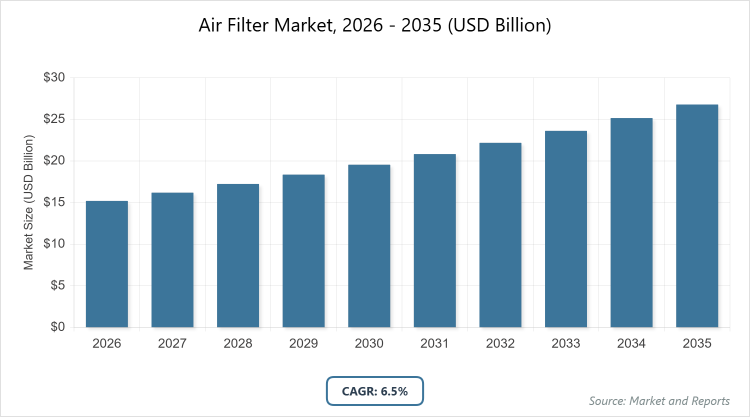
According to MarketnReports, the global Air Filter market size was estimated at USD 15.2 billion in 2025 and is expected to reach USD 28.5 billion by 2035, growing at a CAGR of 6.5% from 2026 to 2035. Air Filter Market is driven by rising air pollution levels and stringent environmental regulations.
What is the Overview of Air Filter Market?
The air filter market encompasses the design, manufacturing, and distribution of filtration systems that remove contaminants such as dust, pollen, and pollutants from air streams to improve indoor and industrial air quality, ensuring health, safety, and operational efficiency. This market includes various filter types like HEPA, ULPA, and bag filters, utilized in HVAC systems, automotive intakes, and industrial processes to capture particles through mechanical or electrostatic means. Market definition refers to the industry focused on air purification solutions that address environmental concerns, regulatory compliance, and consumer demands for cleaner air in residential, commercial, and industrial settings, leveraging advanced materials and technologies to enhance filtration performance while reducing energy consumption and maintenance needs in a pollution-prone world.
What are the Key Insights into Air Filter Market?
- The global air filter market was valued at USD 15.2 billion in 2025 and is projected to reach USD 28.5 billion by 2035.
- The market is expected to grow at a CAGR of 6.5% during the forecast period from 2026 to 2035.
- The market is driven by increasing industrialization and focus on indoor air quality amid urbanization.
- In the product type segment, HEPA filters dominate with a 35% share.
- This dominance is due to their high efficiency in capturing fine particles, driving market growth by meeting stringent health standards in healthcare and cleanrooms.
- In the application segment, HVAC dominates with a 40% share.
- This is attributed to widespread use in buildings for air circulation, fueling expansion through energy-efficient designs that reduce operational costs.
- In the end-user segment, manufacturing dominates with a 30% share.
- This stems from industrial processes requiring clean air for machinery protection, propelling the market by enhancing productivity and compliance.
- Asia Pacific dominates the global market with a 45% share.
- This is owing to rapid urbanization, industrial growth, and pollution control initiatives in China.
What are the Market Dynamics in Air Filter?
Growth Drivers
Growth drivers in the air filter market are anchored in escalating global air pollution levels from industrialization and vehicular emissions, compelling regulatory bodies to enforce stricter air quality standards that mandate advanced filtration systems in commercial and residential spaces for health protection. The rise in awareness of indoor air quality, particularly post-pandemic, has boosted demand for HEPA and smart filters integrated with IoT for real-time monitoring, attracting consumers seeking wellness enhancements. Technological advancements in nanofiber and electrostatic filters improve efficiency and longevity, while urbanization in developing regions increases HVAC installations. Additionally, sustainability trends promote recyclable filters, driving market expansion through eco-friendly innovations that align with corporate green goals.
Restraints
Restraints in the air filter market include high initial costs for advanced filtration systems like ULPA, which deter adoption in cost-sensitive markets and small enterprises, limiting penetration in emerging economies. Frequent replacement needs elevate maintenance expenses, leading to hesitancy among budget-constrained users. Supply chain issues for specialized materials like synthetic fibers increase prices and delay deliveries. Moreover, saturation in mature markets reduces growth potential, while counterfeit products compromise quality and trust, hindering branded manufacturers’ expansion.
Opportunities
Opportunities in the air filter market emerge from the integration of smart technologies, such as AI-driven filters that optimize performance and predict replacements, appealing to tech-savvy consumers in smart buildings and opening avenues for premium products. Expansion in renewable energy sectors, like wind turbines requiring dust protection, presents niche growth. Emerging markets in Africa and Latin America offer untapped potential with rising pollution awareness, where affordable, portable filters can capture share. Partnerships with HVAC manufacturers for bundled solutions further enhance opportunities for integrated systems that address energy efficiency demands.
Challenges
Challenges in the air filter market involve rapid technological obsolescence, requiring continuous R&D to keep pace with evolving pollution types and regulations, straining resources for smaller players. Environmental concerns over disposable filters contribute to waste, pushing for sustainable alternatives that add development costs. Varying global standards complicate compliance for exporters, while economic downturns reduce industrial investments affecting demand. Additionally, consumer education on filter efficacy remains a hurdle, impacting adoption in less aware regions.
Air Filter Market: Report Scope
| Report Attributes | Report Details |
| Report Name | Air Filter Market |
| Market Size 2025 | USD 15.2 Billion |
| Market Forecast 2035 | USD 28.5 Billion |
| Growth Rate | CAGR of 6.5% |
| Report Pages | 220 |
| Key Companies Covered |
Mann+Hummel, Donaldson Company, Camfil, Parker Hannifin, 3M Company, and Others |
| Segments Covered | By Product Type, By Application, By End-User, and By Region |
| Regions Covered | North America, Europe, Asia Pacific (APAC), Latin America, and The Middle East and Africa (MEA) |
| Base Year | 2025 |
| Historical Year | 2020 – 2024 |
| Forecast Year | 2026 – 2035 |
| Customization Scope | Avail customized purchase options to meet your exact research needs. |
The Air Filter market is segmented by product type, application, end-user, and region.
Based on Product Type Segment, the most dominant subsegment is HEPA filters, while the second most dominant is bag filters. HEPA filters lead due to their superior particle capture efficiency for allergens and viruses, driving market growth by ensuring compliance in healthcare and clean environments that prioritize air purity and health safety; bag filters rank second as cost-effective solutions for industrial dust collection, contributing to expansion through durability in high-volume applications that reduce operational downtime.
Based on Application Segment, the most dominant subsegment is HVAC, while the second most dominant is automotive. HVAC dominates owing to essential role in building ventilation for comfort and health, propelling market growth via energy-saving designs that lower utility costs and support green building certifications; automotive follows as the second dominant, driven by engine protection needs, enhancing the market through lightweight filters that improve fuel efficiency in vehicles.
Based on End-User Segment, the most dominant subsegment is manufacturing, while the second most dominant is healthcare. Manufacturing leads because of process requirements for clean air to protect equipment, fueling market growth by minimizing contamination in production lines for quality assurance; healthcare ranks second with sterile environment demands, advancing the market through high-efficiency filters that prevent infections in medical facilities.
What are Recent Developments in Air Filter?
- In 2025, Mann+Hummel launched an advanced nanofiber air filter for automotive applications, enhancing particle capture while reducing pressure drop for better engine performance.
- In late 2024, Donaldson Company acquired a filtration startup specializing in IoT-enabled filters, integrating smart monitoring for predictive maintenance in industrial settings.
- In 2025, Camfil introduced eco-friendly HEPA filters made from recyclable materials, targeting sustainable building projects amid green regulations.
- In 2024, Parker Hannifin expanded its bag filter line with high-temperature variants for mining operations, improving dust control in harsh environments.
What is the Regional Analysis for Air Filter Market?
- Asia Pacific to dominate the global market.
Asia Pacific dominates the air filter market, propelled by severe air pollution from industrialization and urbanization, driving demand for filtration in residential and commercial spaces for health protection. The region’s growth is supported by manufacturing expansions and government pollution control policies. China dominates within Asia Pacific, fueled by its massive industrial base and initiatives like the Air Pollution Prevention Plan, with companies like Mann+Hummel expanding local production for automotive and HVAC; India contributes through urban air quality programs, Japan focuses on precision filters for electronics, but challenges include enforcement of standards in rural areas.
North America holds a significant share in the air filter market, characterized by stringent EPA regulations and high consumer awareness of indoor air quality. Investments in green buildings drive innovation. The United States dominates the region, supported by firms like Donaldson leading in industrial filters and widespread adoption in healthcare amid allergy concerns; Canada benefits from mining applications, Mexico leverages automotive manufacturing, though high costs limit premium segments.
Europe exhibits steady growth in the air filter market, emphasizing sustainability with EU directives on air quality promoting energy-efficient filters. Mature industries in automotive and pharmaceuticals fuel demand. Germany leads as the dominating country, bolstered by its engineering sector and companies like Camfil innovating in cleanroom filters; the UK and France follow with building retrofits, while Eastern Europe offers cost advantages, despite regulatory variations.
Latin America shows emerging potential in the air filter market, influenced by urban pollution and industrial growth. Improving environmental laws facilitate adoption. Brazil dominates as the key country, with its large cities demanding residential filters amid smog issues; Mexico benefits from automotive exports, Argentina focuses on agriculture, though economic instability challenges investments.
The Middle East and Africa (MEA) region is nascent in the air filter market, driven by desert dust and oil industries requiring robust filtration. Investments in healthcare boost demand. South Africa dominates within MEA, supported by mining operations and urban air concerns; the UAE invests in luxury building filters, Saudi Arabia through diversification, but harsh climates and infrastructure gaps restrain progress.
Who are the Key Market Players in Air Filter?
Mann+Hummel focuses on nanofiber innovations and acquisitions to expand automotive and industrial portfolios, strengthening global presence.
Donaldson Company employs IoT integrations for smart filters, targeting predictive maintenance in heavy industries for efficiency.
Camfil pursues sustainable materials, investing in recyclable HEPA for green buildings to meet regulatory demands.
Parker Hannifin adopts high-temperature variants, leveraging partnerships for mining and oil & gas applications.
3M Company concentrates on electrostatic technologies, utilizing R&D for healthcare filters with virus capture.
Honeywell International emphasizes residential HVAC integrations, expanding e-commerce for consumer access.
What are the Market Trends in Air Filter?
- Rise in smart filters with IoT for air quality monitoring.
- Growth in nanofiber technology for finer particle capture.
- Expansion of eco-friendly, recyclable materials amid sustainability.
- Surge in HEPA variants for virus and allergen protection.
- Focus on energy-efficient designs reducing pressure drop.
- Adoption of portable filters for personal use.
- Integration with HVAC for smart buildings.
- Emphasis on antimicrobial coatings for hygiene.
What Market Segments and Subsegments are Covered in the Air Filter Report?
By Product Type
-
- Intake Air Filter
- Cabin Air Filter
- HEPA Filters
- ULPA Filters
- Bag Filters
- Panel Filters
- Compact Filters
- Cartridge Filters
- Dust Collectors
- Mist Collectors
- Others
By Application
-
- HVAC
- Automotive
- Industrial
- Commercial
- Residential
- Pharmaceutical
- Semiconductor
- Food & Beverage
- Metals & Mining
- Pulp & Paper
- Others
By End-User
-
- Automotive Industry
- Building & Construction
- Healthcare
- Manufacturing
- Semiconductor & Electronics
- Food & Beverage
- Metals & Mining
- Pulp & Paper
- Commercial Buildings
- Residential Buildings
- Others
By Region
-
- North America
- U.S.
- Canada
- Europe
- UK
- Germany
- France
- Rest of Europe
- Asia Pacific
- China
- India
- Japan
- Rest of Asia Pacific
- Latin America
- Brazil
- Mexico
- Rest of Latin America
- Middle East & Africa
- UAE
- South Africa
- Rest of Middle East & Africa
- North America
Frequently Asked Questions
Air filters are devices that remove contaminants from air streams to improve quality in various applications.
Key factors include pollution rise, regulatory standards, technological advancements, and urbanization.
The Air Filter market is projected to grow from approximately USD 15.2 billion in 2025 to USD 28.5 billion by 2035.
The Air Filter market is expected to register a CAGR of 6.5% during the forecast period from 2026 to 2035.
Asia Pacific will contribute notably, holding around 45% of the market share due to industrialization and pollution.
Major players include Mann+Hummel, Donaldson Company, Camfil, Parker Hannifin, 3M Company, and Honeywell International, driving growth through innovations and expansions.
The report provides detailed analysis of market size, trends, segmentation, regional insights, key players, and forecasts.
The value chain includes raw material sourcing, design and manufacturing, assembly, distribution, and end-user installation.
Trends are shifting toward smart and sustainable filters, with preferences for efficient, eco-friendly options.
Regulatory factors include air quality standards like EPA, while environmental factors involve pollution controls pushing for green technologies.