
AI Integration in Chemicals Market Size, Share and Trends 2026 to 2035
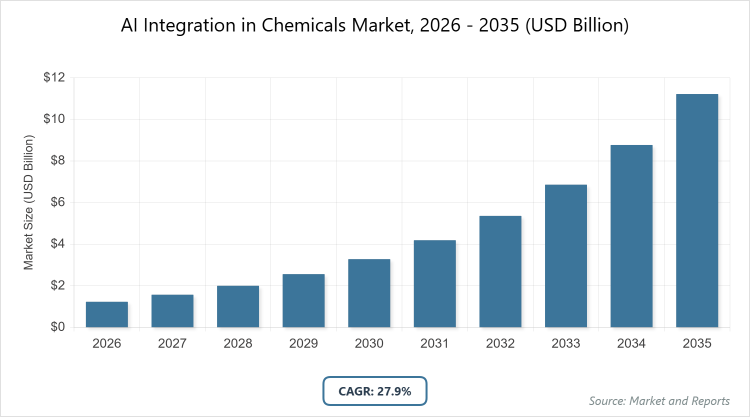
According to MarketnReports, the global AI Integration in Chemicals Market size was estimated at USD 1.225 billion in 2025 and is expected to reach USD 14.353 billion by 2035, growing at a CAGR of 27.9% from 2026 to 2035. AI Integration in Chemicals Market is driven by increasing adoption of advanced technologies for process optimization and sustainability in the chemical industry.
What are the Key Insights of the AI Integration in Chemicals Market?
- The global AI Integration in Chemicals Market was valued at USD 1.225 billion in 2025 and is projected to reach USD 14.353 billion by 2035.
- The AI Integration in Chemicals Market is anticipated to grow at a CAGR of 27.9% during the forecast period from 2026 to 2035.
- The AI Integration in Chemicals Market is driven by the need for process optimization, cost reduction, and sustainability in chemical manufacturing.
- In the type segment, software dominates with a 48% share due to its essential role in implementing AI algorithms for data analysis and process optimization.
- In the application segment, production optimization dominates with a 30% share because it enhances efficiency and reduces operational costs in high-volume chemical processes.
- In the end-user segment, base chemicals & petrochemicals dominate with a 57% share owing to the high demand for AI in managing complex production and supply chains.
- North America dominates the AI Integration in Chemicals Market with a 40% share attributed to advanced technological infrastructure, significant R&D investments, and the presence of leading AI and chemical companies.
What is the AI Integration in Chemicals Market Industry Overview?
The AI Integration in Chemicals Market revolves around the incorporation of artificial intelligence technologies into chemical processes to enhance efficiency, innovation, and decision-making across the value chain. This market includes AI-driven tools for data analysis, predictive modeling, and automation that transform traditional chemical operations into intelligent systems. Market definition refers to the sector encompassing AI applications in chemical manufacturing, research, and supply chain management, aimed at optimizing production, discovering new materials, and ensuring regulatory compliance while reducing costs and environmental impact through advanced algorithms and machine learning.
What are the Market Dynamics of the AI Integration in Chemicals Market?
Growth Drivers
The AI Integration in Chemicals Market is boosted by the rising need for operational efficiency and cost savings, where AI enables predictive maintenance and real-time process adjustments to minimize downtime and waste. Rapid advancements in machine learning and big data analytics allow for faster material discovery and formulation, accelerating R&D cycles in competitive sectors like petrochemicals and pharmaceuticals. Additionally, regulatory pressures for sustainability and safety drive adoption, as AI supports eco-friendly practices and compliance through optimized resource use and risk prediction, fostering innovation and long-term profitability.
Restraints
High implementation costs and the need for substantial infrastructure upgrades limit adoption, particularly among smaller firms lacking the capital for AI integration. Data privacy concerns and the complexity of handling sensitive chemical data pose challenges, requiring robust security measures that increase operational hurdles. Furthermore, a shortage of skilled professionals in AI and chemical domains slows deployment, as companies struggle with talent acquisition and training amid evolving technology landscapes.
Opportunities
The expansion of AI in sustainable chemistry opens avenues for developing green materials and reducing emissions, aligning with global environmental goals and attracting investments. Collaborations between tech giants and chemical manufacturers can lead to customized AI solutions, enhancing scalability in emerging markets. Moreover, the integration of AI with IoT and cloud computing offers potential for advanced analytics, enabling predictive insights that drive efficiency gains and new revenue models in supply chain optimization.
Challenges
Integrating AI with legacy systems in established chemical plants presents technical difficulties, often requiring extensive overhauls that disrupt operations. Ensuring AI model accuracy in dynamic chemical environments demands continuous data quality management, complicating scalability. Additionally, ethical concerns around AI decision-making in safety-critical processes necessitate transparent algorithms and regulatory frameworks to build trust and facilitate broader adoption.
AI Integration in Chemicals Market: Report Scope
| Report Attributes | Report Details |
| Report Name | AI Integration in Chemicals Market |
| Market Size 2025 | USD 1.225 Billion |
| Market Forecast 2035 | USD 14.353 Billion |
| Growth Rate | CAGR of 27.9% |
| Report Pages | 220 |
| Key Companies Covered |
BASF SE, Dow Inc., IBM Corporation, Microsoft Corporation, NVIDIA Corporation, Siemens AG, and Others. |
| Segments Covered | By Type, By Application, By End-User, and By Region. |
| Regions Covered | North America, Europe, Asia Pacific (APAC), Latin America, and The Middle East and Africa (MEA) |
| Base Year | 2025 |
| Historical Year | 2020 - 2024 |
| Forecast Year | 2026 - 2035 |
| Customization Scope | Avail customized purchase options to meet your exact research needs. |
What is the Market Segmentation of the AI Integration in Chemicals Market?
The AI Integration in Chemicals Market is segmented by type, application, end-user, and region.
By Type Segment. Software emerges as the most dominant subsegment, followed by services as the second most dominant. Software leads due to its core function in deploying AI algorithms for analytics and automation, driving the market by enabling precise control and innovation in chemical processes, which boosts efficiency and competitiveness. Services rank second, providing essential consulting and integration support, contributing to market growth by ensuring seamless AI adoption and customization to meet specific industry needs.
By Application Segment. Production optimization stands out as the most dominant subsegment, with new material innovation as the second most dominant. Production optimization's dominance comes from its ability to enhance manufacturing efficiency and reduce costs through real-time adjustments, propelling the market by addressing high operational demands in chemical production. New material innovation follows, accelerating R&D with AI-driven simulations, which advances the market by fostering breakthrough products and sustainable solutions.
By End-User Segment. Base chemicals & petrochemicals is the most dominant subsegment, while specialty chemicals ranks as the second most dominant. Base chemicals & petrochemicals lead because of the scale and complexity of operations requiring AI for optimization and safety, fueling market growth through improved yields and reduced risks. Specialty chemicals comes second, utilizing AI for tailored formulations, which drives the market by enabling high-value innovations and meeting niche demands.
What are the Recent Developments in the AI Integration in Chemicals Market?
- In October 2025, Covestro partnered with ACD/Labs to launch an AI-enabled solvent selection tool aimed at enhancing sustainable chemistry practices.
- In August 2025, Atombeat collaborated with BioDuro to introduce an AI platform for accelerating peptide drug discovery in the chemical sector.
- In July 2025, Kemira joined forces with CuspAI to integrate AI into the research and development process for silicon-based materials.
- In April 2025, the University of Tulsa integrated AI into all courses of its chemical engineering program to prepare students for industry advancements.
- In March 2025, a U.K.-based startup announced plans to use AI for discovering new chemicals and materials, appointing leading AI experts as advisors.
What is the Regional Analysis of the AI Integration in Chemicals Market?
North America to dominate the global market.
North America holds the largest share in the AI Integration in Chemicals Market, driven by robust technological infrastructure and high R&D investments. The United States, as the dominating country, leads with its concentration of tech giants and chemical firms, fostering AI adoption for innovation and efficiency in processes like predictive maintenance.
Asia Pacific follows with rapid growth from industrialization and government initiatives promoting digital transformation. China dominates this region through massive chemical production and AI integration policies, enhancing supply chain optimization and sustainability efforts.
Europe emphasizes regulatory compliance and green chemistry, contributing to steady market expansion. Germany stands out as the dominating country, leveraging its strong engineering base and investments in AI for advanced material development and eco-friendly manufacturing.
Latin America benefits from resource abundance and emerging tech adoption in agrochemicals. Brazil dominates, utilizing AI to improve agricultural chemical efficiency and support export growth amid increasing sustainability demands.
The Middle East and Africa leverage energy resources for petrochemical advancements. Saudi Arabia leads as the dominating country, investing in AI to diversify its chemical industry and optimize production in downstream applications.
What are the Key Market Players and Strategies in the AI Integration in Chemicals Market?
BASF SE. BASF SE focuses on AI-driven R&D for sustainable materials, partnering with tech firms to integrate machine learning in process optimization and reduce environmental impact.
Dow Inc. Dow Inc. emphasizes AI in predictive analytics for supply chain resilience, investing in digital twins to enhance manufacturing efficiency and product innovation.
IBM Corporation. IBM Corporation leverages its Watson AI platform for chemical simulations, collaborating with industry leaders to provide data-driven insights and accelerate drug discovery.
Microsoft Corporation. Microsoft Corporation integrates Azure AI for cloud-based chemical modeling, supporting global firms in real-time data analysis and operational automation.
NVIDIA Corporation. NVIDIA Corporation advances GPU-accelerated AI for molecular simulations, enabling faster computations in material design and partnering for high-performance computing solutions.
Siemens AG. Siemens AG employs AI in industrial automation, developing smart factory systems to optimize energy use and predictive maintenance in chemical plants.
What are the Market Trends in the AI Integration in Chemicals Market?
- Increasing adoption of AI for predictive maintenance to minimize downtime and enhance operational efficiency in chemical manufacturing.
- Growing use of machine learning in new material discovery, accelerating R&D and reducing time-to-market for innovative products.
- Rising integration of AI with IoT for real-time process monitoring and optimization in supply chains.
- Emphasis on AI-driven sustainability practices, including emission reduction and resource-efficient formulations.
- Expansion of generative AI for molecular design and simulation in pharmaceuticals and specialty chemicals.
- Heightened focus on AI for regulatory compliance and safety predictions amid stringent environmental standards.
What are the Market Segments and their Subsegments Covered in the Report?
By Type
- Hardware
- Software
- Services
- Machine Learning Platforms
- Predictive Analytics Tools
- AI-Enabled Sensors
- Data Management Systems
- Cloud Computing Solutions
- Robotics Integration
- Simulation Software
- Others
By Application
- Production Optimization
- New Material Innovation
- R&D Acceleration
- Supply Chain Management
- Predictive Maintenance
- Pricing Optimization
- Feedstock Optimization
- Process Control
- Quality Assurance
- Sustainability Management
- Others
By End-User
- Base Chemicals & Petrochemicals
- Specialty Chemicals
- Agrochemicals
- Pharmaceuticals
- Paints & Coatings
- Adhesives & Sealants
- Water Treatment
- Advanced Materials
- Green & Biochemicals
- Industrial Manufacturing
- Others
By Region
- North America
- U.S.
- Canada
- Europe
- UK
- Germany
- France
- Rest of Europe
- Asia Pacific
- China
- India
- Japan
- Rest of Asia Pacific
- Latin America
- Brazil
- Mexico
- Rest of Latin America
- Middle East & Africa
- UAE
- South Africa
- Rest of Middle East & Africa
Frequently Asked Questions
The AI Integration in Chemicals Market involves the application of artificial intelligence technologies to enhance processes, innovation, and efficiency in the chemical industry.
Key factors include technological advancements in AI, demand for process optimization, and regulatory pressures for sustainability.
The market is projected to grow from USD 1.225 billion in 2026 to USD 14.353 billion by 2035.
The CAGR is expected to be 27.9% during this period.
North America will contribute significantly, driven by advanced infrastructure and R&D investments in the United States.
Major players include BASF SE, Dow Inc., IBM Corporation, Microsoft Corporation, NVIDIA Corporation, and Siemens AG.
The report provides detailed analysis of market size, trends, segmentation, regional insights, and competitive strategies.
Stages include data collection, AI model development, integration into processes, application in end-use, and continuous optimization.
Trends are shifting toward sustainable AI applications, with preferences favoring efficient, eco-friendly chemical solutions.
Stringent regulations on emissions and safety, along with incentives for green technologies, are key influencers.