
AI for Pharmaceutical Market Size, Share, and Trends 2026 to 2035
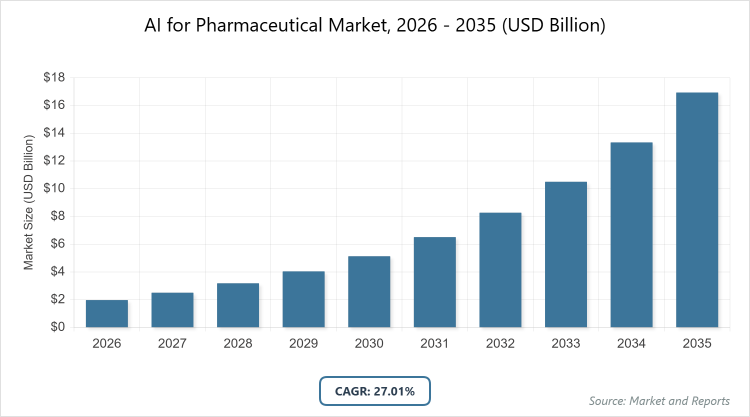
According to MarketReports, the global AI for Pharmaceutical market size was estimated at USD 1.97 billion in 2025 and is expected to reach USD 21.51 billion by 2035, growing at a CAGR of 27.01% from 2026 to 2035. AI for the Pharmaceutical Market is driven by the increasing adoption of AI technologies to accelerate drug discovery and reduce development costs.
Key Insights
- The global AI for Pharmaceutical market was valued at USD 1.97 billion in 2025 and is projected to reach USD 21.51 billion by 2035.
- The market is expected to grow at a CAGR of 27.01% during the forecast period from 2026 to 2035.
- The market is driven by the rising demand for innovative drugs amid increasing chronic diseases and the need for cost-effective R&D solutions.
- In the offering segment, software dominated with a 65% share due to its scalability and ability to integrate advanced AI algorithms for data analysis and predictive modeling.
- In the technology segment, machine learning held the dominant position with 50% share, as it excels in pattern recognition from large datasets, enabling accurate predictions in drug efficacy and safety.
- In the application segment, drug discovery was the leading subsegment with 41% share, driven by AI’s capability to screen millions of compounds rapidly and reduce failure rates in early-stage development.
- In the end-user segment, pharmaceutical & biotechnology companies dominated with 54% share, owing to their extensive R&D investments and direct application of AI to enhance product pipelines.
- North America dominated the global market with a 46% share, attributed to the presence of major tech and pharma companies, substantial venture funding, and supportive regulatory environments.
What is the AI for the Pharmaceutical Market?
The AI for Pharmaceutical market refers to the integration of artificial intelligence technologies into various stages of pharmaceutical processes, including drug discovery, clinical trials, precision medicine, and manufacturing optimization. This market encompasses software, hardware, and services that leverage AI algorithms such as machine learning and deep learning to analyze vast datasets, predict molecular interactions, and streamline R&D efforts. It addresses the inefficiencies in traditional pharmaceutical development by enabling faster identification of drug candidates, personalized treatments, and improved regulatory compliance, ultimately aiming to bring safer and more effective therapies to market more efficiently.
What are the Market Dynamics in the Market Dynamics
Growth Drivers
The primary growth drivers for the AI for Pharmaceutical market include the escalating costs of traditional drug development, which often exceed billions per new drug, prompting companies to adopt AI for efficiency gains. AI technologies significantly shorten timelines by automating data analysis, predicting drug-target interactions, and optimizing clinical trial designs, leading to reduced failure rates and faster time-to-market. Additionally, the surge in big data from genomics, electronic health records, and wearable devices provides rich inputs for AI models, enabling more precise and personalized medicine approaches. Government initiatives and collaborations between tech giants and pharma firms further fuel innovation, with investments in AI platforms rising sharply to address global health challenges like pandemics and rare diseases.
Restraints
Despite its potential, the AI for Pharmaceutical market faces restraints such as data privacy and security concerns, as handling sensitive patient and proprietary research data requires compliance with stringent regulations like GDPR and HIPAA. High initial implementation costs for AI infrastructure, including specialized hardware and skilled personnel, pose barriers for smaller firms. Moreover, the lack of standardized datasets and interoperability between AI systems can lead to inconsistencies in results, while biases in training data may result in unreliable predictions, eroding trust among stakeholders. Regulatory hurdles in validating AI-driven decisions for drug approvals also slow adoption, as agencies demand transparent and explainable models to ensure safety and efficacy.
Opportunities
Opportunities in the AI for Pharmaceutical market abound with the expansion of personalized medicine, where AI can analyze genetic profiles to tailor treatments, opening new revenue streams in oncology and rare diseases. Emerging markets in Asia-Pacific present untapped potential due to growing healthcare infrastructure and increasing R&D spending. Partnerships between AI startups and established pharma companies offer avenues for co-development of specialized tools, such as AI for drug repurposing, which can revive failed compounds cost-effectively. Advancements in generative AI and quantum computing promise to revolutionize complex simulations, while post-pandemic focus on supply chain resilience creates demand for AI in predictive manufacturing and inventory management.
Challenges
Challenges persist in integrating AI with legacy pharmaceutical systems, which often lack the digital maturity needed for seamless adoption, leading to prolonged transition periods and operational disruptions. Ensuring AI model transparency and interpretability remains a hurdle, as “black-box” algorithms complicate regulatory scrutiny and clinical acceptance. The shortage of interdisciplinary talent combining AI expertise with pharmaceutical knowledge exacerbates implementation delays. Ethical issues, including equitable access to AI-driven therapies and potential job displacements in routine R&D tasks, add complexity. Finally, validating AI outputs against real-world outcomes requires extensive clinical evidence, which can be time-consuming and resource-intensive in a highly regulated industry.
AI for Pharmaceutical Market: Report Scope
| Report Attributes | Report Details |
| Report Name | AI for Pharmaceutical Market |
| Market Size 2025 | USD 1.97 Billion |
| Market Forecast 2035 | USD 21.51 Billion |
| Growth Rate | CAGR of 27.01% |
| Report Pages | 220 |
| Key Companies Covered |
IBM Corporation, Exscientia, Insilico Medicine, BenevolentAI, Atomwise, NVIDIA Corporation, and Others |
| Segments Covered | By Offering (Software, Hardware, Services), By Technology (Machine Learning, Deep Learning, Natural Language Processing, Others), By Application (Drug Discovery, Clinical Trials, Precision Medicine, Others), By End-User (Pharmaceutical & Biotechnology Companies, CROs, Academic Institutes, Others), and By Region |
| Regions Covered | North America, Europe, Asia Pacific (APAC), Latin America, and The Middle East and Africa (MEA) |
| Base Year | 2025 |
| Historical Year | 2020 – 2024 |
| Forecast Year | 2026 – 2035 |
| Customization Scope | Avail customized purchase options to meet your exact research needs. |
How is the Market Segmentation?
The AI for Pharmaceutical market is segmented by offering, technology, application, end-user, and region.
Based on Offering Segment. The software subsegment dominates with 65% share, as it provides flexible, algorithm-driven platforms essential for data processing and predictive analytics, driving market growth by enabling rapid iterations in drug design. The services subsegment follows as the second dominant with 25% share, offering consulting and integration support that helps companies customize AI solutions, thereby accelerating adoption and enhancing overall R&D efficiency.
Based on Technology Segment. Machine learning leads with 50% share, owing to its proficiency in handling unstructured data for pattern detection, which propels the market by improving accuracy in drug candidate selection and reducing development timelines. Deep learning is the second dominant with 30% share, excelling in image analysis and complex simulations, contributing to market expansion through advanced applications in biomarker discovery and personalized treatment predictions.
Based on Application Segment. Drug discovery holds the top position with 41% share, as AI streamlines compound screening and toxicity predictions, fueling market growth by cutting costs and speeding up innovation pipelines. Clinical trials rank second with 25% share, where AI optimizes patient recruitment and protocol design, driving the market forward by minimizing delays and enhancing trial success rates.
Based on End-User Segment. Pharmaceutical & biotechnology companies dominate with 54% share, leveraging AI for proprietary R&D to maintain competitive edges, which advances the market through increased investment in innovative therapies. Contract research organizations (CROs) are the second dominant with 20% share, utilizing AI to offer specialized services that support pharma clients, thereby broadening market reach and fostering collaborative advancements.
Recent Developments
- In November 2025, Owkin collaborated with Gustave Roussy and Charité Comprehensive Cancer Center to launch a pan-European agentic infrastructure aimed at making biomedical data AI-ready, enhancing AI-native biology applications in oncology research and accelerating data-driven insights for drug development.
- In November 2025, Insilico Medicine partnered with Eli Lilly for a research and licensing agreement to co-discover novel therapies using Insilico’s Pharma.AI platform, focusing on generating and optimizing compounds for specific targets to advance treatment options in various therapeutic areas.
- In August 2025, Fifty1 Labs and BioSpark AI teamed up to convert over 10,000 unstructured clinical case reports into a structured database with more than 2,000 real-world patient treatment-outcome pathways, improving AI accessibility for evidence-based drug repurposing and clinical decision-making.
- In July 2025, Healx joined forces with SCI Ventures in a USD 2 million collaboration to advance therapies for spinal cord injury through AI-driven drug discovery, emphasizing target identification and repurposing to expedite potential treatments for this challenging condition.
What is the Regional Analysis AI for Pharmaceutical market?
North America to dominate the global market.
North America leads the AI for Pharmaceutical market, holding a 46% share, driven by robust technological infrastructure, high R&D investments, and the presence of leading companies like IBM and NVIDIA. The United States dominates within the region, benefiting from supportive policies, venture capital influx, and collaborations between tech firms and pharma giants, which foster innovation in drug discovery and clinical applications.
Europe follows as a key region, with growth fueled by increasing AI adoption in personalized medicine and regulatory advancements from bodies like the EMA. The United Kingdom and Germany are dominant countries, leveraging strong academic-pharma partnerships and funding for AI initiatives to enhance clinical trials and biomarker research, contributing to efficient drug development processes.
Asia-Pacific is the fastest-growing region, propelled by rising healthcare demands, government initiatives in digital health, and expanding pharma sectors. China and Japan lead, with China focusing on AI in genomics and large-scale data analysis, while Japan emphasizes precision medicine, both driving regional expansion through cost-effective innovations and international collaborations.
Latin America shows emerging potential, supported by improving digital infrastructure and increasing foreign investments in biotech. Brazil dominates, utilizing AI for tropical disease research and clinical trial optimization, aiding market growth by addressing local health challenges and attracting global partnerships.
The Middle East and Africa region is gradually adopting AI, with growth driven by healthcare digitization efforts and collaborations for drug access. South Africa and the UAE are key players, where South Africa applies AI in infectious disease modeling, and the UAE invests in AI hubs for pharma R&D, fostering regional advancements in affordable treatments.
Who are the Key Market Players in the AI for Pharmaceutical market?
IBM Corporation. IBM Corporation employs strategies focused on cloud-based AI platforms like Watson Health, partnering with pharma companies for data analytics in drug discovery and clinical trials, emphasizing scalable solutions to enhance predictive modeling and operational efficiency.
Exscientia. Exscientia pursues automation in drug design through AI-driven platforms, collaborating with biotech firms to accelerate candidate identification, with a strategy centered on precision engineering to reduce development timelines and improve success rates in therapeutic areas like oncology.
Insilico Medicine. Insilico Medicine adopts generative AI for aging-related disease research, forming alliances with pharmaceutical giants to license AI-discovered compounds, prioritizing end-to-end platforms that integrate biology and chemistry for rapid, cost-effective drug advancement.
BenevolentAI. BenevolentAI leverages knowledge graphs and machine learning for hypothesis generation in drug discovery, strategically partnering with academic institutions and pharma to validate AI insights, aiming to uncover novel targets and repurposed drugs efficiently.
Atomwise. Atomwise focuses on virtual screening using deep learning, collaborating on joint ventures for small molecule discovery, with strategies emphasizing high-throughput AI simulations to predict binding affinities and streamline early-stage R&D processes.
NVIDIA Corporation. NVIDIA Corporation provides GPU-accelerated computing for AI models, partnering with software developers and pharma to optimize simulations in genomics and protein folding, pursuing strategies that enhance computational power for faster, more accurate pharmaceutical innovations.
Market Trends
- Increasing integration of generative AI for molecular design and drug repurposing to address unmet medical needs.
- Rise in AI-driven clinical trial optimizations, including patient matching and real-time monitoring for improved outcomes.
- Growing focus on ethical AI practices, with emphasis on bias mitigation and transparent algorithms in regulatory submissions.
- Expansion of cloud-based AI platforms enabling collaborative research across global pharma networks.
- Surge in partnerships between AI startups and traditional pharma for co-development of personalized medicine solutions.
- Adoption of AI in supply chain management to predict disruptions and enhance manufacturing efficiency.
- Emphasis on multimodal AI combining genomics, imaging, and clinical data for comprehensive disease modeling.
Market Segments and their subsegment Covered in the Report
By Offering
- Software
- Hardware
- Services
By Technology
- Machine Learning
- Deep Learning
- Natural Language Processing
- Others
By Application
- Drug Discovery
- Clinical Trials
- Precision Medicine
- Others
By End-User
- Pharmaceutical & Biotechnology Companies
- CROs
- Academic Institutes
- Others
By Region
- North America
- U.S.
- Canada
- Europe
- UK
- Germany
- France
- Rest of Europe
- Asia Pacific
- China
- India
- Japan
- Rest of Asia Pacific
- Latin America
- Brazil
- Mexico
- Rest of Latin America
- Middle East & Africa
- UAE
- South Africa
- Rest of Middle East & Africa
Frequently Asked Questions
AI for Pharmaceutical involves the application of artificial intelligence technologies to enhance processes in the pharmaceutical industry, such as drug discovery, clinical trials, and personalized medicine, by analyzing data to improve efficiency and outcomes.
Key factors include rising R&D costs, increasing chronic diseases, advancements in machine learning, regulatory support for AI integration, and growing collaborations between tech and pharma sectors.
The market is projected to grow from USD 2.5 billion in 2026 to USD 21.51 billion by 2035.
The CAGR is expected to be 27.01% from 2026 to 2035.
North America will contribute notably, driven by high investments and advanced technological infrastructure.
Major players include IBM Corporation, Exscientia, Insilico Medicine, BenevolentAI, Atomwise, and NVIDIA Corporation.
The report provides comprehensive analysis including market size, trends, segmentation, regional insights, key players, and forecasts from 2026 to 2035.
Stages include data collection and preprocessing, AI model development and training, integration into pharma processes, validation and regulatory approval, and deployment in R&D or clinical applications.
Trends are shifting toward personalized medicine and AI-driven repurposing, with preferences favoring ethical, transparent AI solutions that prioritize data privacy and accelerate affordable drug access.
Regulatory factors include evolving FDA and EMA guidelines on AI validation, while environmental factors involve sustainable AI practices like energy-efficient computing to minimize carbon footprints in data centers.