
AI-Driven Cyberattacks Market Size, Share and Trends 2026 to 2035
According to MarketnReports, the global AI-Driven Cyberattacks Market size was estimated at USD 29 billion in 2025 and is expected to reach USD 200 billion by 2035, growing at a CAGR of 22% from 2026 to 2035. AI-Driven Cyberattacks Market is driven by the rapid advancement in AI technologies enabling sophisticated threat vectors and increasing demand for countermeasures.
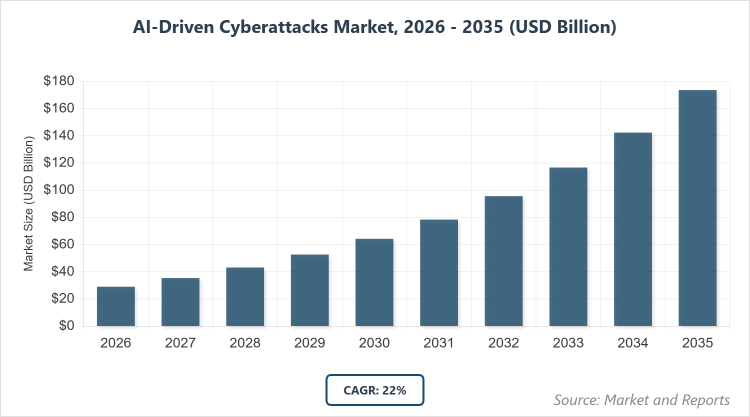
What are the Key Insights into the AI-Driven Cyberattacks Market?
- The global AI-Driven Cyberattacks Market was valued at USD 29 billion in 2025.
- The market is projected to grow at a CAGR of 22% from 2026 to 2035.
- The AI-Driven Cyberattacks Market is driven by the proliferation of AI tools for threat automation, rising cybercrime sophistication, and increasing investments in AI-based defense systems.
- AI-Powered Phishing Tools dominate the Type segment with approximately 35% share because they enable highly personalized and evasive attacks at scale, leveraging natural language processing for convincing social engineering.
- Data Breaches dominate the Application segment with around 30% share as AI accelerates vulnerability identification and exploitation, making it a preferred method for accessing sensitive information.
- Nation-State Actors dominate the End-User segment with over 28% share since they utilize advanced AI for strategic espionage and disruption, backed by substantial resources and expertise.
- North America dominates the global market with 37% share due to advanced technological infrastructure, high incidence of cyber threats, and significant R&D investments in the United States.
What is the Industry Overview of the AI-Driven Cyberattacks Market?
The AI-Driven Cyberattacks Market encompasses the ecosystem of tools, technologies, and services that leverage artificial intelligence to orchestrate, enhance, or mitigate cyberattacks, including automated threat generation, intelligent evasion techniques, and adaptive defense mechanisms against AI-powered adversaries. This market includes offensive AI applications used by threat actors for tasks like phishing, malware evolution, and vulnerability exploitation, as well as defensive solutions that employ AI to detect and respond to such attacks in real-time. The market definition focuses on the intersection of AI and cybersecurity where machine learning models are tailored to either perpetrate or counteract cyber threats, driven by the need for advanced intelligence in an era of digital transformation, regulatory compliance, and escalating geopolitical tensions that amplify the sophistication and frequency of AI-augmented breaches.
What are the Market Dynamics of the AI-Driven Cyberattacks Market?
Growth Drivers
The AI-Driven Cyberattacks Market is propelled by the exponential growth in AI capabilities, enabling threat actors to automate and scale attacks with unprecedented precision, such as generating polymorphic malware or crafting deepfake-based phishing campaigns that evade traditional defenses. Regulatory pressures for enhanced cybersecurity in critical sectors like finance and healthcare drive investments in AI-countermeasures, while the digitalization of economies and the rise of IoT devices expand attack surfaces, necessitating sophisticated AI-driven detection and response systems that adapt in real-time to evolving threats.
Restraints
Significant restraints include the high costs of developing and deploying AI-based security solutions, which require specialized expertise and substantial computational resources, limiting adoption among small and medium enterprises. Ethical concerns and potential misuse of AI for malicious purposes, coupled with regulatory gaps in governing AI in cybersecurity, create barriers, while the risk of AI models being poisoned or adversarial attacks on defenses themselves adds complexity and hesitation in full-scale implementation.
Opportunities
Opportunities arise from the integration of AI with blockchain and quantum computing for next-generation secure systems, alongside expansions into emerging markets where digital infrastructure is rapidly growing but vulnerabilities are high. Collaborations between governments and tech firms for AI ethics frameworks and shared threat intelligence platforms can unlock new revenue streams, particularly in developing AI-driven proactive defenses that predict and neutralize attacks before they materialize.
Challenges
Challenges encompass the arms race between offensive and defensive AI, where rapid advancements in attack techniques outpace security updates, leading to persistent vulnerabilities. Data privacy issues in training AI models on real-world threat data, combined with a global shortage of cybersecurity talent skilled in AI, hinder effective deployment, while geopolitical factors amplify state-sponsored attacks, requiring international cooperation that is often fragmented.
AI-Driven Cyberattacks Market: Report Scope
| Report Attributes | Report Details |
| Report Name | AI-Driven Cyberattacks Market |
| Market Size 2025 | USD 29 Billion |
| Market Forecast 2035 | USD 200 Billion |
| Growth Rate | CAGR of 22% |
| Report Pages | 220 |
| Key Companies Covered |
Darktrace, CrowdStrike, Palo Alto Networks, SentinelOne and Others. |
| Segments Covered | By Type, By Application, By End-User, and By Region. |
| Regions Covered | North America, Europe, Asia Pacific (APAC), Latin America, and The Middle East and Africa (MEA) |
| Base Year | 2025 |
| Historical Year | 2020 - 2024 |
| Forecast Year | 2026 - 2035 |
| Customization Scope | Avail customized purchase options to meet your exact research needs. |
What is the Market Segmentation of the AI-Driven Cyberattacks Market?
The AI-Driven Cyberattacks Market is segmented by Type, Application, End-User, and region.
By Type Segment, AI-Powered Phishing Tools represent the most dominant segment while Automated Malware Generation stand as the second most dominant. AI-Powered Phishing Tools lead due to their ability to create hyper-personalized campaigns using natural language generation, driving market growth by increasing attack success rates and prompting heightened demand for AI-based email security solutions.
By Application Segment, Data Breaches is the most dominant segment followed by Financial Fraud as the second most dominant. Data Breaches dominate as AI enables efficient scanning and exploitation of weaknesses, propelling market expansion through the need for advanced intrusion detection systems that leverage machine learning for anomaly identification.
By End-User Segment, Nation-State Actors is the most dominant while Cybercrime Syndicates constitute the second most dominant. Nation-State Actors prevail owing to their access to cutting-edge AI for strategic operations, supporting market growth by fueling investments in national cybersecurity defenses and international threat-sharing initiatives.
What are the Recent Developments in the AI-Driven Cyberattacks Market?
- In 2025, a major cybersecurity firm reported a surge in AI-generated deepfake attacks targeting executives, leading to enhanced development of AI detection tools.
- Governments in Europe collaborated in early 2026 to establish AI ethics guidelines for cyber defense, addressing the rise in state-sponsored AI threats.
- A leading tech company launched an AI-powered threat intelligence platform in late 2025, focusing on real-time prediction of AI-driven ransomware variants.
- Research institutions published findings in 2026 on adversarial AI techniques, influencing new standards for model robustness in cybersecurity applications.
What is the Regional Analysis of the AI-Driven Cyberattacks Market?
North America to dominate the global market
North America leads the AI-Driven Cyberattacks Market, dominated by the United States with its advanced AI research hubs, high-profile breaches driving investments, and robust regulatory frameworks like NIST guidelines that promote AI in cybersecurity.
Europe exhibits strong growth, led by Germany through EU-wide data protection laws and initiatives like Horizon Europe funding AI defenses against cross-border threats.
Asia Pacific is rapidly expanding, spearheaded by China with state-backed AI developments for both offensive and defensive capabilities amid geopolitical tensions.
Latin America shows emerging trends, with Brazil at the forefront via growing fintech vulnerabilities prompting AI adoption in cyber resilience programs.
The Middle East and Africa are developing, led by the UAE through smart city projects integrating AI for infrastructure protection against sophisticated attacks.
Who are the Key Market Players in the AI-Driven Cyberattacks Market?
Darktrace employs AI-driven autonomous response strategies, focusing on real-time threat detection to counter AI-enhanced attacks.
CrowdStrike prioritizes endpoint protection with Falcon platform integrations, leveraging machine learning for predictive analytics against evolving threats.
Palo Alto Networks adopts Prisma Cloud for comprehensive security, emphasizing AI in network segmentation to mitigate AI-driven intrusions.
SentinelOne focuses on Singularity XDR, using behavioral AI to detect and respond to automated malware and phishing.
Fortinet pursues FortiAI for virtual security analysts, enhancing SOC efficiency against AI-powered adversaries.
What are the Market Trends in the AI-Driven Cyberattacks Market?
- Increasing use of generative AI for creating polymorphic malware that evades detection.
- Growth in AI-based social engineering tools for targeted phishing campaigns.
- Expansion of defensive AI models for anomaly detection in network traffic.
- Rise in collaborative threat intelligence sharing platforms using federated learning.
- Focus on quantum-resistant AI algorithms to future-proof against advanced attacks.
- Integration of AI with zero-trust architectures for enhanced access controls.
- Emphasis on ethical AI frameworks to prevent misuse in cyber operations.
What Market Segments and their Subsegments are Covered in the Report?
By Type
- AI-Powered Phishing Tools
- Automated Malware Generation
- Deepfake Creation Systems
- Adversarial Attack Frameworks
- Intelligent DDoS Systems
- AI-Driven Social Engineering Kits
- Botnet Management Platforms
- Vulnerability Scanning Algorithms
- Ransomware Optimization Models
- Insider Threat Simulation
- Others
By Application
- Data Breaches
- Financial Fraud
- Identity Theft
- Supply Chain Attacks
- Critical Infrastructure Disruption
- Espionage and Surveillance
- Intellectual Property Theft
- Denial-of-Service Campaigns
- Misinformation Spread
- Regulatory Evasion
- Others
By End-User
- Cybercrime Syndicates
- Nation-State Actors
- Hacktivist Groups
- Insider Threats
- Corporate Espionage Firms
- Ransomware-as-a-Service Providers
- Dark Web Vendors
- Security Research Organizations
- Penetration Testing Companies
- Cybersecurity Defense Developers
- Others
- North America
- U.S.
- Canada
- Europe
- UK
- Germany
- France
- Rest of Europe
- Asia Pacific
- China
- India
- Japan
- Rest of Asia Pacific
- Latin America
- Brazil
- Mexico
- Rest of Latin America
- Middle East & Africa
- UAE
- South Africa
- Rest of Middle East & Africa
Frequently Asked Questions
The AI-Driven Cyberattacks Market involves technologies and services using AI to execute or defend against sophisticated cyber threats, focusing on automation and intelligence in attack vectors.
Key factors include AI technological advancements, rising cyber threat sophistication, regulatory demands, and investments in defensive AI solutions.
The market is projected to grow from approximately USD 29 billion in 2026 to USD 200 billion by 2035.
The CAGR is expected to be 22% during the forecast period.
North America will contribute notably, driven by technological leadership and high threat incidence in the United States.
Major players include Darktrace, CrowdStrike, Palo Alto Networks, SentinelOne, and Fortinet.
The report offers in-depth analysis of size, segmentation, dynamics, trends, regional insights, competitive strategies, and forecasts.
Stages include AI model development, threat intelligence gathering, tool deployment, attack execution or defense integration, and post-incident analysis.
Trends favor generative AI for attacks and behavioral analytics for defense, while preferences shift toward automated, intelligent security solutions.
Factors include data privacy regulations like GDPR and environmental concerns over AI's energy consumption in large-scale computations.