
Adiabatic Coolers Market Size, Share and Trends 2026 to 2035
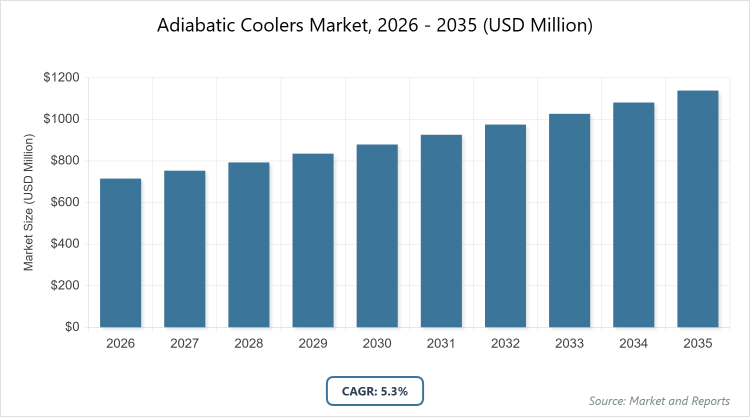
According to MarketnReports, the global Adiabatic Coolers market size was estimated at USD 715.2 million in 2025 and is expected to reach USD 1200 million by 2035, growing at a CAGR of 5.3% from 2026 to 2035. Adiabatic Coolers Market is driven by rising demand for energy-efficient and water-conserving cooling solutions amid increasing industrial activities, stringent environmental regulations, and growth in data centers and manufacturing sectors.
What are the Key Insights of Adiabatic Coolers Market?
- Market size valued at USD 715.2 million in 2025 and projected to reach USD 1200 million by 2035
- CAGR of 5.3% during the forecast period 2026-2035
- Market is driven by energy efficiency demands, water conservation needs, industrial expansion, and adoption in data centers and power sectors
- Dry air cooler dominates the product type segment with around 60% share due to its primary dry operation mode offering lower water usage and maintenance compared to liquid or full evaporative systems
- Industrial manufacturing dominates the end-user industry segment with approximately 30% share as it requires robust process cooling for machinery and production lines in high-temperature environments
- Oil and gas along with chemical and petrochemical are key subsegments in end-user, holding significant combined share due to harsh operating conditions necessitating reliable heat rejection
- North America dominates with around 35% market share attributed to advanced industrial infrastructure, strict energy regulations, and high adoption in data centers and manufacturing hubs
What is Adiabatic Coolers?
The adiabatic coolers market involves energy-efficient heat rejection systems that combine dry cooling with periodic evaporative (adiabatic) enhancement to pre-cool inlet air, thereby improving performance during high ambient temperatures while minimizing water usage compared to traditional evaporative cooling towers. These systems, also known as hybrid dry coolers or adiabatic dry coolers, use fine mist or wetted pads to lower air temperature entering the heat exchanger without continuous water evaporation, keeping coils dry most of the time to prevent scaling and corrosion. The market definition encompasses industrial-grade cooling equipment for process cooling, HVAC, and heat dissipation in sectors requiring reliable, low-maintenance, and eco-friendly alternatives to conventional chillers or cooling towers, driven by sustainability goals, energy cost reductions, and regulatory pressures on water consumption.
What are the Market Dynamics in Adiabatic Coolers?
Growth Drivers
Growth drivers for the adiabatic coolers market stem from the global push for sustainable and energy-efficient cooling technologies amid rising energy prices and environmental concerns. These systems provide up to 30-40% energy savings over traditional air-cooled units by leveraging adiabatic pre-cooling during peak loads, making them ideal for industries facing high ambient temperatures. Expanding data center infrastructure, driven by cloud computing and AI, demands efficient heat rejection with minimal water use. Industrial growth in emerging economies, coupled with regulations promoting low-water technologies, further boosts adoption, as adiabatic coolers align with ESG goals by reducing water footprint and operational costs.
Restraints
Restraints include higher upfront capital costs compared to conventional dry coolers, which can deter adoption in cost-sensitive markets or smaller facilities. Dependence on ambient humidity for optimal adiabatic performance limits effectiveness in extremely humid climates where evaporative benefit diminishes. Maintenance requirements for misting systems, potential legionella risks if not managed properly, and the need for water treatment add operational complexities. Supply chain issues for specialized components and varying regional water availability regulations also pose barriers to widespread deployment.
Opportunities
Opportunities lie in the rapid expansion of data centers globally, where adiabatic coolers offer hybrid efficiency for hyperscale facilities seeking PUE reductions. Integration with IoT for smart controls and predictive maintenance enhances appeal in Industry 4.0 settings. Emerging markets in Asia Pacific and Latin America present growth potential with rising industrialization and supportive green building incentives. Advancements in hybrid designs and low-GWP refrigerants open avenues for retrofitting existing systems, while partnerships with renewable energy projects can drive adoption in sustainable power generation.
Challenges
Challenges encompass ensuring consistent performance across diverse climatic conditions, as adiabatic efficiency varies with humidity and temperature. Cybersecurity risks in connected smart systems require robust protections. Competition from alternative technologies like closed-loop cooling towers or full evaporative systems in water-abundant regions persists. Skilled labor shortages for installation and servicing, along with the need for standardized testing protocols, hinder faster market penetration and scalability.
Adiabatic Coolers Market: Report Scope
| Report Attributes | Report Details |
| Report Name | Adiabatic Coolers Market |
| Market Size 2025 | USD 715.2 Million |
| Market Forecast 2035 | USD 1200 Million |
| Growth Rate | CAGR of 5.3% |
| Report Pages | 220 |
| Key Companies Covered | Baltimore Aircoil Company Inc., EVAPCO Inc., SPX Cooling Technologies, Güntner Group, Alfa Laval, Thermax Limited, FRIGEL FIRENZE S.p.A., MITA Group, ICS Cool Energy Limited, Vistech Cooling Systems, and Others |
| Segments Covered | By Product Type (Dry Air Cooler, Liquid Cooler, Hybrid Adiabatic Systems, Others), By End-User Industry (Oil and Gas, Industrial Manufacturing, Chemical and Petrochemical, Food and Beverages, Power Generation, Data Centers, Commercial HVAC, Others), By Orientation (V Type, Horizontal, Others), and By Region |
| Regions Covered | North America, Europe, Asia Pacific (APAC), Latin America, and The Middle East and Africa (MEA) |
| Base Year | 2025 |
| Historical Year | 2020 – 2024 |
| Forecast Year | 2026 – 2035 |
| Customization Scope | Avail customized purchase options to meet your exact research needs. |
How is the Adiabatic Coolers Market Segmented?
The Adiabatic Coolers market is segmented by product type, end-user industry, orientation, and region.
Based on Product Type Segment. Dry air cooler is the most dominant with around 60% share, followed by liquid cooler as the second most dominant. Dry air coolers dominate due to their ability to operate primarily in dry mode with adiabatic boost only when needed, driving market growth by offering superior water conservation, lower maintenance, and energy efficiency in varied climates, making them preferred for industrial and commercial applications where sustainability and cost savings are priorities.
Based on End-User Industry Segment. Industrial manufacturing is the most dominant with approximately 30% share, followed by chemical and petrochemical along with oil and gas. Industrial manufacturing leads because of extensive use in process cooling for machinery, plastics, and metal production, propelling market expansion through reliable heat dissipation that supports uninterrupted operations, reduces downtime, and complies with energy efficiency standards in high-heat environments.
Based on Orientation Segment. V type is the most dominant, followed by horizontal. V type dominates owing to its compact footprint, efficient airflow distribution, and suitability for space-constrained industrial sites, driving market growth by enabling easier installation in retrofits and new plants while optimizing heat transfer performance.
What are the Recent Developments in Adiabatic Coolers?
- In 2025, Baltimore Aircoil Company introduced an enhanced adiabatic cooler series with advanced misting controls and IoT integration for real-time performance optimization, targeting data center and industrial clients for improved energy efficiency.
- EVAPCO Inc. launched a new hybrid adiabatic model in late 2025 featuring low-noise fans and reduced water consumption, aimed at food and beverage processing facilities to meet stricter environmental compliance.
- SPX Cooling Technologies expanded its adiabatic portfolio in 2025 with modular designs for easier scalability, focusing on oil and gas applications in harsh environments.
- Güntner Group announced upgrades to its adiabatic dry coolers in 2025, incorporating smart sensors for predictive maintenance and better integration with renewable energy systems.
How is the Regional Analysis for Adiabatic Coolers Market?
North America to dominate the global market.
North America dominates the adiabatic coolers market with strong demand from data centers, industrial manufacturing, and power sectors, supported by stringent energy efficiency standards and incentives for sustainable technologies. The United States leads as the dominating country through major investments in hyperscale facilities and advanced manufacturing hubs.
Europe maintains significant growth driven by EU green deal policies promoting water-efficient cooling and decarbonization. Germany dominates the region with its engineering expertise and high adoption in chemical, automotive, and food industries.
Asia Pacific shows the fastest growth due to rapid industrialization, data center boom, and increasing focus on energy conservation. China dominates within the region with large-scale manufacturing and infrastructure projects adopting adiabatic systems for cost and environmental benefits.
Latin America exhibits emerging adoption driven by mining, oil and gas, and food processing sectors seeking efficient cooling. Brazil leads the region through expanding industrial base and regulatory pushes for sustainable practices.
The Middle East and Africa are growing with focus on oil and gas and power generation in arid climates. The United Arab Emirates dominates through ambitious sustainability initiatives and data center developments incorporating water-saving technologies.
Who are the Key Market Players in Adiabatic Coolers?
- Baltimore Aircoil Company Inc. leads with innovative adiabatic and hybrid cooling solutions, focusing on energy-efficient designs and global service networks for industrial and commercial clients.
- EVAPCO Inc. specializes in comprehensive adiabatic systems, emphasizing water conservation and low-maintenance features through continuous R&D and strategic expansions.
- SPX Cooling Technologies offers a broad portfolio of adiabatic coolers, with strategies centered on modular systems and integration for power and process industries.
- Güntner Group prioritizes advanced heat exchanger technologies in adiabatic applications, employing product innovation and partnerships for European and global markets.
- Alfa Laval focuses on efficient liquid-based adiabatic solutions, with growth through acquisitions and emphasis on sustainable industrial cooling.
- Thermax Limited targets emerging markets with cost-effective adiabatic systems for power and chemical sectors, leveraging local manufacturing.
- FRIGEL FIRENZE S.p.A. specializes in closed-loop adiabatic cooling for process industries, focusing on precision temperature control.
- MITA Group develops customizable adiabatic coolers, with strategies on energy recovery and environmental compliance.
- ICS Cool Energy Limited provides rental and permanent adiabatic solutions, emphasizing flexibility for temporary and long-term needs.
- Vistech Cooling Systems concentrates on bespoke adiabatic installations for specialized industrial applications.
What are the Market Trends in Adiabatic Coolers?
- Increasing adoption of hybrid adiabatic-dry systems for dynamic mode switching based on ambient conditions
- Integration of IoT and smart controls for predictive maintenance and energy optimization
- Focus on water conservation features amid stricter regulations on usage
- Growth in data center applications requiring low-PUE cooling solutions
- Advancements in low-noise fans and compact modular designs for urban installations
- Rising demand for retrofitting existing cooling towers with adiabatic enhancements
- Emphasis on corrosion-resistant materials to extend equipment lifespan
- Expansion into renewable energy projects for efficient heat rejection
- Development of AI-driven performance algorithms for real-time adjustments
- Shift toward sustainable certifications and green building compliance
What Market Segments and Subsegments are Covered in the Adiabatic Coolers Report?
By Product Type
- Dry Air Cooler
- Liquid Cooler
- Hybrid Adiabatic Systems
- Others
By End-User Industry
- Oil and Gas
- Industrial Manufacturing
- Chemical and Petrochemical
- Food and Beverages
- Power Generation
- Data Centers
- Commercial HVAC
- Others
By Orientation
- V Type
- Horizontal
- Others
By Region
- North America
- U.S.
- Canada
- Europe
- UK
- Germany
- France
- Rest of Europe
- Asia Pacific
- China
- India
- Japan
- Rest of Asia Pacific
- Latin America
- Brazil
- Mexico
- Rest of Latin America
- Middle East & Africa
- UAE
- South Africa
- Rest of Middle East & Africa
Frequently Asked Questions
Adiabatic coolers are hybrid cooling systems that use dry heat exchange with optional evaporative pre-cooling of inlet air to enhance efficiency, providing energy savings and reduced water consumption for industrial and commercial heat rejection.
Key factors include energy efficiency regulations, data center expansion, industrial growth, water scarcity concerns, technological advancements in hybrid designs, and sustainability initiatives across sectors.
The market is projected to grow from approximately USD 753 million in 2026 to USD 1200 million by 2035.
The CAGR is expected to be 5.3% during 2026-2035.
North America will contribute notably, holding around 35% of the market share due to advanced infrastructure and high demand from data centers and industry.
Major players include Baltimore Aircoil Company Inc., EVAPCO Inc., SPX Cooling Technologies, Güntner Group, Alfa Laval, Thermax Limited, FRIGEL FIRENZE S.p.A., MITA Group, ICS Cool Energy Limited, and Vistech Cooling Systems.
The report provides detailed analysis of market size, trends, segmentation, drivers, regional insights, competitive landscape, and forecasts to 2035.
Stages include R&D and design of heat exchangers, component manufacturing, system assembly and testing, distribution and installation, operation with monitoring, and after-sales service and upgrades.
Trends are shifting toward smart, IoT-enabled systems with hybrid modes, greater emphasis on water savings, low maintenance, and integration with sustainable energy practices for industrial and data center users.
Regulatory factors include energy efficiency standards and water usage restrictions, while environmental factors involve reducing carbon footprints, minimizing water consumption, and complying with green certifications for cooling technologies.