
Adaptive Optics (AO) Market Size, Share and Trends 2026 to 2035
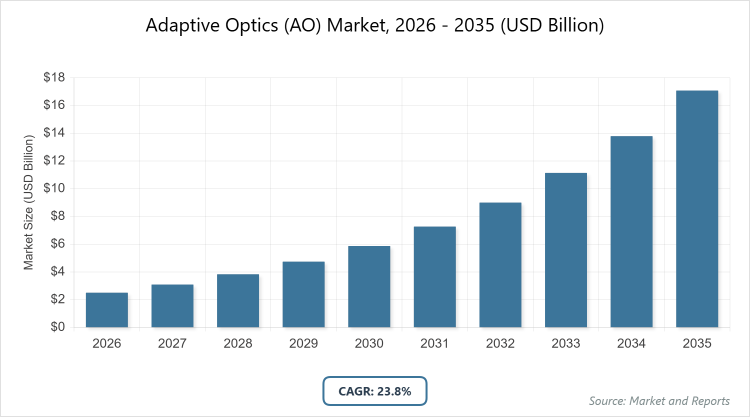
According to MarketnReports, the global Adaptive Optics (AO) market size was estimated at USD 2.5 billion in 2025 and is expected to reach USD 21.1 billion by 2035, growing at a CAGR of 23.8% from 2026 to 2035. Adaptive Optics (AO) Market is driven by increasing adoption in imaging, communication, and consumer applications.
What are the Key Insights into Adaptive Optics (AO) Market?
- The global Adaptive Optics (AO) market was valued at USD 2.5 billion in 2025 and is projected to reach USD 21.1 billion by 2035.
- The market is expected to grow at a CAGR of 23.8% during the forecast period from 2026 to 2035.
- The market is driven by growing investments in laser communication systems, high-resolution microscopy, and government-funded research in defense and space sciences.
- Wavefront Sensor dominates the component segment with 41.6% share due to its critical role in detecting optical distortions for real-time corrections.
- Military & Defense dominates the end-use industry segment with 31% share because of high demand for enhanced surveillance, laser weapons, and targeting systems.
- North America dominates the regional segment with 37% share owing to substantial military defense spending and advanced astronomical research initiatives.
What is the Overview of Adaptive Optics (AO) Market?
The Adaptive Optics (AO) market encompasses technologies designed to enhance optical system performance by compensating for distortions in light waves caused by atmospheric turbulence or optical aberrations. This market includes components such as sensors, modulators, and control systems that enable real-time adjustments for clearer imaging and precise laser applications across various industries. Market definition refers to the ecosystem of hardware, software, and services that facilitate wavefront correction to improve resolution in fields like astronomy, defense, and biomedical imaging, addressing challenges in high-precision optics without relying on quantitative metrics.
What are the Dynamics Shaping Adaptive Optics (AO) Market?
Growth Drivers
The primary growth drivers in the Adaptive Optics (AO) market stem from technological advancements in wavefront correction, which are pivotal for applications in high-resolution imaging and laser-based systems. Increasing prevalence of eye diseases has boosted adoption in ophthalmology for retinal imaging, enabling early detection and treatment through tools like optical coherence tomography. Government investments in defense sectors for laser weapons and surveillance further propel demand, as adaptive optics enhance accuracy over long distances by mitigating atmospheric distortions. Additionally, expansion into consumer electronics, such as AR/VR headsets and smartphone cameras, drives growth through miniaturization and cost reductions, making the technology accessible for mass-market immersive experiences.
Restraints
High initial costs and complexity of integration pose significant restraints in the Adaptive Optics (AO) market, limiting widespread adoption in cost-sensitive sectors. The need for specialized expertise in system calibration and maintenance adds to operational challenges, particularly for smaller enterprises. Technical limitations in handling extreme environmental conditions, such as severe atmospheric turbulence, can reduce system efficacy, deterring potential users in outdoor applications. Moreover, regulatory hurdles in biomedical and defense approvals delay market entry for new innovations, constraining growth in regulated industries.
Opportunities
Emerging opportunities in the Adaptive Optics (AO) market arise from integration with AI and machine learning for automated wavefront correction, enhancing efficiency in real-time applications. Expansion into free-space optical communications offers potential for high-speed data transmission in telecommunications, addressing bandwidth demands in remote areas. The rise of precision manufacturing and 3D printing in industrial sectors creates avenues for adaptive optics to improve accuracy and reduce defects. Additionally, growing space exploration initiatives provide opportunities for telescope upgrades and satellite imaging, where adaptive optics can deliver sharper deep-space observations.
Challenges
Key challenges in the Adaptive Optics (AO) market include achieving scalability for compact, affordable systems suitable for consumer devices without compromising performance. Rapid technological obsolescence requires continuous R&D investment, straining resources for smaller players. Environmental factors, such as varying atmospheric conditions, challenge consistent system reliability in outdoor and defense applications. Furthermore, supply chain disruptions for specialized optical components can lead to delays and increased costs, impacting project timelines in research and industrial settings.
Adaptive Optics (AO) Market: Report Scope
| Report Attributes | Report Details |
| Report Name | Adaptive Optics (AO) Market |
| Market Size 2025 | USD 2.5 Billion |
| Market Forecast 2035 | USD 21.1 Billion |
| Growth Rate | CAGR of 23.8% |
| Report Pages | 220 |
| Key Companies Covered |
Teledyne e2v, Northrop Grumman Corporation, Thorlabs Inc., Iris AO, Inc., Adaptica S.R.L., Active Optical Systems LLC, OKO Technologies, Imagine Optic Sa, Boston Micromachines Corporation, Phasics CORP, and Others |
| Segments Covered | By Component, By End-Use Industry, and By Region |
| Regions Covered | North America, Europe, Asia Pacific (APAC), Latin America, and The Middle East and Africa (MEA) |
| Base Year | 2025 |
| Historical Year | 2020 – 2024 |
| Forecast Year | 2026 – 2035 |
| Customization Scope | Avail customized purchase options to meet your exact research needs. |
How is the Segmentation Structured in Adaptive Optics (AO) Market?
The Adaptive Optics (AO) market is segmented by Component, End-Use Industry, and Region.
Based on Component Segment, Wavefront Sensor emerged as the dominant subsegment, holding 41.6% market share, driven by its essential function in measuring wavefront distortions for precise corrections across applications. The second dominant subsegment is Wavefront Modulator, which plays a key role in compensating for detected aberrations through deformable mirrors or similar devices, helping to drive the market by enabling high-resolution outputs in demanding fields like astronomy and defense.
Based on End-Use Industry Segment, Military & Defense stands as the most dominant subsegment with 31% share, attributed to its critical use in surveillance, laser defense systems, and biometric security, which drives market growth through enhanced operational accuracy and government funding. Bio-Medical follows as the second dominant, fueled by applications in ophthalmology and microscopy for detailed cellular analysis, contributing to market expansion via improved diagnostic capabilities in healthcare.
What are the Recent Developments in Adaptive Optics (AO) Market?
- In January 2025, Thorlabs Inc. acquired JML Optical Industries, LLC, a precision optics manufacturer, to bolster its capabilities in developing advanced adaptive optics components for consumer and industrial applications.
- In June 2025, Teledyne Technologies launched the Snappy Wide 8K CMOS image sensor, optimized for wide-field logistics but with potential integrations into adaptive optics for enhanced imaging in biomedical and astronomy sectors.
- In January 2024, CEA and Imagine Optics established Nanolite, a joint laboratory focused on innovative optical metrology and shorter-wavelength imaging solutions, advancing adaptive optics for high-precision research.
How Does Regional Analysis Impact Adaptive Optics (AO) Market?
North America to dominate the global market.
North America leads the Adaptive Optics (AO) market, primarily driven by the United States, which benefits from extensive military defense budgets exceeding USD 2 billion in related technologies in 2024. The region’s dominance is supported by advanced R&D in astronomical observatories and biomedical imaging, with projections showing a 23.0% CAGR through 2035, reaching USD 21.1 billion in market value. Key factors include collaborations between government agencies like NASA and private firms for space exploration, enhancing adaptive optics adoption in telescopes and satellite systems.
Asia-Pacific emerges as the fastest-growing region, with China dominating due to rapid industrialization and consumer electronics adoption, projecting a 26.0% CAGR and USD 1.2 billion market value by 2035. Japan’s contributions in precision manufacturing and South Korea’s focus on communication technologies further strengthen the region, driven by investments in AR/VR and laser systems for manufacturing efficiency.
Europe holds a significant share, led by the United Kingdom with a 23.9% projected CAGR and USD 0.674 billion by 2035, fueled by advancements in biomedical research and defense applications through EU-funded projects.
Who are the Key Market Players in Adaptive Optics (AO) Market?
- Teledyne e2v focuses on product innovation through launches like advanced CMOS image sensors, emphasizing R&D in high-resolution imaging for biomedical and industrial applications to expand market reach.
- Northrop Grumman Corporation pursues growth via acquisitions, such as Orbital ATK, integrating adaptive optics into defense systems for enhanced surveillance and laser targeting to strengthen its position in military sectors.
- Thorlabs Inc. employs acquisition strategies, including JML Optical Industries, to enhance precision optics manufacturing, supporting development of compact adaptive systems for consumer and astronomy uses.
- Iris AO, Inc. invests in R&D for deformable mirror technologies, targeting improvements in wavefront modulation for high-precision applications in bio-medical and communication fields.
- Adaptica S.R.L. prioritizes miniaturization and partnerships to develop affordable adaptive optics devices for ophthalmology, aiming to penetrate consumer healthcare markets.
- Active Optical Systems LLC concentrates on system integration services, collaborating with end-users in defense and industrial manufacturing to customize solutions for optical performance optimization.
- OKO Technologies advances wavefront correction through innovative sensor designs, focusing on alliances with research institutes to drive adoption in astronomy and microscopy.
- Imagine Optic Sa leverages joint ventures, like Nanolite with CEA, to innovate in metrology and imaging, targeting shorter-wavelength solutions for emerging industrial applications.
- Boston Micromachines Corporation specializes in MEMS-based deformable mirrors, employing R&D investments to improve scalability for AR/VR and defense systems.
- Phasics CORP emphasizes sensor technology enhancements, forming partnerships for AI-integrated wavefront analysis to boost efficiency in communication and bio-medical sectors.
What are the Trends Influencing Adaptive Optics (AO) Market?
- Integration of AI and machine learning for automated, real-time wavefront correction in imaging and laser systems.
- Shift toward compact, cost-effective sensors and deformable mirrors for consumer electronics like AR/VR headsets and smartphones.
- Increasing adoption in free-space optical communications for high-speed data transmission in telecommunications.
- Expansion into industrial processes, such as precision manufacturing and 3D printing, for improved accuracy and efficiency.
- Growing use in biomedical applications for high-resolution retinal imaging and early disease detection.
What Market Segments and their Subsegments are Covered in the Adaptive Optics (AO) Report?
By Component
- Wavefront Sensor
- Wavefront Modulator
- Control System
- Deformable Mirrors
- Shack-Hartmann Sensor
- Pyramid Sensor
- Curvature Sensor
- Bimorph Mirrors
- Membrane Mirrors
- Segmented Mirrors
- Others
By End-Use Industry
- Consumer
- Astronomy
- Bio-Medical
- Military & Defense
- Industrial Manufacturing
- Communication
- Head-Mounted Display
- Ophthalmology
- Biomedical Microscopy
- Cell Analysis
- Others
By Region
- North America
- U.S.
- Canada
- Europe
- UK
- Germany
- France
- Rest of Europe
- Asia Pacific
- China
- India
- Japan
- Rest of Asia Pacific
- Latin America
- Brazil
- Mexico
- Rest of Latin America
- Middle East & Africa
- UAE
- South Africa
- Rest of Middle East & Africa
Frequently Asked Questions
Adaptive Optics (AO) refers to technologies that correct distortions in light waves to improve optical system performance in applications like imaging and lasers.
Key factors include technological advancements in wavefront correction, rising demand in defense and biomedical imaging, and integration into consumer electronics.
The market is projected to grow from approximately USD 3.1 billion in 2026 to USD 21.1 billion by 2035.
The CAGR is expected to be 23.8% during 2026-2035.
North America will contribute notably, driven by defense spending and R&D in astronomy and biomedical fields.
Major players include Teledyne e2v, Northrop Grumman Corporation, Thorlabs Inc., Iris AO, Inc., and Boston Micromachines Corporation.
The report provides comprehensive analysis on size, trends, segments, drivers, restraints, opportunities, regional insights, and key players.
Stages include component manufacturing, system integration, distribution, end-user application, and after-sales support.
Trends lean toward AI integration and compact devices, with preferences shifting to affordable, high-precision solutions in consumer and industrial sectors.
Regulatory approvals in biomedical and defense sectors, along with environmental adaptations for atmospheric conditions, influence growth and innovation.