
AC DC Power Adapter Market Size, Share and Trends 2026 to 2035
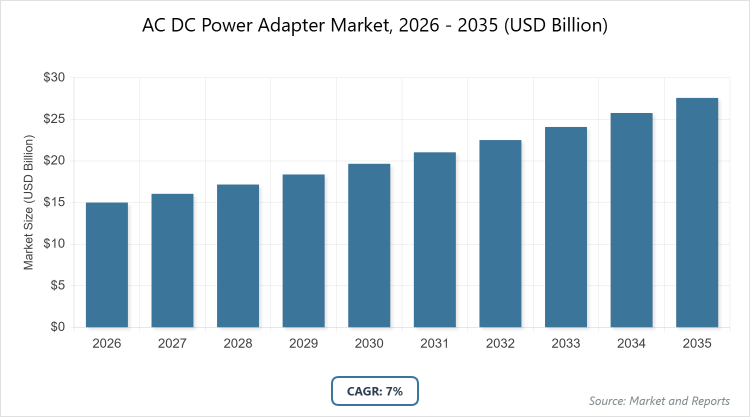
According to MarketnReports, the global AC DC Power Adapter market size was estimated at USD 15 billion in 2025 and is expected to reach USD 30 billion by 2035, growing at a CAGR of 7% from 2026 to 2035. The AC-DC Power Adapter Market is driven by surging demand for consumer electronics and advancements in charging technologies.
What are the Key Insights into AC DC Power Adapter?
- The global AC DC Power Adapter market was valued at USD 15 billion in 2025 and is projected to reach USD 30 billion by 2035.
- The market is expected to grow at a CAGR of 7% during the forecast period from 2026 to 2035.
- The market is driven by growth in consumer electronics, electric vehicles, renewable energy, and demand for efficient charging solutions.
- In the type segment, USB adapters dominate with a 40% share due to their universal compatibility and support for fast charging in mobile devices.
- In the application segment, consumer electronics dominate with a 50% share, as it requires compact, high-efficiency adapters for smartphones and laptops.
- In the end-user segment, residential consumers dominate with a 45% share owing to widespread use in home electronics and charging.
- Asia Pacific dominates the regional market with a 50% share, driven by manufacturing hubs in China, low production costs, and high electronics export volumes.
What is the Industry Overview of AC DC Power Adapter?
The AC DC Power Adapter market encompasses devices that convert alternating current (AC) from mains power to direct current (DC) for electronic devices, ensuring safe and efficient power supply across various applications like consumer gadgets, medical equipment, and industrial machinery. Market definition includes adapters with features such as voltage regulation, overcharge protection, and compact designs, utilizing components like transformers and rectifiers to meet energy efficiency standards, emphasizing portability, reliability, and compatibility while addressing challenges in thermal management, regulatory compliance for safety, and adaptation to fast-charging protocols for modern electronics in global power distribution.
What are the Market Dynamics of AC DC Power Adapter?
Growth Drivers
The AC DC Power Adapter market is propelled by the exponential growth in consumer electronics and portable devices, where adapters provide essential power conversion for efficient charging, supporting features like USB-C and GaN technology to reduce size and improve heat dissipation, catering to mobile lifestyles and remote work trends. Advancements in fast-charging standards and wireless power increase demand for high-wattage adapters, while the rise of electric vehicles and renewable energy systems requires robust, weather-resistant models for home and commercial use. Regulatory pushes for energy efficiency, such as Energy Star certifications, drive innovation in low-standby power designs. Expanding e-commerce and global trade facilitate distribution, boosting market accessibility.
Restraints
High competition from low-cost, counterfeit adapters undermines quality standards and safety, leading to regulatory crackdowns and consumer distrust in emerging markets. Volatility in raw material prices for semiconductors and plastics increases manufacturing costs, impacting profitability. Stringent safety and efficiency regulations require extensive testing, delaying product launches and raising expenses. Supply chain disruptions from geopolitical tensions affect component availability, while environmental concerns over e-waste from disposable adapters push for sustainable but costly alternatives.
Opportunities
Opportunities emerge from integrating GaN and SiC technologies for compact, high-efficiency adapters, enabling faster charging for EVs and laptops, attracting investments in green electronics. Expansion into smart home and IoT applications offers potential for intelligent adapters with monitoring features. Partnerships with device manufacturers for bundled products can capture market share, while the growth of 5G and edge computing creates demand for reliable power in telecom. Government incentives for renewable energy in Asia and Europe open niches for solar-compatible adapters.
Challenges
Challenges include ensuring compatibility with evolving charging standards like USB-PD and requiring R&D to avoid obsolescence. Cybersecurity risks in smart adapters with connectivity features demand secure designs. Talent shortages in electrical engineering hinder innovation, while global trade barriers complicate supply chains. Environmental regulations on plastic use necessitate eco-friendly materials, adding costs.
AC DC Power Adapter Market: Report Scope
| Report Attributes | Report Details |
| Report Name | AC DC Power Adapter Market |
| Market Size 2025 | USD 15 Billion |
| Market Forecast 2035 | USD 30 Billion |
| Growth Rate | CAGR of 7% |
| Report Pages | 195 |
| Key Companies Covered | Delta Electronics, Inc., Belkin International, Inc., Lite-On Technology Corporation, Phihong USA Corporation, Mean Well Enterprises Co., Ltd., CUI Inc., XP Power, GlobTek, Inc., and Others |
| Segments Covered | By Type, By Application, By End-User, and By Region |
| Regions Covered | North America, Europe, Asia Pacific (APAC), Latin America, and The Middle East and Africa (MEA) |
| Base Year | 2025 |
| Historical Year | 2020 – 2024 |
| Forecast Year | 2026 – 2035 |
| Customization Scope | Avail customized purchase options to meet your exact research needs. |
What is the Market Segmentation of AC DC Power Adapter?
The AC DC Power Adapter market is segmented by type, application, end-user, and region.
By Type. USB adapters are the most dominant subsegment, holding approximately 40% market share, due to their versatility and support for multiple devices with fast charging. This dominance drives the market by enabling universal power solutions and reducing consumer costs. Wall-mounted adapters rank as the second most dominant, with around 30% share, offering convenience for fixed setups, propelling growth through home and office use.
By Application. Consumer electronics emerge as the most dominant subsegment, capturing about 50% share, primarily because it powers smartphones and laptops efficiently. This leads to market growth by aligning with gadget proliferation, enhancing portability. Medical devices follow as the second most dominant, with a roughly 20% share, requiring reliable power for safety, driving the market via healthcare advancements.
By End-User. Residential consumers represent the most dominant subsegment at about 45% share, driven by home charging needs. This dominance accelerates market expansion through everyday use. Industrial sector ranks second most dominant, holding around 25% share for equipment power, contributing to growth via manufacturing efficiency.
What are the Recent Developments in AC DC Power Adapter?
- In January 2025, Delta Electronics launched a GaN-based 100W adapter with USB-C for laptops.
- In December 2024, Belkin expanded its multi-port adapters with wireless charging integration.
- In November 2024, Lite-On partnered with a tech firm for smart adapters with IoT monitoring.
- In October 2024, Phihong introduced high-power adapters for EV home charging.
- In September 2024, Mean Well released energy-efficient medical-grade adapters meeting new standards.
What is the Regional Analysis of AC DC Power Adapter?
- Asia Pacific to dominate the global market.
Asia Pacific holds the largest share at approximately 40%, with China as the dominating country, due to massive manufacturing bases and the e-commerce boom. This region’s growth is fueled by low labor costs and investments in automation, positioning it as a production hub. High urbanization in India drives warehouse demand. Japan’s precision engineering excels in automotive conveyors. South Korea’s electronics industry adopts modular systems. Southeast Asian nations like Vietnam expand through FDI in logistics. Environmental regulations push for energy-efficient designs. Strong supply chains enable quick customization. Government initiatives like Made in China 2025 support smart manufacturing upgrades. Rapid growth in Indonesia and Thailand increases food processing applications. Cultural emphasis on efficiency boosts industrial adoption.
North America follows closely, driven by advanced logistics and tech integration, where the United States dominates through Amazon and Walmart’s warehouse expansions. Growth stems from labor shortages and Industry 4.0 adoption. Canada’s mining sector uses heavy-duty conveyors. Government grants support automation in manufacturing. The region’s focus on safety standards drives sensor integration. Venture capital funds startups in smart conveyors. Regulatory frameworks promote sustainable materials. Strong e-commerce growth in Mexico adds cross-border demand. High investment in semiconductor plants increases electronics handling needs. Collaborative R&D centers advance modular designs.
Europe exhibits strong performance with emphasis on sustainability, led by Germany through engineering firms like Siemens. The region’s expansion benefits from EU automation subsidies and green manufacturing. The UK’s e-commerce growth increases distribution demand. France’s food industry adopts hygienic systems. Italy and Spain focus on packaging applications. Circular economy policies recycle conveyor components. Collaborative R&D under Horizon Europe advances AI integrations. Multilingual compliance aids exports to diverse markets. Emphasis on worker safety enhances ergonomic designs. Nordic countries prioritize energy-efficient systems.
Latin America shows moderate advancement, dominated by Brazil’s industrial sector, supported by foreign investments though limited by infrastructure. Mexico benefits from NAFTA ties for automotive conveyors. Government plans in Argentina promote mining applications. Chile’s copper industry demands robust systems. Colombia’s e-commerce rise drives warehouse upgrades. However, economic volatility affects investments. Emerging cooperatives in Peru share conveyor resources. Local manufacturing reduces import costs. Growing food export in Argentina increases processing lines.
The Middle East and Africa remain emerging, with the UAE leading through logistics hubs, constrained by diversification but promising via oil & gas applications. Saudi Arabia’s Vision 2030 funds port conveyors. South Africa’s mining uses bulk handling systems. Egypt’s Suez Canal expansions increase transportation demand. However, water scarcity influences dust control designs. Investments in renewable projects create niches for material handling. International aid supports infrastructure in Kenya. Emerging demand in Nigeria for food processing conveyors drives growth. Regional trade agreements facilitate equipment imports.
What are the Key Market Players in AC DC Power Adapter?
- Delta Electronics, Inc. Delta focuses on GaN technology, expanding for high-power applications.
- Belkin International, Inc. emphasizes multi-port designs, investing in wireless integration.
- Lite-On Technology Corporation. Lite-On specializes in OEM adapters, pursuing efficiency certifications.
- Phihong USA Corporation. Phihong offers EV chargers, strategizing on industrial power.
- Mean Well Enterprises Co., Ltd. Mean Well invests in medical adapters, expanding global distribution.
- CUI Inc. focuses on compact designs, targeting consumer electronics.
- XP Power. XP Power pursues high-reliability adapters for industrial use.
- GlobTek, Inc. emphasizes custom solutions, investing in safety features.
What are the Market Trends in AC DC Power Adapter?
- Increasing adoption of GaN for compact, fast charging.
- Rise of USB-C and PD standards for universality.
- Growth in wireless and multi-port adapters.
- Focus on energy-efficient, eco-friendly materials.
- Expansion of smart adapters with IoT.
- Integration with renewable energy systems.
What Market Segments and Subsegments are Covered in the AC DC Power Adapter Report?
By Type
- Wall-Mounted Adapters
- Desktop Adapters
- Plug-In Adapters
- USB Adapters
- Multi-Port Adapters
- High-Power Adapters
- Low-Power Adapters
- Medical Grade Adapters
- Industrial Grade Adapters
- Consumer Grade Adapters
- Others
By Application
- Consumer Electronics
- Medical Devices
- Industrial Equipment
- Telecommunications
- Automotive
- IT & Networking
- Renewable Energy Systems
- Home Appliances
- Office Equipment
- Lighting Systems
- Others
By End-User
- Residential Consumers
- Commercial Sector
- Industrial Sector
- Healthcare Facilities
- Telecommunication Companies
- Automotive Manufacturers
- IT Companies
- Renewable Energy Providers
- Electronics Manufacturers
- Lighting Companies
- Others
By Region
-
- North America
- U.S.
- Canada
- Europe
- UK
- Germany
- France
- Rest of Europe
- Asia Pacific
- China
- India
- Japan
- Rest of Asia Pacific
- Latin America
- Brazil
- Mexico
- Rest of Latin America
- Middle East & Africa
- UAE
- South Africa
- Rest of Middle East & Africa
- North America
Frequently Asked Questions
AC DC Power Adapters are devices that convert mains AC power to DC for electronic equipment, ensuring safe and efficient operation.
Key factors include electronics growth, EV demand, and charging tech advancements.
The market is projected to grow from USD 15 billion in 2025 to USD 30 billion by 2035.
The CAGR is expected to be 7%.
Asia Pacific will contribute notably, holding around 50% share due to manufacturing hubs.
Major players include Delta Electronics, Inc., Belkin International, Inc., Lite-On Technology Corporation, Phihong USA Corporation, and Mean Well Enterprises Co., Ltd.
The report provides comprehensive analysis of size, trends, segments, regions, players, and forecasts.
Stages include component sourcing, design, manufacturing, testing, distribution, and after-sales.
Trends evolve toward GaN and USB-C, with preferences for fast, compact chargers.
Efficiency standards and e-waste regulations influence design and materials.